Institutions and Organizations
-

The opening up of Myanmar (Burma) and the steps undertaken taken toward political reform in that formerly isolated dictatorship have been among Asia's most dramatic and least expected events.  But the establishment of full democracy is still on the agenda and faces many challenges.  How willing is the current government in Burma to allow a full and free exercise of political rights, including media freedom?  A panel of experts, including Aung Zaw, the editor and founder of The Irrawaddy and this year's recipient of the Shorenstein Award for Journalism in Asia, will address that question in discussing "Burma's Democracy:  How Real?"

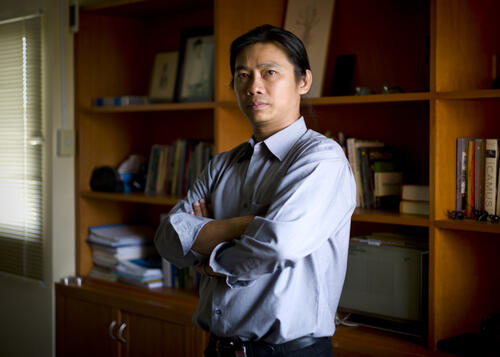
Stanford University’s Walter H. Shorenstein Asia-Pacific Research Center (Shorenstein APARC) is pleased to announce Aung Zaw as the 2013 recipient of the Shorenstein Journalism Award. Zaw has been selected for his leadership in establishing independent media in Myanmar (Burma) and his dedication to integrity in reporting on Southeast Asia.

Image
 Aung Zaw

Aung Zaw is the founding editor-in-chief and executive director of The Irrawaddy, an independent Burmese media organization operating in Myanmar and northern Thailand. Zaw has been an active campaigner for democratic reform in Burma/Myanmar over the last two decades. He was awarded the 2010 Prince Claus Fund Award for journalism along with two journalists from Iran and Cuba – and is recognized for his active dedication to achieving democratic governance in Burma and his work to uphold press freedom.

Zaw studied Botany at Rangoon University. As a student activist in Burma, he was part of the 1988 protests in Rangoon against the Burmese military regime of General Ne Win. He was arrested and detained for a week in Rangoon’s notorious Insein prison where he was severely tortured during interrogation about his pro-democracy activities. Upon release Aung Zaw continued to work with the resistance movement until the military staged a coup in September that year and he was forced to leave the country for neighboring Thailand.

Two years later, Aung Zaw founded the Burma Information Group (BIG) in Bangkok, to document human rights violations in Burma. He began to write political commentaries for national newspapers in Thailand and internationally, and in late 1993 launched The Irrawaddy News Magazine in Bangkok, covering Burma affairs. He worked in Bangkok for two years producing The Irrawaddy Magazine until relocating to the more secure position in Chiang Mai in the north of Thailand.

In February 2012, Aung Zaw was able to return to his homeland for the first time in more than 20 years for a temporary visit as an independent journalist. By the end of 2012, The Irrawaddy was able to establish a media and news office in central Yangon, returning to Burma/Myanmar to practice independent journalism, whilst retaining a regional office in Thailand.

In 2013, the government lifted ban on The Irrawaddy and other exiled websites, the Irrawaddy English magazine and the Irrawaddy Dateline Current Affairs TV program is available for audiences in Myanmar. Aung Zaw writes for New York Times, International Herald Tribune, Time, The Guardian, Bangkok Post, The Nation and several publications in the Europe. His interviews have also appeared on CN, BBC and Al Jazeera. He is the author of the Face of Resistance and is a recent Visiting Scholar at UC Berkeley, School of Journalism.

Bechtel Conference Center

Aung Zaw 2013 Journalism Prize Winner and Founder and Editor, The Irrawaddy News Magazine Panelist
Nayan Chanda Director of Publications and the Editor of YaleGlobal Online Magazine Panelist Yale Center for the Study of Globalization
0
Senior Fellow Emeritus at the Freeman Spogli Institute for International Studies
Affiliated Faculty, CDDRL
Affiliated Scholar, Abbasi Program in Islamic Studies
aparc_dke.jpg PhD

At Stanford, in addition to his work for the Southeast Asia Program and his affiliations with CDDRL and the Abbasi Program in Islamic Studies, Donald Emmerson has taught courses on Southeast Asia in East Asian Studies, International Policy Studies, and Political Science. He is active as an analyst of current policy issues involving Asia. In 2010 the National Bureau of Asian Research and the Woodrow Wilson International Center for Scholars awarded him a two-year Research Associateship given to “top scholars from across the United States” who “have successfully bridged the gap between the academy and policy.”

Emmerson’s research interests include Southeast Asia-China-US relations, the South China Sea, and the future of ASEAN. His publications, authored or edited, span more than a dozen books and monographs and some 200 articles, chapters, and shorter pieces.  Recent writings include The Deer and the Dragon: Southeast Asia and China in the 21st Century (ed., 2020); “‘No Sole Control’ in the South China Sea,” in Asia Policy  (2019); ASEAN @ 50, Southeast Asia @ Risk: What Should Be Done? (ed., 2018); “Singapore and Goliath?,” in Journal of Democracy (2018); “Mapping ASEAN’s Futures,” in Contemporary Southeast Asia (2017); and “ASEAN Between China and America: Is It Time to Try Horsing the Cow?,” in Trans-Regional and –National Studies of Southeast Asia (2017).

Earlier work includes “Sunnylands or Rancho Mirage? ASEAN and the South China Sea,” in YaleGlobal (2016); “The Spectrum of Comparisons: A Discussion,” in Pacific Affairs (2014); “Facts, Minds, and Formats: Scholarship and Political Change in Indonesia” in Indonesian Studies: The State of the Field (2013); “Is Indonesia Rising? It Depends” in Indonesia Rising (2012); “Southeast Asia: Minding the Gap between Democracy and Governance,” in Journal of Democracy (April 2012); “The Problem and Promise of Focality in World Affairs,” in Strategic Review (August 2011); An American Place at an Asian Table? Regionalism and Its Reasons (2011); Asian Regionalism and US Policy: The Case for Creative Adaptation (2010); “The Useful Diversity of ‘Islamism’” and “Islamism: Pros, Cons, and Contexts” in Islamism: Conflicting Perspectives on Political Islam (2009); “Crisis and Consensus: America and ASEAN in a New Global Context” in Refreshing U.S.-Thai Relations (2009); and Hard Choices: Security, Democracy, and Regionalism in Southeast Asia (edited, 2008).

Prior to moving to Stanford in 1999, Emmerson was a professor of political science at the University of Wisconsin-Madison, where he won a campus-wide teaching award. That same year he helped monitor voting in Indonesia and East Timor for the National Democratic Institute and the Carter Center. In the course of his career, he has taken part in numerous policy-related working groups focused on topics related to Southeast Asia; has testified before House and Senate committees on Asian affairs; and been a regular at gatherings such as the Asia Pacific Roundtable (Kuala Lumpur), the Bali Democracy Forum (Nusa Dua), and the Shangri-La Dialogue (Singapore). Places where he has held various visiting fellowships, including the Institute for Advanced Study and the Woodrow Wilson International Center for Scholars. 


Emmerson has a Ph.D. in political science from Yale and a BA in international affairs from Princeton. He is fluent in Indonesian, was fluent in French, and has lectured and written in both languages. He has lesser competence in Dutch, Javanese, and Russian. A former slam poet in English, he enjoys the spoken word and reads occasionally under a nom de plume with the Not Yet Dead Poets Society in Redwood City, CA. He and his wife Carolyn met in high school in Lebanon. They have two children. He was born in Tokyo, the son of U.S. Foreign Service Officer John K. Emmerson, who wrote the Japanese Thread among other books.

Selected Multimedia

Date Label
Donald K. Emmerson Senior Fellow at FSI, Emeritus; Affiliated Faculty, CDDRL; Affiliated Scholar, Abbasi Program in Islamic Studies and Director, Southeast Asia Forum Panelist Stanford University
Daniel C. Sneider Associate Director for Research, Shorenstein Asia-Pacific Research Center Moderator Stanford University
Panel Discussions
-

A year has passed since the Japanese government embarked on the new economic policy package called “Abenomics” with three “arrows”: aggressive monetary easing, flexible fiscal policy, and a growth strategy. The package is designed to bring the Japanese economy out of 20 years of stagnation and 15 years of deflation, and put it on a sustainable growth path. How effective has the policy package been during the first year of the Abe administration?  Will it succeed in bringing sustainable growth to Japan?  Professor Takatoshi Ito, a prominent expert on the Japanese economy, tackles these questions.

Takatoshi Ito, Professor at Faculty of Economics and Dean of Graduate School of Public
Policy, University of Tokyo, has taught extensively both in the United States and Japan,
including at University of Minnesota, Hitotsubashi University, and Harvard University.
He held visiting professor positions at Harvard University (1986-87 and 1992-94), Stanford
University (as National Fellow; 1984-85); Columbia Business School (fall semester, 2009),
and Tun Ismail Ali Chair Professor at University of Malaya (summer semester, 2008). His
public sector experiences include Senior Advisor in the Research Department, IMF
(1994-97); Deputy Vice Minister for International Affaires at Ministry of Finance
(1999-2001); and a member of the Prime Minister’s Council of Economic and Fiscal
Policy (2006-08). He is an author of many books including The Japanese Economy (MIT
Press), The Political Economy of the Japanese Monetary Policy (MIT Press), and
Financial Policy and Central Banking in Japan (MIT Press), and more than 50
refereed academic journal articles on international finance and the Japanese economy,
including ones in American Economic Review and Econometrica. He has distinguished
academic and research appointments such as President of the Japanese Economic
Association in 2004; Fellow of Econometric Society, since 1992; Research Associate at
National Bureau of Economic Research since 1985; and Faculty Fellow, Centre for
Economic Policy Research, since 2006. His research interest includes capital flows and
currency crises, microstructures of the foreign exchange rates, and inflation targeting. He
contributes frequently op-ed columns and articles to Financial Times, Nihon Keizai Shinbun,
Mainichi Shinbun, and Toyo Keizai Weekly.

Philippines Conference Room

Takatoshi Ito Speaker University of Tokyo
Seminars
-

This talk explores the work of Swiss diplomats and Red Cross delegates to explain the experience of Allied POWs and civilian internees in the Pacific War. As the only foreigners allowed into both POW and internee camps, and the only ones to work in Japan as well as Allied countries, they were uniquely positioned to record the flow of information between the two sides, the attempts to deliver material and financial aid, and the intensifying exchange of recrimination and threats. Washington and Tokyo made claims and counter-claims about the observance or non-observance of the Geneva Conventions. Both sides threatened and carried out reprisals and made their observance of international law conditional on the conduct of the enemy. While life was far worse for Allied captives than for their Japanese counterparts, it was not because of a deliberate policy of cruelty. Instead, senior Japanese officials never developed clear policy guidance for POWs and failed to provide adequate logistical and administrative support. The few Japanese officials who oversaw the camp system lacked any authority over individual commanders. Even so, the Swiss may well have helped prevent a bad situation from becoming even worse.


Sarah Kovner is a graduate of Princeton University (A.B.) and Columbia University (Ph.D), associate professor of history at the University of Florida, and is currently a Chauncey Fellow in International Security Studies at Yale. She works on modern Japanese history, international history, and the history of war and society. Kovner's first book, Occupying Power: Sex Workers and Servicemen in Postwar Japan, won the Southeast Conference Association for Asian Studies book prize. It is available in paperback from Stanford University Press. She is now writing a history of Allied prisoners in the Pacific War.


Philippines Conference Room

Sarah Kovner Associate Professor of History Speaker University of Florida
Seminars
Date Label
-

By any measure, China’s economy and defense budget are second only to those of the United States. Yet tremendous uncertainties persist concerning China’s military development and national trajectory, and areas with greater information available often conflated misleadingly. Fortunately, larger dynamics elucidate both areas. Particularly since the 1995-96 Taiwan Strait Crisis, China has made rapid progress in aerospace and maritime development, greatly facilitating its military modernization. The weapons and systems that China is developing and deploying fit well with Beijing’s geostrategic priorities. Here, distance matters greatly: after domestic stability and border control, Beijing worries most about its immediate periphery, where its unresolved disputes with neighbors and outstanding claims lie primarily in the maritime direction. Accordingly, while it would vastly prefer pressuring concessions to waging war, China is already capable of threatening potential opponents’ military forces should they intervene in crises over islands and maritime claims in the Yellow, East, and South China Seas and the waterspace and airspace around them. Far from mainland China, by contrast, it remains ill-prepared to protect its own forces from robust attack. Fortunately for Beijing, the non-traditional security focus of its distant operations makes conflict unlikely; remedying their vulnerabilities would be difficult and expensive. Despite these larger patterns, critical unknowns remain concerning China’s economic development, societal priorities, industrial efficiency, and innovation capability. Dr. Erickson will examine these and related issues to probe China’s development trajectory and future place in the international system. 


The views expressed by Dr. Erickson are his alone, and do not represent the policies or estimates of any organization with which he is affiliated.


Dr. Andrew S. Erickson is an Associate Professor in the Strategic Research Department at the U.S. Naval War College and a core founding member of the department’s China Maritime Studies Institute (CMSI). He is an Associate in Research at Harvard University’s John King Fairbank Center for Chinese Studies (2008-). Erickson also serves as an expert contributor to the Wall Street Journal’s China Real Time Report (中国实时报), for which he has authored or coauthored 25 articles. In spring 2013, he deployed in the Pacific as a Regional Security Education Program scholar aboard USS Nimitz (CVN68), Carrier Strike Group 11.

Erickson received his Ph.D. and M.A. in international relations and comparative politics from Princeton University and graduated magna cum laude from Amherst College with a B.A. in history and political science. He has studied Mandarin in the Princeton in Beijing program at Beijing Normal University’s College of Chinese Language and Culture and Japanese language, politics, and economics in the year-long Associated Kyoto Program at Doshisha University.

Erickson’s research, which focuses on Asia-Pacific defense, international relations, technology, and resource issues, has been published widely in English- and Chinese-language edited volumes and in such peer-reviewed journals as China QuarterlyAsian SecurityJournal of Strategic StudiesOrbisAsia Policy (forthcoming January 2014), and China Security; as well as in Foreign Affairs, The National InterestThe American InterestForeign PolicyJoint Force QuarterlyChina International Strategy Review (published in Chinese-language edition, forthcoming in English-language edition January 2014), and International and Strategic Studies Report (Center for International and Strategic Studies, Peking University). Erickson has also published annotated translations of several Chinese articles on maritime strategy. His publications are available at <www.andrewerickson.com> and <www.chinasignpost.com>.

This event is co-sponsored with CEAS and is part of the China under Xi Jinping series.

Philippines Conference Room

Andrew Erickson Associate in Research Speaker John King Fairbank Center for Chinese Studies, Harvard University
Seminars
Paragraphs

Daniel Sneider writes that relations between South Korea and Japan have noticeably deteriorated in the past few months. After a recent trip to Seoul, Sneider postures that diplomatic ties may be at their lowest since 1965.  While the United States has attempted to promote dialogue, its hesitant intervention is unlikely to change the overall dynamic of the Japan-Korea relationship. Sneider suggests a more active U.S. mediation role, such as appointing a special envoy or negotiating reparations, may better encourage reconciliation and normalization of relations.

This commentary was produced by The National Bureau of Asia Research (NBR) and originally was published on the NBR website (www.nbr.org). NBR retains all rights to this material in all languages.

All Publications button
1
Publication Type
Policy Briefs
Publication Date
Journal Publisher
National Bureau of Asian Research
Authors
Paragraphs

New Challenges for Maturing Democracies in Korea and Taiwan takes a creative and comparative view of the new challenges and dynamics confronting these maturing democracies.

Numerous works deal with political change in the two societies individually, but few adopt a comparative approach—and most focus mainly on the emergence of democracy or the politics of the democratization processes. This book, utilizing a broad, interdisciplinary approach, pays careful attention to post-democratization phenomena and the key issues that arise in maturing democracies.

“As two paradigmatic cases of democratic development, Korea and Taiwan are often seen as exemplars of both modernization and democratization. This volume both contributes and moves beyond this focus, looking forward to assess the maturation but also the risks to democracy in both countries. With its strong comparative focus and a sober appreciation of how hard it can be not to just to attain but to sustain democracy, it represents a major contribution."  

     — Benjamin Reilly, Dean, Sir Walter Murdoch School of Public Policy and International Affairs, Murdoch University

What emerges is a picture of two evolving democracies, now secure, but still imperfect and at times disappointing to their citizens—a common feature and challenge of democratic maturation. The book demonstrates that it will fall to the elected political leaders of these two countries to rise above narrow and immediate party interests to mobilize consensus and craft policies that will guide the structural adaptation and reinvigoration of the society and economy in an era that clearly presents for both countries not only steep challenges but also new opportunities.

_________________________________________________________________________

Larry Diamond is a Senior Fellow at the Hoover Institution and the Freeman Spogli Institute for International Studies at Stanford. He is also Director of Stanford's Center on Democracy, Development, and the Rule of Law. Gi-Wook Shin is Director of the Walter H. Shorenstein Asia-Pacific Research Center, the Tong Yang, Korea Foundation, and Korea Stanford Alumni Chair of Korean Studies, and Professor of Sociology at Stanford.

All Publications button
1
Publication Type
Books
Publication Date
Journal Publisher
Stanford University Press
Authors
Gi-Wook Shin
Number
9780804787437
Paragraphs

This volume collects 22 articles by Masahiko Aoki, selected from writings published over the course of his 45-year academic career. These fascinating essays cover a range of issues, including mechanism design, comparative governance, corporate governance, institutions and institutional change, but are tied together by a focus on East Asia and a comparative institutional framework.

Specific topics include the early stages of mechanism design theory, comparative analysis of vertical, horizontal and modular industrial coordination and its applications, cooperative game-theoretic approaches to the diversity of corporate government structure, the endogenous nature of institutions, and comparative and historical analysis of institutions in Japan, China and Korea.

Students, professors and scholars with an interest in comparative institutional studies and East Asian studies will find this book a useful and illuminating resource.

All Publications button
1
Publication Type
Books
Publication Date
Journal Publisher
Edward Elgar Pub
Authors
Masahiko Aoki
Number
978 1 78254 839 3
Paragraphs

The Tenth Korea-U.S. West Coast Strategic Forum was held at Stanford University on June 28, 2013. Established in 2006 by Stanford University’s Walter H. Shorenstein Asia-Pacific Center (Shorenstein APARC), and now convening twice annually and alternating in venue between Stanford and Seoul, the forum brings together distinguished South Korean (Republic of Korea, or ROK) and U.S. West Coast–based American scholars, experts, and former military and civilian officials to discuss North Korea, the U.S.-ROK alliance, and regional dynamics in Northeast Asia. The Sejong Institute of Korea is co-organizer of the forum. Operating as a closed workshop under the Chatham House Rule of individual confidentiality, the forum allows participants to engage in candid, in-depth discussion of current issues of vital national interest to both countries. Participants constitute a standing network of experts interested in strengthening and continuously adapting the alliance to best serve the interests of both countries. Organizers and participants hope that the publication of their discussions at the semi-annual workshops will contribute to the policy debate about the alliance in both countries and throughout Northeast Asia.

All Publications button
1
Publication Type
Policy Briefs
Publication Date
Journal Publisher
Shorenstein APARC
Paragraphs

The digital information technology (IT) revolution currently underway is profoundly reshap- ing economic activity, influencing politics, and transforming societies around the world. It is also forcing a reconceptualization of the global and local: many of the technologies, platforms, and fundamental disruptions are global in nature, but national or local contexts critically influence the uses and effects of IT.

The Asia-Pacific region provides a fascinating array of countries for examination of the political, economic, and sociocultural effects of digital media on the modern world. Economies range from developing to advanced. Governments include varied democracies as well as one-party regimes. The press enjoys relative freedom in some countries, undergoes limited constraints in others, and is tightly controlled in a few. Populations range from dense to sparse, and from diverse to relatively homogenous.

Held September 12–13, 2013, in Kyoto, Japan, the fifth Stanford Kyoto Trans-Asian Dialogue focused on the catalyzing effects of digital media for change in the Asia-Pacific. Four major themes were addressed:

  1. Digital Media versus Traditional Media
  2. Digital Media and Political Change in Asia
  3. Social Change and Economic Transformation
  4. Digital Media and International Relations
All Publications button
1
Publication Type
Policy Briefs
Publication Date
Journal Publisher
Shorenstein Asia-Pacific Research Center
Subscribe to Institutions and Organizations