FSI scholars produce research aimed at creating a safer world and examing the consequences of security policies on institutions and society. They look at longstanding issues including nuclear nonproliferation and the conflicts between countries like North and South Korea. But their research also examines new and emerging areas that transcend traditional borders – the drug war in Mexico and expanding terrorism networks. FSI researchers look at the changing methods of warfare with a focus on biosecurity and nuclear risk. They tackle cybersecurity with an eye toward privacy concerns and explore the implications of new actors like hackers.
Along with the changing face of conflict, terrorism and crime, FSI researchers study food security. They tackle the global problems of hunger, poverty and environmental degradation by generating knowledge and policy-relevant solutions.
"Although peace was the prevailing theme of the opening night at the Pyeongchang Winter Olympics, the air in the VIP box was charged with awkwardness and intimidation," said researchers at the Shorenstein Asia-Pacific Research Center in a recently published article. "The real test for Moon's leadership begins now."
The full article in East Asia Forum is available here.
This paper examines how the spatial distribution of economic activity evolved within North Korea during a period of economic sanctions. Countries have used economic sanctions to isolate North Korea from the benefits of international trade and finance. China, however, has not imposed the sanctions, and consequentially has offset the trade restrictions imposed by other countries. I hypothesize three channels by which North Korea could have responded in this context: regional favoritism by the ruling elites, reallocation of commerce that reflects the trade diversion to China, and import substitution. Using nighttime lights from North Korea, I find that the capital city, trade hubs near China, and manufacturing cities become relatively brighter when sanctions increase. However, production shifts away from capital-intensive goods, potentially deterring industrial development. The results imply that despite the intention to target the ruling elites, sanctions may increase regional inequality at a cost to the already marginalized hinterlands.
When U.S. Vice President Michael Pence recently met with Japanese Prime Minister Shinzo Abe in Tokyo ahead of the Pyeongchang Winter Olympics, he declared that “The United States-Japan alliance is the cornerstone of peace, prosperity, and freedom in the Indo-Pacific.” Examining U.S.-Japan security relations is a priority of Stanford’s U.S.-Asia Security Initiative (USASI) at the Shorenstein Asia-Pacific Research Center. Just days prior to the Vice President’s remarks, USASI and the Sasakawa Peace Foundation (SPF) co-hosted the 2018 the U.S.-Japan Security and Defense Dialogue Series, where a key theme was coordination and cooperation in the long-standing U.S.-Japan security relationship.
Held in Tokyo from January 31 through February 2, this workshop convened senior Japanese and American policymakers, military leaders, scholars, and regional experts to discuss Japan's security strategy and the alliance between Japan and the United States. It is part of a dialogue series that deepens a discourse on contemporary Asia-Pacific security issues, while building bridges between American and Asian academics, government and military officials, and other defense and security policy specialists. Over the course of three days, core participants held frank discussions with scholars, government officials, and military leaders from both countries about the status of the U.S.-Japan security alliance given the present array of challenges in the region; met in private with key members of the Japanese government and the United States Embassy; and also engaged in candid conversations with military leaders that analyzed Japanese and American combined military planning and operations.
“This year’s workshop was the second meeting of the US-Japan Security and Defense Dialogue Series,” said USASI Director, Ambassador Karl Eikenberry. “It continues to be an excellent venue for the exchange of views between government and military officials, academics, and those with policy experience on U.S.-Japan security relations.”
Workshop Co-Host, Lieutenant General Noboru Yamaguchi, Japanese Ground Self Defense Force (Retired) and Special Advisor to the Sasakawa Peace Foundation, commented: "The issues we discussed were timely and important as the security environment surrounding the alliance is serious and cooperation among Japan, the United States, the Republic of Korea, and other partners, while improving, has a long way to go."
Solidifying the U.S. Alliance with Japan
(From left to right: General Vincent Brooks, Commander, UNC/CFC/USFK; Ambassador David Shear; Ambassador Michael Armacost; and Workshop Co-Hosts Ambassador Karl Eikenberry and Lieutenant General, (Retired) Noboru Yamaguchi)
(From left to right: General Vincent Brooks, Commander, UNC/CFC/USFK; Ambassador David Shear; Ambassador Michael Armacost; and Workshop Co-Hosts Ambassador Karl Eikenberry and Lieutenant General, (Retired) Noboru Yamaguchi)
Day One of the dialogue saw participants engage in a series of frank discussions on many of the challenges facing the U.S.-Japan security alliance, including American and Japanese assessments of security trends in East Asia; training, operations, and strategic planning between the U.S. and Japan armed forces; and security cooperation and instability on the Korean Peninsula.
“The Workshop is an unique opportunity for participants to share their views on political, economic, and security developments in the Indo-Pacific area,” reflected Ambassador Eikenberry. “It provides a way for the United States and Japan to explore ways to achieve the shared goal of maintaining peace and prosperity in the region.”
Visits with U.S. Mission and Japan Foreign Minister
Highlights for Day Two included a meeting between core dialogue participants and key officials at the U.S. Embassy in Japan, including Ambassador William Hagerty. The day ended with a consultation with Japan Foreign Minister Taro Kono. APARC faculty and affiliates at that meeting included Ambassador Eikenberry, Ambassador Michael Armacost, USASI Associate Director Dr. Belinda Yeomans, and visiting scholar Dan Sneider.
“The diversity of the participants made the dialogue especially interesting,” said Ambassador Armacost. “The presentations and comments were both thoughtful and practical.” The frank and open dialogue about the operation of the U.S.-Japan security alliance, noted Sneider, covered topics ranging “from the broad strategic level to the nitty gritty issues of alliance coordination and cooperation. Both Japanese and American participants have found this to be refreshing and revealing.”
Fleet Activities Yokosuka
(Meeting with Commander of the Japanese Self-Defense Fleet, Vice Admiral Kazuki Yamashita)
(Meeting with Commander of the Japanese Self-Defense Fleet, Vice Admiral Kazuki Yamashita)
The 2018 U.S.-Japan Security and Defense Dialogue Series closed with a group of the U.S. and Japanese participants visiting United States Fleet Activities Yokosuka. There, they met with the Commander of the U.S. 7th Fleet, Vice Admiral Phil Sawyer, and had a working lunch aboard USS Chancellorsville. They subsequently toured the Memorial Ship Mikasa (famous for serving as Admiral Togo’s flagship during the Russo-Japanese War) and met with the Commander of the Self-Defense Fleet, Vice Admiral Suzuki Yamashita at his headquarters. The conversations throughout the day focused on the importance of the alliance and the challenges of conducting combined U.S.-Japanese naval and joint operations.
Chatham House Rule applied to the dialogue, but a workshop report with no direct attribution or remarks will soon be made available to the public.
June 2018 Update: the 2018 workshop report is now published. Read it now.
The U.S.-Asia Security Initiative is part of Stanford University’s Walter H. Shorenstein Asia-Pacific Research Center (APARC). Led by former U.S. Ambassador and Lieutenant General (Retired) Karl Eikenberry, USASI seeks to further research, education, and policy relevant dialogues at Stanford University on contemporary Asia-Pacific security issues.
Hero Image
(Seated at table, from left to right: Japan Foreign Minister Taro Kono, Ambassador Michael Armacost, Ambassador Karl Eikenberry, and Ambassador David Shear)
Co-sponsored by the Southeast Asia Program and the Abbasi Program in Islamic Studies
Transnational Islam lacks the centralized leadership and institutions associated with Catholicism. Yet hierarchical and authoritative bodies do make decisions regarding Islam in various contemporary settings, including within the institutional frameworks of states. What happens when Muslim faith and practice are adapted to the terms and procedures of bureaucracy and the modern nation-state?
Dr. Müller will present an original conceptual framework for studying the bureaucratization of Islam. He will apply it to five Southeast Asian cases—Brunei, Indonesia, Malaysia, the Philippines, and Singapore. State bureaucracies in these countries vary widely, but generally they aim to influence or control trends and meanings in local Islamic discourse. Drawing on current debates in the anthropology of the state, with particular reference to Brunei and Singapore, Müller will offer an original analytic framework to explain similarities and differences in bureaucratized Islam in Southeast Asia. Possible implications beyond the region will also be explored.
Dominik Müller
Image
heads the Max Planck Institute for Social Anthropology’s Research Group on the Bureaucratization of Islam and Its Socio-Legal Dimensions in Southeast Asia. He is also a non-resident fellow in the Centre for Asian Legal Studies at the National University of Singapore (NUS). Prior positions include visitorships at NUS (2016), the University of Oxford (2015), the University of Brunei Darussalam (2014), and Stanford University (APARC, 2013). His doctorate in anthropology is from Goethe University Frankfurt (2012).His latest publication is an article on “Hybrid Pathways to Orthodoxy” in Brunei in the April-May 2018 Journal of Current Southeast Asian Affairs, a special issue on bureaucratized Islam that he also guest-edited.
Shorenstein APARC
Stanford University
Encina Hall, Room C331
Stanford, CA 94305-6055
(650) 724-5656
(650) 723-6530
0
dominikm@stanford.edu
Visiting Scholar
MullerDominik.jpg
PhD
Dominik Müller joins the Walter H. Shorenstein Asia-Pacific Research Center (Shorenstein APARC) from February until May 2013 from the Department of Anthropology at Goethe-University Frankfurt where he serves as a postdoctoral research associate.
His research interests encompass Islam and popular culture in contemporary Southeast Asia, Malaysian domestic politics, and socio-legal change in the Malay world.
During his time at the Shorenstein APARC, Müller will conduct research on the religious bureaucracy of Malaysia. His research project at Stanford is funded by the German Academic Exchange Service (DAAD).
Müller obtained his PhD summa cum laude in 2012 in cultural anthropology from the Cluster of Excellence the “Formation of Normative Orders” at Frankfurt University. He previously studied anthropology, philosophy, and law in Frankfurt and at Leiden University. His dissertation on Islam, Politics, and Youth in Malaysia received the Frobenius Society’s Research Award 2012 and will be published in 2013.
Visiting Fellow, Islamic Legal Studies Program on Law and Social Change, Harvard University
“I don't think [young South Koreans] necessarily want reunification,” APARC director Gi-Wook Shin tells an audience during the World Affairs panel, “Responding to North Korea: South Korea’s Olympic Olive Branch and US Cyber Warfare Options." Joined by Ambassador Kathleen Stephens, the two spoke with World Affars CEO Jane Wales about many of the issues facing the Korean peninsula as it prepares for the start of the Pyeongchang Winter Olympics
Lee Jong-Seok served as vice-secretary of South Korea’s National Security Council and as its unification minister under the Roh Moo-Hyun administration (2003–08). After Roh’s tragic death in 2009, Lee resolved to present a record of the so-called participatory government’s achievements and failures in the realm of unification, foreign affairs, and national security.
Peace on a Knife’s Edge is the translation of Lee’s 2014 account of Roh’s efforts to bring peace to the Korean Peninsula in the face of opposition at home from conservative forces and abroad from the Bush administration’s hard stances of “tailored containment” and its declaration of the North as part of the “axis of evil.” Lee’s narrative will give American readers rare insights into critical moments of Roh’s incumbency, including the tumultuous Six-Party Talks; the delicate process of negotiating the relocation and reduction of United States Forces Korea; Roh’s pursuit of South Korea’s “autonomous defense”; conflicts with Japan over history issues; and the North’s first nuclear weapons test.
In this talk, Nirupama Rao, the former Indian Foreign Secretary, will address the current relationship between India and China in the light of her three-and-a-half decades of experience dealing with this crucial bilateral relationship. The politics of a fractious history still complicates this relationship: a history tied to the brief but intense border conflict of 1962, the presence of the exiled Dalai Lama and the Tibetan refugee community in India, and Sino-Pakistani friendship. These issues have proved they have an extended shelf life and they are coupled with 21st century strategic competition in maritime Asia between the two nations, the ascent of China as well as India’s rapid economic growth, and China’s growing assertiveness and presence in India’s neighborhood. Besides Pakistan, Nepal and Sri Lanka are two examples of countries where the Chinese profile has grown dramatically in recent years. On issues like multilateral trade negotiations and climate change issues, China and India have much in common despite their bilateral rivalries in other areas. But where, essentially, is this crucially important relationship headed? How are the deepening friendship and strategic partnership between India and the United States, and trilateral India-US-Japan cooperation, affecting China and its relationship with India? Ambassador Rao will address these issues in her talk through the prism of her unique experience as a former Ambassador to China, and her long years in the Indian Ministry of External Affairs.
Image
Nirupama Rao was Foreign Secretary of India from 2009 to 2011. Prior to that she served as High Commissioner to Sri Lanka (2004-2006) and Ambassador to China (2006-2009). On the completion of her tenure as Foreign Secretary she was appointed India’s Ambassador to the United States where she served from 2011 to 2013.
Ambassador Rao joined the Indian Foreign Service in 1973, having placed first in the list of men and women candidates who had taken a nation-wide examination to enter the civil service. She grew up in various parts of India as the daughter of an Army officer. During her diplomatic career she served also in Vienna, Lima and Moscow. She was and remains the only woman in the Indian Foreign Service to have served as spokesperson of the Foreign Office (and also the only Indian woman to have served as High Commissioner to Sri Lanka and as Ambassador to China).
Mrs. Rao was a member of the Indian Atomic Energy Commission from 2009 to 2011.
In retirement, Ambassador Rao has taught a course on Indian foreign policy at Brown University. She has been a Fellow of the India-China Institute at the New School in New York and a Public Policy Fellow at The Wilson Center in Washington DC (where she is also a Global Fellow). She is on the Advisory Council of the Women in Public Service Project at the Wilson Center. She is a Member of the Board of Governors of the Indian Institute of Management, Bangalore and serves on the Advisory Council of the National Institute of Advance Study, Bangalore. She is a frequent contributor on Indian foreign policy issues to Indian newspapers and is currently working on a book called “The Politics of History: India and China, 1949 to 1962” to be published by Penguin, India.
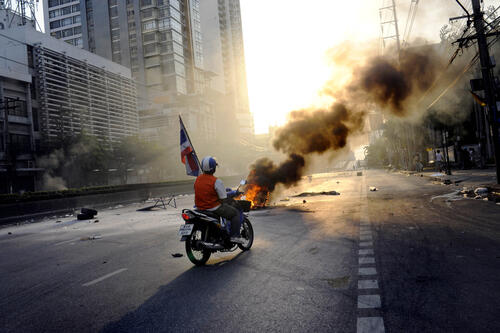
After the Cold War, Thailand became a poster child of democratizing processes in Southeast Asia. Student protests, farmers’ activism, a thriving civil society, and an expanding middle class suggested a model of successful democratic transition. In the last decades, however, many of the forces that supported that process turned sour on electoral politics. Dr. Sopranzetti’s book will explore how that happened—new class alliances, discourses of corruption and morality, questions of law. In this context, he will portray Thailand as an experimental space for a new model of authoritarianism, inspired by Beijing and now spreading throughout the region. The book, Owners of the Maps: Motorcycle Taxi Drivers, Mobility, and Politics in Bangkok, will be available for sale at the talk.
Claudio Sopranzetti is a Postdoctoral Research Fellow at All Souls College at the University of Oxford. He is the author of Owners of the Maps: Motorcycle Taxi Drivers, Mobility, and Politics in Bangkok and he is currently working on Awakened, an anthropological graphic novel on Thai politics.
Claudio Sopranzetti
Postdoctoral Research Fellow, All Souls College, Oxford University
Over the last dozen years, Taiwan’s democracy has deepened in important ways. Executive power has rotated twice, from the DPP’s Chen Shui-bian to the KMT’s Ma Ying-jeou in 2008, and from Ma to the DPP’s Tsai Ing-wen in 2016. The majority in the legislature also changed for the first time in 2016, from the KMT to the DPP. Taiwan’s most recent overall Freedom House ranking is 93/100, significantly higher than the United States. Its freedom of the press ranking is the highest in all of Asia, ahead of Korea and even Japan, and its rule of law and anti-corruption scores are trending in a positive direction as well.
To be sure, serious concerns remain about the practice of democracy in Taiwan, including a poorly institutionalized and often chaotic lawmaking process, incomplete legislative oversight of executive branch actions, and a partisan and increasingly fragmented media environment. Nevertheless, the greatest threat to Taiwan’s continued place among the world’s liberal democracies now appears to be external, not internal. The People’s Republic of China (PRC) has always posed an existential threat to Taiwan, but its growing economic influence, rapid military modernization, assertive territorial claims in the region, and aggressive global efforts to isolate Taiwan have accelerated in recent years. Put simply, Taiwan’s long-term future as a democracy is imperiled by China’s rise.
The PRC’s growing power presents difficult security challenges for most of the countries in the Asia-Pacific region, not just for Taiwan. But these challenges are rarely considered from a multi-lateral perspective—most analyses of regional security issues instead tend to focus on bilateral or trilateral (US-China-Country X) relationships. This pattern is particularly common in discussions of Taiwan’s security, where the dominant focus is on Cross-Strait and US-Taiwan relations to the neglect of Taiwan’s other relationships in the region.
The goals of this workshop, then, are to place Taiwan’s security challenges in a broader, regional context, to consider possible obstacles to and opportunities for greater regional cooperation on security issues, and to devise a set of recommendations for Taiwan and its partners and allies. Workshop participants will include experts on a wide array of economic, diplomatic, and security topics from Taiwan, the United States, and elsewhere in the Asia-Pacific region.
Remarks are Off-the-Record. Recording, reporting and citation of remarks is strictly prohibited.
AGENDA
Monday, March 5 - Koret-Taube Conference Center, John A. and Cynthia Fry Gunn Building
9:00-9:30am CONTINENTAL BREAKFAST
9:30-9:45am OPENING REMARKS Larry Diamond, Senior Research Fellow, Center on Democracy, Development, and the Rule of Law Karl Eikenberry, Director, U.S.-Asia Security Initiative, Asia-Pacific Research Center
9:45am – 11:30am: PANEL I. Assessment of US Alliances and the Political and Military Situation in the Western Pacific Chair: Tom Fingar (APARC, Stanford) • Overview of Military Trends and US Strategy in Region. Karl Eikenberry (APARC, Stanford) • US-Taiwan Relations. Robert Wang (Center for Strategic and International Studies) • US-Japan Relations. TJ Pempel (UC Berkeley) • US-Korea Relations. Kathy Stephens (APARC, Stanford)
11:30am-1:00pm LUNCH Keynote Speaker: Robert Sutter (George Washington University) - "Will Trump administration advance support for Taiwan despite China's objections?"
1:15pm-3:00pm: PANEL II. Trade and Economic Relations in the Western Pacific Chair: Phillip Lipscy (APARC, Stanford) • Regional Trade Agreements after TPP: RCEP vs TPP-11. Barbara Weisel (former Assistant US Trade Representative for SE Asia and the Pacific) • China’s Institution-Building: OBOR, Maritime Silk Road, AIIB. Amy Searight (Center for Strategic and International Studies) • Taiwan’s New Southbound Policy. Russell Hsiao (Global Taiwan Institute)
3:15-5:00pm: PANEL III. Maritime Security Issues: The South and East China Seas Chair: Karl Eikenberry (APARC, Stanford) • Interpreting Chinese Maritime Strategy in the South China Sea, Don Emmerson (APARC, Stanford) • China’s Maritime Militia. Andrew Erickson (Naval War College) • Evolution of US Policy: FONOPS and Beyond. Dale Rielage (Captain, US Navy) • Taiwan’s Role in Maritime Security Issues. Yeong-Kang Chen, (Admiral (Ret.), ROC Navy)
Tuesday, March 6 - McCaw Hall, Stanford Alumni Center
9:00-9:30am CONTINENTAL BREAKFAST
9:30-11:15am: PANEL IV. Taiwan’s Key Asian Relations Chair: Kharis Templeman (APARC, Stanford) • A Taiwanese Perspective on Asian Relations. Lai I-chung (Prospect Foundation) • NE Asia, Yeh-chung Lu (National Chengchi University) • SE Asia, Jiann-fa Yan (Chien Hsin University of Science and Technology)
11:30-1:15pm: PANEL V. Cross-Strait Relations Chair: Larry Diamond • The Domestic Politics of Security in Taiwan. Kharis Templeman (APARC, Stanford) • Beijing’s Taiwan Policy after the 19th Party Congress. Alice Miller (Hoover Institution) • US Role in the Trilateral Relationship. Raymond Burghardt (former chairman, American Institute in Taiwan)
1:15am-2:15pm LUNCH
March 5: Koret-Taube Conference Center, Gunn–SIEPR Building, 366 Galvez Street, Stanford, CA 94305
March 6: McCaw Hall, Frances C. Arrillaga Alumni Center, 326 Galvez St, Stanford, CA 94305
In October 2017, twenty-two scholars from eight countries attended a workshop titled “ASEAN @ 50, Southeast Asia @ Risk: What should be done?” The workshop was designed to facilitate a frank and creative discussion of policy recommendations, with the intention of providing the resulting proposals to ASEAN member states and other regional powers. Following two days of discussion and debate, the attendees produced a series of specific policy recommendations (SPRs).
Four sets of Southeast Asia-related topics were covered during the workshop: regional security, regional infrastructure, regional economy, and improving ASEAN. The attending scholars—which included Director of the U.S.-Asia Security Initiative Karl Eikenberry and Director of the Southeast Asia Program Donald Emmerson—submitted 24 SPRs for discussion.
Over two-and-a-half days, the group evaluated each SPR for its effectiveness, significance, specificity, and feasibility. The intention was to produce specific proposals addressing some of the main challenges facing Southeast Asia. So as to encourage openness in the dialogue, the workshop was held under the Chatham House Rule.
The Southeast Asia Program and the U.S.-Asia Security Initiative in the Walter H. Shorenstein Asia-Pacific Research Center prepared this program and final publication in cooperation with multiple partners. Their final recommendations have been included in the 20-page report which is now available online.


 (From left to right: General Vincent Brooks, Commander, UNC/CFC/USFK; Ambassador David Shear; Ambassador Michael Armacost; and Workshop Co-Hosts Ambassador Karl Eikenberry and Lieutenant General, (Retired) Noboru Yamaguchi)
 (Meeting with Commander of the Japanese Self-Defense Fleet, Vice Admiral Kazuki Yamashita)