FSI researchers strive to understand how countries relate to one another, and what policies are needed to achieve global stability and prosperity. International relations experts focus on the challenging U.S.-Russian relationship, the alliance between the U.S. and Japan and the limitations of America’s counterinsurgency strategy in Afghanistan.
Foreign aid is also examined by scholars trying to understand whether money earmarked for health improvements reaches those who need it most. And FSI’s Walter H. Shorenstein Asia-Pacific Research Center has published on the need for strong South Korean leadership in dealing with its northern neighbor.
FSI researchers also look at the citizens who drive international relations, studying the effects of migration and how borders shape people’s lives. Meanwhile FSI students are very much involved in this area, working with the United Nations in Ethiopia to rethink refugee communities.
Trade is also a key component of international relations, with FSI approaching the topic from a slew of angles and states. The economy of trade is rife for study, with an APARC event on the implications of more open trade policies in Japan, and FSI researchers making sense of who would benefit from a free trade zone between the European Union and the United States.
In this fourteenth session of the Strategic Forum, former senior American and South Korean government officials and other leading experts will discuss current developments in the Korean Peninsula and North Korea policy, the future of the U.S.-South Korean alliance, and a strategic vision for Northeast Asia. The session is hosted by the Korea Program at the Shorenstein Asia-Pacific Research Center, in association with Korea National Diplomatic Academy, a top South Korean think tank.
Weeks away from a final international accord on Iran’s nuclear program, Stanford scholars are focusing on the technical, political and practical aspects of the pending deal intended to loosen sanctions while restricting Tehran’s ability to build a nuclear weapon.
“In two to three weeks we will have what some pundits are already calling the most revolutionary positive change in Iranian-American relations and others are saying a disastrous policy of appeasement to the Iranian regime,” said Scott Sagan, a senior fellow at the university’s Freeman Spogli Institute for International Studies. Sagan moderated a discussion at the FSI's Center for International Security and Cooperation (CISAC) on Tuesday that included FSI’s Siegfried Hecker and Thomas Fingar, as well as Abbas Milani, director of Stanford’s Iranian Studies.
Hecker, a former director of the Los Alamos National Laboratory, said Iran has developed its civilian nuclear capabilities to concurrently have a nuclear weapon option. However, at this point, they do not yet have nuclear weapons, nor have they produced the fissile materials, plutonium or highly enriched uranium, that would fuel such weapons.
“They’ve demonstrated they can enrich uranium to the levels allowed for civilian applications, but that gives them the capability to produce highly enriched uranium for bombs should they choose to do so,” Hecker said. “If they complete the Arak reactor, they will have the potential for plutonium production, although they have not developed a facility to extract the plutonium. If you look in terms of timelines for making fissile materials, they were somewhere between weeks to a month or two away for making enough fissile material for one bomb at the start of the negotiations in November 2013. The nuclear deal would move that timeline, called the ‘breakout’ time to one year, giving the international community more time to respond.”
Hecker said the technical issues are “secondary to whether Iran actually wants to go ahead and decide to build the bomb.”
He met with Iranian negotiators – including Foreign Minister Mohammad Javad Zarif – in 2013, and said the officials were anxious to reach a deal.
“Zarif told me that the cost of acquiring strategic capabilities will make Iran less safe rather than more safe,” Hecker said.
Fingar, who chaired the National Intelligence Council while also serving as the U.S. deputy director of national intelligence for analysis between 2005 and 2008, stressed the need for strong verification mechanisms if any deal with Iran is going to work.
“Verification can establish some facts but what it means is fundamentally a contextual and political judgment. What is most important? Catching somebody in a technical violation or preserving the overall purpose for which you are conducting verification. Verification requirements are an integral part of the negotiating process,” Fingar said.
That is especially true for Iran, which has proven that it is not trustworthy, he said.
“It did have a military program, it was seeking the bomb. It continues to lie about it. It lied to the European negotiators, to the UN, to the IAEA,” Fingar said. "This history mandates having a rigorous verification capability."
Monitoring is done in three bins, he said. The first, and most important, is the IAEA on-site inspections. The second is that done by other countries’ intelligence services, including those of the other P5 plus 1 countries and Israel. The third bin is the U.S. intelligence community.
“We will learn far more about what Iran is doing from the IAEA inspections than from any other mechanism,” Fingar said.
Milani focused on the politics of the deal inside Iran. Discussion of this political dimension, he said, cannot be understood unless we take into account two critical issues: Recent concerns with the health of Iran’s supreme leader, Ayatollah Ali Khamenei, and the heated battle on who might succeed him; and secondly the rise of ISIS and the fact that they are near Iran’s borders and have repeatedly threatened the country’s Shiites.
The debate in Iran is heated, he said, with many in favor of the agreement and a few opposed to it.
“Part of what is being fought over is what happens after the deal,” he said. “Who can claim victory for the deal? Who can take blame for it? These are profoundly political issues and they are being fought over.”
Milani said that he has never seen any policy issue, in the entire 35-year history of the Islamic Republic, being discussed with as much detail, and with as much ferocity as the nuclear deal.
There are occasional, detailed debates happening in Tehran University and other places Milani said. One side –typically pro-regime hard-liner – argues that this is the worst deal in Iran’s history. Reformists and scholars supporting President Rouhani’s government defend the agreement.
But he said these conservative opponents of the agreement are in the minority. He estimates that they have no more than 7 to 10 million supporters in a country with a population of 75 million. The vast majority of the population wants a deal, he said. The Iranian Revolutionary Guard Corps, which wields more power than any other group, is not all in favor of the deal and has made threats against the government in recent weeks.
Still, the ultimate political obstacle is that the deal must contain language that all actors can sell to their respective constituencies as a victory. And finding a language that passes this political hurdle is every bit as hard as the problems discussed by Hecker and Fingar.
Joshua Alvarez is a freelance writer.
Hero Image
Secretary Kerry Poses for a Photo With P5+1 Leaders and Iranian Foreign Minister Zarif Following Negotiations About Future of Iran's Nuclear Program
Kathleen Stephens, a former U.S. ambassador to the Republic of Korea, will join Stanford University’s Walter H. Shorenstein Asia-Pacific Research Center (APARC) as the William J. Perry Distinguished Fellow in the Korea Program.
Her fellowship, made possible through the generous support of Jeong and Cynthia Kim, is effective Sept. 1, 2015.
Ambassador Stephens will be housed at Shorenstein APARC, the center in the Freeman Spogli Institute for International Studies working on policy-relevant interdisciplinary research related to the Asia-Pacific.
“Kathy Stephens brings exceptional diplomatic experience on a global scale to Shorenstein APARC. Equally impressive, she has four decades of experience in Korean affairs, first as a Peace Corps volunteer in rural Korea in the 1970s, and in ensuing decades as a diplomat and as U.S. ambassador in Seoul,” said Shorenstein APARC Director Gi-Wook Shin.
"She is often cited as one of the most popular American envoys ever to South Korea. Her ability to deal with tough issues like North Korea and the U.S.-South Korean free trade agreement -- and to connect with everyday Koreans -- speaks to her deep expertise.”
Stephens came to Stanford previously as the 2013-14 Koret Fellow after 35 years as a foreign service officer in the U.S. Department of State. At Stanford, she taught a course on U.S.-Korea relations and contributed extensively to center activities, including a Koret Workshop focused on inter-Korean relations and the biannual Korea-U.S. West Coast Strategic Forum. Her time at Stanford, though, was cut short when she was recalled to the diplomatic service to lead the U.S. mission in India as charge d'affaires during the first seven months of the new administration led by Narendra Modi.
Stephens' diplomatic career included serving as acting under secretary of state for public diplomacy and public affairs in 2012; U.S. ambassador to the Republic of Korea from 2008 to 2011; principal deputy assistant secretary of state for East Asian and Pacific affairs from 2005 to 2007; and deputy assistant secretary of state for European and Eurasian affairs from 2003 to 2005.
She also served in numerous positions in Asia, Europe and Washington D.C., including as U.S. consul general in Belfast, Northern Ireland from 1995 to 1998, during the negotiation of the Good Friday Agreement, and as director for European affairs at the White House during the Clinton Administration.
“I am delighted and honored to return to Stanford,” Stephens said. “Shorenstein APARC is an incredibly stimulating place – an opportunity to be immersed in one of the world’s leading community of scholars working on U.S.-Asia-Pacific affairs.”
Stephens holds a bachelor’s degree in East Asian studies from Prescott College and a master’s of public administration from Harvard University, in addition to honorary degrees from Chungnam National University and the University of Maryland. As an undergraduate, she studied at the University of Hong Kong and was an Outward Bound instructor in Hong Kong. She was previously a senior fellow at Georgetown University's Institute for the Study of Diplomacy.
Stephens' awards include the Presidential Meritorious Service Award (2009), the Sejong Cultural Award, and Korea-America Friendship Association Award (2013). She is a trustee at The Asia Foundation, and on the boards of The Korea Society and Pacific Century Institute.
Stanford University’s Walter H. Shorenstein Asia-Pacific Research Center (APARC) is launching a U.S.-Asia Security Initiative spearheaded by a former top American diplomat to deepen dialogue on contemporary Asia-Pacific security issues and to further bridge American and Asian academics, government officials and industry leaders.
A new and uncertain multipolar system is emerging in Asia. The United States is and will remain a global power, but it is evident the post-Cold War international order is increasingly under strain. There is a pressing need for research about how developments in the Asia-Pacific region impact U.S. interests, and what the optimal strategies are to respond. Led by Karl Eikenberry, who served as U.S. ambassador to Afghanistan from 2009 to 2011, the initiative will look beyond simplistic notions of nations engaging harmoniously or competing against each other and explore a range of policy options.
Combining expertise from across Stanford University, the initiative will gather faculty and researchers from the Freeman Spogli Institute for International Studies (FSI), and take place under the auspices of Shorenstein APARC, a center focused on interdisciplinary research on contemporary issues of international cooperation, governance and security in the Asia-Pacific region.
Eikenberry, an Oksenberg-Rohlen Distinguished Fellow at Shorenstein APARC, retired from the U.S. Army as a lieutenant general after 35 years of service before taking the role as ambassador. At Stanford, he has returned to an early and longstanding interest in Asia, contributing to an urgent discussion about how the United States should respond regionally and globally to an increasingly strong China. The initiative is founded on the premise that there is a role for an institution that not only fosters groundbreaking research, but also serves to convene academic and governmental expertise from across the Asia-Pacific region in a dialogue aiming to inform policy and strategy.
“As China rises and Japan seeks a greater defense role in Asia, a number of questions are raised over the United States’ role in the region. This creates a great impetus for stakeholders to gather and develop an understanding of today’s perplexing security issues,” Eikenberry said.
“It’s an honor to lead this Stanford initiative and make possible opportunities for students, scholars, peers and leaders across the world.”
Before arriving at Stanford, Eikenberry’s Asia-related postings included assistant army, and later, defense attaché at the U.S. Embassy Beijing, operational assignments in the Republic of Korea and Hawaii, Director for Strategic Plans and Policy at U.S. Pacific Command, Senior Country Director for China at the Office of the Secretary of Defense, and two senior command tours in Afghanistan. He is a graduate of the U.S. Military Academy, holds master’s degrees from Harvard University and Stanford University, and has an advanced degree in Chinese history from Nanjing University.
The three-year initiative will build synergies with existing activities at Stanford, drawing scholars, government officials and industry leaders to engage at conferences and public seminars on important U.S.-Asia security themes. Understanding that inquiry is enlivened through interdisciplinary dialogue, participants will share best practices across multiple fields including diplomacy, military strategy and environmental risk.
“I can’t think of a better person to drive this initiative – Karl has a profound understanding of the economic, diplomatic and military complexities in the region. I have every confidence that it will develop into a robust, established project under his leadership,” said Gi-Wook Shin, director of Shorenstein APARC.
Launching July 1, 2015, the initiative aims to bolster local, national and global networks through several foundational components, including a core working group of experts from Stanford and peer institutions to provide new perspectives on U.S. policies in Asia; educational opportunities for Stanford students; and public programs that will bring intellectual and strategic leaders to Stanford to enrich the conversation on Asia-Pacific security.
The initiative seeks to operate as a focal point for academic scholarship on the west coast of the United States and offer practical steps that stakeholders can take to strengthen the security architecture and U.S. alliance commitments in the region. Outcomes from the initiative’s activities will include publications and policy reports, many of which will be offered open access online.
“As the Asia-Pacific region continues to rise, we see new threats but also greater opportunity to work together,” said Michael McFaul, director of FSI. “Stanford and FSI excel in offering practical solutions to policy challenges and can play a role in identifying strategies aimed at maintaining peace and stability in the region.”
Initiative inquires: Charlotte Lee, Shorenstein APARC, cplee@stanford.edu, (650) 725-6445
Media inquires: Lisa Griswold, Communications and Outreach Coordinator, Shorenstein APARC, lisagris@stanford.edu, (650) 736-0656
Hero Image
In Sasebo, Japan, members from the maritime forces of India, Japan and the United States observe a trilateral naval field exercise in July 2014.
As people around the world look to support earthquake relief efforts in Nepal, scholars from Stanford and the London School of Economics and Political Science offer new research that can help donors make better decisions about where and how to contribute their money.
“NGO reports tend to focus on quantity in delivery, such as numbers of homes and people served—but not on quality,” write Yong Suk Lee (Stanford) and J. Vernon Henderson (LSE).
In a forthcoming paper, the coauthors evaluate reconstruction efforts in Indonesia following the 2004 earthquake and tsunami, and find two trends: aid agencies that directly execute their services—point-to-point—perform the highest quality work. And, when agencies contract their services, higher quality work is performed when a global, not domestic, implementer completes the work.
Knowing this reality, and with improved disclosure of outcomes, the coauthors hope that donors would be able to make more informed choices.
Fishing village survey
Figure 1. A map details the survival rate of the population and flood damage within northern Indonesia in 2004. Darker shaded areas show a higher survival rate, lighter shaded areas show a lower survival rate. Striped areas denote flooding, largely on the northeastern border. Boundaries marked with thicker lines are ‘kabupaten,’ or county divisions, and lightly colored lines are ‘kecamatan,’ or sub-county units larger than a village alone. (Courtesy of Yong Lee).
Through fieldwork and three rounds of surveys – in 2005, 2007 and 2009 – Henderson and Lee investigated aid work in Aceh, an area of coastal villages in northern Indonesia (Figure 1).
Humanitarian efforts there focused on “hard aid” such as construction of houses and fishing boats. Total aid delivered amounted to $7.7 billion and was implemented by international and domestic aid agencies—some directly and some as contractors—as well as the Indonesian government.
First, Henderson and Lee conducted a pilot survey, and then with a cohort of surveyors from the University of Indonesia, held interviews with village leaders and fishing families. Participants were asked to rate their housing accommodation, and if applicable, how their fishing activity compared to before the disaster.
“Mostly, we sat with villagers to see how willing they were to talk about aspects of aid,” Lee said. “Since it was several years after the tsunami hit, people were pretty open throughout the process.”
Data from those surveys was combined with information from the Recovery Aceh-Nias relief project database maintained by the government and the U.N., as well as demographic information provided by participants.
Delivering aid: Global v. local
Empirical analysis revealed that aid agencies such as the Red Cross and Catholic Relief Services reflected higher quality aid delivery (at a mean quality near 3.00), while agencies such as Save the Children and Concern Worldwide reflected lower quality (at a mean quality between 1.0-1.5).
“What’s surprising is that reputation didn’t really line up with what was expected,” Lee said, citing a few renowned agencies that didn’t receive high marks.
Lee said this could be explained by the fact that aid agencies that specialize in disaster recovery are better equipped, while a learning curve might exist for agencies with wider missions.
Global aid agencies are more likely to have logistical experience given their reach across multiple disaster situations. And while all NGOs face reputational costs for their results, global aid agencies are greater exposed to criticism because, by size, they’re more visible.
Yet, while global aid agencies and implementers may have the raw skills, local implementers have the cultural know-how.
“Local implementers might not have the most experience – like how to construct a house or manufacture a fishing boat – but they will likely know what’s actually desired,” Lee said. “So, there are obvious tradeoffs at play.”
For example, villagers reported bad ventilation in houses. This was because some aid agencies used small windows and concrete instead of wood material more traditionally used in Indonesia. Some boats were impossible to use because of improper design; they sank upon first use or fell apart after a few months.
Image
Collection of photos from fieldwork in Aceh, Indonesia, provided courtesy of Yong Lee. Upper left: A house built in an aid project village shows windows retrofitted after initial construction. Upper right: Boats constructed by aid agencies for fishing activity are refashioned to serve as water taxis for people and cars. Lower: Fishing boats sit unused on the side of the road many of them impossible to use, according to villagers surveyed.
Upper left: A house built in an aid project village shows windows retrofitted after initial construction. Upper right: Boats constructed by aid agencies for fishing activity are refashioned to taxi people and cars. Lower: Fishing boats sit unused on the side of the road many of them impossible to operate, according to villagers surveyed. (Courtesy of Yong Lee).
Logistics and oversight
Aid delivery depends in many ways on the location and scale of the disaster. But, a few main aspects can determine if an aid agency doing its own work or operating as an implementer meets or exceeds expectations.
Henderson and Lee suggest that agencies that were highly supervisory had greater positive outcomes from their workers. In the case of Aceh, better monitoring and insistence on quality by leadership is a likely corollary between construction of better quality homes and boats.
“Rather than just give money, NGOs need to really oversee the projects. Organization and management are essential facets,” Lee said. “And that requires a lot of additional effort on their part.”
Oversight is especially relevant in disaster situations because of the often-overwhelming need for reconstruction. A flood of less-skilled workers enters the market to fill this gap, and on average the quality of work degrades.
“It’s much more difficult to impose quality control at this point,” Lee said. “So the implication that comes out of it is how does the implementer effectively utilize less-skilled workers.”
Getting to know the implementers and evaluating their work in-progress would help ensure quality on behalf of the aid agency. And, better dissemination of information about aid outcomes would help assure donors that their monies are being applied in the best possible way.
Future study
Most “hard aid” delivered to Aceh’s villages had finished by 2010, but “soft aid” such as democracy promotion and women’s empowerment stayed longer.
Henderson and Lee conducted one final survey in 2011. The data has been offered as open source material for researchers along with the larger data set.
Noting this, Lee said, “We’re thrilled that people are looking into the data further. It’s exactly what we wanted.”
Research projects applying the data include the impact of the tsunami on Aceh’s local economies and health effects on the population, among other areas.
Hero Image
A United Nations Humanitarian Air Service helicopter offloads relief supplies from the World Food Programme in Gorkha District, Nepal. Villagers help distribute tents and food.
RSVPS ARE NO LONGER BEING ACCEPTED AS WE HAVE REACHED VENUE CAPACITY. Seating is first come, first served.
The livestream experienced technical difficulties and was not able to be broadcast. Video of the event is now posted below.
Secretary-General Ban Ki-moon’s visit will highlight the 70th anniversary of the founding of the UN, part of a larger trip to the Bay Area to commemorate the San Francisco Conference, where the charter establishing the UN was signed in 1945. After his speech, he will participate in a question and answer session with Ambassador Kathleen Stephens, the U.S. ambassador to the Republic of Korea (2008-11).
This is Ban’s second visit to Stanford in under three years. In January 2013, he delivered a speech to mark the occasion of the Walter H. Shorenstein Asia-Pacific Research Center’s thirtieth anniversary.
Media must pre-register by 9 a.m. on June 25. Please direct media inquires to Ms. Lisa Griswold, lisagris@stanford.edu.
Stanford scholars are urging Japan to take advantage of an upcoming opportunity to show clear, heartfelt remorse for its actions surrounding World War II.
Making such amends will give Japan credibility as it seeks to assume a global leadership role well into the future, they say.
On Aug. 15, Prime Minister Shinzo Abe will publish a short statement to commemorate the 70th anniversary of the end of World War II, which follows similar practices of his predecessors.
Stanford's Walter H. Shorenstein Asia-Pacific Research Center (APARC), which has long advocated wartime reconciliation in Asia, recently issued a 15-page report in English and Japanese featuring eight hypothetical statements suggesting what the Japanese prime minister might say in his August address. The report, which is available in both English and Japanese, was recently made available to academics, media and the general public and has already received interest from the Japanese media.
The wording of Abe's statement will be scrutinized by governments and experts in Asia and around the world, the Stanford scholars say. During WWII, China and Korea, as well as other Asian nations, endured brutal Japanese military occupations.
"Many have been speculating what the (Abe) statement will be like," wrote Takeo Hoshi, director of the Japan Program at the Shorenstein Center, and APARC associate director for research Daniel Sneider in the report.
For example, Hoshi and Sneider asked, will Abe follow the direction set by prior Japanese prime ministers by expressing remorse for the suffering of Japan's Asian neighbors while apologizing for past aggression and colonization? Future collaboration in world affairs is also important, they added.
"We asked our colleagues what they would say in the 70th anniversary statement if they were the prime minister of Japan, and to write their own version of the statement," Hoshi and Sneider wrote.
"Our goal is to understand the diversity of reasonable views on the issue of Japan's responsibility for the cruel and violent war and Japan's role in building a peaceful and prosperous world," Hoshi and Sneider said.
The Stanford experts who wrote the statements included Hoshi and Sneider as well as Alberto Diaz-Cayeros, a senior fellow at the Freeman Spogli Institute for International Studies; Peter Duus, a professor emeritus of Japanese history; Thomas Fingar, a distinguished fellow at the Freeman Spogli Institute; David Holloway, a professor of international history and of political science; Yong Suk Lee, the SK Center Fellow at the Freeman Spogli Institute; and Harry Rowen, a professor emeritus of public policy and management.
For example, Fingar said in his version, "Let us also resolve to make the 80th anniversary of World War II the 10th anniversary of a more cooperative, more inclusive, and more secure region," and Hoshi wrote in his version, "To avoid any potential misunderstandings, Japan needs to recall past failures, remember the suffering of neighboring Asian peoples, and reaffirm the commitment to world peace more than ever."
On the subject of women, Lee's version noted, "The war and Japan's colonial rule created much suffering, but I would like to especially ask forgiveness to the women from many nations who suffered under colonial rule."
In August 2014, the Shorenstein Asia-Pacific Research Center issued a report on a Stanford-hosted dialogue on World War II memories in northeast Asia. Heightened tensions the last few years among the governments of China, Japan and South Korea have revolved around territorial disputes and the way WWII is portrayed in speeches and educational materials.
"Each nation in northeast Asia and even the U.S. has selective or divided memories of the past, and does not really understand the views of the other side," said Stanford's Gi-Wook Shin, director of the Shorenstein center, in a 2014 Stanford news release.
Clifton Parker is a writer for the Stanford News Service.
Responses to the project
Toyo Keizai, a leading Japanese business weekly, published all eight verisons in English and Japanese stating, "we hope this will provide an opportunity to bring about a wide range of discussion."
University of Tokyo professor Tetsuji Okazaki wrote about the project in the Asahi Shimbun (the article is in Japanese and also attached as a PDF below).
Hero Image
A sunrise in Nauru, an island in the Central Pacific.
On August 15, Prime Minister Shinzo Abe will publish a short statement to commemorate the seventieth anniversary of the end of World War II. This follows similar practices of his predecessors. Prime Minister Tomiichi Murayama started by delivering a short statement on the fiftieth anniversary in 1995. Prime Minister Junichiro Koizumi followed in 2005 with the statement on the sixtieth anniversary.
Eight scholars at Shorenstein Asia-Pacific Research Center (APARC) and Freeman Spogli Institute for International Studies (FSI) wrote their own version of the statement -- what speech they would deliver if they were the Prime Miniser of Japan. This book is a compilation of those statements.
In a recent interview with Korea Daily, Gi-Wook Shin, director of the Shorenstein Asia-Pacific Research Center, said that South Korea needs to be more strategic in its approach to its foreign policy agenda. The country’s leadership must aim to be more proactive in handling current diplomatic issues.
Shin suggested that South Korea should separate wartime history issues from other diplomatic priorities such as trade and security. This type of organization would allow each issue to receive the focused attention and expertise needed to understand and work toward resolution.
Recently, Japan provided a successful model for this, Shin said, referencing Japanese Prime Minister Shinzo Abe’s official state visit to the United States. Abe visited many major U.S. regions including Silicon Valley. He spoke mainly about the U.S.-Japan alliance and economic development as policy priorities for Japan. He did not address at length issues of the wartime past since the focus of his visit was U.S.-Japan relations and the economy.
Shin said he thinks it is important that South Korean President Park Geun-hye delivers a concrete foreign policy vision in her June visit to the United States. For the long-term, South Korea should find ways to boost its public diplomacy efforts to shore up support for that vision.
The full article is in Korean and available by clicking here.
Hero Image
U.S. President Barack Obama and President Park Geun-hye of the Republic of Korea walk on the Colonnade of the White House in May 2013.
When China first proposed creating the Asian Infrastructure Investment Bank (AIIB) in 2013, it generated considerable anxiety in Washington and many other capitals. Many pundits and policymakers view the AIIB as a bid to undermine or replace the international architecture designed by the United States and its allies since the end of World War II. Although several U.S. allies, including Australia, Germany, and the United Kingdom, have declared their intention to join the AIIB, others, including Japan, have expressed ambivalence. For its part, the United States has made it clear that it will seek to influence the institution from the outside. But it would be a mistake to shun or undermine the AIIB. Rather, it should be welcomed. Both the United States and Japan have far more to gain by joining the AIIB and shaping its future than remaining on the sidelines.
The details remain vague, but the AIIB is meant to be a multilateral development institution that will focus on infrastructure needs in Asia. There is no question that this is a deserving cause. Asia’s large population, rapid growth, and integration with the global economy all generate demand for better infrastructure. A report by the Asian Development Bank (ADB) estimates the region needs about $750 billion annually in infrastructure-related financing. Citing historical underinvestment, McKinsey & Company, a global management consulting firm based in New York City, proclaims a “$1 trillion infrastructure opportunity” in Asia. [...]
This article was originally published on Foreign Affairs on May 7, 2015, and an excerpt has been reproduced here with permission. The full article may be viewed on the Foreign Affairs website.
Hero Image
U.S. Secretary of State John Kerry and U.S. Treasury Secretary Jack Lew meet with Chinese Premier Li Keqiang at an economic dialogue between the two nations in July 2014.

 FSI researchers strive to understand how countries relate to one another, and what policies are needed to achieve global stability and prosperity. International relations experts focus on the challenging U.S.-Russian relationship, the alliance between the U.S. and Japan and the limitations of America’s counterinsurgency strategy in Afghanistan.


 Figure 1. A map details the survival rate of the population and flood damage within northern Indonesia in 2004. Darker shaded areas show a higher survival rate, lighter shaded areas show a lower survival rate. Striped areas denote flooding, largely on the northeastern border. Boundaries marked with thicker lines are ‘kabupaten,’ or county divisions, and lightly colored lines are ‘kecamatan,’ or sub-county units larger than a village alone. (Courtesy of Yong Lee).
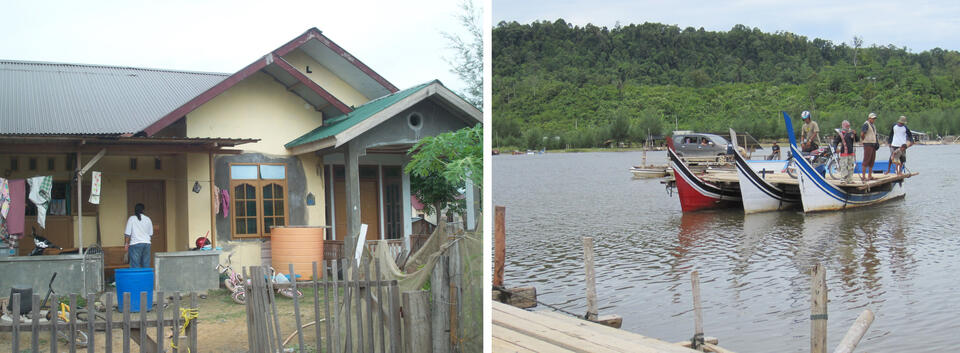
 Collection of photos from fieldwork in Aceh, Indonesia, provided courtesy of Yong Lee. Upper left: A house built in an aid project village shows windows retrofitted after initial construction. Upper right: Boats constructed by aid agencies for fishing activity are refashioned to serve as water taxis for people and cars. Lower: Fishing boats sit unused on the side of the road many of them impossible to use, according to villagers surveyed.





