Authors
Noa Ronkin
News Type
News
Date
Paragraphs

When Shibani Mahtani reopened the Washington Post’s Southeast Asia and Hong Kong bureau in 2018, the paper was in the middle of a major expansion of its foreign coverage, adding correspondents and reestablishing reporting hubs from Seoul to London. She later served as The Post’s international investigative correspondent with a broad mandate across the Asia-Pacific region, reflecting the paper’s commitment to deep, accountability-driven journalism outside of the United States. Since then, however, The Post has shuttered its foreign desk as part of sweeping newsroom layoffs in February 2026. “There is no China bureau, no India bureau, no Southeast Asia bureau,” says Mahtani, winner of the 2026 Shorenstein Journalism Award for excellence in Asia coverage.

Speaking at the October 20 award ceremony, Mahtani, whose role was cut in the layoffs, acknowledged the irony of being honored largely for work at an outlet that has since withdrawn from the region. But in her keynote, titled “What’s Your Agenda?”: Attacks Against the Free Press and Democratic Backsliding in Southeast Asia,” she drew attention to what she called “a more sobering story” of an embattled media environment across Asia, and of what the world loses as a result.

The waning commitment to foreign reporting by outlets like The Post occurs as governments across Asia are increasingly weaponizing their laws against the media – with local news media in places like Hong Kong, Cambodia, Myanmar, and Singapore battered by sustained attacks against the free press – and as funding for independent, nonprofit outlets in the region is drying up following the closure of the U.S. Agency for International Development.
Image
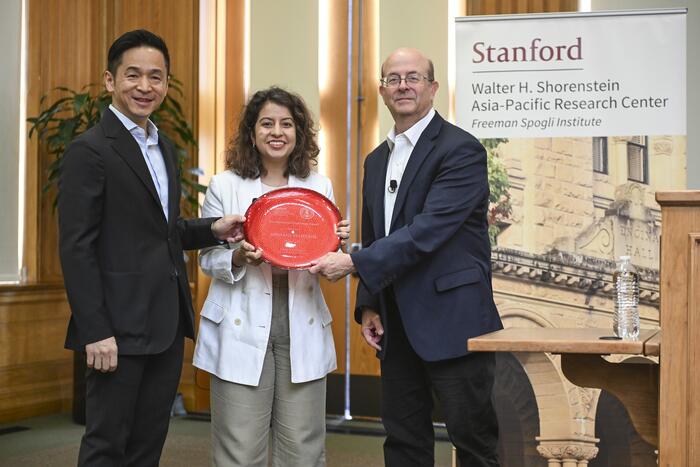
Kiyoteru Tsutsui and James Hamilton present the 2026 Shorenstein Journalism Award to Shibani Mahtani.
APARC Director Kiyoteru Tsutsui (left) and Stanford Vice Provost for Undergraduate Education James Hamilton, Hearst Professor of Communication and director of the Journalism Program, present Shibani Mahtani with the 2026 Shorenstein Journalism Award. | Photo credit: Rod Searcey.
 

Sign up for APARC newsletters to receive insights and analysis from our experts and guest speakers >


Accountability-Driven Investigations Across Asia


The Shorenstein Journalism Award, which carries a $10,000 prize, recognizes outstanding journalists and news outlets who have contributed to a greater understanding of Asia. Sponsored by APARC, it commemorates the legacy of the late Walter H. Shorenstein, the center's benefactor, by honoring two causes he cared about: promoting journalism at its best and an informed understanding of Asia. 

In his welcome remarks, APARC Director Kiyoteru Tsutsui noted that this year’s ceremony marks the 25th anniversary of the Shorenstein Award. “With each new honoree, APARC is proud to carry Walter’s legacy forward and affirm our support for independent, nuanced, fact-based journalism. This commitment is critical as trust in the news media plummets and as the truth, and those who report it, are under attack.”

The 2026 Shorenstein Award honors Mahtani for her original, powerful accountability-driven reporting across the region, particularly Southeast Asia. As he introduced her, James Hamilton, Stanford vice provost for undergraduate education, the director of the Journalism Program, and a member of the Shorenstein Award judging committee, cited her chronicling of Beijing’s crackdown on Hong Kong; exposés on China’s quest to reshape Asia in its image; reporting on transnational repression; and investigations into the rise of organized crime syndicates connected to state actors. As the award judging committee put it, Mahtani “has broken stories that others would not or could not report.”

Following her keynote, Hamilton moderated a discussion with panelists Anna Fifield, a New Zealand journalist and foreign affairs analyst, former Asia-Pacific editor at the Washington Post, recipient of the 2018 Shorenstein Journalism Award, and a member of the award judging committee, and Oren Samet, an assistant professor of political science at Rice University and a former postdoctoral fellow at Stanford’s Center on Democracy, Development and the Rule of Law.

A Beleaguered Free Press and Untold Stories


Mahtani began her career in 2011 as a Southeast Asia correspondent for the Wall Street Jouranl at a time of optimism about the region and its free press. In Myanmar, amid democratic opening, exiled outlets returned home. In Hong Kong, platforms like Apple Daily and Stand News made it “one of the most fearless press environments anywhere in Asia.”

Today, none of those outlets exist in the same form. “They've either been forced into closure by authoritarian governments, or pushed back into exile after a string of defamation suits,” Mahtani said. The Online Citizen, an independent news platform focused on public interest reporting, has been forced out of Singapore and now operates from Taiwan. Most recently, two Singapore ministers won a defamation case against Bloomberg News, sending a chill across the media industry operating there. 

Simply put, there are far fewer outlets and far fewer platforms for the work that I’m being honored for today.
Shibani Mahtani

Mahtani explained that the question in her keynote title, “What’s your agenda?”, is one Singaporean officials often put to reporters. It captures “how governments across the region treat journalism as a threat rather than a pillar of democratic life.” From terrorism charges in the Philippines to lawsuits in Singapore and Thailand to cybersecurity laws in Myanmar and Vietnam modeled on China’s, “governments are increasingly weaponizing their laws against the media.”

Under these conditions, what go unnoticed are stories about “quiet, universal struggles”: demographic decline, disenfranchised young people drawn into violent online subcultures, anxiety over AI, and more. “Behind every single one of these stories are powerful institutions, corporations, and governments who must be held to account,” Mahtani said. “That work cannot be done without journalists.”

Granted, media entrepreneurs are creating new collaborative models across the Asia-Pacific, and some outlets remain committed to independent reporting on the region, such as Maria Ressa (winner of the 2019 Shorenstein Journalism Award) and Rappler in the Philippines, the Hong Kong Free Press, and Tempo in Indonesia. “But they are doing so with less support than ever before,” she emphasized. 

No longer part of America's biggest news outlets, Mahatani herself is navigating a new reality, committing to independent investigative reporting on Asia, and trying to build a community of independent journalists and an Asia-centric journalism model.

“The work here at Stanford to support research on this region is deeply encouraging and should be championed by other educational institutions and media organizations with the resources to do so, especially at a time when Washington is distracted and fumbling,” she said at the conclusion of her keynote remarks. “ It is not an exaggeration to say that our collective future depends on it.”

Geopolitics, AI, and the Future of News


Fifield highlighted the costs of an increasingly dangerous environment for reporters in China and the information vacuum created by Beijing’s expulsion of many foreign correspondents. She warned that, as more correspondents report on China from outside its borders, coverage loses “the humanizing stories about the things that bind us all together have become almost impossible to tell from China.” This trend feeds into the narrative of geopolitical rivalry that “helps with othering.”

Samet expounded on two trends driving democratic backsliding in Asia. First, in today’s geopolitical climate, governments across the region, mostly autocratic but some democratic too, feel emboldened to attack the press, civil society, and the opposition. Second, the infrastructure underlying international support that once protected these groups and helped finance their work is being pulled away. He cautioned that viewing Southeast Asia primarily through the lens of the U.S.-China rivalry obscures the region’s own domestic and international politics. 

Asked whether repression in Southeast Asia is inspired, or perhaps exported by China’s controls in terms of censorship and imprisonment of journalists, Mahtani said that the legal framework of repression as manifested in cybersecurity and espionage laws has been borrowed from Beijing’s sophisticated version of it. “But honestly, most recently, I think it's not China, but the lack of leadership from Washington that is also enabling authoritarian governments to do as they please in the region,” she stated.

Offering final reflections, Samet urged the audience to keep an open mind about the opportunities to change the trajectory of politics and developments in Asia, including through AI and other new technologies. Considering the future of news, Fifield identified news fatigue as a risk to the industry even greater than AI, but reminded the audience that, over the years, journalists and newsrooms have proven nimble and adaptable to major technology shifts that threatened to upend their industry. She noted she was “fundamentally optimistic about our profession and our calling.”

In the age of AI, Mahtani concluded, media literacy is crucial. “Whatever we can do to empower people to understand and differentiate between what they see on TikTok and what they see in the New York Times, the better all our societies will be for it.”

Read More

Pavin Chachavalpongpun delivers remarks at a lectern in a conference room.
News

Four Ways Thailand’s Monarchy Has Constrained Democracy Since the 2020 Youth-Led Protests

Thai scholar Pavin Chachavalpongpun argues that the Thai monarchy has entrenched absolute power within the constitutional framework to neutralize reformist momentum.
Four Ways Thailand’s Monarchy Has Constrained Democracy Since the 2020 Youth-Led Protests
Lives in Limbo: Refugee Place Making and Survival in Malaysia by Gerhard Hoffstaedter
News

Anthropologist Gerhard Hoffstaedter Explores How Refugees Build Lives Amid Exclusion in Malaysia

In his new book, 'Lives in Limbo: Refugee Place-Making and Survival in Malaysia,' Hoffstaedter draws on nearly two decades of research to examine how Chin and Rohingya refugees build communities, find belonging, and navigate legal exclusion.
Anthropologist Gerhard Hoffstaedter Explores How Refugees Build Lives Amid Exclusion in Malaysia
Two people walking in Memorial Court, Main Quad, Stanford Campus. Text: "Shorenstein APARC Call for Applications: 2027-2029 Fellowships."
News

Stanford’s Asia-Pacific Research Center Invites Applications for 2027-2029 Postdoctoral and Visiting Fellowships

The center and its research programs offer multiple postdoctoral and visiting fellowships in Asian studies starting in fall quarter 2027. Opportunities are open to scholars of contemporary Asia from a wide range of disciplines, encompassing both pan-regional research and specialized tracks focused on specific regions and themes.
Stanford’s Asia-Pacific Research Center Invites Applications for 2027-2029 Postdoctoral and Visiting Fellowships
Hero Image
All News button
1
Subtitle

Amid autocratization and newsrooms’ retreat, fewer local journalists and foreign correspondents covering Asia are left to hold power to account and tell universal, human stories, says Singapore-based investigative journalist Shibani Mahtani, winner of the 2026 Shorenstein Journalism Award.

Date Label
Display Hero Image Wide (1320px)
Yes
Authors
Noa Ronkin
News Type
News
Date
Paragraphs

When young protesters took to Thailand’s streets in 2020 with a ten-point program for reforming the monarchy, Pavin Chachavalpongpun, a scholar of politics and international relations at the University of Kyoto’s Center for Southeast Asian Studies, saw a possible opening for political change and democratic reform.

“I thought, 'Oh my God, this is it. The time has come,'” says Chachavalpongpun, who, after the coup of 2014, was forced to flee Thailand and seek refugee status with Japan because of his critical views of the Thai monarchy and military.

What followed, however, was a profound shift by the Thai monarchy toward a more confrontational and legally absolute model of rule, Chachavalpongpun explained at a recent talk titled Five Years after the Youth Protests: The Thai Monarchy Strikes Back. Hosted by the Southeast Asia Program at Stanford University’s Walter H. Shorenstein Asia-Pacific Research Center (APARC), the event marked his return to APARC after he served as a 2015-16 Lee Kong Chian NUS-Stanford fellow on contemporary Southeast Asia.

Chachavalpongpun describes the monarchy’s response as “overt power codification and defensive hyper-personalization”: a shift toward making royal authority more explicit, more personal, and harder for elected institutions or public critics to challenge.

He identified four interconnected ways this consolidation of power has unfolded:

1. Turning Royal Wealth into Personal Property


This strategy began even before the 2020 youth-led protests, according to Chachavalpongpun. After King Vajiralongkorn’s succession, legal changes in 2017 and 2018 transferred assets formerly held by the Crown Property Bureau into the king’s personal possession.

These changes removed the finance minister from the bureau’s governing structure and placed the assets, including land, cash, equity stakes, and investments, in the king’s name. This move “fundamentally altered the legal character of royal property,” creating a durable barrier against future public or democratic scrutiny, Chachavalpongpun explains.

The result is “a sophisticated legal hardening” of royal wealth: a firewall against public scrutiny and blurring the line between institutional assets and the monarch’s personal property. Now that the assets belong to the king, elected representatives find it extremely difficult to question the monarchy’s wealth.

Sign up for our newsletters to receive event invites and guest speaker insights >


2. Using Political Gatekeeping to Nullify Electoral Mandates


Chachavalpongpun argues that, rather than relying on coups, the monarchy and its allied non-elected institutions have learned to work through electoral and judicial mechanisms by leveraging their network of proxy and institutional influence.

A telling example is the institutional process that prevented democracy icon Pita Limjaroenrat from taking office after he led the progressive Move Forward Party to a landmark victory in the 2023 general election and appeared poised to lead Thailand's next government.

Under the military-drafted 2017 Constitution, the 250-member upper house, whose senators are backed by a military-backed system, holds a joint vote to select the prime minister. To become prime minister, a candidate must secure 376 votes across the combined 750-seat parliament, effectively allowing an unelected upper house to dilute the power of the 500 democratically elected lower house. 

“For sure, you would not have 250 from the Senate voting for you,” Chachavalpongpun says. This is why Limjaroenrat failed to secure enough support in parliament. “So the almost prime minister did not get the vote. Even if you won the election, you did not have access to political power.”

Another form of political gatekeeping, according to Chachavalpongpun, is to neutralize the second-largest political party, as reflected in the results of Thailand’s February 2026 elections, in which the progressive People’s Party finished second but refused to join a conservative Bhumjaithai government backed by the royalist establishment and the military. He describes the accommodation between the Bhumjaithai Party and the populist Pheu Thai Party, the third-place finisher, as a kind of co-optation: an alliance that helped bring former Prime Minister Thaksin Shinawatra back into Thailand while isolating the newer progressive movement.
 

3. Controlling the Monarchy’s Image


A third mechanism is what Chachavalpongpun calls “defensive hyper-personalization” that aims to “restore the monarch’s presence at the national centre, assert control over dynastic succession, and challenge the reformist narrative seeking to shrink the king’s political space.” 

For much of his reign before the 2020 protests, King Vajiralongkorn spent prolonged periods in Germany. This absence offered reformists a potent narrative of an absentee monarch while the country faced economic turmoil and COVID-19. In response to the youth-led protests, the monarchy has made efforts to re-centre the king as the focus of national life. This symbolic control involves maximising physical visibility through a busy schedule of rituals and ceremonies, granting audiences to the private sector, and oversight of royal development projects.

The monarchy has also sought to manage public narratives about the royal family and succession. Chachavalpongpun describes the official succession line as increasingly uncertain and argues that efforts to discuss possible heirs have narrowed as the royalist network has sought to control “what you can speak and what you cannot speak.”

“Stability in a monarchy also brings stability in politics as a whole,” he says, warning that uncertainty about succession could deepen political anxiety.

The systematic weaponisation of Article 112... translates the legal codification of financial power and the re-centring of the king into a concrete mechanism of state violence.
Pavin Chachavalpongpun

4. Expanding Legal Coercion


Finally, Chachavalpongpun describes the lèse-majesté law, or Article 112 of the Thai Criminal Code – which punishes defamation or insult to the king, queen, heir-apparent, or regent with prison terms of three to 15 years per offence – as a central instrument for silencing criticism. Once deployed inconsistently and systematically, the law returned to active use at the height of the protests in late 2020 and is now applied systematically and broadly against ordinary citizens and activists. “The lèse-majesté is the automatic weapon to punish any disloyal subject,” argues Chachavalpongpun. This maneuver systematically silenced and institutionalized the criminalization of the political critiques raised during the 2020 protests and has been used as a tool for widespread political suppression. 

As a core gatekeeping apparatus, lèse-majesté is weaponized to disqualify democratic challengers. This strategy is exemplified in the August 2024 Constitutional Court’s decision to dissolve the Move Forward Party on the grounds that its platform to amend Article 112 constituted an attempt to "overthrow the constitutional monarchy," Chachavalpongpun writes in the journal article on which his talk is based. The verdict remains a perpetual threat against the People’s Party and future reformist movements.

“The systematic weaponisation of Article 112 is the clearest expression of the monarchy’s strategy of overt power codification and defensive hyper-personalisation,” writes Chachavalpongpun. “It translates the legal codification of financial power and the re-centring of the king into a concrete mechanism of state violence.” 

The state has also used the Computer Crime Act and, in Chachavalpongpun’s account, coordinated with military information operations and royalist vigilante groups to monitor and pursue critics online.

Thus, since the 2020 youth protests, these four strategies have consolidated monarchical dominance over wealth, government, symbolism, and coercion, Chachavalpongpun concludes. They mark a break from the older “network monarchy” and a pivot to a more confrontational model in which royal power is increasingly personal, codified, and protected from democratic challenge.

Read More

Pita Limjaroenrat speaks at a fireside chat hosted by APARC's Southeast Asia Program.
News

Pita Limjaroenrat Strategizes a Path Forward for Thailand

Banned from political office but unbowed, the Thai pro-democracy leader revisited Stanford to analyze the recent electoral defeat of his progressive party, weigh in on regional tensions in Southeast Asia and Thailand’s geopolitical balancing act, and consider the prospects for the country’s future and his political comeback.
Pita Limjaroenrat Strategizes a Path Forward for Thailand
Pita Limjaroenrat
News

Inside Thailand’s Political Struggle for Democracy: Insights from Pita Limjaroenrat

At a discussion hosted by APARC’s Southeast Asia Program, Thai politician and democracy advocate Pita Limjaroenrat assessed the challenges facing Thailand and provided a hopeful vision for its future, one that relies on perseverance, strategic electoral victories, and the pursuit of a more just and equitable political system.
Inside Thailand’s Political Struggle for Democracy: Insights from Pita Limjaroenrat
Lives in Limbo: Refugee Place Making and Survival in Malaysia by Gerhard Hoffstaedter
News

Anthropologist Gerhard Hoffstaedter Explores How Refugees Build Lives Amid Exclusion in Malaysia

In his new book, 'Lives in Limbo: Refugee Place-Making and Survival in Malaysia,' Hoffstaedter draws on nearly two decades of research to examine how Chin and Rohingya refugees build communities, find belonging, and navigate legal exclusion.
Anthropologist Gerhard Hoffstaedter Explores How Refugees Build Lives Amid Exclusion in Malaysia
Hero Image
All News button
1
Subtitle

Thai scholar Pavin Chachavalpongpun argues that the Thai monarchy has entrenched absolute power within the constitutional framework to neutralize reformist momentum.

Title
Four Ways Thailand’s Monarchy Has Constrained Democracy Since Youth-Led Protests
Aria Label
Read More of Four Ways Thailand’s Monarchy Has Constrained Democracy Since the 2020 Youth-Led Protests
Date Label
Display Hero Image Wide (1320px)
Yes
Authors
Noa Ronkin
News Type
News
Date
Paragraphs

In May 2023, Thai pro-democracy reformer and lawmaker Pita Limjaroenrat led Thailand’s Move Forward Party to a stunning victory in the general election on a platform of progressive change. The party won a clear mandate from over 14 million voters, but conservative powers and military-appointed senators blocked Pita’s path to the prime ministership. Fifteen months later, Thailand’s Constitutional Court dissolved the Move Forward Party – the same fate its predecessor, the Future Forward Party, met in 2020. The court also barred Pita from politics for a decade.

It is a story he recounts in his political memoir, The Almost Prime Minister, and one he discussed at a February 2025 fireside chat hosted by APARC’s Southeast Asia Program. In his current role as a Senior Democracy Fellow back at his alma mater, the Harvard Kennedy School, Pita continues to champion transparent and equitable governance, coaches a new generation of political leaders, and strategizes a democratic path forward for Thailand. 

On May 29, 2026, Pita returned to Stanford for a follow-up discussion with APARC Director Kiyoteru Tsutsui, who also serves as co-director of the Southeast Asia Program. Pita examined political developments in Thailand since the contentious 2023 election, the tensions between Thailand and Cambodia, the crisis in Myanmar, ASEAN’s role in the region, and how Thailand and other middle powers should hedge their bets amid the U.S.-China competition and a fragmenting world order. 


Get APARC event invites and guest speakers’ insights delivered to your inbox >


Autocrats want to make sure that politics is dramatized, boring, or irrelevant. And you guys get tired when you talk about politics. And that's what we call 'voter fatigue by design.'
Pita Limjaroenrat

Anatomy of a Defeat


Pita’s opening remarks focused on the outcome of Thailand’s recent general election, in which the People’s Party – the successor to the dissolved Move Forward Party – suffered a decisive defeat. Entering the February 8, 2026, election, the People’s Party had hoped to convert widespread calls for democratic reform into power. Instead, the conservative Bhumjaithai Party secured a clear victory and then joined forces with the third-place populist Pheu Thai Party to form a coalition government.

Pita, who had campaigned for the People’s Party ahead of the election – a political activity he remains eligible to undertake despite being barred from seeking office – offered a candid assessment of the party’s loss.

Lower voter turnout was a key determinant of the February 8 election results, he argued: at 65 percent, it was sharply down from 76 percent in the 2023 general election that he won. Many voters came to believe that the costs of participating in the political process outweighed the potential benefits, Pita said.

That is the calculus of autocrats when they manipulate elections, he argued. Recognizing that electoral participation is the linchpin of a representative democracy's legitimacy and power, and that voter turnout of upward of 70 percent would all but guarantee a People Party victory, "they want to make sure that the cost of going to an election is higher than the benefit."

Pita pointed to his experience as evidence. Despite winning the 2023 election, Thai supporters now see him, three years later, living in Boston rather than governing from Bangkok. The message to voters, he said, is clear: If you keep voting and nothing changes, then why bother?

Pita calls this "voter fatigue by design" – a tactic used by autocrats to make politics seem “dramatized, boring, or irrelevant.”

He labels this Thai establishment's effort to convince voters that political participation is futile as “constituency.” It is one element in a “five C’s framework” that explains the People’s Party’s recent election defeat, he says.

A second factor, which he names “competitive collusion,” was evident in the decision by conservative candidates to coordinate their efforts – whether by merging campaigns or stepping aside – to avoid splitting the vote and present a unified front against the reformist People’s Party.

Third, conflict – by which Pita refers to the recent flare-up of tensions between Thailand and Cambodia – rallied nationalistic sentiment, lending greater legitimacy to the military and thus benefiting the conservative parties associated with it.

The fourth element, according to Pita, is Thailand’s Constitution, under which the Election Commission – the country’s sole election management body – is effectively appointed by the King on the recommendation of the Senate. “So I felt the [February 2026] election was not fair,” Pita said. “There was no linkage to the people, and there were no checks and balances.”

Finally, Pita pointed to the People Party's own missteps, which he categorizes as “candidacy.” He described a “Brahmin left versus merchant right” dynamic, arguing that the party became overly focused on technocratic, urban-centered policies and lost touch with the rural grassroots base that had been crucial to the Move Forward Party’s 2023 electoral success.

We have to aim for a durable peace between Thailand and Cambodia, and I think the only mechanism to do that is to return back to the JBC, the Joint Boundary Commission.
Pita Limjaroenrat

Regional Flashpoints: Cambodia and Myanmar


On the Thailand-Cambodia border dispute, Pita called for a renewed commitment to diplomacy, arguing that lasting peace can only be achieved through dialogue. He pointed to the Joint Boundary Commission, the bilateral body the two countries established in 1997 to oversee the demarcation of their border, as the most viable mechanism for resolving the dispute.

“If we return to the table and try to negotiate that out, I think that could be a path toward durable peace between Thailand and Cambodia.”

Turning to Myanmar, Pita stressed the need for Thailand and the Association of Southeast Asian Nations (ASEAN) to take a more active role in addressing the civil war that has devastated the country since the military coup of February 2021. The conflict’s spillover effects, he noted, extend well beyond Myanmar’s borders, fueling cyber scam operations, human trafficking, and illicit financial activity that directly affect Thailand.

“If the ASEAN core, especially Thailand, with its geographic proximity, doesn't do anything, it's going to keep going in a dangerous drift like that.” 

Pita noted, however, that the crisis in Myanmar has grown more complex in recent years. Beyond the struggle among ethnic armed groups and between the military and pro-democracy forces, it now encompasses resource politics as part of a broader competition over rare earths and China’s expanding strategic interests linked to trade corridors and energy infrastructure.

As China’s involvement in the region deepens through its trade routes and gas pipeline interests, the conflict in Myanmar has become much harder to resolve, he said.

As a way forward, Pita proposed a minilateral coalition comprising key ASEAN states, along with India, China, and possibly Japan and South Korea. The goal, he said, would be to work with Myanmar’s opposition forces to “turn resistance into governance” and lay the groundwork for a viable political transition toward a post-conflict Myanmar.

Once you choose sides, that's the end of everything that you have. So how do you think about neutrality? Not as a position, but as a capability.
Pita Limjaroenrat

The Middle Power Moment and U.S.-China Rivalry


Zooming out to the global stage, Pita spoke of his interest in the prospects of a "middle power moment" taking shape, citing Canadian Prime Minister Mark Carney’s recent diplomatic tour of the Indo-Pacific region to urge middle power nations, including India, Australia, and Japan, to unite in response to the U.S.-China great power rivalry and the transformation of U.S. foreign policy under the Trump administration.

“Thailand is still the second-largest country in ASEAN,” Pita said. “So we have agency and autonomy. Whether we use it or not, that is something that remains to be seen.”

“You realize that if you rely on the Americans for security and the Chinese for the economy, you are going to be forced to choose sides. And once you choose sides, that's the end of everything that you have.” He argued that, if nations are to avoid being forced to choose sides, they must redefine neutrality as an active capability rather than a passive position.

Here, too, he suggested, flexible, issue-based minilaterals could be beneficial. “So I think we'll see a rise of multilaterals on various issues, whether it's AI governance, semiconductors, maritime management, cybersecurity, or critical minerals.”

I think about it every single night, to return to the arena and become a player. But I can wait [...] And when I return, I will change Thailand for good.
Pita Limjaroenrat

From Player to Coach


Forced to the sidelines of Thai politics, Pita has embraced a new role. "My calling now is to groom next-gen leaders. I used to be a player, and I did a good job. And then they stopped me. They forced me to sit down. So I decided to become a coach instead.” At Harvard Kennedy School, he now co-teaches a class on running for public office in developing countries, turning his recent, raw experiences into a textbook for the next generation.

Despite the setbacks, Pita’s message remains one of resilience and determination. When asked if he could still win, he was unequivocal. "I think I can," he stated. “I think about it every single night, to return to the arena and become a player. But I can wait. I could strategize, I could accumulate small victories until I'm strong, vigorous, and capable. And when I return, I will change Thailand for good.”.

In His Own Words: Pita's Column in Matichon Weekly


Pita contributes a regular column to the Thai-language news magazine Matichon Weekly (มติชนสุดสัปดาห์), providing analysis on topics ranging from global economic shifts and international politics to urban development and his experiences engaging with leaders in politics, technology, business, and social activism. In his column of June 12, 2026, he reflects on his May 29 visit to Stanford and APARC.

Below is an English version of the column, generated by Google Translate. It has been mildly edited for accuracy and style.


Palo Alto Annual Event


I'm back at Stanford University and Palo Alto again, after visiting last year. I was so impressed that I've decided I'd like to visit every year if I can, not just because of the good weather and pleasant atmosphere, but because this place is a hub of knowledge, conversation, and unique perspectives on the world that are hard to find elsewhere.

I spent three days as a guest of APARC, or the Walter H. Shorenstein Asia-Pacific Research Center, Stanford University's Asia-Pacific research center, which is part of the Freeman Spogli Institute for International Studies (FSI), one of the world's most influential institutions in international relations and public policy, as well as the Hoover Institution, a public policy institute that brings together thinkers, historians, economists, and former policymakers from around the globe.

These three institutions set Stanford apart from typical universities, creating a space where the academic and policy worlds converge tangibly. The people you pass each day might be Larry Diamond, who has studied democratic transitions and declines for decades; Francis Fukuyama, author of The End of History and the Last Man; Gi-Wook Shin, an expert on East Asia; or Kiyoteru Tsutsui, who studies human rights issues. On the other side of the university is a collection of former top U.S. policymakers, from Condoleezza Rice to Michael McFaul, making conversations here both academic and practical. Importantly, the questions I'm asked at Stanford are always more difficult than anywhere else.

Many conversations this year have revolved around the same question: Is the world entering an era where geopolitics and technology are increasingly intertwined? While in the past, technology companies competed to create superior products, today they face geopolitical questions similar to those governments do. From restrictions on chip exports and access to rare earth minerals to energy security and the restructuring of international supply chains, the names Nvidia, TSMC, and ASML are frequently mentioned alongside those of major powers, as the ability to design, manufacture, and control advanced technology has become an integral part of state power.

In the world of AI, the question has changed significantly this year. At Stanford and Silicon Valley, I hear less talk about frontier models than I expected, but more and more talk about inference, compute, and energy. The excitement isn't about how well the next model will perform, but about who can get these models out of the lab and into real-world economic applications first.

On the other hand, competition is shifting from the digital world to the physical world. Waymo's self-driving cars are becoming commonplace on San Francisco streets, while Amazon's Zoox is beginning to enter the fray as a major player. The development of humanoid robots is also being discussed more seriously than ever before. Many believe that the next decade will be the time when AI begins to develop its own "arms and legs," no longer confined to computer screens.

As technology has advanced to this point, the conversation has once again turned to geopolitics. This includes issues such as controls on the export of advanced chips, competition to attract leading researchers, access to energy for hyperscale data centers, and concerns about the concentration of computing power in the hands of a few companies and countries. If in the 20th century, oil was the strategic resource of superpowers, many are beginning to see that in the 21st century, computing may be heading towards a similar status. The world is therefore not just witnessing a technological competition, but a new restructuring of power through technology.

Another thing I always try to do whenever I come to Stanford and Silicon Valley is to meet Thai students, researchers, entrepreneurs, and Thais working in the technology industry. Because, if you look closely, Thais are already a part of the global competitiveness we talk about.

Over the past two years, since being disqualified from politics, I have dedicated part of my time to traveling, meeting, and systematically building a database of Thai talent abroad. This includes scientists, engineers, economists, artificial intelligence researchers, and executives in global technology companies. This trip was no exception. I had the opportunity to meet Thais working at Google, Meta, Apple, Salesforce, Nvidia, OpenAI, and many other leading technology companies. Some work in semiconductors, some develop AI models, and some manage products with hundreds of millions of users worldwide. Many may not be well-known in Thailand, but they are part of the workforce driving the world's future economy today.

Every time I speak with this group of Thais, I leave feeling hopeful. Hopeful to see that Thais can stand at the forefront of industries that are shaping the future of the world, on par with anyone else. And hopeful that their knowledge, experience, and networks can connect and create even more value for Thailand in the future. I can only hope that one day I will have the opportunity to work with them for the future of our nation.

Read More

Kimberly Hoang and Kiyoteru Tsutsui seated in an office during a recorded podcast conversation.
News

Weaponized Corruption, Extreme Wealth, and Democratic Reordering: Insights from Asia

Speaking on the APARC Briefing video series, University of Chicago sociologist Kimberly Kay Hoang examines the architecture of global capital and how corruption discourse is transforming governance and political order in Asia and the United States.
Weaponized Corruption, Extreme Wealth, and Democratic Reordering: Insights from Asia
Portrait photo of Shibani Mahtan, winner of the 2026 Shorenstein Journalism Award.
News

Singapore-Based Investigative Journalist Shibani Mahtani Wins 2026 Shorenstein Journalism Award for Excellence in Asia-Pacific Coverage

Sponsored by Stanford University’s Shorenstein Asia-Pacific Research Center, the 25th annual Shorenstein Journalism Award honors Mahtani for her exemplary investigations into the erosion of democracy in Hong Kong and China's growing global influence.
Singapore-Based Investigative Journalist Shibani Mahtani Wins 2026 Shorenstein Journalism Award for Excellence in Asia-Pacific Coverage
Portrait photo of Gaea Morales.
Q&As

How Cities Are Rewriting Global Climate Governance

Political scientist Gaea Morales, APARC’s 2025-26 Shorenstein postdoctoral fellow on contemporary Asia, studies questions at the nexus of global policy and local action and how Southeast Asian megacities build climate resilience by drawing on local knowledge and global networks to drive change from the ground up, even in the absence of central government support.
How Cities Are Rewriting Global Climate Governance
Hero Image
All News button
1
Subtitle

Banned from political office but unbowed, the Thai pro-democracy leader revisited Stanford to analyze the recent electoral defeat of his progressive party, weigh in on regional tensions in Southeast Asia and Thailand’s geopolitical balancing act, and consider the prospects for the country’s future and his political comeback.

Image
Pita Limjaroenrat speaks at a fireside chat hosted by APARC's Southeast Asia Program.
Title
Pro-Democracy Leader Pita Limjaroenrat Strategizes a Path Forward for Thailand
Aria Label
Read More Pita Limjaroenrat Strategizes a Path Forward for Thailand
Date Label
Display Hero Image Wide (1320px)
Yes
Subscribe to The Future of Global Democracy