A dramatic opening created by the unique strategic outlooks and personalities of Moon Jae-in, Kim Jong Un and Donald Trump instigated a series of highly symbolic summits in the early months of 2018. The process kicked off by those summits has bogged down, however, as the necessary compromises for an agreement between the United States and North Korea have proved elusive. This year's Koret Workshop will therefore invite experts from a variety of areas in order to reflect on what the stumbling blocks have been as well as prospects for overcoming them. Conference participants will work towards better understanding and supporting potential emerging solutions to the persistent conflict on the Korean Peninsula.
The workshop will consist of three sessions:
Session I: Assessments of Summit Diplomacy
Session II: Challenges and Opportunities in Media Coverage
Session III: Prospects and Pitfalls in the Near-Term
NOTE: During the conference, a keynote address is open to the general public. Please click here to register for the public event on March 15.
This is part 2 of a talk presenting how innovative large Japanese companies are harnessing Silicon Valley. It is a review of the fireside chats and panels presented at the Silicon Valley – New Japan Summit last November at Stanford, which was in Japanese. The talk adds some historical context, and introduces through many of the company cases from the summit, including Panasonic, Fuji Film, Itochu, Rakuten, Obayashi, Nomura Holdings, Sourcenext, Komatsu, SMBC, and Toyota Research Institute.
The current surge of large Japanese companies into Silicon Valley is focused on firms aiming to identify new opportunities to collaborate with the startup ecosystem in order to understand future technological and industry trajectories, to facilitate new forms of “open” innovation within the company, and in some cases to even redefine how to add value to their core offerings. However, given a vast differently economic context from their core operations in Japan, many of the large Japanese firms’ initial forays tend to fall into patterns of “worst practices” that are ineffective. Yet, a small but growing number of innovative Japanese companies are producing novel and valuable collaborations with a variety of Silicon Valley firms, investors, and ecosystem players. The talk will survey a range of strategic options available to Japanese companies, with implications for how to better adapt companies from Japan to Silicon Valley, and more broadly from different political economic systems.
SPEAKER:
Kenji Kushida, Research Scholar, Shorenstein APARC Japan Program and Stanford Silicon Valley-New Japan Project Leader
BIO:
Kenji E. Kushida is the Japan Program Research Scholar at the Shorenstein Asia-Pacific Research Center at Stanford University (APARC), Project Leader of the Stanford Silicon Valley – New Japan Project (Stanford SV-NJ), research affiliate of the Berkeley Roundtable on the International Economy (BRIE), International Research Fellow at the Canon Institute for Global Studies (CIGS), and Visiting Researcher at National Institute for Research Advancement (NIRA). He holds a PhD in political science from the University of California, Berkeley, an MA in East Asian studies and BAs in economics and East Asian studies, all from Stanford University.
Kushida’s research streams include 1) Information Technology innovation, 2) Silicon Valley’s economic ecosystem, 3) Japan’s political economic transformation since the 1990s, and 4) the Fukushima nuclear disaster. He has published several books and numerous articles in each of these streams, including “The Politics of Commoditization in Global ICT Industries,” “Japan’s Startups Ecosystem,” “Cloud Computing: From Scarcity to Abundance,” and others. His latest business book in Japanese is “The Algorithmic Revolution’s Disruption: a Silicon Valley Vantage on IoT, Fintech, Cloud, and AI” (Asahi Shimbun Shuppan 2016).
He has appeared in media including The New York Times, Washington Post, Nihon Keizai Shimbun, Nikkei Business, NHK, PBS NewsHour, and NPR.
He is also a trustee of the Japan ICU Foundation, a fellow of the US-Japan Leadership Program, an alumni of the Trilateral Commission David Rockefeller Fellows, and a member of the Mansfield Foundation Network for the Future.
AGENDA:
4:15pm: Doors open 4:30pm-5:30pm: Talk and Discussion 5:30pm-6:00pm: Networking
Kenji E. Kushida was a research scholar with the Japan Program at the Walter H. Shorenstein Asia-Pacific Research Center from 2014 through January 2022. Prior to that at APARC, he was a Takahashi Research Associate in Japanese Studies (2011-14) and a Shorenstein Postdoctoral Fellow (2010-11).
Kushida’s research and projects are focused on the following streams: 1) how politics and regulations shape the development and diffusion of Information Technology such as AI; 2) institutional underpinnings of the Silicon Valley ecosystem, 2) Japan's transforming political economy, 3) Japan's startup ecosystem, 4) the role of foreign multinational firms in Japan, 4) Japan's Fukushima nuclear disaster. He spearheaded the Silicon Valley - New Japan project that brought together large Japanese firms and the Silicon Valley ecosystem.
He has published several books and numerous articles in each of these streams, including “The Politics of Commoditization in Global ICT Industries,” “Japan’s Startup Ecosystem,” "How Politics and Market Dynamics Trapped Innovations in Japan’s Domestic 'Galapagos' Telecommunications Sector," “Cloud Computing: From Scarcity to Abundance,” and others. His latest business book in Japanese is “The Algorithmic Revolution’s Disruption: a Silicon Valley Vantage on IoT, Fintech, Cloud, and AI” (Asahi Shimbun Shuppan 2016).
Kushida has appeared in media including The New York Times, Washington Post, Nihon Keizai Shimbun, Nikkei Business, Diamond Harvard Business Review, NHK, PBS NewsHour, and NPR. He is also a trustee of the Japan ICU Foundation, alumni of the Trilateral Commission David Rockefeller Fellows, and a member of the Mansfield Foundation Network for the Future. Kushida has written two general audience books in Japanese, entitled Biculturalism and the Japanese: Beyond English Linguistic Capabilities (Chuko Shinsho, 2006) and International Schools, an Introduction (Fusosha, 2008).
Kushida holds a PhD in political science from the University of California, Berkeley. He received his MA in East Asian Studies and BAs in economics and East Asian Studies with Honors, all from Stanford University.
The video is part of the project “40 People on 40 Years: An Interview Series Commemorating the 40th Anniversary of China-U.S. Diplomatic Normalization.” January 1, 2019 marks that 40th anniversary of the establishment of diplomatic relations between China and the United States.
The project features exclusive interviews with 40 renowned experts (20 from the United States, 20 from China) and aims to closely examine the diplomatic path leading the two countries to where they are today, while also exploring the potential to strengthen mutual understanding and enhance collaboration.
Watch an edited recording of Fingar’s interview below. A more complete written account is available online.
Hero Image
Shorenstein APARC Fellow Thomas Fingar appearing in "40 People on 40 Years: An Interview Series Commemorating the 40th Anniversary of China-US Diplomatic Normalization"
On November 1-2, 2018, the two-day conference "Future Visions: Opportunities and Challenges of Korean Studies in North America" was convened by Shorenstein APARC's Korea Program to examine the current state of Korean studies and consider the current challenges and opportunities. This report summarizes the discussions of the six panels on history, literature, the social sciences, language education, library collections and services, and the Korean Wave.
While Americans may be well acquainted with China’s quest for influence through the projection of power in the diplomatic, economic, and military spheres, they are less aware of the various ways in which Beijing has more recently been exerting cultural and informational influence. According to a new report, some of these ways challenge and even undermine our democratic processes, norms, and institutions.
With a growing realization that the ambition of Chinese influence operations requires far greater scrutiny than it has been getting, a group of American scholars and policy practitioners set out to document the extent of China’s influence-seeking activities in American society. The working group, co-chaired by Larry Diamond, senior fellow at the Freeman Spogli Institute for International Studies and at the Hoover Institution, and Orville Schell, Arthur Ross director of the Asia Society’s Center on U.S.-China Relations, just released its findings and recommendations in a report that has drawn much attention, “Chinese Influence and American Interests: Promoting Constructive Vigilance.” On December 4, Diamond and Schell discussed the report’s findings and implications at a special roundtable organized by Shorenstein APARC’s U.S.-Asia Security Initiative (USASI).
Diamond and Schell described the report’s detailing of a range of assertive and opaque “sharp power” activities that China has stepped up within the United States in multiple sectors, including Congress, state and local government, universities, think tanks, media, corporations, technology and research, and the Chinese American community. These activities, they argue, penetrate deeply the social and political fabric of our democratic society and exploit its openness. Unlike legitimate “soft power” efforts within the realm of normal public diplomacy, they constitute improper interference that demands greater awareness and a calibrated response.
“The report was born out of a recognition that things have changed,” said Schell. “Our engagement with China has either failed or is teetering on the brink of failure. The report aims to put the question of our interaction and exchange with China within the context of policy.”
Diamond noted that “The question at least has to be asked whether there is a threat to U.S. national interests.” He emphasized that the members of the working group that produced the report seek a productive relationship between China and the United States. The report therefore advocates for perspective and framework that are built on three principles regarding U.S.-China relations: transparency, institutional integrity, and reciprocity.
Diamond and Schell were joined at the panel by Hwang Ji-Jen, a Taiwanese scholar in the Institute for East Asian Studies at the University of California - Berkeley, who helped situate the forms and effects of Chinese “sharp power” in the United States in comparison to its practice in and toward Taiwan. Karl Eikenberry, director of USASI, chaired the discussion.
The event was co-sponsored by the US-Asia Security Initiative in the Asia-Pacific Research Center, and FSI’s Center on Democracy, Development, and the Rule of Law.
Audio from the event is available for download or streaming:
Hero Image
(Left to right) Larry Diamond, Orville Schell, and Karl Eikenberry speak to audience members during 12/4 panel on China's Sharp Power | Noa Ronkin, APARC
Shorenstein APARC's annual overview of the Center's 2017-18 activities is now available to download.
Feature sections look at the Center's seminars, conferences, and other activities in response to the North Korean crisis, research and events related to China's past, present, and future, and several Center research initiatives focused on technology and the changing workforce.
The overview highlights recent and ongoing Center research on Japan's economic policies, innovation in Asia, population aging and chronic disease in Asia, and talent flows in the knowledge economy, plus news about Shorenstein APARC's education and policy activities, publications, and more.
Shorenstein APARC's annual overview for academic year 2017-18 is now available.
Download it for information on the wide variety of Center research from the the past academic year, Shorenstein APARC's educational activities, and major Center events like the Shorenstein Journalism Award.
Future Visions: Challenges and Possibilities of Korean Studies in North America — Social Science panel. From left to right: UC Berkeley's Laura Nelson, University of Michigan's Jordan Siegel, Stanford's Yong Suk Lee, USC's David Kang, Harvard's Paul Chang.
How can Korean studies faculty cultivate supportive and critical scholarly communities with graduate students? What can be done to overcome the severe constraints on Korean language training in North America? Why is there a dearth of Korea scholarship in academic literature? And how should Korean studies librarians prepare for the future in the light of new technologies and young researchers’ increasing interest in digital scholarship?
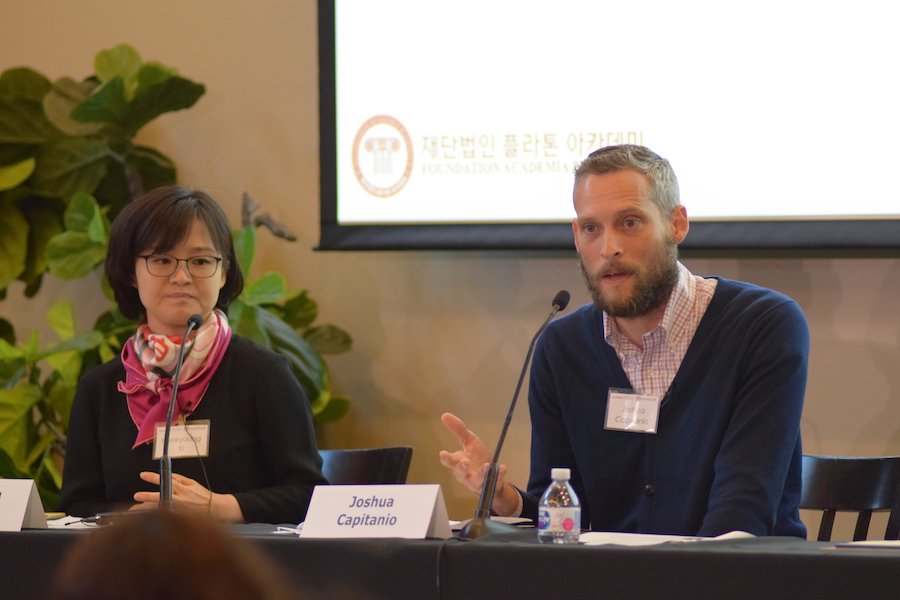
These were some of the questions examined at a two-day conference, “Future Visions: Challenges and Possibilities of Korean Studies in North America,” convened by the Korea Program of Stanford’s Shorenstein Asia-Pacific Research Center (APARC) on November 1-2. Co-sponsored by the Seoul-based Foundation Academia Platonica, the conference, the first of its kind, gathered distinguished Korean studies scholars from twelve North American institutions to consider the state of the field, assess its challenges, and carry forward a vision for its future direction and potential. Its six unique panels focused not only on the major disciplines of Korean studies—history, literature, and the social sciences—but also on language education, library collections and services, and Korean Wave.
“The presentations and discussions by our fellow experts reflected the breadth and depth of Korean studies in North America,” says APARC Director and the Korea Program Director Gi-Wook Shin. “Our program was established at Stanford in 2001 and has since become a leader in Korean studies in North America, so it is a special privilege for us to bring together colleagues from eminent institutions around the continent to further advance Korean studies education and research in the academic and policy worlds, and to build upon our track record of action and achievements.”
“The field of Korean studies, however,” notes Shin, “has significantly changed over the past seventeen years and it isn’t without its challenges. This is our opportunity to consider frankly where we go next and how we could explore the path ahead together.”
Conference participants indeed engaged in deep conversations and shared ideas and dilemmas regarding teaching in the different disciplines of Korean studies in North America. Harvard sociologist Paul Chang listed three types of challenges facing the field: publication, academic, and professional challenges. David C. Kang, professor of international relations and director of the Korean Studies Institute at the University of Southern California, emphasized the publication challenge: why is it, asked Kang, that top academic journals in the discipline of political science and international relations publish so much more scholarship about Europe than they do about Korea and Asia at large, even while the rise of Asian nations is surely one of the most consequential issues of the twenty-first century? The onus, Kang argued, comes back to East Asia scholars “to produce better and more compelling scholarship, and to better train graduate students.”
University of British Columbia's Ross King and conference participants.
Yet complex issues surround the question of how to broaden graduate coursework—and whether to do so. Korean language and linguistics expert Ross King, head of the department of Asian Studies at the University of British Columbia in Vancouver, Canada, was one of several panelists who considered the obstacles to graduate training, among different aspects of academic challenges facing the field of Korean studies. King probed into how Sinocentrism and what he called the “Mandarin conceit”—that is, the notion that training in Literary Sinitic should be predicated on a near-native proficiency in modern Mandarin Chinese—are emerging as a major stumbling block to the study of premodern Korean literary culture. He also pointed to the constraints on language training in both Korean and hanmun in North America, which, he claimed, is why we can probably anticipate continued decrease in the number of ethnically non-Korean (non-Korea-educated) graduate students undertaking graduate study in Korean literature.
University of Washington's Hyokyoung Yi (left) and Stanford's Joshua Capitanio at a panel on library collections and service.
Sung-Ock Sohn, who coordinates the Korean language program in the department of Asian languages and cultures at the University of California – Los Angeles, further shed light on King’s prediction. She explained that while enrollments in Korean language classes have shown a sharp increase in American higher education institutions in the past decade, particularly at the introductory level and among ethnically non-Korean students, there is a high attrition rate of students from an introductory to advanced Korean classes nationwide.
How should the field move forward?
Participants proposed a host of ideas to that end. These included helping graduate students collaborate with colleagues in Korea; dedicating funding for junior faculty to spend periods of time before tenure conducting research and honing language skills in Korea at appropriate institutions, and for mid-career scholars to spend a year in Korea; emphasizing the application of social science theories and methods to premodern and modern East Asia; motivating scholars to apply a comparative lens to the study of the historical and contemporary experience of East Asia; and integrating linguistic and cultural diversity in Korean language classes by, for example, incorporating service learning in authentic contexts and extending the content spectrum to include topics such as Korean popular culture.
Image
K-pop star Siwon Choi (left) highlights closing panel on Korean Wave.
Korean Wave was the focus of the conference’s widely attended closing panel that featured K-pop star Siwon Choi, a member of Korean boy band Super Junior, and multi-platinum music producer Dominique Rodriguez, managing director of SM Entertainment USA. They spoke about the global reach of Korean pop music and some of the ways in which Korean popular culture could stimulate interest in Korean studies. Dafna Zur, assistant professor in Stanford’s department of East Asian languages and cultures, who chaired the panel, challenged her students to consider “what it means not just to monetize culture but to design culture with specific markets and audience in mind.” The Stanford Daily published a detailed article on the panel.
“We are grateful to Foundation Academia Platonica for its generous support of Stanford’s Korea Program at Shorenstein APARC and for making this conference possible through our shared vision for the future of Korean studies in North America,” said Gi-Wook Shin. “Our thanks also go to our many other friends and partners, including the Korea Foundation that has helped achieve great results through its commitment to promoting understanding of Korea in academia and beyond and its support of the overseas Korean Studies Program since its establishment in 1991.”
South Korean TV company SBS NBC filmed the conference that will be featured in an upcoming documentary about Korean studies in the United States.
Read the conference report or listen to the audio recordings of the sessions, below.
On August 9, 2018 the Shorenstein Asia Pacific Research Center (APARC) Japan Program hosted a conference, "Break Through: Women in Silicon Valley, Womenomics in Japan." Women thought-leaders and entrepreneurs from Stanford, Silicon Valley, and Japan came together to discuss innovative ideas for narrowing the gender gap, and cultivating interpersonal support networks and collaboration across the pacific. The program combined panel presentations with participatory exercises and startup showcases which afford participants the opportunity to 1) discuss progress and challenges in women's advancement in Silicon Valley and Japan, 2) share practices and organizational features that better enable the hiring and retaining of women, 3) showcase Silicon Valley and Japanese women entrepreneurs and 4) provide tools for branding and building support networks.
The Break Through conference was supported by the Acceleration Program in Tokyo for Women (APT), a program that aims to shape a new narrative by providing opportunities for women entrepreneurs to build networks, receive mentoring, and become a focal point for dynamism. The program, spearheaded by Tokyo's first female governor, Yuriko Koike, is undertaken by the Tokyo Metropolitan government and supported by Tohmatsu Venture Support.
The full conference report, now available, outlines the issues and offers an analysis of the themes that were discussed in the presentations, panels and participatory exericses throughout the day.
On August 9, 2018, the Shorenstein Asia Pacific Research Center (APARC) hosted a conference, “Break Through: Women in Silicon Valley, Womenomics in Japan" with support from the Acceleration Program in Tokyo for Women (APT). Women thought-leaders and entrepreneurs from Stanford, Silicon Valley, and Japan came together to discuss innovative ideas for narrowing the gender gap, and cultivated interpersonal support networks and collaboration across the Pacific. The report, which is an outcome of the conference, offers an analysis and discussion of the themes and takeaways from the day.
All Publications button
1
Publication Type
Policy Briefs
Publication Date
Journal Publisher
Japan Program at the Shorenstein Asia-Pacific Research Center