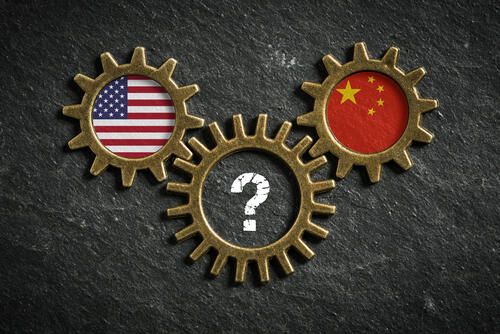
U.S. and Chinese trade negotiators remain engaged in intensive talks, although it is yet to be seen whether and when they can strike a final deal. But even if they are able to reach an agreement, in the confrontation between Washington and Beijing “the trade part is incidental: it’s a technology war, not a trade war,” said Ambassador
Craig Allen, president of the U.S.-China Business Council (USCBC), speaking at Shorenstien APARC on March 11.
Allen has spent much of his career in Asia and dealing with China-related issues from various posts within government, including serving as deputy assistant secretary for China at the U.S. Department of Commerce. As head of USCBC, he now leads an organization representing over 200 American companies doing business with China. He delivered his remarks at a
seminar that is part of the
China Program’s
colloquia series about the future of U.S.-China relations.
Allen first brought the audience up to speed on the latest developments in the U.S.-China trade talks, where there are still outstanding questions such as whether the tariffs end now or later and whether a trade agreement will include a unilateral or bilateral enforcement mechanism. He expressed optimism that an agreement would bring significant progress on multiple fronts from the U.S. perspective, including enormous expansion in Chinese purchase of U.S. goods in various sectors; progress over IP rights; progress in eliminating forced technology transfers; improved market access to China; and even renewed commitment to reducing cybertheft. Yet Allen also suggested that these changes, which the Chinese are willing to make, are the ones that they know serve to make their markets more competitive in the end.
Structural vs. Cosmetic Changes
Allen was far less confident, however, about the prospects of addressing structural issues with China, that is, areas where the Chinese economy is an outlier to the global economy, violates WTO rules, and greatly differs from OECD norms. This is because these core dimensions touch on the role of the Chinese Communist Party (CCP) in the government and in the economy.
He counted among these structural issues the enormous role of state-owned enterprises (SOEs); the scale of subsidies going to the technology sector and their lack of transparency; prohibitions on foreign investment in sensitive industries like telecommunications and media; the unequal treatment of foreign companies; discriminatory implementation of regulations and the lack of an appeals process; uneven implementation of IP rights; the outsized role of the CCP in the economy; the dominant role of industrial policy; Xi Jinping government’s aggressive techno-nationalism, which is manifested in its calls for indigenous innovation and for self-reliance; and its excessive control over the information space.
“China is willing to make cosmetic changes to these problems,” said Allen, “even muscular changes, but no changes to the skeleton, the core, the system under which the CCP has complete control.”
A trade deal might remove the immediate threat of tariffs as a source of friction between the United States and China, noted Allen, but the essence of the conflict is not about trade: rather, it has to do with technology. “The trade war will morph into a technology war,” he predicted, and 2019 will mark a change in that direction, making life much more complicated for both American—especially Silicon Valley—and Chinese companies.
A Security Dilemma
Both the United States and China are now locked in a “security dilemma,” noted Allen. “One side takes defensive measures which the other side perceives as aggressive measures,” and “we are ratcheting up on national security.” The U.S. Department of Commerce, for instance, is looking to change the ways of dealing with Chinese companies and to expand export controls, extending their scope to a whole new category of “emerging technologies,” regarding whose definition there is intensive debate in Washington. Depending on its scope, a broad definition could jeopardize hundreds of thousands of projects and disrupt investment and global supply chains.
On the Chinese side, Allen noted, there is a parallel process going on. In 2019, we should expect China to similarly impose tightened export controls, he cautioned, cybersecurity law, personal identification information law, data localization requirements, and a strengthened national security law that, among other requirements, will ratchet up audit requirements of American companies seeking market access and the type of companies allowed to have only Chinese-origin equipment.
Both countries have given in to exaggerated security concerns that threaten the global commons, argued Allen. “American and Chinese companies have worked together in the innovation space for years in a beautiful manner. It has been a remarkably productive exercise over the last four decades that brought tremendous benefit for everyone. You can't imagine a company like Apple without China, and you can't imagine China without a company like Apple. Now all this is being put into question.”
The heightened security measures on both sides are fraught with threats to research institutions, businesses, and the innovation ecosystem at large. Academic exchanges, students, and professors will be deemed exports of knowledge subject to technology licensing laws, cautioned Allen. He asked: “How many thousands of collaborative research ventures will be impacted?”
We are entering the technology war at the wrong time, said Allen, just as China is becoming a middle-income country with hundreds of millions of middle-class citizens who want to buy American-made goods and services that U.S. companies want to sell to them. Now is the time to take advantage of China’s transitioning to a consumption-led economy, he claimed, and “become a good friend of Chinese middle-class consumers.”
China is also forging ahead with its innovative economy, particularly in areas such as AI, 5G, and aspects of the life sciences. “This isn’t a one-way street,” emphasized Allen. “We need their brains as much as they need ours […] China will remain an innovative country, and we need to deal with that.”
“This is not a time to panic,” he pointed out, “but a time to reset and ask: ‘What are the rules of the road for technology cooperation and competition? What are the rules for enforcement and how do we enforce the new rules fairly?”
“If China follows its WTO obligations then we would get there,” Allen claimed. “But if President Xi is going to be single-minded about self-reliance and cutting foreign influence on the Chinese economy, then we’re up for rough sledding and 2019 will be a definitive year in determining the course forward.”
Trade deal or no deal, in the U.S.-China race for technology supremacy, he concluded, trust is a commodity in short supply.