The Korean Peninsula After Kim Jong Il: Challenges and Opportunities
PLEASE NOTE: VENUE CHANGED TO THE
OKSENBERG CONFERENCE ROOM, ENCINA HALL 3RD FLOOR
Kim Jong Il’s sudden death December 17, 2011 has prompted wildly varied speculation that the anachronistic North Korean state may collapse, reform, lash out at the South, or reunify with it. What does the dynastic leadership change to Kim’s young son Kim Jong Un really portend? Will the succession proceed smoothly? Will the new leadership undertake changes or reforms? Will ordinary North Koreans fare better? What about the prospects for inter-Korean relations and denuclearization? And how should the United States and other members of the international community respond? Walter H. Shorenstein Asia-Pacific Research Center experts will tackle these and other questions that bear not only on the future of the Korean Peninsula but on peace and stability in all of Northeast Asia.
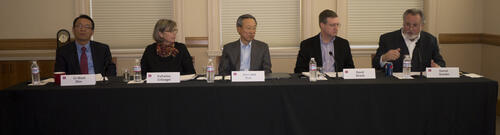
Oksenberg Conference Room
Gi-Wook Shin
Gi-Wook Shin is the William J. Perry Professor of Contemporary Korea in the Department of Sociology, senior fellow at the Freeman Spogli Institute for International Studies, and the founding director of the Korea Program at the Walter H. Shorenstein Asia-Pacific Research Center (APARC) since 2001, all at Stanford University. In May 2024, Shin also launched the Taiwan Program at APARC. He served as director of APARC for two decades (2005-2025). As a historical-comparative and political sociologist, his research has concentrated on social movements, nationalism, development, democracy, migration, and international relations.
In Summer 2023, Shin launched the Stanford Next Asia Policy Lab (SNAPL), which is a new research initiative committed to addressing emergent social, cultural, economic, and political challenges in Asia. Across four research themes– “Talent Flows and Development,” “Nationalism and Racism,” “U.S.-Asia Relations,” and “Democratic Crisis and Reform”–the lab brings scholars and students to produce interdisciplinary, problem-oriented, policy-relevant, and comparative studies and publications. Shin’s latest book, The Four Talent Giants, a comparative study of talent strategies of Japan, Australia, China, and India to be published by Stanford University Press in the summer of 2025, is an outcome of SNAPL.
Shin is also the author/editor of twenty-seven books and numerous articles. His books include The Four Talent Giants: National Strategies for Human Resource Development Across Japan, Australia, China, and India (2025); Korean Democracy in Crisis: The Threat of Illiberalism, Populism, and Polarization (2022); The North Korean Conundrum: Balancing Human Rights and Nuclear Security (2021); Superficial Korea (2017); Divergent Memories: Opinion Leaders and the Asia-Pacific War (2016); Global Talent: Skilled Labor as Social Capital in Korea (2015); Criminality, Collaboration, and Reconciliation: Europe and Asia Confronts the Memory of World War II (2014); New Challenges for Maturing Democracies in Korea and Taiwan (2014); History Textbooks and the Wars in Asia: Divided Memories (2011); South Korean Social Movements: From Democracy to Civil Society (2011); One Alliance, Two Lenses: U.S.-Korea Relations in a New Era (2010); Cross Currents: Regionalism and Nationalism in Northeast Asia (2007); and Ethnic Nationalism in Korea: Genealogy, Politics, and Legacy (2006). Due to the wide popularity of his publications, many have been translated and distributed to Korean audiences. His articles have appeared in academic and policy journals, including American Journal of Sociology, World Development, Comparative Studies in Society and History, Political Science Quarterly, Journal of Asian Studies, Comparative Education, International Sociology, Nations and Nationalism, Pacific Affairs, Asian Survey, Journal of Democracy, and Foreign Affairs.
Shin is not only the recipient of numerous grants and fellowships, but also continues to actively raise funds for Korean/Asian studies at Stanford. He gives frequent lectures and seminars on topics ranging from Korean nationalism and politics to Korea's foreign relations, historical reconciliation in Northeast Asia, and talent strategies. He serves on councils and advisory boards in the United States and South Korea and promotes policy dialogue between the two allies. He regularly writes op-eds and gives interviews to the media in both Korean and English.
Before joining Stanford in 2001, Shin taught at the University of Iowa (1991-94) and the University of California, Los Angeles (1994-2001). After receiving his BA from Yonsei University in Korea, he was awarded his MA and PhD from the University of Washington in 1991.
Stanford Next Asia Policy Lab (SNAPL)
Explore SNAPL
Joon-woo Park
Shorenstein APARC
Encina Hall C324
616 Serra Street
Stanford University
Stanford, CA 94305-6055
Joon-woo Park, a former senior diplomat from Korea, is the 2011–12 Koret Fellow with the Korean Studies Program (KSP).
Park brings over 30 years of foreign policy experience to Stanford, including a deep understanding of the U.S.-Korea relationship, bilateral relations, and major Northeast Asian regional issues. In view of Korea’s increasingly important presence as a global economic and political leader, Park will explore foreign policy strategies for furthering this presence. In addition, he will consider possibilities for increased U.S.-Korea collaboration in their relations with China, as well as prospects for East Asian regional integration based on the European Union (EU) model. He will also teach a course during the winter quarter, entitled Korea's Foreign Policy in Transition.
In 2010, while serving as ambassador to the EU, Park signed the EU-South Korea Free Trade Agreement (FTA) in Brussels. That same year he also completed the Framework Agreement, strengthening EU-South Korea collaboration on significant global issues, such as human rights, the non-proliferation of nuclear weapons, and climate change. Park’s experience with such major bilateral agreements comes as the proposed Korea-U.S. FTA is nearing ratification.
Park holds a BA and an MA in law from Seoul National University.
The Koret Fellowship was established in 2008 through the generosity of the Koret Foundation to promote intellectual diversity and breadth in KSP, bringing leading professionals in Asia and the United States to Stanford to study U.S.-Korea relations. The fellows conduct their own research on the bilateral relationship, with an emphasis on contemporary relations, with the broad aim of fostering greater understanding and closer ties between the two countries.
David Straub
No longer in residence.
David Straub was named associate director of the Korea Program at the Walter H. Shorenstein Asia-Pacific Research Center (Shorenstein APARC) on July 1, 2008. Prior to that he was a 2007–08 Pantech Fellow at the Center. Straub is the author of the book, Anti-Americanism in Democratizing South Korea, published in 2015.
An educator and commentator on current Northeast Asian affairs, Straub retired in 2006 from his role as a U.S. Department of State senior foreign service officer after a 30-year career focused on Northeast Asian affairs. He worked over 12 years on Korean affairs, first arriving in Seoul in 1979.
Straub served as head of the political section at the U.S. embassy in Seoul from 1999 to 2002 during popular protests against the United States, and he played a key working-level role in the Six-Party Talks on North Korea's nuclear program as the State Department's Korea country desk director from 2002 to 2004. He also served eight years at the U.S. embassy in Japan. His final assignment was as the State Department's Japan country desk director from 2004 to 2006, when he was co-leader of the U.S. delegation to talks with Japan on the realignment of the U.S.-Japan alliance and of U.S. military bases in Japan.
After leaving the Department of State, Straub taught U.S.-Korean relations at the Johns Hopkins University's School of Advanced International Studies in the fall of 2006 and at the Graduate School of International Studies of Seoul National University in spring 2007. He has published a number of papers on U.S.-Korean relations. His foreign languages are Korean, Japanese, and German.