Authors
Jean C. Oi
News Type
Commentary
Date
Paragraphs

This commentary was first published in The Hill.


The future sustainability of the Earth cannot do without the coordinated actions of its two largest carbon polluters — the United States and China.

The most recent highlight in that realm is the U.S.-China Joint Glasgow Declaration on Enhancing Climate Action in the 2020s at the UN climate change conference COP26 in November 2021. The joint statement, which came during a turbulent time in U.S.-China relations, was both surprising and valued. The declaration reaffirms both nations’ commitment to “tackling [climate change] through their respective accelerated actions in the critical decade of the 2020s, as well as through cooperation in multilateral processes.”

The declaration also calls for “concrete actions in the 2020s to reduce emissions aimed at keeping the Paris Agreement-aligned temperature limit within reach,” including in the areas of methane reduction, decarbonization and forest protection. 

While the declaration represents a promising step forward and offers reassurances about new momentum for sustained future cooperation, it offers few details regarding concrete plans, nor the opportunities and challenges to enact and implement those plans.

Last fall, we at Stanford University partnered with Peking University to convene a series of discussions on a broad range of themes around U.S.-China collaboration on climate change, such as global sustainable finance, corporate climate pledges, as well as opportunities and challenges for the acceleration of decarbonization in both countries in general — both nationally and by sector — with particular emphasis on power, transportation and industry. The outcomes and insights were synthesized in a report on how to accelerate decarbonization in China and the United States, in which we highlight two urgent recommendations to facilitate constructive cooperation between both nations as they tackle growing environmental challenges.


Sign up for APARC newsletters to receive our experts' commentary and analysis.

U.S.-China scientific collaboration in fundamental research can be an invaluable tool to build both nations’ capacity in addressing climate change, including protecting supply chains essential for meeting pledged goals, amid rising geopolitical tensions.

First, we need open-science research and development (R&D) collaboration.

This must be the case regardless of the politicized environment surrounding U.S.-China relations. Rigorous R&D programs are the foundation of innovative technologies, which can greatly accelerate the energy transition while minimizing disruptions if applied at scale.

Some promising areas for R&D include, but are not limited to, energy-efficient buildings utilizing heat pumps; low-carbon cement and construction; low-carbon agriculture, carbon capture, utilization, and storage (CCUS); power grid infrastructure upgrades; large-scale and long-duration energy storage; and methane leakage prevention and removal. 

Unfortunately, U.S.-China cooperation on R&D has been thwarted due to Chinese companies’ theft of proprietary U.S. intellectual property. According to estimates by the National Bureau of Asian Research, U.S. companies incur a loss of between U.S. $225 billion to $600 billion every year due to intellectual property infringement in China. Piracy of intellectual property is of grave concern and must be curbed. 

However, the two countries need to realize the crucial difference between fundamental research and proprietary research. Proprietary research, by definition, is owned and must receive its due protection. By contrast, fundamental or basic research is intended to be “out there” for all to learn and build on in advancing the understanding or prediction of phenomena. Therefore, fundamental research should be pursued under terms of academic freedom, especially within universities.

U.S.-China scientific collaboration in fundamental research can be an invaluable tool to build both nations’ capacity in addressing climate change, including protecting supply chains essential for meeting pledged goals, amid rising geopolitical tensions. 

Common terminology and standards will provide a basis for carbon legislation. Having clearly stipulated standards and procedures can also make implementation easier and more straightforward.

Second, we need to be explicitly cognizant of political and institutional constraints.

This is necessary in order to translate promises into progress while protecting social benefits and their equitable distribution amid the green energy transition. As noted in both the joint declaration and our report, bilateral dialogues so far remain very high-level. We need future discussions and workshops at the sectoral and local levels to develop concrete plans. In enacting and implementing concrete plans, political and institutional constraints can pose real obstacles, as demonstrated by China’s past and ongoing efforts to control air pollution.

Hence, strong support from both national and local governments will be critical. As a first step, we need to gain a good understanding of who the relevant actors are in both policymaking and implementation and the incentives they face.

In this period of transition when there are still regional mismatches between energy supply and demand, it is too easy to let short-term needs push climate mitigation goals to the bottom of the barrel to address regional energy shortages. In both countries policymakers and those charged with implementation face multiple and sometimes conflicting goals. The prioritization of goals is shaped by incentive structures. Fostering incentive structures conducive to decarbonization is particularly important during the transitional period when consensus around goals and priorities is less clear. 

Furthermore, it is time to standardize standards. A recurring theme across our discussions is the need for shared, clearly specified regulatory frameworks and standards across both nations. Harmonizing standards will expedite trade, validation, accounting, climate pledges and environmental, social and corporate governance (ESG) evaluation.

Only if there is standardization can organizations be required to follow unified disclosure practices for making available important information like the amount of carbon emitted. We need to make and implement more legislation to encourage a faster pace of decarbonization, and having unified terminology and standards is conducive to both effective carbon legislation and policy implementation. Common terminology and standards will provide a basis for carbon legislation. Having clearly stipulated standards and procedures can also make implementation easier and more straightforward. 

Last but not least, we are hopeful about the future of U.S.-China cooperation on climate change and believe that universities can play a significant role in the global energy transition. Universities are often the birthplaces of innovative technology, training grounds for talent from across the globe, as well as conveners of bilateral and multilateral dialogues. We hope the governments on both sides of the Pacific will work together to hammer out the needed details to build the momentum and make a real impact in the fight against global climate change. 


Shiran Victoria Shen is the W. Glenn Campbell and Rita Ricardo-Campbell national fellow at Stanford University’s  Hoover Institution, as well as an assistant professor of environmental politics at the University of Virginia. 

Jean C. Oi is the William Haas professor of Chinese politics, senior fellow at the Freeman Spogli Institute of International Studies, as well as the director of Stanford University’s China Program. She is also the Lee Shau Kee director of the Stanford Center at Peking University. 

Yi Cui is the director of Stanford University’s Precourt Institute for Energy, as well as professor of materials science and engineering. He is a senior fellow at the Woods Institute for the Environment, and professor, by courtesy, of Chemistry, Stanford University. 

Liang Min is managing director of the Bits & Watts Initiative of the Precourt Institute for Energy at Stanford University. 

Read More

Cover of the report 'Accelerating Decarbonization in China and USA through Bilateral Collaboration'
News

Collaborating Against Carbon: Stanford and Peking University Partner on Decarbonization Research

A report on China and the United States' decarbonization and carbon neutrality proposes areas of collaboration on climate change action, global sustainable finance, and corporate climate pledges. The report is the product of roundtables with participants from the Stanford Precourt Institute for Energy, SCPKU, APARC's China Program, and Peking University’s Institute of Energy.
Collaborating Against Carbon: Stanford and Peking University Partner on Decarbonization Research
Vladamir Putin and Xi Jinping shake hands.
Commentary

Beijing Is Used to Learning from Russian Failures

The invasion of Ukraine is offering useful lessons for the PLA.
Beijing Is Used to Learning from Russian Failures
Portrait of Emily Feng with text about her winning the 2022 Shorenstein Journalism Award.
News

NPR's Beijing Correspondent Emily Feng Wins 2022 Shorenstein Journalism Award

Feng, whose compelling and bold reporting has amplified the voices of Chinese citizens amid rapidly deteriorating press freedom in the country, is the recipient of the 21st Shorenstein Journalism Award.
NPR's Beijing Correspondent Emily Feng Wins 2022 Shorenstein Journalism Award
Hero Image
Benxi steel plant
Benxi steel plant in Liaoning Province, China.

Andreas Habich via Wikimedia Commons
All News button
1
Subtitle

There are multiple, concreate areas for constructive cooperation between the United States and China as they tackle growing environmental challenges.

-


Image
Event Banner card for APARC Japan Program webinar on May 9: "The New Landscape of Economic Security and the U.S. - Japan Alliance, featuring headshot photos (from left to right) of Kazuto Suzuki, Mireya Solís, and Kiyoteru Tsutsui

May 9, 5:00 p.m - 6:30 p.m. PT / May 10, 9:00 a.m. - 10:30 a.m. JT

Economic security has emerged as a key foreign policy issue in Japan in recent years. Arguably one of the most active players in this field, the Japanese government has developed a comprehensive policy on economic security that seeks to protect its economy from the vagaries of geopolitical disruptions. Recent legislative efforts have centered around supply chain risks, critical infrastructure, and sensitive technologies and patents. Prompted by risks associated with business with China and intensified further by Russia’s invasion of Ukraine, concerns about economic security require governments and businesses to adjust their reliance on market mechanisms in international trade and compel them to formulate new policies and frameworks that would address these concerns. Featuring two leading experts on economic security and trade in Japan and the United States, this panel will discuss what those new policies might look like and what roles the US-Japan alliance should play in building resilient economic frameworks that would mitigate the economic damages of geopolitical disruptions.

Panelists


Image
Photo portrait of Kazuto Suzuki

Kazuto Suzuki is a Professor of Science and Technology Policy at the Graduate School of Public Policy at the University of Tokyo, Japan, and senior fellow of Asia Pacific Initiative (API), an independent policy think tank. He graduated from the Department of International Relations at Ritsumeikan University and received a Ph.D. from Sussex European Institute, University of Sussex, England. He has worked in the Fondation pour la recherche stratégique in Paris, France, as an assistant researcher, Associate Professor at the University of Tsukuba from 2000 to 2008, and served as a Professor of International Politics at Hokkaido University until 2020. He served as an expert in the Panel of Experts for the Iranian Sanction Committee under the United Nations Security Council from 2013 to July 2015. 

Suzuki currently serves as the President of the Japan Association of International Security and Trade. His research focuses on the conjunction of science & technology and international relations; subjects including space policy, non-proliferation, export control, and sanctions.  His recent work includes Space and International Politics (2011, in Japanese, awarded Suntory Prize for Social Sciences and Humanities), Policy Logics and Institutions of European Space Collaboration (2003), and many others.


Image
Square photo portrait of Mireya Solís

Mireya Solís is director of the Center for East Asia Policy Studies, Philip Knight Chair in Japan Studies, and a senior fellow in the Foreign Policy program at Brookings. Prior to her arrival at Brookings, Solís was a tenured associate professor at American University’s School of International Service.

Solís is an expert on Japanese foreign economic policy, U.S.-Japan relations, international trade policy, and Asia-Pacific economic integration. She is the author of "Banking on Multinationals: Public Credit and the Export of Japanese Sunset Industries" (Stanford University Press, 2004) and co-editor of "Cross-Regional Trade Agreements: Understanding Permeated Regionalism in East Asia" (Springer, 2008) and "Competitive Regionalism: FTA Diffusion in the Pacific Rim" (Palgrave Macmillan, 2009). Her most recent book, “Dilemmas of a Trading Nation: Japan and the United States in the Evolving Asia-Pacific Order” (Brookings Press, 2017), offers a novel analysis of the complex tradeoffs Japan and the United States face in drafting trade policy that reconciles the goals of economic competitiveness, social legitimacy, and political viability. “Dilemmas of a Trading Nation” received the 2018 Masayoshi Ohira Memorial Award.


Moderator


Image
Square photo portrait of Kiyoteru Tsutsui

Kiyoteru Tsutsui is the Henri H. and Tomoye Takahashi Professor, Professor of Sociology, Senior Fellow at the Freeman Spogli Institute for International Studies, and Deputy Director of the Walter H. Shorenstein Asia-Pacific Research Center, where he is also Director of the Japan Program. He is the author of Rights Make Might: Global Human Rights and Minority Social Movements in Japan (Oxford University Press, 2018), co-editor of Corporate Responsibility in a Globalizing World (Oxford University Press, 2016) and co-editor of The Courteous Power: Japan and Southeast Asia in the Indo-Pacific Era (University of Michigan Press, 2021). 

Kiyoteru Tsutsui
Kiyoteru Tsutsui

via Zoom Webinar

Kazuto Suzuki Professor Graduate School of Public Policy, University of Tokyo
Mireya Solís Director and Senior Fellow – Center for East Asia Policy Studies, Philip Knight Chair in Japan Studies Brookings
Authors
Oriana Skylar Mastro
News Type
Commentary
Date
Paragraphs

This commentary first appeared in Foreign Policy.

Russia’s invasion of Ukraine has been a double disaster for President Vladimir Putin, as he faces a poorly performing military combined with an inability to shield his country from economic punishment. Both of these possibilities historically have also been sources of apprehension for the Chinese Communist Party (CCP). But China’s leadership turned its anxiety into action about 10 years ago, deliberately working to fix many of the problems and minimize the risks currently plaguing Russia in Ukraine.

One result is that the Chinese military is more likely to perform well even though it has not fought a war since 1979, when it lost thousands of troops in a punitive but brief invasion of Vietnam. Adding to that, China’s economy is both far larger and deliberately more diversified than Russia’s. A sanctions effort like the one presently aimed at Russia would be much harder to sustain against China. These two observations do not mean deterrence won’t hold, only that the unfolding events in Ukraine will likely do little to make Beijing more cautious.

Nearly everyone overestimated Russia’s military capabilities—including probably Putin himself. During its invasion of Ukraine, Russia’s air-ground coordination has been ineffective, and Russian forces have shown risk-adverse tendencies in the air. Russia has also struggled with logistics and keeping its military supplied. Notably, it appears that Russia acted on bad intelligence and therefore did not believe initial strikes that maxed out its firepower were necessary. Furthermore, many Russian weapons platforms are outdated (for example, its Cold War-era tanks), and modern Su-57 fighter jets and T-14 Armata tanks only exist in comparatively small numbers.

The Chinese military used to clearly exhibit the same deficiencies. But over the past decade, it has embraced significant reforms, creating a much more capable fighting force that should give even the United States pause.


Sign up for APARC newsletters to receive our experts' commentary and analysis.


Chinese President Xi Jinping identified similar training and competency issues [to the human element of Russia’s failures in Ukraine] in the PLA 10 years ago. But under his command, the PLA has been proactively implementing significant reforms to avoid similar pitfalls.

First, while Russia allowed its conventional capabilities to atrophy, Chinese military spending has exploded over the past three decades, increasing by 740 percent (in comparison to Russia’s 69 percent) from 1992 to 2017. According to data from the Stockholm International Peace Research Institute, China spent almost four times on its military in 2020 than Russia ($244.9 billion to $66.8 billion). In 1999, less than 2 percent of its fighter jets were fourth-generation, 4 percent of its attack submarines were modern, and none of its surface ships were. Twenty years later, not only did China have much more of everything, but the majority was the most advanced, modern versions available—with China exhibiting advantages over Russia, even in combat aircraft, a traditional area of weakness for China.

Indeed, People’s Liberation Army (PLA) commentators often refer to China’s economic might as one of the reasons their military would outperform Russia’s—Russia has been “stingy” with its military modernization and production of precision-guided munitions primarily because of a lack of resources. By contrast, China has more than 2,200 conventionally armed ballistic and cruise missiles, making the PLA Rocket Force the world’s largest ground-based missile force. Estimates place the number of missiles positioned against Taiwan alone at around 1,000.

Russia’s poor performance does remind us that it takes more than just a lot of fancy systems to win a war (though having more advanced systems and more of them surely would have helped). The human element of Russia’s failures is front and center. Putin probably did not have an open and honest communication channel with the military, which was fearful of providing unfavorable information to the erratic leader. Russian troops were largely considered incompetent, but Putin thought superior technology could overcome human deficiencies.

Chinese President Xi Jinping identified similar training and competency issues in the PLA 10 years ago. But under his command, the PLA has been proactively implementing significant reforms to avoid similar pitfalls. And unlike Putin, who apparently believed technology could overcome deficiencies in personnel, Xi came to the opposite conclusion. When he came to power, he took one look at the military and recognized that with all its fancy equipment, the PLA probably could not fight and win wars and perform the missions it had been assigned. Of particular importance, according to China’s national military strategy, was to fight local wars under informationalized conditions. This meant that the network between platforms and people—the ease of connectivity—was the main feature of modern warfare. China needed the best equipment; an advanced command, control, computers, communication, intelligence, surveillance, and reconnaissance (C4ISR) network; and tons of precision-guided munitions. But perhaps most importantly, it needed troops that could leverage these systems to conduct seamless operations across services and top-down through the chain of command.

The Chinese military is learning lessons from Ukraine, whether it is to stockpile more precision-guided munitions, ensure solid command and control, or cut off internet access [...], which will only serve to improve its warfighting capability in the future.

What followed was a series of slogans—the two incompatibles, two inabilities, two big gaps, the five incapables—all designed to point out the organizational and personnel issues of the military and focus leadership attention and resources on fixing the issue. A massive military reorganization followed with moves such as reorganizing effective combat units to be smaller so that they can mobilize more quickly and can remain self-sufficient for long periods of time. This means, in contrast with the Russian military, the PLA will likely have less reliance on generals at the front lines. China also established theater commands to facilitate joint operations and prioritized realism in its military exercises to help it prepare for real combat. Part of all of this was Xi’s demand that the military communicate its failures and weaknesses so that they could be addressed. Moreover, to improve command and control, China has moved toward engaging in multidomain joint operations all while standing up a new joint operations center that will ensure that, unlike with the Russian military, orders will be communicated and understood at the lowest levels. Indeed, the main reason that Xi has not yet made a play for Taiwan is likely his desire to hone this command and control structure and practice joint operations in realistic conditions for a few more years—a cautious and pragmatic approach that the situation in Ukraine only encourages further.

The PLA itself acknowledges that it still has some distance to go with training, particularly with regard to joint operations, but it looks as if the hard work is paying off. The complexity and scale of China’s national military exercises are eye-opening. It takes a great deal of planning, synchronization, and coordination to take service-level operations to the joint level. China appears to have made great strides in this area. The United States has observed, for example, China executing deep-attack air operations in its exercises that have combined intelligence, surveillance, and reconnaissance (ISR) with multi-domain strike; lift for rapid mobility and advanced fighter manuevers. Russia has relied heavily on artillery and tanks, now and historically, while the PLA is showing a more balanced approach to combined arms operations.

For all these reasons, we should not expect the Chinese military to perform as poorly in its first real military operation since 1979. The PLA is structurally superior to the Russian military. And the Chinese know it. Granted, it’s hard to know whether some of the outlandish claims in the Chinese media are true—that the PLA Air Force would actually “be able to take out the Ukrainian air force in one hour.” But one thing is for certain—the Chinese military is learning lessons from Ukraine, whether it is to stockpile more precision-guided munitions, ensure solid command and control, or cut off internet access to prevent the leaking of information to the West, which will only serve to improve its warfighting capability in the future.

That does not mean it’s perfect. China is still in the process of building its corps of noncommissioned officers, recruiting more college graduates and technical experts so as to be less reliant on conscripts and shift away from an officer-heavy structure. Also, there is always the possibility that Xi’s anti-corruption campaign, which has impacted even the highest levels of the military, may begin to impinge on these reforms. But to date, it seems that those against necessary reforms have been largely targeted. In other words, Xi has not had to choose yet between his goals of consolidating domestic power and the professionalization of the armed forces.

The economic side is less about what has happened in the past six weeks than what will happen in the next six months or even six years. As tempting as it is in the case of Russia’s invasion, the impact of economic sanctions cannot be properly evaluated over a short time period. The need for a longer time horizon also applies to Russia-China economic comparisons, as it will generally require more extensive and more durable sanctions to deter or compel China than it would Russia.

Russia is thought, at least, to be highly vulnerable to sanctions applied to date. And it is certainly the case that China can be harmed by sanctions. Beijing is more integrated in global trade and finance than Moscow and thus has more to lose. But integration cuts both ways—compared with Russia, more countries would be harmed to a greater extent by equivalent actions taken against China. Further, China has demonstrated greater capacity to weather extended economic blows. This combination of features reduces the willingness of the United States and others to enforce durable sanctions, a fact that Beijing well appreciates.

The CCP survived three decades of worse poverty than experienced by the Soviet Union at the time, a self-inflicted depression in 1989-90 paralleling in some respects the events that ended the Soviet Union, the global financial crisis, and another partly self-inflicted economic wound via China’s determination to maintain its zero-COVID policy in 2021-22.

During more recent events, Beijing has been able to mobilize first greater capital resources than Moscow and then far greater. In 2020, the World Bank put China’s gross fixed capital formation at 20 times Russia’s. Xi attacked some of China’s richest citizens, as well as other elements of the private sector, in part because he believed them too intertwined with foreign capital. These were voluntary steps by China that mirror how the world currently seeks to punish Russia. Whatever their wisdom, Xi knows China can afford them, while Russia’s capability is in doubt.

Some Russian foreign reserves have been effectively frozen and some financials excluded from the Society for Worldwide Interbank Financial Telecommunication (SWIFT), limiting international transactions. In the short term, these steps could have a similar impact on China, but they would be much harder to sustain.

Beijing has conducted currency swaps with dozens of countries that will want their renminbi to be useful. China also holds foreign government bonds in amounts that countries cannot ignore. U.S. Treasurys see the largest holdings, but there are also sizable quantities of Japanese government bonds, for instance. With official Chinese reserves upwards of $3 trillion, perhaps five times Russia’s, a partial freeze would quickly wear on governments and firms looking for bond buyers.

For any SWIFT restrictions that interfere with outbound U.S. portfolio investment, that volume stood at $85 billion in Russia and $1.15 trillion in China in 2020. The stock of U.S. direct investment was 10 times higher in China than Russia—companies willing to exit Russia would face leaving a lot more behind in a China contingency. Most broadly, the yuan can erode the role of the dollar; the ruble certainly cannot. Beijing lacks the will to allow free movement of the yuan and make it a true reserve currency, but heavy, durable sanctions might change that.

On the goods side, existing pressure to spare Russian vital exports would be more intense in China’s case. The loss of Russian oil and gas exports of $230 billion in 2021 threatens energy markets. Chinese exports are at least as important within chemicals, textiles, household appliances, industrial machinery, and consumer electronics. Would they all be exempted?

Certain Russian exports, such as palladium, play supply chain roles beyond their direct financial value. As expected from its manufacturing and export volumes, China’s supply chain participation is far larger than Russia’s, extending from inputs crucial to global pharmaceuticals to processed rare earths crucial to clean-energy applications. Russian ships have been banned from some ports. By tonnage, Russia accounts for a bit over 1 percent of the world’s commercial fleet, while China accounts for more than 11 percent. Banning Chinese ships would cause seaborne trade to noticeably contract, hitting supply chains that would already be strained by the diversion of Chinese goods.

Even an area of clear Russian advantage—lower import dependence—is double-edged. Inhibiting Chinese imports of iron ore or integrated circuits, for example, would hit the country hard. But China is such a huge purchaser that many producers would refuse to join a sustained embargo against it. As elsewhere, the barriers to Russian imports adopted thus far could hurt China only in the unlikely event that they are maintained for many months.

From how to remain in power to how to advance on the international stage, militarily and economically, the CCP has been learning what not to do from the Russian or Soviet experience for decades. Chinese strategists are unquestionably evaluating whether the nature of warfare has changed or if they failed to consider some critical factors necessary for success. Chinese economists are certainly looking to identify missed vulnerabilities based on how the economic dimension of the war in Ukraine plays out—and will work to address them to prevent exploitation by the United States and others.

Not that it will all be easy for Beijing. But China is already better prepared than Russia, economically and militarily. The steps to support Ukraine and punish Russia are immediately less potent in a China contingency. And an unfortunate side effect of the tragedy in Ukraine is that China has a relatively low-cost opportunity to learn—it may become a more formidable challenger than it would’ve been otherwise. The United States and its allies should realize that their effectiveness with regard to Russia is highly unlikely to translate. In a Taiwan contingency, the United States must be able to immediately implement both a stronger package of actions aimed at China and also a second package aimed at minimizing the long-term cost of the first.

Read More

Putin and Xi
Commentary

An Uncomfortable Friendship: Understanding China’s Position on the Russia-Ukraine War and Its Implications for Great Power Competition

On WBUR’s "On Point" and Fox 2 KTVU, Center Fellow Oriana Skylar Mastro shares insights about China's alignment with Russia and the worldwide implications of its calculus on Ukraine.
An Uncomfortable Friendship: Understanding China’s Position on the Russia-Ukraine War and Its Implications for Great Power Competition
Protesters display placards in front of the Representative Office of the Moscow-Taipei Coordination Commission to protest against Russia’s military invasion of Ukraine on February 25, 2022 in Taipei, Taiwan.
Commentary

Invasions Are Not Contagious

Russia’s War in Ukraine Doesn’t Presage a Chinese Assault on Taiwan
Invasions Are Not Contagious
millward
News

Unpacking the Crisis in Xinjiang: James Millward on China's Assimilationist Policies and U.S.-China Engagement

APARC Visiting Scholar James Millward discusses PRC ethnicity policy, China's crackdown on Uyghur Muslims and other minorities in Xinjiang province, and the implications of the Xinjiang crisis for U.S. China strategy and China's international relations.
Unpacking the Crisis in Xinjiang: James Millward on China's Assimilationist Policies and U.S.-China Engagement
Hero Image
Vladamir Putin and Xi Jinping shake hands.
All News button
1
Subtitle

The invasion of Ukraine is offering useful lessons for the PLA.

Date Label
-


Image
Shorenstein APARC Japan Program April 18 Webinar information card: Japan's Foreign Policy in the Aftermath of the Russian Invasion of Ukraine, including photo portraits of speakers Hiroyuki Akita, Yoko Iwama, and Kiyoteru Tsutsui

April 18, 5:00 p.m - 6:30 p.m. PT / April 19, 9:00 a.m. - 10:30 a.m. JT

Russia’s invasion in Ukraine has transformed the landscape of international security in a multitude of ways and reshaped foreign policy in many countries. How did it impact Japan’s foreign policy? From nuclear sharing to the Northern Territories, it sparked new debates in Japan about how to cope with Putin’s Russia and the revised international order. With NATO reenergized and the United States having to recommit some resources in Europe, how should Japan counter an expansionist China, an emboldened North Korea, and a potentially hamstrung Russia to realize its vision of Free and Open Indo-Pacific? What might be the endgame in Ukraine and how would it impact the clash of liberal and authoritarian forces in the Indo-Pacific region? Featuring two leading experts on world politics and Japan’s foreign policy, this panel tackles these questions and charts a way forward for Japan.

Square photo portrait of Yoko Iwama

Yoko Iwama is Professor of National Graduate Institute for Policy Studies (GRIPS). She is also the director of Security and Strategy Program and Maritime Safety and Security Program at GRIPS. 

She graduated from Kyoto University in 1986 and earned her PhD in Law. Having served as Research Assistant of Kyoto University (1994–97), Special Assistant of the Japanese Embassy in Germany (1998–2000), and Associate Professor at GRIPS (2000), she was appointed Professor at GRIPS in 2009. She was a student at the Free University of Berlin between 1989-1991, where she witnessed the end the reunification of the two Germanies. 

Her specialty is international security and European diplomatic history centering on NATO, Germany, and nuclear strategy. 

Her publications include John Baylis and Yoko Iwama (ed.) Joining the Non-Proliferation Treaty: Deterrence, Non-Proliferation and the American Alliance, (Routledge 2018); “Unified Germany and NATO,” (in Keiichi Hirose/ Tomonori Yoshizaki (eds.) International Relation of NATO, Minerva Shobo, 2012). 

Her newest book The 1968 Global Nuclear Order and West Germany appeared in August 2021 in Japanese. She is working on a co-authored book on the origins and evolution of the nuclear-sharing in NATO and a co-authored book on the Neutrals, the Non-aligned countries and the NPT.  

Square photo portrait of Hiroyuki Akita

Hiroyuki Akita is a Commentator of Nikkei. He regularly writes commentaries, columns, and analysis focusing on foreign and international security affairs. He joined Nikkei in 1987 and worked at the Political News Department from 1998 to 2002 where he covered Japanese foreign policy, security policy, and domestic politics. Akita served as Senior & Editorial Staff Writer from 2009 to 2017, and also worked at the “Leader Writing Team ” of the Financial Times in London in late 2017. 

 Akita graduated from Jiyu Gakuen College in 1987 and Boston University (M.A.). From 2006 to 2007, he was an associate of the US-Japan Program at Harvard University, where he conducted research on US-China-Japan relations. In March 2019, he won the Vaughn-Ueda International Journalist Award, a prize for outstanding reporting of international affairs. He is an author of two books in Japanese: “Anryu (Power Game of US-China-Japan)”(2008), and “Ranryu (Strategic Competition of US-Japan and China)”(2016). 

Square photo portrait of Kiyoteru Tsutsui

Kiyoteru Tsutsui is the Henri H. and Tomoye Takahashi Professor, Professor of Sociology, Senior Fellow at the Freeman Spogli Institute for International Studies, and Deputy Director of the Walter H. Shorenstein Asia-Pacific Research Center, where he is also Director of the Japan Program. He is the author of Rights Make Might: Global Human Rights and Minority Social Movements in Japan (Oxford University Press, 2018), co-editor of Corporate Responsibility in a Globalizing World (Oxford University Press, 2016) and co-editor of The Courteous Power: Japan and Southeast Asia in the Indo-Pacific Era (University of Michigan Press, 2021).  


Kiyoteru Tsutsui
Kiyoteru Tsutsui

Via Zoom Webinar

Yoko Iwama Professor & Center Director National Graduate Institute for Policy Studies (GRIPS)
Hiroyuki Akita Commentator Nikkei
Authors
Michael Breger
Noa Ronkin
News Type
Q&As
Date
Paragraphs

U.S.-based donors and international organizations have long dominated the development sector, but their Asian peers are increasingly challenging Western hegemony in the field, argues APARC Postdoctoral Fellow in Contemporary Asia Mary-Collier Wilks.

Wilks is currently at work on a book project that examines variation in ‘aid chains,’ or the links through which programs travel from donors to international nongovernmental organizations (INGOs), and finally to implementing partners. Her ethnographic research examines two aid chains focused on the delivery of women’s health services in Cambodia. After completing her residency at APARC this summer, she will head to the University of North Carolina Wilmington to start a tenure track position at the Department of Sociology.

In the following Q&A, Wilks discusses her research and fellowship experience at Stanford. The interview was slightly edited for length and clarity.


Sign up for APARC newsletters to receive research and commentary updates from our scholars


Your research centers on meaning-making and power dynamics in international organizations. What drew you to this topic?

Before going to graduate school, I worked at a Cambodian NGO, Social Services of Cambodia, that implemented social welfare programs for women and children. While there, I observed conversations between the foreign director, local staff, donors, and beneficiaries, and noticed how these interactions shaped SSC’s work. I was particularly struck by how differently donors from various nations defined gender empowerment. These questions evolved into a desire to go to graduate school and study how donor differences impact international development programs in Southeast Asia.

East Asian nations are increasingly vying for influence and offering new, alternative models for development.
Mary-Collier Wilks

You are working on your first book. Can you tell us a bit about what to expect from it?

During my postdoctoral fellowship at APARC, I’m focusing on transforming my dissertation into a book. Learning to write a book is a difficult, unique, and rewarding process in and of itself! It’s still a work in progress, but the book argues that the global development sector is shifting. Donors and international organizations based in the United States, Europe, and Australia have long been dominant actors, producing prevailing global norms around “good development.” However, East Asian nations are increasingly vying for influence and offering new, alternative models for development. As a case study of these transformations, I conduct a multi-sited ethnography of two INGOs, one from the United States and the other from Japan, that implement development programs in Cambodia.

I see Cambodian practitioners render the above geopolitical transformations meaningful in their own lives by discussing two “development imaginaries” or narratives about the best way for society to develop, one “Asian” and the other “Western.” Consequently, I contend Cambodia is a case of a larger phenomenon in which Asian donors and development organizations are playing a more prominent role, challenging Western hegemony in the development sector and producing new development norms. This book is therefore trying to tell a dual story about the macro-level geopolitical transformations taking place in the development space in Cambodia, and Asia more generally, and the micro-level meanings, practices, and contradictions that these changes create in the lives of the people living through them.

Health screening in a Cambodia primary school
A team of health workers screens children in a primary school in Cambodia. | Global Partnership for Education/Natasha Graham via Flickr (CC BY-NC-ND 2).

You have mentioned your interest in how people encounter international development and foreign aid in their everyday lives. What are some aspects of those encounters that you find revealing about the dynamics of global development?

Cambodia is a nation where international donors have a lot of power. But, that’s never the whole story. Development is never just donor-driven. In my work, I try to center the ways Cambodian practitioners make sense of, adapt, or resist donor visions of their nation’s development.

For instance, during my fieldwork, I met an NGO director who I’ll call Rith and whose career trajectory can provide us with some insights. Rith was born in 1979, at the very end of the Khmer Rouge regime. In his twenties, he decided to become a monk to bring merit to his family. In the late 1990s, Rith started noticing the influx of foreign aid funding and the proliferating numbers of international and local NGOs in his country. In 2000, he decided to quit being a monk to open an NGO. He turned out to be a savvy fundraiser, securing funding for his NGO to implement multiple health, education, and economic empowerment projects. However, when I met him in 2019, Rith told me he thought “it might be time to change paths” because NGO funding from Western donors “is not like it was ten years ago.” Two years later, he became the co-CEO of a private construction and sourcing company that takes advantage of the numerous infrastructure development loans China provides to Cambodia.

You can therefore observe how the larger geopolitical changes Cambodia undergoes play out in a micro-way in Rith’s strategic career choices as he shifts from being a monk to an NGO director to a CEO.

I believe that projects that support a strong state and those that encourage the market and nonprofit actors could be synchronized for more effective aid.
Mary-Collier WIlks

What do you see as some of the biggest challenges to delivering aid via INGOs?

There are several answers to this question floating around in my data. One that immediately comes to mind is synchronization. Despite a shared aim of improving women’s health, INGOs from the United States and Japan implement very different kinds of programs in Cambodia. Japanese INGOs focus on strengthening government-provided maternal health services in Cambodia. In contrast, U.S. organizations are more likely to promote a diverse maternal and reproductive healthcare sector, including private providers and civil society advocacy. I’ve also found that INGOs that originate in the United States and Japan are unaware of each other’s distinctive projects. Often, U.S. INGO directors and donors don’t even know Japanese NGOs exist!

While they work with different stakeholders, I believe that projects that support a strong state and those that encourage the market and nonprofit actors could be synchronized for more effective aid. To start with, U.S.-based INGOs sometimes try to upgrade private clinics, provide education, and refer beneficiaries to women’s health services in the same regions where Japanese INGOs support public clinics. On a basic level, if you could just get the INGO directors from Japan and the U.S. organizations that are working in the same areas to sit down together, U.S. INGO health educators might be able to do things like referring to improved private and public clinics if they know which public clinics the Japanese INGO works with, or collaborate on healthcare provision training for private and public clinic doctors.  

Beyond your book project, what are you working on while at APARC? How has your time here advanced your research?

The main thing a postdoctoral fellowship affords is the privilege of time to read and write. Outside of the book project, I have been able to work on two other papers while here at Stanford. One article proposes to theorize the process of “script decoupling” and why INGOs might formally adopt the same global script but enact it very differently in implementation. The second paper investigates how the meanings of aid money in NGOs is shaped by the business cultures of donor and recipient nations. I plan to have both papers under review before I leave APARC at the end of July.

Being at APARC has provided me with numerous opportunities to discover insightful, new perspectives on my research projects and career prospects from my postdoctoral advisor, Kiyoteru Tsutsui, as well as various other faculty, fellows, and associates here. For instance, Kiyo is starting a Japanese studies lunch-and-learning session where fellows get to meet and discuss their research. I’m particularly interested in the policy-oriented lectures and learning how to articulate that side of my research since that’s something I wasn’t taught to do in graduate school. Overall, my time at Stanford has been invigorating for my research and writing process. I’ve enjoyed being part of the learning community at FSI and the university at large, and have greatly benefited from connecting with different scholars and working groups across campus.

Has the Covid-19 pandemic affected your ability to travel and do research? How have you adapted?

I was incredibly lucky because I completed my international fieldwork in the fall of 2019. So I was able to collect all the data I needed for my dissertation before the pandemic hit us hard. But, due to Covid, I was not able to do the follow-up field visits that I wanted to do in order to find out what happened when the two INGOs I studied completed their projects. Also, continuing connections in the field for new ideas and the next research project is important for an ethnographer. I have done what I could to catch up with Cambodian friends and practitioners over Zoom. Now that Cambodia has lifted its quarantine requirements, I may be able to return this summer. 

What is on the horizon for you? What's next?

As I have wanted to be a college professor since I was 19 (after I gave up my dream of being a pop singer), I’m extremely happy to share I was offered a tenure track position in the Department of Sociology at the University of North Carolina Wilmington! I’ll be starting there in the fall and continuing my research on international development and Southeast Asia.

Read More

A health worker checks a patient's blood pressure at a clinic in Pokhara, Nepal.
News

New Cross-Country Study Underscores the Importance of Health Workforce Development and Socioeconomic Factors in Affecting Health Outcomes

Analyzing data from 191 World Health Organization member countries, a new study from APARC’s Karen Eggleston indicates that strengthening the health workforce is an urgent task in the post-COVID era critical to achieving health-related Sustainable Development Goals and long-term improvement in health outcomes, especially for low- and lower-middle-income countries.
New Cross-Country Study Underscores the Importance of Health Workforce Development and Socioeconomic Factors in Affecting Health Outcomes
Encina Commons, Stanford with text about APARC's 2022-23 predoctoral fellowship
News

APARC Invites 2022-23 Predoctoral Fellowship Applications

Up to three fellowships are available to Stanford Ph.D. candidates. Submissions are due by April 15, 2022.
APARC Invites 2022-23 Predoctoral Fellowship Applications
millward
News

Unpacking the Crisis in Xinjiang: James Millward on China's Assimilationist Policies and U.S.-China Engagement

APARC Visiting Scholar James Millward discusses PRC ethnicity policy, China's crackdown on Uyghur Muslims and other minorities in Xinjiang province, and the implications of the Xinjiang crisis for U.S. China strategy and China's international relations.
Unpacking the Crisis in Xinjiang: James Millward on China's Assimilationist Policies and U.S.-China Engagement
Hero Image
Portrait of Mary-Collier Wilks
All News button
1
Subtitle

Ethnographer and APARC Postdoctoral Fellow Mary-Collier Wilks unveils how distinct development narratives shape the dynamics of aid chains and international organizations’ delivery of services in Southeast Asia.

Authors
Michael Breger
News Type
Commentary
Date
Paragraphs

In February 2022, China’s Xi Jinping and Russia’s Vladimir Putin declared a partnership with no limits. Soon after, Russia invaded Ukraine, complicating the relationship of the two nations.

In conversation  WBUR's "On Point" with Meghna Chakrabarti, Center Fellow Oriana Skylar Mastro discussed the dynamics of the China-Russia relationship, and the implications of the war in Ukraine. 


Sign up for APARC newsletters to receive our experts' commentary and analysis.

"We shouldn't expect China to be forthcoming about support for Russia in Ukraine."
Oriana Skylar Mastro

According to Mastro, what China wants from the Russia-Ukraine War is a quick resolution through a negotiated settlement that provides Russia security assurances from the West and China legitimacy if they need to use force over Taiwan. "The China-Russia alignment is extremely deep," said Mastro "but the scope [of their security partnership] is very narrow." At present, Russia helps China challenge U.S. hegemony in Asia, but "we shouldn't expect China to be forthcoming about support for Russia in Ukraine."

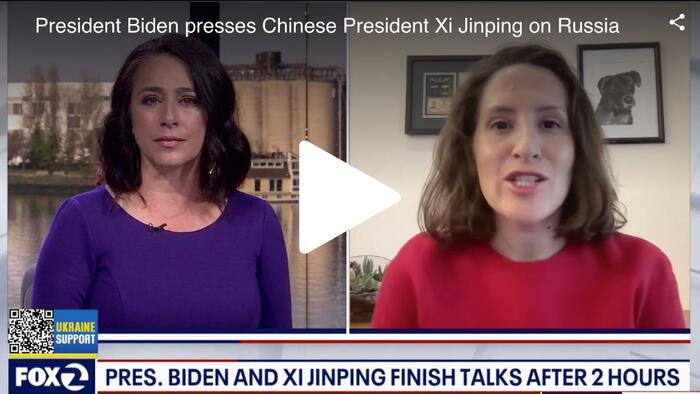
Mastro also spoke to Fox 2 KTVU following a two-hour phone call between President Biden and Chinese President Xi Jinping, in which Biden Warned Xi of ‘Consequences’ if China aids Russia’s invasion of Ukraine. Mastro remarked that China has "not come out in condemnation of this blatant use of force and China can't stand on the sidelines and expect for its reputation not to be tarnished if they continue to support Russia, even implicitly."

Image
Oriana Skylar Mastro on KTVU with a host of the show "Mornings on 2"

Mastro suggested that this moment has serious implications for the U.S.-China great power competition and that success in the U.S.-China relationship "isn’t about [the two powers] but about [their] relationships with the rest of the world...the United States is trying to compete with China economically, politically, and militarily around the world and [the United States has] commitments everywhere...China is very focused on the region, at least militarily, and that makes it difficult for the United States to compete."

Read More

Protesters display placards in front of the Representative Office of the Moscow-Taipei Coordination Commission to protest against Russia’s military invasion of Ukraine on February 25, 2022 in Taipei, Taiwan.
Commentary

Invasions Are Not Contagious

Russia’s War in Ukraine Doesn’t Presage a Chinese Assault on Taiwan
Invasions Are Not Contagious
Army Reserve members during practice
Commentary

Ukraine Is a Distraction from Taiwan

Getting bogged down in Europe will impede the U.S.’s ability to compete with China in the Pacific.
Ukraine Is a Distraction from Taiwan
Chinese military propaganda depicting the Second Taiwan Strait Crisis of 1958.
News

Reassessing China’s Capabilities and Goals for Strategic Competition

On the World Class podcast, Oriana Skylar Mastro argues that in order to set effective policy toward China, the United States needs to better understand how and why China is projecting power.
Reassessing China’s Capabilities and Goals for Strategic Competition
Hero Image
Putin and Xi Getty Images
All News button
1
Subtitle

On WBUR’s "On Point" and Fox 2 KTVU, Center Fellow Oriana Skylar Mastro shares insights about China's alignment with Russia and the worldwide implications of its calculus on Ukraine.

0
Visiting Scholar at APARC, 2021-2022
Lee Kong Chian NUS-Stanford Fellow on Contemporary Southeast Asia, 2021-2022
enze_han_4x4_.jpeg Ph.D.

Enze Han joined the Walter H. Shorenstein Asia-Pacific Research Center (APARC) as visiting scholar and 2021-2022 Lee Kong Chian NUS-Stanford Fellow on Contemporary Southeast Asia for the spring quarter of 2022. Dr. Han is currently Associate Professor at the University of Hong Kong's Department of Politics and Public Administration. While at APARC, Dr. Han conducted research on China's increasing connectivity with mainland Southeast Asia, and how such connectivity should be analyzed through the lens of international relations, development studies, and borderland studies.

Authors
Oriana Skylar Mastro
News Type
Commentary
Date
Paragraphs

This essay was originally published in Foreign Affairs magazine.

As Russian President Vladimir Putin intensifies his assault on Ukraine, a growing number of U.S. military and foreign policy analysts are voicing concern that China may be emboldened by Russia’s example and try to take Taiwan by force. “If Russia can grab chunks of Ukraine or install a puppet regime and withstand economic sanctions, that could embolden nationalists in China to look to Taiwan and think they could do the same,” Ian Johnson, a China expert at the Council on Foreign Relations, has argued. Representative Michael McCaul, Republican of Texas, made a similar argument in an interview last month, as did retired Army General Jack Keane, who said that Chinese President Xi Jinping sees “weakness in the West and how that can advantage him in terms of his national objectives as well.”

Xi is certainly watching events in Ukraine, but his calculus for whether to use force against Taiwan is shaped primarily by domestic factors, not foreign ones. As I have argued in Foreign Affairs, Chinese leaders are considering “armed reunification” with Taiwan more seriously than at any time in the last 50 years. But Xi will assert Chinese control over the island only if he is confident his military can conduct a successful amphibious invasion and if he believes the timing is right for his own career.


Sign up for our newsletters to receive in-depth analysis from our experts.


Shifts in the international environment would be important for Taiwan if they changed Xi’s thinking on either count. But the war in Ukraine has not. Xi’s views about U.S. power and resolve and about the likely international response to an invasion of Taiwan probably remain unchanged. If anything, China’s desire not to invite comparisons with Russia at a time when the world is united against Moscow will lengthen its timeline for taking control of Taiwan, not shorten it.

Too Big to Sanction?

The economic sanctions that the United States, Canada, and many European countries have imposed on Russia give China little reason for pause. To the contrary, these punitive measures simply confirm Beijing’s previous assessments of the possible economic repercussions of using force against Taiwan. Chinese leaders expect the economic costs of an invasion to be heavy but acceptable—partly because of how the international community has responded to Chinese provocations in the past and partly because Beijing’s foreign policy is designed to convince countries to stay out of China’s “internal” affairs, such as the status of Taiwan.

That is not to say the economic measures Washington and its allies have imposed on Russia in recent days are insignificant. The United States and European countries have blocked Russia’s access to most of its foreign currency reserves, making it impossible for Moscow to intervene to prop up its collapsing currency. They have frozen the assets of senior Russian officials, including Putin himself. And they have moved to exclude big Russian banks from SWIFT, the global financial messaging system.

China’s ability to retaliate against the West with economic sanctions of its own is much greater than Russia’s.
Oriana Skylar Mastro

But the United States and its allies could do more to punish Russia. They could bar all transactions with Russia, whether trade or financial. They could seize all Russian assets within their jurisdictions. Washington could announce secondary sanctions on anyone using U.S. dollars for any transaction with Russia. Most important, the United States could use these and other measures to prevent Russia from exporting oil and gas. Letting Russia continue to export oil and gas would be like letting China sell consumer electronics even after it had taken Taiwan by force.

If the United States and its allies have been cautious in their response to Russia, they are likely to be even more restrained when responding to China — and Beijing knows it. China’s ability to retaliate against the West with economic sanctions of its own is much greater than Russia’s. Singapore, which announced trade and banking restrictions against Moscow, trades about $2.5 billion worth of goods with Russia each year — but $57 billion worth of goods with China. China’s leaders likely do not fear U.S.-led economic sanctions in the event of a Taiwan takeover because they probably think that China’s own productive capacity, resources, and friendly partners will allow them to survive on their own, especially since China will soon be the world’s largest economy. They are probably right. China could absorb the types of sanctions being imposed on Russia. And given China’s ability to inflict pain on Western countries, any measures levied against Beijing would likely be softer than those imposed on Moscow.

Taiwan Is Not Ukraine

The Western military response to Russia’s invasion of Ukraine will have an even smaller impact than sanctions on China’s thinking about Taiwan. True, neither the United States nor NATO has deployed troops to fight on Ukraine’s behalf. And U.S. military assistance to Ukraine has been modest: late last month, President Joe Biden instructed the State Department to release up to an additional $350 million worth of weapons from U.S. stocks to Ukraine.

But Russia would have to invade a NATO ally without provoking a U.S. military response for Chinese leaders to seriously question Washington’s commitment to defending Taiwan. Biden has made clear from the beginning of the crisis that his administration will never send troops to Ukraine—a stark contrast with his rhetoric on Taiwan. Just last week, Biden stated unequivocally that the United States would defend Taiwan in the event of a Chinese attack. As a show of support, he also sent to the island a delegation of former U.S. officials led by Mike Mullen, a former chairman of the Joint Chiefs of Staff.

Chinese planners largely assume the United States would intervene militarily on behalf of Taiwan.
Oriana Skylar Mastro

In any case, Chinese planners largely assume the United States would intervene militarily on behalf of Taiwan. What some of them question is whether the United States could amass enough forces fast enough to blunt a Chinese assault on the island. Ironically, if the United States had launched a military operation in response to Russia’s invasion of Ukraine, Chinese leaders would have had further reason to question Washington’s ability to thwart a Chinese assault on Taiwan. The United States does not have the resources to fight the Russians in Europe and prepare adequately for a great-power war in Asia.  

Of course, these facts have not prevented China from trying to manipulate the narrative to undermine Taiwan’s resolve. Chinese state media has been flush with stories about how the United States did not come to Ukraine’s aid and therefore won’t come to Taiwan’s either. Like much of what appears on Chinese state media, however, these stories reflect what Chinese leaders want the world to believe—not what they believe themselves.

Not the Right Time

Chinese leaders are without a doubt considering an attack on Taiwan, but now is not the right time. China’s military is still honing the capabilities it would need to take and hold the island. And Xi is unlikely to take a dangerous gamble on Taiwan before the next Party Congress in late 2022, when he is widely expected to secure a third term as general secretary of the Chinese Communist Party. Xi is also working hard to lessen China’s technological dependence on the West, thus minimizing the impact on any further decoupling after a possible war. For all these reasons, an assault on Taiwan before 2025 is unlikely.

If anything, the crisis in Ukraine creates an additional incentive for China to wait. Beijing does not want the world to equate the two scenarios. From China’s perspective, Ukraine is an independent country engaged in a border dispute with Russia. Taiwan, by contrast, “has always been an inalienable part of China’s territory,” as China’s ambassador to the Association of Southeast Asian Nations, Deng Xijun, put it late last month. In other words, linking the two issues would undermine China’s claim to the island.

China also understands that moving against Taiwan now would solidify fears in the West of an axis of autocrats. The United States may not have the resolve to fight a protracted war to defend Taiwan. But suddenly faced with a need to defend freedom and democracy against an authoritarian alliance, Washington could muster a greater military response and convince its allies to do the same. Partly for this reason, China has desperately tried to maintain some semblance of neutrality during the Ukrainian crisis.

Russia’s invasion of Ukraine has certainly changed aspects of the international order. It has rallied European countries against Russia, prompted Germany to increase defense spending, and even convinced historically neutral countries such as Finland, Sweden, and Switzerland to take a stance against Moscow. From China’s perspective, however, nothing Russia or its adversaries have done meaningfully alters the calculus on Taiwan. 

Headshot of Oriana Skylar Mastro

Oriana Skylar Mastro

Center Fellow at the Freeman Spogli Institute for International Studies

Read More

Army Reserve members during practice
Commentary

Ukraine Is a Distraction from Taiwan

Getting bogged down in Europe will impede the U.S.’s ability to compete with China in the Pacific.
Ukraine Is a Distraction from Taiwan
President Xi and Kim Jong Un meet on a TV screen
Commentary

North Korea Is Becoming an Asset for China

Pyongyang’s Missiles Could Fracture America’s Alliances
North Korea Is Becoming an Asset for China
Chinese military propaganda depicting the Second Taiwan Strait Crisis of 1958.
News

Reassessing China’s Capabilities and Goals for Strategic Competition

On the World Class podcast, Oriana Skylar Mastro argues that in order to set effective policy toward China, the United States needs to better understand how and why China is projecting power.
Reassessing China’s Capabilities and Goals for Strategic Competition
Hero Image
Protesters display placards in front of the Representative Office of the Moscow-Taipei Coordination Commission to protest against Russia’s military invasion of Ukraine on February 25, 2022 in Taipei, Taiwan.
Lam Yik Fei/ Getty Images
All News button
1
Subtitle

Russia’s War in Ukraine Doesn’t Presage a Chinese Assault on Taiwan

Date Label
Authors
Oriana Skylar Mastro
News Type
Commentary
Date
Paragraphs

This commentary was originally published by The Wall Street Journal.


A Russian invasion of Ukraine would be the most consequential use of military force in Europe since World War II and could put Moscow in a position to threaten U.S. allies in Europe. Many in the American foreign-policy establishment argue that the appropriate U.S. response to any such invasion is a major American troop deployment to the Continent. This would be a grave mistake.

The U.S. can no longer afford to spread its military across the world. The reason is simple: an increasingly aggressive China, the most powerful state to rise in the international system since the U.S. itself. By some measures, China’s economy is now the world’s largest. And it has built a military to match its economic heft. Twenty-five years ago, the Chinese military was backward and obsolete. But extraordinary increases in Beijing’s defense budget over more than two decades, and top political leaders’ razor-sharp focus, have transformed the People’s Liberation Army into one of the strongest militaries the world has ever seen.


Sign up for APARC newsletters to receive our experts' commentary and analysis.


China’s new military is capable not only of territorial defense but of projecting power. Besides boasting the largest navy in the world by ship count, China enjoys some capabilities, like certain types of hypersonic weapons, that even the U.S. hasn’t developed.

Most urgently, China poses an increasingly imminent threat to Taiwan. Xi Jinping has made clear that his platform of “national rejuvenation” can’t be successful until Taiwan unifies with the mainland—whether it wants to or not. The PLA is growing more confident in its ability to conquer Taiwan even if the U.S. intervenes. Given China’s military and economic strength, China’s leaders reasonably doubt that the U.S. or anyone else would mount a meaningful response to an invasion of Taiwan. To give a sense of his resolve, Mr. Xi warned that any “foreign forces” standing in China’s way would have “their heads . . . bashed bloody against a Great Wall of steel forged by over 1.4 billion Chinese people.”

If Taiwan falls into Chinese hands, the U.S. will find it harder to defend critical allies like Japan and the Philippines, while China will be able to project its naval, air and other forces close to the U.S. and its territories

The U.S. must defend Taiwan to retain its credibility as the leader of a coalition for a free and open Indo-Pacific. From a military perspective, Taiwan is a vital link in the first island chain of the Western Pacific. If Taiwan falls into Chinese hands, the U.S. will find it harder to defend critical allies like Japan and the Philippines, while China will be able to project its naval, air and other forces close to the U.S. and its territories. Taiwan is also an economic dynamo, the ninth-largest U.S. trading partner of goods with a near-monopoly on the most advanced semiconductor technology—to which the U.S. would most certainly lose access after a war.

The Biden administration this month ordered more than 6,000 additional U.S. troops deployed to Eastern Europe, with many more potentially on the way. These deployments would involve major additional uncounted commitments of air, space, naval and logistics forces needed to enable and protect them. These are precisely the kinds of forces needed to defend Taiwan. The critical assets—munitions, top-end aviation, submarines, and intelligence, surveillance and reconnaissance capabilities—that are needed to fight Russia or China are in short supply. For example, stealthy heavy bombers are the crown jewel of U.S. military power, but there are only 20 in the entire Air Force.

The U.S. has no hope of competing with China and ensuring Taiwan’s defense if it is distracted elsewhere. It is a delusion that the U.S. can, as Pentagon press secretary John Kirby said recently, “walk and chew gum at the same time” with respect to Russia and China. Sending more resources to Europe is the definition of getting distracted. Rather than increasing forces in Europe, the U.S. should be moving toward reductions.

To be blunt: Taiwan is more important than Ukraine. America’s European allies are in a better position to take on Russia than America’s Asian allies are to deal with China.

There is a viable alternative for Europe’s defense: The Europeans themselves can step up and do more for themselves, especially with regard to conventional arms. This is well within Europe’s capacity, as the combined economic power of the NATO states dwarfs that of Russia. NATO allies spend far more on their militaries than Russia. To aid its European allies, the U.S. can provide various forms of support, including lethal weapons, while continuing to remain committed to NATO’s defense, albeit in a more constrained fashion, by providing high-end and fungible military capabilities. The U.S. can also continue to extend its nuclear deterrent to NATO.

The U.S. should remain committed to NATO’s defense but husband its critical resources for the primary fight in Asia, and Taiwan in particular. Denying China the ability to dominate Asia is more important than anything that happens in Europe. To be blunt: Taiwan is more important than Ukraine. America’s European allies are in a better position to take on Russia than America’s Asian allies are to deal with China. The Chinese can’t be allowed to think that America’s distraction in Ukraine provides them with a window of opportunity to invade Taiwan. The U.S. needs to act accordingly, crisis or not.

Ms. Mastro is a center fellow at the Shorenstein Asia-Pacific Research Center, part of Stanford’s Freeman Spogli Institute for International Studies, and a nonresident senior fellow at the American Enterprise Institute. Mr. Colby is a principal at the Marathon Initiative and author of “The Strategy of Denial: American Defense in an Age of Great Power Conflict.”

Headshot of Oriana Skylar Mastro

Oriana Skylar Mastro

Center Fellow at the Freeman Spogli Institute for International Studies
Full Biography

Read More

President Xi and Kim Jong Un meet on a TV screen
Commentary

North Korea Is Becoming an Asset for China

Pyongyang’s Missiles Could Fracture America’s Alliances
North Korea Is Becoming an Asset for China
Chinese military propaganda depicting the Second Taiwan Strait Crisis of 1958.
News

Reassessing China’s Capabilities and Goals for Strategic Competition

On the World Class podcast, Oriana Skylar Mastro argues that in order to set effective policy toward China, the United States needs to better understand how and why China is projecting power.
Reassessing China’s Capabilities and Goals for Strategic Competition
Taiwan Wall
Commentary

Would the United States Come to Taiwan's Defense?

On CNN's GPS with Fareed Zakaria, APARC Center Fellow Oriana Skylar Mastro shares insights about China's aspirations to take Taiwan by force and the United States' role, should a forceful reunification come to pass.
Would the United States Come to Taiwan's Defense?
Hero Image
Army Reserve members during practice
U.S. Army Reserve members during a Cold Weather Operations Course near Fort McCoy, Wisconsin, Jan. 13, 2022.
U.S. Army Reserve photo by Sgt. 1st Class Clinton Wood
All News button
1
Subtitle

Getting bogged down in Europe will impede the U.S.’s ability to compete with China in the Pacific.

Date Label
Authors
Noa Ronkin
News Type
News
Date
Paragraphs

As the COVID-19 pandemic remains a crucial global public health threat, pandemic control measures such as lockdowns and mobility restrictions continue to disrupt the provision of health services, leading to reduced healthcare use. Indeed, evidence shows the pandemic has emerged as a particular challenge for people with chronic conditions such as diabetes and hypertension. Yet there is limited data comparing the pandemic’s impact on access to care and the severity of chronic disease symptoms at the population level across Asia.

Now a new collaborative study, published by the Asia Pacific Journal of Public Health, addresses this limitation. The study co-authors, including APARC’s Asia Health Policy Program Director and FSI Senior Fellow Karen Eggleston, offer the first report comparing the impacts of the COVID-19 pandemic and its associated mobility restrictions on people with chronic conditions at different stages of socio-demographic and economic transitions in five Asian regions — India, China, Hong Kong, Korea, and Vietnam.

The findings show that the pandemic has disproportionately disrupted healthcare access and worsened diabetes symptoms among marginalized and rural populations in Asia. Moreover, the pandemic’s broad social and economic impact has adversely affected population health well beyond those directly suffering from COVID-19, with the resulting delayed and foregone care leading to uncertain longer-term effects.


 [Sign up for APARC newsletters to receive the latest research by our scholars]


Unintended Adverse Consequences

Routine screening, risk factor control, and continuity of care for non-communicable diseases are a global challenge. The COVID-19 pandemic has exacerbated the challenge even further. Existing reports show the pandemic has particularly adverse impacts on essential prevention and treatment services for people with chronic conditions. These reductions in health services arose from pandemic-associated factors such as mobility restrictions, lack of public transport, and lack of health workforce.

Eggleston and a group of colleagues set out to provide evidence on how the pandemic has impacted chronic disease care in diverse settings across Asia during COVID-19-related lockdowns. Using standardized questionnaires, the researchers surveyed 5672 participants aged 55.9 to 69.3 years with chronic conditions in India, China, Hong Kong, Korea, and Vietnam. The researchers collected data on participants’ demographic and socio-economic status, comorbidities, access to healthcare, employment status, difficulty in accessing medicines due to financial and nonfinancial (COVID-19 related) reasons, treatment satisfaction, and severity of their chronic condition symptoms.

If no immediate actions are taken to mitigate pandemic impacts, the Asia-Pacific region will struggle to achieve the 2030 Sustainable Development Goal target 3.4 to reduce premature mortality from non-communicable diseases […] and to promote mental health and wellbeing.
Karen Eggleston et al.

The results show that the pandemic’s broad social and economic impact has adversely affected population health well beyond those directly suffering from COVID-19. Study participants with chronic conditions faced significant challenges in managing their symptoms during the pandemic. They experienced a loss of income and difficulties in accessing healthcare or medications, with the resulting delayed and foregone care leading to uncertain longer-term effects. For a nontrivial portion of participants, these factors are associated with the worsening of diabetes symptoms. The threat is twofold among people living in rural populations with limited access, availability, and affordability of healthcare services.

A Global Health Priority

The unintended adverse consequences of the COVID-19 pandemic on chronic disease care may also further aggravate inequality in health outcomes. “If the trend continues and no immediate actions are taken to mitigate pandemic impacts,” Eggleston and her colleagues caution, then “the Asia-Pacific region will struggle to achieve the 2030 Sustainable Development Goal (SDG) target 3.4 to reduce premature mortality from non-communicable diseases by a third relative to 2015 levels and to promote mental health and wellbeing.”

Addressing the pandemic’s unintended negative social and economic impacts on chronic disease care is a global health priority, determine the researchers. They propose several measures to help provide timely care for people with chronic conditions in resource-constrained settings. These include implementing innovations in healthcare delivery models to improve the adoption of healthy lifestyle changes and self-management of chronic disease and mild COVID-19 symptoms, increasing investment in interventions to provide social and economic support to disadvantaged populations, and strengthening primary healthcare infrastructure and support of healthcare providers.

The study was supported in part by funding from Shorenstein APARC’s faculty research award, Stanford King Center for Global Development, and a seed grant from the Stanford Center for Asian Health Research and Education.

Read More

 A woman at a desk in a village medical clinic in China.
News

Strengthening the Frontline: How Primary Health Care Improves Net Value in Chronic Disease Management

Empirical evidence by Karen Eggleston and colleagues suggests that better primary health care management of chronic disease in rural China can reduce spending while contributing to better health.
Strengthening the Frontline: How Primary Health Care Improves Net Value in Chronic Disease Management
Closeup on hands holding a glucometer
News

A New Validated Tool Helps Predict Lifetime Health Outcomes for Prediabetes and Type 2 Diabetes in Chinese Populations

A research team including APARC's Karen Eggleston developed a new simulation model that supports the economic evaluation of policy guidelines and clinical treatment pathways to tackle diabetes and prediabetes among Chinese and East Asian populations, for whom existing models may not be applicable.
A New Validated Tool Helps Predict Lifetime Health Outcomes for Prediabetes and Type 2 Diabetes in Chinese Populations
money
News

Bargaining Behind Closed Doors: Why China’s Local Government Debt Is Not a Local Problem

New research in 'The China Journal' by APARC’s Jean Oi and colleagues suggests that the roots of China’s massive local government debt problem lie in secretive financing institutions offered as quid pro quo to localities to sustain their incentive for local state-led growth after 1994
Bargaining Behind Closed Doors: Why China’s Local Government Debt Is Not a Local Problem
Hero Image
A makeshift barricade is seen in front of a residential area to restrict movement and control COVID-19 spread in Hanoi, Vietnam.
A makeshift barricade is seen in front of a residential area to restrict movement and control COVID-19 spread, September 2021, Hanoi, Vietnam.
Linh Pham / Getty Images
All News button
1
Subtitle

In the first report of its kind comparing the impacts of the pandemic on people with chronic conditions in five Asian regions, researchers including APARC’s Karen Eggleston document how the pandemic’s broad social and economic consequences negatively affected population health well beyond those directly suffering from COVID-19.

Subscribe to Northeast Asia