News Type
Commentary
Date
Paragraphs
David Straub, the acting director of Korean Studies Program, argues that Obama administration will finally give diplomacy a chance to deal with the North Korean nuclear problem. He stresses that Senator Obama understands the difficulties of dealing with North Korea and will proceed carefully. If North Korea does not respond to this more nuanced American approach, he concludes, the international community is likely to be more supportive of U.S. efforts to constrain North Korean behavior.

Among conservatives in Korea and other American allied countries, there seems to be some anxiety about the election of a relatively unknown, young African-American liberal as the next American president. Typically, when a new U.S. president is elected, American diplomats seek to reassure allies by telling them that the incoming president will pursue fundamentally the same policies as the outgoing president. However, President Obama clearly will adopt a significantly different foreign policy than President Bush, including toward North Korea.

Obama’s soaring rhetoric has led to a widespread (and correct) impression of him as idealistic, but the long presidential campaign also revealed him to be a disciplined politician and a skillful manager. His foreign policy will be much closer to the prudent realpolitik of President Bush’s father than it will be to the “neo-con” approach of President Bush himself.
And while it is true that Obama does not have deep experience in foreign affairs, his youthful years spent in Indonesia and Hawaii, taken together with his successful navigation of American society as a young African-American man, have given him a genuine empathy for different peoples and cultures. He has the self-confidence and intelligence to listen with an open mind to others and then carefully to make his own decisions.

President Obama’s policy toward North Korea will defy stereotypes of the past. In some ways he will be “softer” on North Korea than President Bush; in other ways, he will be “tougher.”  Like President Bush and his predecessors, President Obama will take the position that he can never accept a North Korea with nuclear weapons. On the other hand, Obama will not engage in bluster such as “all options are on the table,” which most South Koreans reject and which only plays into the DPRK’s hands.

Instead, Obama will finally give diplomacy a fighting chance. Even during the past couple of years, President Bush remained very reluctant to engage fully in negotiations with North Korea. President Obama will order that a policy review be conducted expeditiously, and he will probably appoint a very senior special envoy to take charge of negotiations with North Korea. While maintaining the framework of the Six-Party Talks and consulting very closely with the Republic of Korea and Japan, he will also authorize meaningful bilateral negotiations with North Korea. If those negotiations bear real fruit, he may even visit Pyongyang himself if he is confident that he will be able to strike a deal completely ending North Korea’s nuclear ambitions.

President Obama will probably offer North Korea a “more for more” deal. In other words, compared to President Bush he will propose a much more detailed and concrete series of steps to be taken by North Korea, the United States, and other members of the Six-Party Talks. The aim will be agreement on an early end to North Korea’s nuclear weapons programs.

The North Koreans should not think that President Obama will be “easier” than President Bush. If, as may well be the case, the North Koreans reject President Obama’s approach or drag their feet in responding to it, he, unlike President Bush, will have the international credibility to work more effectively with other members of the Six-Party Talks and the international community to limit North Korea’s options.

Moreover, as a hardheaded domestic politician, President Obama will be careful to avoid situations in which the Republican opposition could credibly criticize him as being naïve about North Korea. Indeed, Obama’s team recognizes clearly that, having declared itself a nuclear weapons state and tested a nuclear device, North Korea may not be prepared to verifiably give up its nuclear weapons ambitions.

In formulating and conducting his policy toward North Korea, President Obama will have access to many trusted experts on North Korea, beginning with Vice President Biden and his staff. Obama is also advised by a number of experienced officials from the Clinton administration, from former Defense Secretary Bill Perry to former career diplomat Jeffrey Bader.

U.S. relations with the Republic of Korea are key to any successful American policy toward North Korea. Obama and his team fully appreciate the importance of U.S.-ROK relations and the security alliance. They will coordinate very closely with the Lee Myung-bak administration and never sacrifice the interests of the Republic of Korea, which is immeasurably more important to the United States than the DPRK is or ever will be.
 
President Obama will support the implementation of the agreements President Bush reached with the Republic of Korea on the realignment of U.S. Forces of Korea and the transfer of wartime operational control, as befits the ROK’s military and economic might.
 
Under President Obama, the United States will also aim to approve, with some adjustments, the U.S.-ROK Free Trade Agreement, although it may take a year or so to do so as he perforce deals first with the global financial and economic crises and wars in Iraq and Afghanistan.  President Obama must be cognizant of the viewpoint of leading congressional Democrats and the constituencies they represent. It may be counterproductive if the ROK pushes too hard, too fast for U.S. approval of the FTA.
 
Obama’s inauguration will also open up new possibilities for U.S.-ROK coordination and cooperation on global issues. Unlike President Bush, whose early unilateralist mindset and specific policies caused dismay among international friends and foes alike, President Obama begins with a vast reservoir of sympathy and respect throughout the world. That will make it easier, and more useful, for the Republic of Korea to cooperate globally more with the United States.
 
In short, South Koreans should be reassured, not that President Obama’s foreign policy will be like that of President Bush, but that it will be different. Perhaps South Koreans will even begin to feel that their alliance with the United States is not just one that they feel they must have for their country’s long-term interests – but also one of which they can feel proud.

All News button
1
Authors
Phillip Lipscy
News Type
Commentary
Date
Paragraphs
Professor Phillip Lipscy discusses the current international financial crisis and provides insight for future reforms. "The IMF and World Bank should be reformed to better reflect the interests and concerns of rising economic powers. Voting shares need to be further redistributed to reflect underlying economic realities. Decision making rules should be modified to give greater weight or agenda-setting authority to regional actors -- the US may have a strong interest in loans to Mexico, but Japan may have a greater stake in Indonesia. Assignment of the top positions should be made truly competitive. Core functions should be decentralized -- both institutions are headquartered in Washington, impeding employment of top talent from Asia and limiting intellectual exchange."

Major international crises often produce tectonic shifts in international relations. Under pressure from key European counterparts, President Bush has agreed to a "new Bretton Woods" summit on Nov. 15.

It would be hard to overstate the potential significance of this meeting. The first Bretton Woods, in 1944, set the rules for monetary relations among nations, and it created the International Monetary Fund (IMF) and the World Bank.

While European leaders are pushing for greater regulation and a major overhaul of the international financial order, US policymakers have been lukewarm, emphasizing the preservation of free-market capitalism. This transatlantic drama has obscured the more fundamental problem—how to accommodate the historic shift of economic power away from the West toward Asia.

Including India, broader East Asia encompasses more than half of the world's population. The region already accounts for about one-third of global economic output, oil consumption, and CO2 emissions, and this is only likely to grow in the future. Over the course of the 21st century, Asia's economic and geopolitical weight in the world will, in all likelihood, come to rival that of Europe in the 19th century. Asian problems will become increasingly indistinguishable from global problems.

In the face of such dramatic change, the IMF and World Bank are becoming relics of a bygone era. At the time of their creation, by US and European negotiators, the major challenge was to get capital flowing from the US to war-ravaged Europe. The days of the US as creditor state are long gone—our massive current account deficit is financed by importing nearly $1 trillion in foreign capital every year. Major US banks are being rescued by sovereign wealth funds and financial institutions from the Middle East and East Asia. China and Japan alone held over $600 billion of securities issued by Fannie Mae and Freddie Mac, making the bailout of those institutions a major foreign policy issue.

Despite these changed realities, both Bretton Woods institutions remain dominated by the West. By convention, the IMF is led by a European, the World Bank by a US national. The US is the only country with veto power over important decisions in either body.

My analysis of voting shares in the IMF indicates that the Allied powers of World War II have been consistently overrepresented compared to Axis powers despite the passing of more than 60 years since the end of that war. Studies show that IMF lending is biased in favor of recipients with strong economic and diplomatic ties to the US and key European states at the expense of other members.

This unbalanced representation had real consequences during the Asian Financial Crisis of 1997-98, when the IMF, as part of its rescue operation, implemented policies widely viewed as contrary to Asian interests. During the crisis, Japanese financial authorities proposed an Asian Monetary Fund as a potential alternative source of liquidity. This proposal was rejected by US officials, who feared dilution of IMF authority. However, over the past decade, East Asian states have stockpiled foreign currency reserves and developed regional cooperation that may eventually develop into a credible alternative to the IMF.

The IMF and World Bank should be reformed to better reflect the interests and concerns of rising economic powers. Voting shares need to be further redistributed to reflect underlying economic realities. Decisionmaking rules should be modified to give greater weight or agenda-setting authority to regional actors—the US may have a strong interest in loans to Mexico, but Japan may have a greater stake in Indonesia. Assignment of the top positions should be made truly competitive. Core functions should be decentralized—both institutions are headquartered in Washington, impeding employment of top talent from Asia and limiting intellectual exchange.

An international financial architecture that fragments or remains centered on the West as Asia rises will probably prove grossly ineffective. Europe attempted much the same during the turbulent period between the two World Wars, resurrecting a system based on British hegemony even as Britain was in relative decline. Those were scary times, with free riding and beggar-thy-neighbor policies feeding mutual distrust and economic catastrophe.

This will not be the last financial crisis we face. Next time, ad hoc cooperation by the US and Europe may prove insufficient. Franklin Roosevelt had the foresight to include China on the United Nations Security Council long before that nation became a geopolitical heavyweight. Similar foresight should be brought to bear as world leaders debate the future of the international financial architecture.
All News button
1
-

Despite early talk of being able to “decouple” itself from the U.S. financial crisis and accompanying credit crunch, the damage has spread to Asia. Collapsing export markets, currency instability and stock market collapses are plaguing all of Asia, not least China, Japan and South Korea. At the same time, China and Japan are major financiers of the United States federal government and newly nationalized financial firms Fannie Mae and Freddie Mac.

Two leading economic experts on Japan and China will discuss the impact of the U.S. financial crisis on Asia. Does Japan’s experience with banking collapse bear any lessons for the United States today? Will China continue to finance the United States government? How will a U.S. recession affect the prospects for economic growth in Asia?

Richard Katz has taught about Japan’s economy as an Adjunct Associate Professor at the New York University Stern School of Business. Previously, and as a Visiting Lecturer in Economics at the State University of New York (SUNY) at Stony Brook.  Mr. Katz is the author of two books on Japan's economic trvails; The System That Soured--The Rise and Fall of the Japanese Economic Miracle (M.E. Sharpe 1998) and Japanese Phoenix: The Long Road to Economic Revival (M.E. Sharpe 2002).  He has twice testified about Japan and Asia before Congress, in 1998 and 2005. Both times the hearings were held by the Asia-Pacific Subcommittee of the House International Relations Committee. In the year 2000, he served on the Council of Foreign Relations' Task Force on the Japanese economy.  Having received his B.A. degree in History from Columbia University in 1973, Mr. Katz went on to obtain his M.A. in Economics at New York University (NYU) in 1996.
 
Mark Spiegel served as an assistant professor in the Department of Economics at New York University.  He has served as a visiting professor in the Economics Department of U.C. Berkeley, as well as a lecturer at the Haas School of Business at U.C. Berkeley.  He has also served as a consultant at the World Bank, as a visiting scholar at the Bank of Japan, and as Chairman of the Federal Reserve System Committee on International Economic Analysis.  Dr. Spiegel received his Ph.D. in economics from the University of California at Los Angeles and his B.A. in economics from the University of California at Berkeley.  Dr. Spiegel has published numerous articles in both academic and policy-oriented journals on international financial issues and on economic issues associated

Philippines Conference Room

Richard Katz Co-Editor Speaker The Oriental Economist Report
Mark Spiegel Vice President, International Research and Director Speaker Center for Pacific Basin Studies at the Federal Reserve Bank of San Francisco
Seminars
Paragraphs

Will China come to dominate global high-tech innovation?

In the future, perhaps. Today, however, Greater China—Mainland China, Taiwan, and Hong Kong—is focused on the quest for innovation. The dominant paradigm on the Mainland is one of execution, not innovation. Beijing now aims to turn China—historically an adopter of technologies from elsewhere—into a major technology creator. Self-reliance has become the government’s watchword and its ultimate goal.

The talents and resources available are impressive. More Chinese young people are well-educated, international patents and research and development (R&D) spending are on the rise, and China boasts a growing presence in world scientific literature.

Still, negatives remain. China must overcome the legacies of a top-down, state-run research system that is largely disconnected from commerce, and an academic system not always supportive of independent scholarly inquiry. The government is working to change these outdated institutions, but such shifts do not occur overnight.

Taiwan and Hong Kong have followed different paths to high-tech innovation. Taiwan’s route has been dominated by government but implemented by mostly small- and medium-sized firms, with help from its Industrial Technology Research Institute (ITRI), a model for moving concepts to commerce. Significantly, Taiwan’s companies maintain strong links to multinational firms both in the United States and in Mainland China. Taiwan’s Hsinchu Science-based Park is seen as a model high-tech cluster throughout Asia and beyond.

Hong Kong has taken another road. While its formal R&D activity is small, it innovates in business models, particularly in logistics chains that reach into the Mainland and globally. It is a (largely unheralded) story of great success.

The big question is: When will Greater China’s high-tech innovation have a major impact on the world economy?

Examination copies: Desk, examination, or review copies can be requested through Stanford University Press.

All Publications button
1
Publication Type
Books
Publication Date
Authors
Henry S. Rowen
Book Publisher
Shorenstein APARC
-

This event - the final in a series of 4 film screening which will be followed by a discussion with director Clint Eastwood - is part of the second phase of a three year research effort to compare the formation of the divided memories in Japan, China, South Korea, Taiwan and the United States. We will conduct a comparative study of popular cinema dealing with historical subjects focusing roughly on the period from 1931-1951.

Letters From Iwo Jima Synopsis

Sixty-one years ago, US and Japanese armies met on Iwo Jima. Decades later, several hundred letters are unearthed from that stark island's soil. The letters give faces and voices to the men who fought there, as well as the extraordinary general who led them.

The Japanese soldiers are sent to Iwo Jima knowing that in all probability they will not come back. Among them are Saigo (Kazunari Ninomiya), a baker who wants only to live to see the face of his newborn daughter; Baron Nishi (Tsuyoshi Ihara), an Olympic equestrian champion known around the world for his skill and his honor; Shimizu (Ryo Kase), a young former military policeman whose idealism has not yet been tested by war; and Lieutenant Ito (Shidou Nakamura), a strict military man who would rather accept suicide than surrender.

Leading the defense is Lt. General Tadamichi Kuribayashi (Ken Watanabe), whose travels in America have revealed to him the hopeless nature of the war but also given him strategic insight into how to take on the vast American armada streaming in from across the Pacific.

With little defense other than sheer will and the volcanic rock of the island itself, Gen. Kuribayashi's unprecedented tactics transform what was predicted to be a quick and bloody defeat into nearly 40 days of heroic and resourceful combat.

Almost 7,000 American soldiers were killed on Iwo Jima; more than 20,000 Japanese troops perished. The black sands of Iwo Jima are stained with their blood, but their sacrifices, their struggles, their courage and their compassion live on in the letters they sent home.

Cubberley Auditorium
485 Lasuen Mall
Stanford University
Stanford, CA 94305

Clint Eastwood Director Speaker
Seminars
-

This is the second phase of a three year research effort to compare the formation of the divided memories in Japan, China, South Korea, Taiwan and the United States.  We will conduct a comparative study of popular cinema dealing with historical subjects focusing roughly on the period from 1931-1951.

This is the third in a series of 4 film screening which will be followed by a discussion of the audience.

Yamato Synopsis

During late World War II, the Japanese army starts loosing the battle.  Special junior officers including Kamio (Kenichi Matsuyama) board Yamato and meet officer Moriwaki (Takashi Sorimachi) and Uchia (Shidou Nakamura).  However, this battle marks the virtual end of the combined fleet of the ikmperial Japanese Navy.  Then in April 1945. Yamato is ordered to carry out a suicide mission and sets out tot he waters of Okinawa...

Philippines Conference Room

Seminars
-

This is the second phase of a three year research effort to compare the formation of the divided memories in Japan, China, South Korea, Taiwan and the United States.  We will conduct a comparative study of popular cinema dealing with historical subjects focusing roughly on the period from 1931-1951.

This is the first in a series of 4 film screening which will be followed by a discussion of the audience.

Devils on the Doorstep synopsis

Renowned actor Jiang Wen directs this sweeping look at a small Chinese village located near the Great Wall during the closing days of WWII. As Japanese soldiers march up and down the village's main thoroughfare, Ma Dasan (Wen) is making love with his widowed lover Yu'er (Jiang Hongbo). Suddenly, there is a knock at the door and a gun at Ma's head. He is informed that for the next week he is to house two gagged and bound prisoners, one a fanatical Japanese soldier, the other a Chinese translator -- and to interrogate the pair. The village elders uneasily question the two, while the translator intentionally mistranslates the epithets and insults from the soldier. When the Chinese resistance fighters do not return to pick up the prisoners, the villagers panic and order Ma to execute them. Ma, in turn, panics and tries to hide the cantankerous duo in the Great Wall -- that is until the villagers discover his ruse and almost lynch him, despite a strongly worded defense by Yu'er. Six months later, the villagers become increasingly worried about boarding these prisoners, lest they all be branded collaborators. This film won the prestigious Grand Prix at the 2000 Cannes Film Festival.

Philippines Conference Room

Seminars
-

This is the second phase of a three year research effort to compare the formation of the divided memories in Japan, China, South Korea, Taiwan and the United States.  We will conduct a comparative study of popular cinema dealing with historical subjects focusing roughly on the period from 1931-1951.

This is the second in a series of 4 film screening which will be followed by a discussion of the audience.

Blue Swallow synopsis

An aspiring Japanese aviator longing to take flight from Japanese-occupied Korea enrolls in Tachikawa Flight Academy in director Yoon Jong-chan's lavish look at the life of pre-World War II aviatrix Park Gyeong-weon. Raised in the Korean countryside but longing to embrace her Korean heritage, Park Gyeong-weon (Jang Jin-yeong) longs to take to the sky "like a swallow." Park is convinced that she has what it takes to soar through the clouds, and in 1925 she begins to pursue her dreams by enrolling in the Tachikawa Flight Academy. An amiable cab driver by day, the tomboyish aeronaut eventually strikes up a close friendship with fellow Koreans Kang Se-gi (Kim Tae-hyeok) and Lee Jeong-heui (Han ji-men) while entering into a tenuous romance with handsome student Han Ji-hyeok (Kim Ju-hyeok). High up in the sky Park attempt to hold her own against airborne Nipponese nemesis Masako Gibe (Yuko Fueki), and as tensions begin to heat up between Japan and Korea the skillful pilot plans a high-profile "friendship" flight to Manchuria in hopes of encouraging peaceful relations between the two countries. - Jason Buchanan,

Philippines Conference Room

Seminars
-

In addition to Iraq, Afghanistan, Pakistan, the financial crisis, and the housing crisis (as if that were not enough!), the next American president will have his hands full with matters on the Korean peninsula.  What will be the future of Six Party talks?  What is the status of the leadership in Pyongyang?  How do changes in leadership in Washington (and potentially in Pyongyang) affect outcomes?  What are the prospects for US-ROK relations?  And what of the KORUS FTA?  Victor Cha, former director of Asian affairs at the White House, will lead a discussion on these issues.

Professor Cha is director of Asian Studies and holds the D.S. Song Chair in the Department of Government and School of Foreign Service at Georgetown University.  He left the White House in May 2007 after serving since 2004 as Director for Asian Affairs at the National Security Council.  At the White House, he was responsible primarily for Japan, the Korean peninsula, Australia/New Zealand and Pacific Island nation affairs.   Dr. Cha was also the Deputy Head of Delegation for the United States at the Six Party Talks in Beijing, and received two Outstanding Service commendations during his tenure at the NSC.  

He is the award-winning author of Alignment Despite Antagonism: The United States-Korea-Japan Security Triangle (Stanford University Press) (winner of the 2000 Ohira Book Prize) and co-author of Nuclear North Korea: A Debate on Engagement Strategies (Columbia University Press, 2004).  He has written articles on international relations and East Asia in journals including Foreign Affairs, International Security, Political Science Quarterly, Survival, International Studies Quarterly, and Asian Survey.   Professor Cha is a former John M. Olin National Security Fellow at Harvard University, two-time Fulbright Scholar, and Hoover National Fellow,  CISAC Fellow, and William J. Perry Fellow at Stanford University.

Image
beyond the final score
He serves as an independent consultant, and has testified before Congress on Asian security issues.  He has been a guest analyst for various media including CNN, ABC Nightline, NBC Today Show, CBS Morning Show, Fox News, MSNBC, CNBC, BBC, ESPN, Sports Illustrated, and National Public Radio.

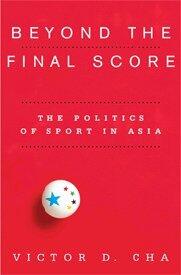
His new book Beyond the Final Score: The Politics of Sport in Asia (Columbia University Press, 2008) looks at the politics of sports and the Beijing Olympics. Cha holds a BA and Ph.D. from Columbia University, MA from University of Oxford.

This event is sponsored by the Pantech Group in Korea.

Philippines Conference Room

Victor D. Cha Director of Asian Studies Speaker Georgetown University
Seminars
Subscribe to The Americas