Authors
Noa Ronkin
News Type
News
Date
Paragraphs


By 1978, after the “epic impoverishment” borne of Mao’s non-market, ideologically-driven economy, China was almost like “a hot air balloon [that had been held] ten feet underwater” and suddenly let go, described Daniel Rosen, founding partner of the Rhodium Group, before an audience at a recent colloquium organized by Shorenstein APARC’s China Program.

Rosen—who leads the Rhodium Group’s work in China, India, and Asia—drew on his 26 years of professional experience analyzing China’s economy, commercial sector, and external interactions, to share his insights on the implications of China’s recent divergence from liberal market norms even as the U.S. and China are trying to reach an agreement that could end a protracted trade war.

With its explosive rise, increasing U.S.-China economic tensions, argued Rosen, were inevitable. By reverting to non-market principles under Xi Jinping, however, China’s divergence from advanced economic norms has triggered a hostile reaction from the United States.  He acknowledged that China has “the sovereign right to choose the system it thinks best for itself,” including reverting to non-market principles.  But, he noted, “as an old adage goes, paraphrased, China’s freedom to swing its fists stops where other noses begin.”

China, with its thirteen trillion-dollar economy is now the world’s second largest economy.  China’s economic footprint, too—as trader, foreign investor, and lender, among others—is enormous around the world.  Thus, Rosen pointed out, now when “China sneezes, the rest of the world can catch a cold or pneumonia.”  By disavowing the primacy of market principles, furthermore, China’s decisions will now have spillover consequences for not only the way the rest of the global economy functions but also for economic prospects of the United States.

Rosen highlighted, in particular, three aspects of China’s divergence from market norms:  its financial markets, competitive regimes; and IP protection rules.  China’s capital markets give preferential treatment to its domestic state firms and discriminates against not only foreign firms but also its private firms.  He also stressed China’s uneven competition policies—as most dramatically epitomized in its “Made in 2025” policy—that establish asymmetric market access for foreign firms in China versus Chinese firms abroad; China’s state and sub-state financial subsidies set up to advantage domestic firms; and China’s domestic control of intellectual property in large swathes of critical industries.  China’s “Made in 2025” policy thereby, for example, distorts the innovation ecosystem of the world and the United States.  As Rosen asserted, “We depend for our vitality on structural conditions that non-market policy choices by a systemically important national could disrupt.”

In Rosen’s assessment, President Xi Jinping had begun his tenure with a far-reaching set of economic reforms called the “60 Decisions” of the Third Plenum Resolution in 2013.  But these market-centered initiatives, many of which Xi’s administration did push initially, led to “mini” (and “many”) crises, he stated.  These reforms, therefore, have stalled.  “The shadow over U.S.-China economic engagement comes not because China refused to reform in the Xi Jinping years,” Rosen asserted, “but because lately it has stumbled in attempting to do so.”
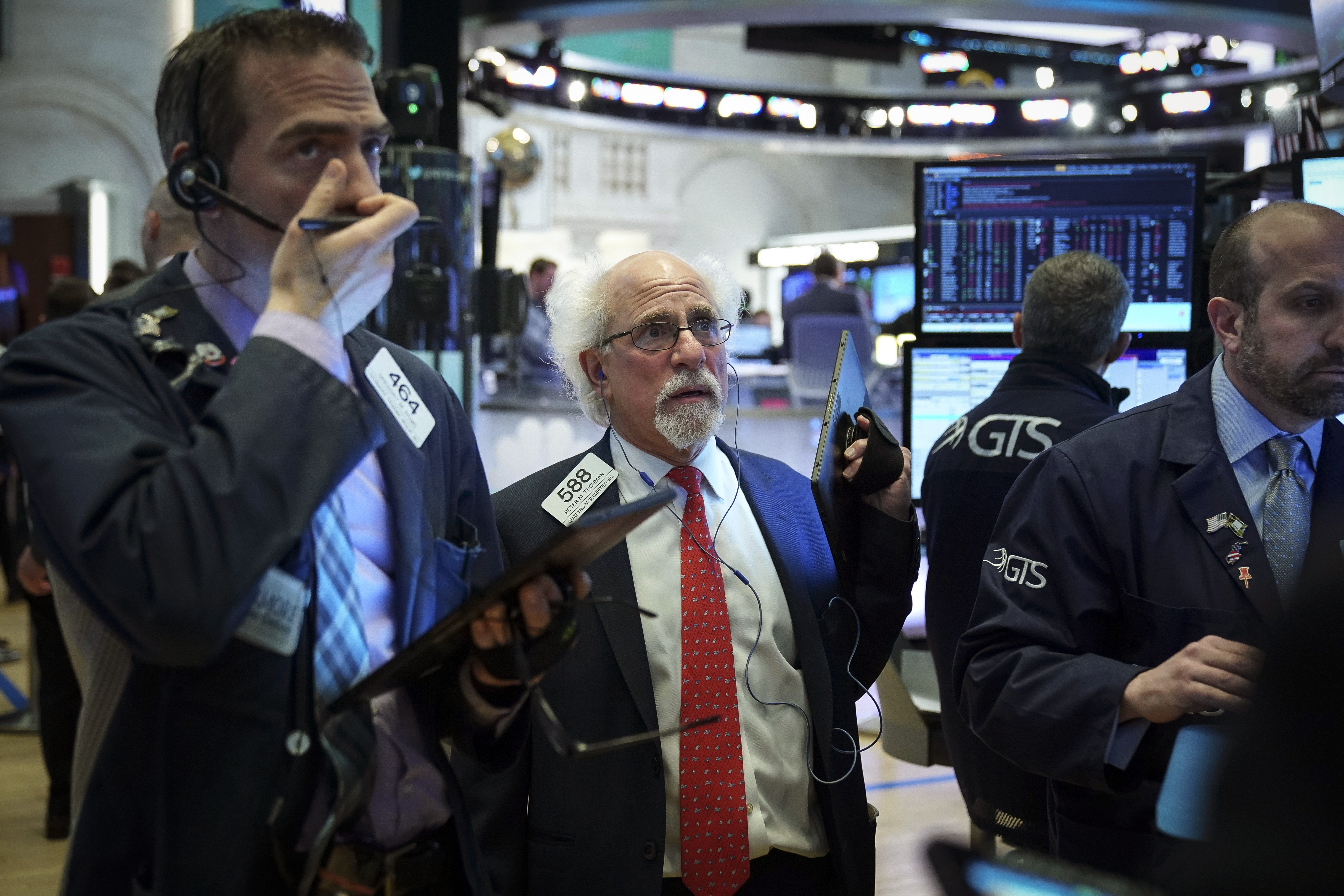
NEW YORK, NY - MAY 6: Traders and financial professionals work at the opening bell on the floor of the New York Stock Exchange (NYSE), May 6, 2019 in New York City. The Dow Jones Industrial Average dropped over 360 points at the open on Monday morning after U.S. President Donald Trump said that the U.S. will raise tariffs on goods imported from China. China also threatened to skip upcoming trade talks following tariff threats from President Trump.

According to Rosen, hardening U.S. approach to Chinese trade policy and the current discussion of possible “disengagement” with China are the result of U.S. recognition that China had changed course away from convergence with the liberal international economic order.  It, in fact, stems from the U.S.’s valid need to protect its economic welfare and the welfare of other market economies from the deleterious effects of China’s illiberal policies.  In the same way, he claimed, that the U.S. is not as deeply engaged with Italy as it is with Germany, and that we are not as deeply engaged with Germany as we are with Great Britain, it is not “heresy” to say that nations that do not share the same basic economic framework cannot be as engaged together—or as interoperable—as nations that do.  

But, Rosen predicted, China’s own turn away from market principles is bound to fail.  Liberal market reforms delivered double-digit growth for China since Deng Xiaoping’s Opening and Reform.  And “[u]nless everything we think we know about the relative efficiency and dynamism of free markets over politically controlled economies is wrong, the present Chinese policy turn will be, in the end, a dead-end,” Rosen remarked.  According to his prediction, therefore, we will either see a weakened China that poses less of an economic and national security threat to the U.S. or a China that eventually returns to market norms (i.e., “a reversion back to what will work.”).

In the meantime, therefore, he suggested that the American response must be “provisional,” “partial,” and “peaceful.”  American policy must be adaptable and readily reversible such that our ability to reengage to the maximum with China is carefully protected.  Secondly, it must be “partial” rather than absolute.  And, lastly, it must be “peaceful.”  When Beijing’s non-market policies fail, as it will, Rosen averred, and China re-orients itself towards economic convergence with advanced economy norms once more, we must ensure a “foundation of good will” between the U.S. and China to which China can return.

Rosen also cautioned against the U.S. abandoning its own source of national strength—i.e., its openness.  Arguing that economic protectionism has too often been confused with national security, Rosen argued that primary threats to U.S. national security now stem more from new causes like climate change, pandemics, migration pressures and access to weapons of mass destruction.  “Economic protection will do little to nothing to address those risks,” Rosen pointed out.

Rosen spoke at Shorenstein APARC as part of the China Program’s Colloquia Series “A New Cold War?: Sharp Power, Strategic Competition, and the Future of U.S.-China Relations.”  The series continues on May 3 with Ambassador Chas W. Freeman, Jr.’s seminar “On Hostile Coexistence with China.”

Hero Image
Traders and financial professionals work at the opening bell on the floor of the New York Stock Exchange (NYSE), May 6, 2019
NEW YORK, NY - MAY 6: Traders and financial professionals work at the opening bell on the floor of the New York Stock Exchange (NYSE), May 6, 2019 in New York City. The Dow Jones Industrial Average dropped over 360 points at the open on Monday morning after U.S. President Donald Trump said that the U.S. will raise tariffs on goods imported from China. China also threatened to skip upcoming trade talks following tariff threats from President Trump.
Getty Images / Drew Angerer
All News button
1
News Type
News
Date
Paragraphs

On Thursday, the third Asia-Pacific Geo-Economic Strategy Forum (APGEO) saw discussion on issues of international strategic cooperation in the Asia-Pacific with a particular focus on the U.S.-Japan relationship. Speakers included experts on defense and foreign affairs, including former U.S. National Security Advisor H.R. McMaster and former Japanese Ministers of Defense.

Organized by the Hoover Institution, Nikkei Inc. and the Freeman Spogli Institute of International Studies (FSI), the talks occurred within the context of the United State’s Free and Open Indo-Pacific Strategy (FOIP) and Japan’s Medium Term Defense Program, both recently updated to outline the U.S. and Japan’s respective regional commitments.

The forum’s speakers focused on the rise of China as a common theme underscoring the importance of the U.S.-Japan alliance. Particularly, the speakers shared a general consensus that China’s attempts to increase its economic and political influence and its initiatives to drive progress on technological frontiers such as 5G networks and artificial intelligence pose a threat to the current international order...

Read the full article in The Stanford Daily

Hero Image
Gen H.R. McMaster at podium, delivering speech
Gen. H.R. McMaster, Hoover Institution, addresses the 3rd Asia-Pacific Geo-Economic Strategy Forum
Thom Holme, APARC
All News button
1
-

The 3rd Asia-Pacific Geo-Economic Strategy Forum
 

May 2, 2019

Hauck Auditorium, Hoover Institution, Stanford University

Sponsored and organized by Nikkei Inc., The Hoover Institution, and the Freeman Spogli Institue of International Studies (FSI)


RSVP REQUIRED: https://www.global-nikkei.com/19apgeo/
(RSVP starts from April 10)


Agenda

1:00pm - 1:05pm
Welcome Remark:
Adm. Gary Roughead, Hoover Institution, Stanford University


1:005pm - 1:25pm
Keynote Speech:
Itsunori Onodera, Former Minister of Defense, Japan
 

1:30pm - 2:20pm
Panel I: Indo-Pacific Strategy vs Belt & Road Initiative

Chair: Akihiko Tanaka, President, National Graduate Institute for Policy Studies

Panelists:
Masahisa Sato, State Minister for Foreign Affairs of Japan
Akio Takahara,  Tokyo University
Donald Emmerson, Freeman Spogli Institue for International Studies, Stanford University
 

2:20pm - 2:30pm
Coffee Break


2:30pm - 2:50pm
Special Speech
:
Gen. H.R. McMaster,
Hoover Institution


2:55pm - 3:50pm
Panel Discussion II: US-Japan Strategic Collaboration: Technology, Trade and Economics

Chair: Satoru Mori, Hosei University

Panelists:
Kenji Wakamiya, Former State Minister of Defense, Japan
Hideaki Watanabe, Former Commissioner of Acquisition, Technology & Logistics Agency (ATLA)
Janis Pamiljans, President, Northrop Grumman Aerospace Systems
Nelson Pedeiro, Vice President, Advanced Technology Center, Lockheed Martin
 

3:50pm - 4:00pm
Coffee Break


4:05pm - 4:55pm
Panel Discussion III: Japan`s Defense/Security Strategy

Chair: Satoshi Morimoto, Former Minister of Defense of Japan

Panelists:
Gen Nakatani, Former Minister of Defense, Japan
Itsunori Onodera, Former Minister of Defense, Japan
James Fearon, Freeman Spogli Institute for International Studies, Stanford University
 

4:55pm - 5:00pm
Closing Remark:

Adm. Gary Roughead, Hoover Institution, Stanford University


Everett and Jane Hauck Auditorium
David and Joan Traitel Building of Hoover Institution
435 Lasuen Mall, Stanford, CA 94305
Stanford University


Symposiums
-
Image
Stanford University landscape with Memorial Church and the Main Quad at the center.

The JIIA-Stanford Symposium

"The Past, Present, and Future International Order in East Asia"

May 10, 2019

Bechtel Conference Center, Encina Hall, Stanford University

Sponsored and organized by the Japan Institute for International Affairs (JIIA) and Japan Program and the US-Asia Security Initiative of the Walter H. Shorenstein Asia-Pacific Research Center (APARC) of the Freeman Spogli Institue of International Studies (FSI) at Stanford University 
 

Interstate relations in East Asia are at a critical juncture.  The post-World War II regional order, shaped by the San Francisco Treaty of 1951, underpinned by a common commitment to a liberal trade system, and led by the United States, is under stress.  The end of the Cold War, rise of China, and recent changes in America’s foreign policy orientation have transformed the environment that sustained “the San Francisco System.”  It is unclear if this system will be maintained, and if not, what will replace it.  The lineage of the San Francisco System itself reaches back to the post-World War I Versailles-Washington System.  An examination of the success and shortcomings of each of these systems can offer insights on the rise and fall of international systems, especially in an Asian context.  In this symposium, we explore the circumstances that shaped the establishment and evolution of the East Asian political, economic, and security architectures from post-WWI to present; discuss the forces that built and undermined the past and existing architecture; and debate possible regional futures.  We will emphasize the perspectives and roles of the U.S., Japan, and China, and focus on major influencing factors including historical legacies, the changing distribution of global power, alliance structures, and political ideologies.


Agenda

9:00am - 9:30am 
Registration and Breakfast 
 

9:30am - 9:45am 
Welcome Remarks: 
Gi-Wook Shin, Director, APARC, Stanford University 
Kenichiro Sasae, President, JIIA 
Takeo Hoshi, Director, Japan Program, APARC, Stanford Univeristy 
 

9:45am - 11:30am 
Panel I: Comparing “the Versailles-Washington System” and “San Francisco System”: Lessons from the Rise and Fall of International Orders in East Asia

Chair: Daniel Sneider, FSI, Stanford University

Panelists: 
Shin Kawashima, University of Tokyo 
Masaya Inoue,  Seikei University 
Lin Hsiao-ting, Hoover Institution, Stanford University 
David Kennedy, Center for International Security and Cooperation (CISAC), FSI, Stanford University 
 

11:30am - 1:15pm 
Lunch 

Keynote Speaker: Ambassador Michael Armacost


1:15pm - 3:00pm 
Panel Discussion II: Japanese, U.S. and Chinese Interests and Security

Chair: Kenichiro Sasae, JIIA 

Panelists: 
Ken Jimbo, Keio University 
Tetsuo Kotani, JIIA 
Mike Lampton, APARC, Stanford University 
Jim Schoff, Carnegie Endowment for International Peace (CEIP) 
 

3:00pm - 3:30pm 
Coffee Break 
 

3:30pm - 5:15pm 
Panel Discussion III: Alternative Future East Asia Systems

Chair: Phillip Lipscy, FSI, Stanford University 

Panelists: 
Jim Fearon, FSI, Stanford University 
Ryo Sahashi, University of Tokyo 
Kenichiro Sasae, President, JIIA 
Tom Christensen, Columbia University 
 

5:15pm - 5:35pm 
Rapporteurs' review of symposium discusisons 
 

5:35pm - 5:45pm 
Closing Remarks: 
Karl Eikenberry, Director, US-Asia Security Initiative, APARC, Stanford University 
Kenichiro Sasae, President, JIIA 
 

5:45pm - 6:30pm 
Reception (Encina Lobby)

Bechtel Conference Center
616 Serra Mall
Encina Hall, Central, 1st Floor
Stanford, CA 94305

Symposiums
News Type
News
Date
Paragraphs

On March 4, Brent Christensen, Director of the American Institute in Taiwan’s Taipei office, delivered the keynote speech at the Taiwan Democracy and Security Project's annual workshop. A video recording of the event is available below for 30 days (additionally, a transcript of Mr. Christensen's prepared remarks is available on the American Institute in Taiwan website).


Hero Image
irector of the American Institute in Taiwan, Brent Christensen Speaking to Stanford Audience
Director of the American Institute in Taiwan Brent Christensen speaks before a Stanford Audience.
Thom Holme, APARC
All News button
1
Authors
News Type
Commentary
Date
Paragraphs

Three years into the Trump administration, “the United States and the People’s Republic of China find their bilateral relationship at a dangerous crossroads,” write Orville Schell of the Asia Society and Susan Shirk of the University of California San Diego (UCSD), co-chairs of the Task Force on U.S.-China Policy, at the opening of a recently published report, Course Correction: Toward an Effective and Sustainable China Policy. The report features the second set of findings issued by the Task Force, a group comprising China specialists from around the United States, which is convened by Asia Society’s Center on U.S.-China Relations and UCSD’s 21st Century China Center and which includes Karl Eikenberry, director of APARC’s U.S.-Asia Security Initiative.

In its first report, issued in 2017, the Task Force identified the fundamental interests of the United States in its relationship with China. Since then, more stresses and strains have beset the bilateral relations between the two countries. But while “Beijing’s recent policies under Xi Jinping’s leadership are primarily driving this negative dynamic” and the “Trump administration is justified in pushing back harder against China’s actions, note Schell and Shirk, “pushback alone isn’t a strategy. It must be accompanied by the articulation of specific goals and how they can be achieved.” The new report propose a strategy to that end, which the Task Force calls “smart competition.”

APARC caught up with Ambassador Eikenberry to learn more about the report and its recommendations.

Note: the following has been edited for clarity.

How does the February 2019 report by the Task Force on U.S.-China Policy differ from its 2017 report? 

Since our Task Force’s first report was published in February 2017, the Trump Administration’s China policy has developed significantly, its defining characteristics being demonstrated in trade and economic policy and in security strategy. Our new Task Force study takes stock of the current state of U.S.-China relations and focuses on policy analysis and policy prescription. It seems clear that President Trump’s shift from a strategy of engagement to one of more explicit competition was overdue. This report suggests the best organizing principles for the management of what will likely be an increasingly competitive U.S.-China relationship in the coming years.

How does this report frame Sino-American relations?

The report underscores the fact that this is not a zero-sum game. Emphasis is placed on finding ways and means to cooperate with China when mutually advantageous—and there are many issue areas where this is or might be possible, such as climate change and denuclearization of the Korean Peninsula. But the report also makes clear that in the domains of economic exchange, security, and political values—such as individual freedom and the primacy of the rule of law—America needs to work with like-minded allies and partners to ensure the global system that has benefitted all for over seven decades is not overturned by those seeking unilateral advantage.

Several of the report’s Task Force members were also involved in the recent China report from the Hoover Institution, Chinese Influence and American Interests: Promoting Constructive Vigilance. Where do you think these two publications intersect and part ways?

There was some overlap among the contributors to the two reports—full disclosure, I had the opportunity to participate in both projects. I think the studies are actually complementary—the portion of Course Correction devoted to PRC overseas influence activities drew upon the findings published in Chinese Influence and American Interests.

What development is of greatest concern to you as you think about the future of Sino-American relations?

I’m most concerned about the blurring of the management of economic exchange (trade and investment issues) and security competition (which includes maintaining a technological advantage over one’s competitors). The proliferation of technologies with military applications is complicating efforts of those trying to maintain robust economic relations between China and the United States. If our economies decouple, we will have a new Cold War


Hero Image
U.S. Secretary Of State Mike Pompeo Meets with Chinese Foreign Minister Wang Yi
Daisuke Suzuki /Pool/Getty Images
All News button
1
Authors
News Type
News
Date
Paragraphs

An air of uncertainty remains prevalent in the Indo-Pacific region. The South China Sea continues to be in contention, with six governments exerting claims on overlapping areas. The threat of a full-blown trade war between China and the United States puts the stability of the regional (and global) economy in question. Meanwhile, the Korean peninsula appears to swing between the brink of conflict to the possibility of dramatic diplomatic breakthroughs. It was in the midst of this precarious period for the region that the third annual gathering of the U.S.-Japan Security and Defense Dialogue Series took place in Tokyo from January 30 to February 1.

The 2019 meeting was co-sponsored by the Sasakawa Peace Foundation and APARC’s U.S.-Asia Security Initiative (USASI). For the past three years, the series has convened senior Japanese and American policymakers, military leaders, scholars, and regional experts to discuss Japan's security strategy and the alliance between Japan and the United States. Support for the workshop came from the Carnegie Corporation of New York.

Since its inception in 2016, the dialogue series has provided a venue for in-depth discourse on contemporary Asia-Pacific security issues, and has helped build bridges between American and Asian academics, government and military officials, and other defense and security policy specialists. “We have continued to expand the range of attendees from the Japanese and U.S. government and military,” said USASI Director Karl Eikenberry. “This has ensured for our dialogue even greater policy relevance with each iteration.”

“The U.S.-Japan security dialogue is unique because it combines civilians and military officers, both retired and serving, which simply does not take place elsewhere,” observed Stanford Lecturer in International Policy Daniel Sneider, a regular participant. “It also avoids the sometimes-empty rhetoric about our alliance in favor of an operational, but strategically informed, approach that gets at not only what is being accomplished, but where the gaps exist in our alliance.”

Threats, Challenges, and the Appropriate Responses

L to R: Amb. Karl Eikenberry and Lt. General Noboru Yamaguchi (Workshop Co-Chairs)

The 2019 dialogue opened with a day of discussions on many of the challenges facing the U.S.-Japan security alliance, including an assessment of the latest security trends in the Indo-Pacific, as well as Japan’s new National Defense Program Guidelines (NDPG). Passed by the Japanese Cabinet only a month earlier, the NDPG was the focus of two sessions on day one, including a discussion of its implications for Indo-Pacific security, as well as a session on the guideline’s ramifications for concepts of Integrated Air and Missile Defense and Archipelagic Defense

“Unsurprisingly, the global rise of China—along with the U.S. and Japan’s separate and combined responses to PRC strategy in the Indo-Pacific Region—helped shape both our agenda and the selection of participants,” observed Eikenberry. “We were specifically interested in the implications for the maritime domain and certain operational aspects of the U.S.-Japan security alliance.”

The day one closing ceremony featured remarks from the U.S. Ambassador to Japan, the Honorable William Hagerty.


L to R: Dan Sneider, Amb. William Hagerty, and Lt. General Noboru Yamaguchi
 

Developing Policy Recommendations, Meeting with Policymakers

L to R: Major Rodger Welding and Colonel Daniel Munter (United States Pacific Air Forces), and Lt. Colonel Yuka Nakazato, (Japan Air Self-Defense Force)

Days two and three were designed for small group sessions. Referred to as “Core Group”, its U.S. and Japanese members met the morning of January 31 to review the preceding day’s workshop and develop corresponding policy recommendations. The quality and depth of the conversations underscored just how great an impact the expanded range of participants had on the resulting policy.

“Participants weren't afraid to address sensitive, big-picture questions,” said Phillip Lipscy, a Center Fellow at the Freeman Spogli Institute for International Studies at Stanford, “like the slow growth of Japanese military spending in the face of increasing regional threats and the challenges posed by unpredictable US administration policies.”

“Even as an expert of Japanese politics, I found the dialogue extremely informative and stimulating,” shared Lipscy.

Sneider agreed as well. “One thing that stood out this year, in contrast to the previous years, was a greater willingness on the part of our Japanese colleagues to air their sense of unease about and even opposition to the direction of American foreign and security policy under the Trump administration,” he said. “In the past, the American participants were much more open about their criticism of their own government, the Japanese tended to be polite—not so much this year, which made for a lively exchange on many issues.”

In the afternoon, core U.S. participants again met with the US Ambassador, along with his embassy team, as well as with senior Cabinet Office officials from the government of Japan.

Field Testing Ideas

During the second annual gathering in 2018, the dialogue began including a visit by the core workshop participants to a combined U.S. military—Japanese Self Defense facility. As part of the 2019 dialogue, the Core Group spent their third and final day visiting Yokota Air Base, the headquarters of both United States Forces Japan and Japan Air Self Defense Force Air Defense Command.

“These visits allow us to better understand Alliance operational challenges in the field,” noted Eikenberry. “Just as importantly, it affords us an immediate opportunity to test out some of the very ideas discussed during the preceding days.”

http://www.japantimes.co.jp/wp-content/uploads/2015/05/n-yokota-a-20150514.jpg

Yokota Air Base, Japan

Chatham House Rules applied to the dialogue, but a workshop report is forthcoming.

View the reports from the first and second annual workshops.

The U.S.-Asia Security Initiative is part of Stanford University’s Walter H. Shorenstein Asia-Pacific Research Center (APARC). Led by former U.S. Ambassador and Lieutenant General (Retired) Karl Eikenberry, USASI seeks to further research, education, and policy relevant dialogues at Stanford University on contemporary Asia-Pacific security issues.

(L to R: Karl Eikenberry, Michael McFaul, Major Marcus Morgan (U.S. Army LNO to Japan Ground Self Defense Force Northern Army and Stanford University Center for East Asian Studies MA ’18), Phillip Lipscy, Daniel Sneider)


Hero Image
2019 US Japan Defense and Security dialogue 4 1
All News button
1
News Type
News
Date
Paragraphs
 
 
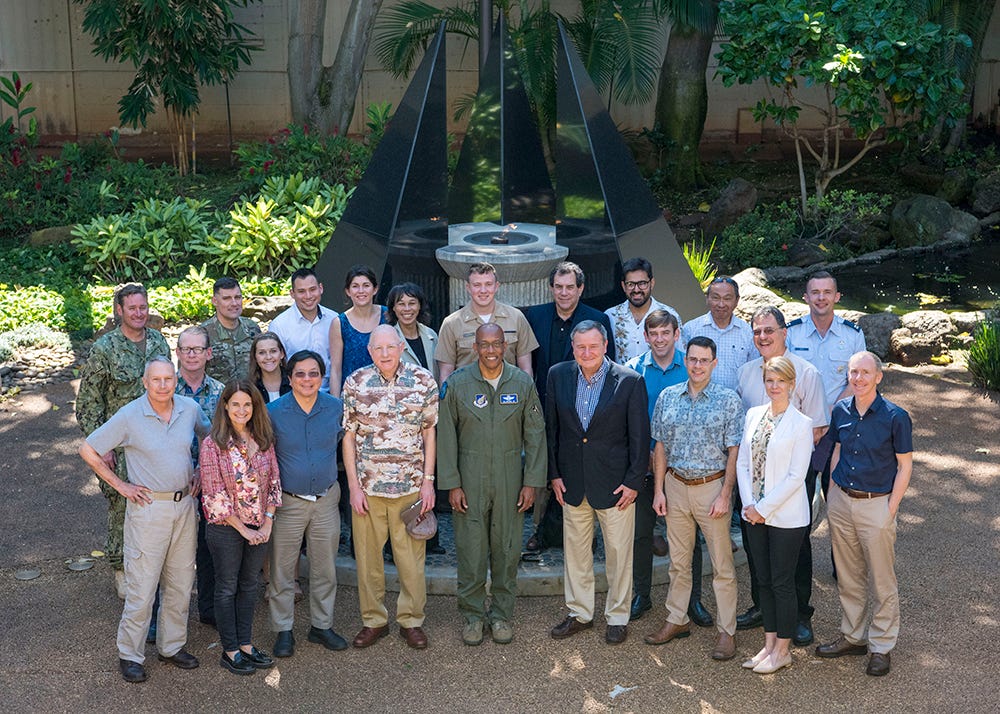
A group of 20 faculty and fellows participate in an orientation visit to Indo-Pacific Command headquarters, Honolulu, Hawaii, February 21–22, 2019, organized and sponsored by the U.S.-Asia Security Initiative. Photo courtesy of the U.S.-Asia Security Initiative

A group of 20 faculty and fellows participate in an orientation visit to Indo-Pacific Command headquarters, Honolulu, Hawaii, February 21–22, 2019, organized and sponsored by the U.S.-Asia Security Initiative. Photo courtesy of the U.S.-Asia Security Initiative

On February 21–22, faculty and fellows from Stanford University traveled to Oahu, Hawaii for an orientation visit at the United States Indo-Pacific Command (INDOPACOM), the U.S. military command responsible for the conduct of the U.S. military’s missions throughout the Indian and Pacific Oceans, and Asia.

The visit brought together scholars and researchers from Stanford, the Massachusetts Institute of Technology, the Council on Foreign Relations, and Macquarie University, Australia. Organized by the U.S.-Asia Security Initiative (USASI) and the Shorenstein Asia-Pacific Research Center at the Freeman Spogli Institute for International Studies (FSI), the visit included meetings with the commanders and staffs of INDOPACOM and five of its subordinate commands (U.S. Army Pacific, U.S. Pacific Fleet, U.S. Air Forces Pacific, U.S. Marine Forces Pacific, and U.S. Special Operations Command Pacific), and a tour of Arleigh Burke-class Aegis destroyer USS John Paul Jones (DDG-52).

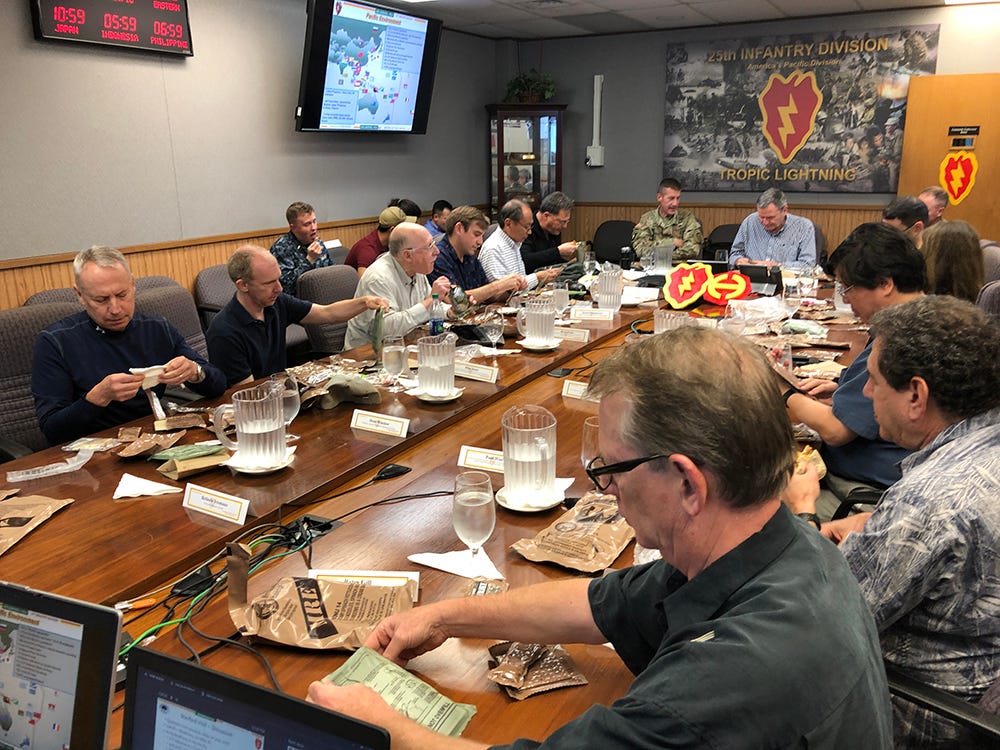
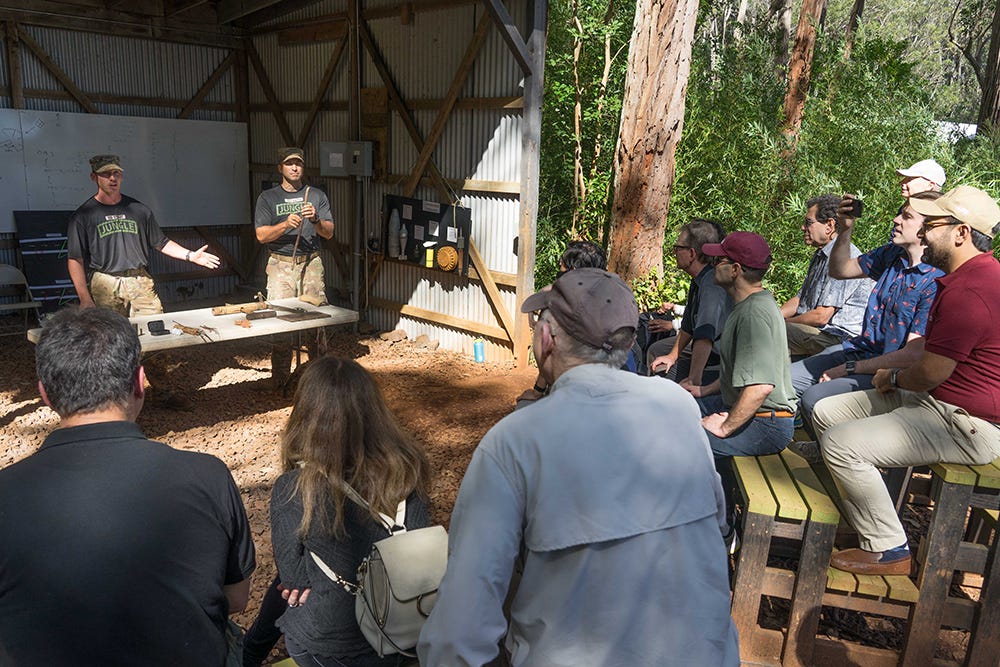
The visitors also interacted with the U.S. Army’s 25th Infantry Division’s leadership and the unit’s Jungle Training Center. The busy itinerary provided the group a superb opportunity to learn about INDOPACOM’s and its subordinate units’ threat assessments, capabilities, doctrine, regional partnerships, and readiness challenges.

These trips offer great access to America’s armed forces to those whose research focuses on or relates to national security issues, says Karl Eikenberry.

Karl Eikenberry, Director of the U.S.-Asia Security Initiative (USASI), a former U.S. ambassador to Afghanistan and himself a retired U.S. Army lieutenant general said: “USASI has over the past five years organized annual trips to U.S. military commands for Stanford FSI faculty and fellows. These trips offer great access to America’s armed forces to those whose research focuses on or relates to national security issues. The insights gained inform analysis, while the host organizations gain fresh perspectives different from those found within their commands.”

 
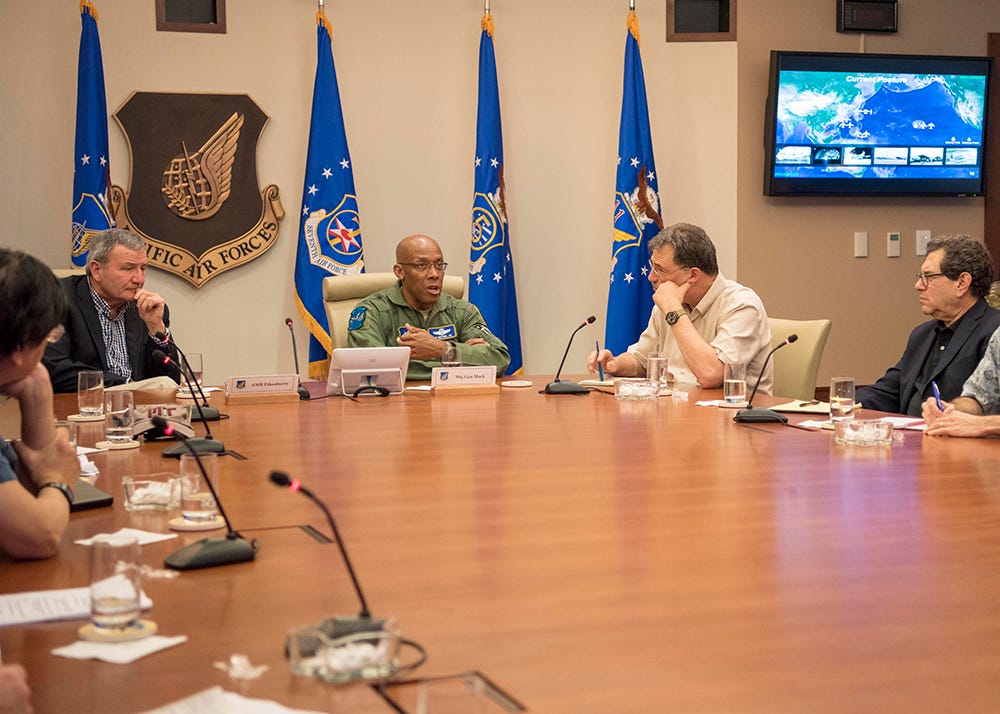
general speaks at a table
Photo courtesy of the U.S.-Asia Security Initiative

Discussions began on February 21st at Camp H.M. Smith, the Headquarters of INDOPACOM. Brigadier General Jonathan Braga, U.S. Army, SOCPAC Commander and his staff discussed his command’s unique capabilities and roles in both conventional and counterterrorist/counterinsurgency warfare operations. Major General Michael Minihan, U.S. Air Force, INDOPACOM Chief of Staff, then hosted a wide-ranging session on his organization’s implementation of the National Security Strategy and National Defense Strategy at a time of dynamic change within the region.

 
Table of attendees
Photo courtesy of Timothy R. Mungie

This was followed by a working lunch at the INDOPACOM Flag Mess with key staff members of MARFORPAC who explained U.S. Marine force posture and contingency missions throughout the Pacific Region. The Stanford group then proceeded to Hickam Field and met with General Charles Brown, Commander, PACAF, and his Deputy Commander, Major General Russell Mack. General Brown detailed the critical role played by airlift and airpower in the vast Indo-Pacific region, and the development of new concepts for the employment of U.S. Air Force capabilities in joint (inter-service) and combined (inter-allied) operations.

 
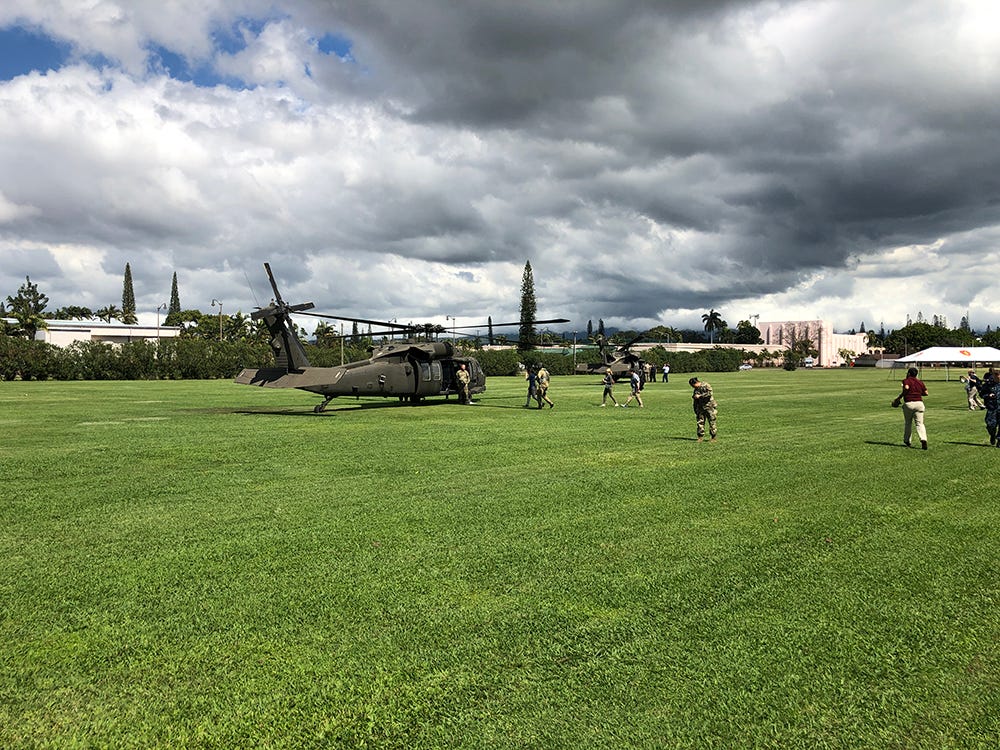
Helicopter parked in a field
Photo courtesy of Timothy R. Mungie

The visiting faculty and fellows then transited to Pearl Harbor for a tour of USS John Paul Jones led by Commanding Officer, Commander Jesse Mink, United States Navy, and Executive Officer, Commander Robert Watts, USN. Noteworthy was the destroyer’s sophisticated integrated air, surface, and underseas warfare systems, and the emphasis placed on resilience in high-end combat situations. Following the ship tour, the group attended a PACFLT command briefing chaired by the Commander, Admiral John Aquilino.

The dialogue made clear PACFLT’s emphasis on a holistic approach to deterrence and decisive operations, with an eye on future requirements. The first day of the trip ended with a working reception at the historic “Nimitz House” hosted by Admiral Aquilino, offering the attendees a chance to engage in conversations with the Commander and his staff.

The second day of the trip began with an introduction to the Daniel K. Inouye Asia-Pacific Center for Security Studies (APCSS), followed by expert presentations and breakout sessions on select topics including the Chinese One Belt One Road plan, the security of Taiwan, pandemic threats in the Indo-Pacific region, and cyber operations. The Stanford team then traveled to Fort Shafter for a meeting with Brigadier General Pete Andrysiak, U.S. Army and Chief of Staff, USARPAC. BG Andrysiak and the USARPAC staff elaborated on the evolving U.S. Army’s regional doctrine and extensive partnership activities.

A highlight of the group’s time in Oahu came with a visit to the U.S. Army’s 25th Infantry Division at Schofield Barracks, and the 25th ID Jungle Training center via UH-60 Blackhawk Helicopters. There Brigadier General J.B. Vowell, Assistant Division Commander, 25th Infantry Division and U.S. Army Hawaii (himself a former FSI Senior Military Fellow), discussed the division’s extensive missions throughout the region, including in the Korean Peninsula.

 
Atendees listen to a presenter
Photo courtesy of Francis Fukuyama

Faculty and fellows were also able to “get their boots (or at least tennis shoes) muddy” in the U.S. Army’s rugged training area in northern Oahu, with highly skilled soldiers demonstrating jungle warfare tactics and techniques. The trip ended with the participants hosting a reception at the Hale Koa Hotel Warriors Lounge for their many hosts over the past two days.

The trip to INDOPACOM Headquarters provided a rare opportunity for participants to talk directly with senior U.S. military leaders in the most important region of the world and to gain a better understanding of their perspectives and the many challenges that they are addressing. Faculty and fellows interacted with junior leaders at the tactical level, helping them gain an appreciation of the ethos of those serving at the cutting edge. The hosts all commented on the benefit of learning the views of scholars, many of whom have spent their academic careers writing about national security issues.

The trip provided fascinating insights into how the U.S. military views the rapidly evolving national security challenges in the Indo-Pacific region, says Larry Diamond.

“The trip provided fascinating insights into how the U.S. military views the rapidly evolving national security challenges in the Indo-Pacific region, and how it is organized to defend against the threats. You can read about much of this in the media and the journals, but there is just no substitute for being there, seeing our facilities on the ground, and engaging directly with the remarkable men and women (and one thing that struck me is that there are quite a number of women) who are responsible for our defense,” said Larry Diamond, senior fellow at the Hoover Institution and at the Center on Democracy, Development & the Rule of Law (CDDRL) at FSI.

FSI scholars particularly valued the opportunity to connect one-on-one.

“It was invaluable to meet and hear directly from the individuals and organizations who are working so hard to ensure our security,” said Center for International Security and Cooperation (CISAC) Senior Research Scholar Megan Palmer. For CISAC Pre-doctoral Fellow Erik Lin-Greenberg, “the opportunity to interact with decision-makers from tactical to strategic levels was incredibly valuable and helped inform my own research.”

Hero Image
pacaf hq photo Courtesy US-Asia Security Initiative
All News button
1
Authors
Gi-Wook Shin
News Type
Commentary
Date
Paragraphs

President Trump caught the world by surprise once again yesterday with a decision not to sign a deal with his North Korean counterpart, Chairman Kim Jong-un, in Hanoi, Vietnam. While walking away is a common tactic in working-level negotiation, what happened in Hanoi was a rare case and the least expected outcome.

Read the full article on Axios.

Hero Image
President Trump waves to camera at Hanoi Summit
President Trump at a news conference following his second summit with North Korean leader Kim Jong-un.
Tuan Mark via Getty Images
All News button
1
Subscribe to The Americas