


Ballots, Bullets, and Bargains: American Foreign Policy and Presidential Elections
Related Multimedia
Third Annual Stanford Summer Juku on Japanese Political Economy
News Type
News
Date
Paragraphs
The Japan Program held the third annual Stanford Summer Juku on Japanese Political Economy from August 10-13. Over 40 scholars from various parts of the US and Japan participated in the conference, which took place at the Bechtel Conference Center at Encina Hall. The first two days focused on political science and the second day on economics. Distinctive features of the Summer Juku are the long times allotted to each paper to allow for two in-depth discussants and discussion among participants, as well as ample time for informal discussions and interactions among participants allowing for collaborations and expansion of the network of researchers on Japan in political science and economics. Particularly notable this year was a large number of cross-disciplinary and cross-national collaborations between scholars ranging from political science, economics, management, infomatics, and medicine.
The first day included four papers in political science. Amy Catalinac from New York University presented her paper, "Positioning Under Alternative Electoral Systems: Evidence from 7,497 Japanese Candidate Election Manifestos", with discussants Gary Cox (Stanford) and Harukata Takenaka (National Graduate Institute for Policy Studies, Japan).
Daniel Smith (Harvard University) presented a paper co-authored by Yusaku Horiuchi (Dartmouth College) and Teppei Yamamoto (MIT) entitled "Identifying Multidimensional Policy Preferences of Voters in Representative Democracies: A Cojoint Field Experiment in Japan". The Discussants for the paper were Kay Shimizu (Columbia University) and Karen Jusko (Stanford).
Harukata Takenaka from the National Graduate Institute for Policy Studies presented his paper on “Changes in Power of Japanese Prime Minister: Still Away from a Westminster Model.” Tsuneo Akaha (Middlebury Institute of International Studies at Monterey) and Kenji Kushida (Stanford University) were the discussants.
The fourth paper was “Territorial Issues and Support for the Prime Minister: A survey Experiment on Rally-‘Round-the Flag Effect in Japan” by Tetsuro Kobayashi (National Institute of Informatics, Japan) and Azusa Katagiri (Stanford), discussed by Tsuneo Akaha (Middlebury Institute of International Studies at Monterey) and Daniel Smith (Harvard).
The second day focused on political economy and international relations. Gene Park (Loyola Marymount University, and former Shorenstein Fellow at APARC) presented his paper co-authored with Saori Katada (University of Southern California) and Giacomo Chiozza (Vanderbilt University) entitled “Policy ideas and monetary policy: The Bank of Japan's delayed break with the monetary orthodoxy". Discussants were Azusa Katagiri (Stanford) and Ayako Saiki (De Netherlandsche Bank).
The second paper of the day was "The Political Economy of the Trans-Pacific Partnership: Implications beyond Economics" by Hiroki Takeuchi (Southern Methodist University), discussed by Kay Shimizu (Columbia University) and Gene Park (Loyola Marymount University).
After lunch, Llewelyn Hughes (Australian National University) presented "Lead Markets, Vertical Specialization, and Standards Competition in Electric Vehicles" with discussants Kenji Kushida (Stanford University) and Phillip Lipscy (Stanford University). The final session was "Renegotiating the World Order: Institutional Change in International Relations” which were select chapters from a book manuscript by Phillip Lipscy (Stanford University). The discussants were Amy Catalinac (New York University) and Llewelyn Hughes (Australian National University). A group dinner followed the second day.
The third day was the kick-off for economics papers, where we also saw cross-disciplinary collaborations with colleagues from the US and Japan.
Karen Eggleston (Stanford University) presented “Medical spending and health care utilization in Japan, 2010-2014: Projections from Future Elderly Model microsimulation”, which was co-authored by Hawre Jajal (Stanford University), Brian K. Chen (University of Southern California), Hideki Hashimoto (University of Tokyo), Toshiaki Iizuka (University of Tokyo), Lena Shoemaker (Stanford University), and Jay Bhattacharya (Stanford University). Yong Suk Lee (Stanford University) was the discussant.
The second paper, "The adverse effects of value-based purchasing in health care: dynamic quantile regression with endogeneity" by Galina Besstremyannaya (Visiting Scholar, Stanford University), was discussed by Jay Battacharya (Stanford University) and Takeo Hoshi (Stanford University).
The third paper was ""How Do Agricultural Markets Respond to Radiation Risk? Evidence from the 2011 Disaster in Japan" by Kayo Tajima (Rikkyo University), Masashi Yamamoto (University of Toyama), and Daisuke Ichinose (Rikkyo University). Discussants for the paper presented by Tajima were Satoshi Koibuchi (Chuo University and Visiting Scholar, Stanford University) and Yong Suk Lee (Stanford University).
The final paper for the third day was "Shocks and Shock Absorbers in Japanese Bonds and Banks During the Global Financial Crisis" by Hyonok Kim (Tokyo Keizai University), Yukihiro Yasuda (Hitotsubashi University), and James A. Wilcox (University of California, Berkeley). Discussants were Sabrina Howell (New York University) and Suparna Chakraborty (University of San Francisco).
The final day included two papers. The first was "Impact of Financial Intermediary's Information Production on Market Value of Firm: Case Studies on the DBJ's Liquidity Providing During the Financial Crisis and the Environmental Rating of Firm" by Hiroaki Suzuoka (Development Bank of Japan), Atsushi Motohashi (Development Bank of Japan), Shinya Nakamura (Development Bank of Japan), Tomoya Maruoka (Development Bank of Japan), and Takamasa Uesugi (Development Bank of Japan), presented by Takamasa Uesugi. Discussants were Jess Diamond (Hitotsubashi University) and Masami Imai (Wesleyan University). The final paper was "Selective Disclosure: The Case of Nikkei Preview Articles" by William N. Goetzmann (Yale School of Management), Yasushi Hamao (University of Southern California), and Hidenori Takahashi (Kobe University), presented by Yasushi Hamao. Eiichiro Kazumori (University of Buffalo) was the discussant.
After the completion of four days of Summer Juku, participants who had enough time before their flights held an “uchiage” (completion celebration) gathering—a tradition at the conclusion of the Summer Juku—at “The Patio” in downtown Palo Alto for further informal exchange over drinks and appetizers.
Hero Image

All News button
1
Stanford Summer Juku 2015
-
Stanford Summer Juku on Japanese Political Economy (SSJ-JPE)
August 10-13, 2015
Oksenberg Conference Room
Stanford Japan Program at Shorenstein Asia-Pacific Research Center
The Japan Program at the Walter H. Shorenstein Asia-Pacific Research Center (S-APARC) at Stanford University started Stanford Summer Juku (SSJ) in 2013. In SSJ, researchers on Japanese politics and Japanese economy get together and discuss their research in a relaxed setting. The third annual meeting is held at Stanford on August 10-13, 2015. The first two days again focus on research in political science/political economy and international relations, and the latter two days focus on research in economics and business.
Takeo Hoshi, Kenji E. Kushida, Phillip Lipscy
Report - Stanford Summer Juku 2015
Program
8/10/2015
8:30-9:00 Breakfast
9:00-10:15 Session I:
"Positioning Under Alternative Electoral Systems: Evidence from 7,497 Japanese Candidate Election Manifestos", Amy Catalinac (Harvard University)
Discussants:
Gary Cox (Stanford University)
Harukata Takenaka (National Graduate Institute for Policy Studies)
10:15-10:45 Break
10:45-12:00 Session II:
"Identifying Multidimensional Policy Preferences of Voters in Representative Democracies: A Cojoint Field Experiment in Japan", Yusaku Horiuchi (Dartmouth College), Daniel Smith (Harvard University), and Teppei Yamamoto (Massachusetts Institute of Technology)
Discussants:
Kay Shimizu (Columbia University)
Karen Jusko (Stanford University)
12:00-1:00 Lunch
1:00-2:15 Session III:
"Changes in Power of Japanese Prime Minister: Still Away from a Westminster Model", Harukata Takenaka (National Graduate Institute for Policy Studies)
Discussants:
Tsuneo Akaha (Middlebury Institute of International Studies at Monterery)
Kenji Kushida (Stanford University)
2:15- 3:30 Session IV:
"Territorial Issues and Support for the Prime Minister: A Survey Experiment on Rally-‘Round-the Flag Effect in Japan", Tetsuro Kobayashi (National Institute of Informatics, Japan), Azusa Katagiri (Stanford University)
Discussants:
Tsuneo Akaha (Middlebury Institute of International Studies at Monterery)
Daniel Smith (Harvard University)
8/11/2015
8:30-9:00 Breakfast
9:00-10:15 Session I:
"Institutions and central bank norm diffusion: The Bank of Japan's delayed break with the monetary orthodoxy", Gene Park (Loyola Marymount University), Saori Katada (University of Southern California), Giacomo Chiozza (Vanderbilt University)
Discussants:
Azusa Katagiri (Stanford University)
Ayako Saiki (De Netherlandsche Bank)
10:15-10:45 Break
10:45-12:00 Session II:
"The Political Economy of the Trans-Pacific Parternship: Implications beyond Economics", Hiroki Takeuchi (Southern Methodist University)
Discussants:
Kay Shimizu (Columbia University)
Gene Park (Loyola Marymount University)
12:00-1:00 Lunch
1:00-2:15 Session III:
"Lead Markets, Vertical Specialization, and Standards Competition in Electric Vehicles", Llewelyn Hughes (George Washington University)
Discussants:
Kenji Kushida (Stanford University)
Phillip Lipscy (Stanford University)
2:15-3:30 Session IV:
"Renegotiating the World Order: Institutional Change in International Relations (select chapters from book manuscript)", Phillip Lipscy (Stanford University)
Discussants:
Amy Catalinac (Harvard University)
Llewelyn Hughes (George Washington University)
6:30 Group Dinner at Gravity Bistro and Wine Bar (544 Emerson St, Palo Alto, CA 94301)
8/12/2015
8:30-9:00 Breakfast
9:00-10:15 Session I:
"Medical spending and health care utilization in Japan, 2010-2040: Projections from a Future Elderly microsimulation", Hawre Jajal (Stanford University), Brian K. Chen (University of Southern California), Karen Eggleston (Stanford University), Hideki Hashimoto (University of Tokyo), Toshiaki Iizuka (University of Tokyo), Lena Shoemaker (Stanford University), and Jay Bhattacharya (Stanford University)
Discussants:
Yong Suk Lee (Stanford University)
TBD
10:15-10:45 Break
10:45-12:00 Session II:
"The adverse effects of value-based purchasing in health care: dynamics quantile regression with endogeneity", Galina Besstremyannaya (Visiting Scholar, Stanford University)
Discussants:
Jay Battacharya (Stanford University)
Takeo Hoshi (Stanford University)
12:00-1:00 Lunch
1:00-2:15 Session III:
How Do Agricultural Markets Respond to Radiation Risk? Evidence from the 2011 Disaster in Japan", Kayo Tajima (Rikkyo University), Masashi Yamamoto (University of Toyama), and Daisuke Ichinose (Rikkyo University)
Discussants:
Satoshi Koibuchi (Chuo University and Visiting Scholar, Stanford University)
Yong Suk Lee (Stanford University)
2:15-3:30 Session IV:
"Shocks and Shock Absorbers in Japanese Bonds and Banks During the Global Financial Crisis", Hyonok Kim (Tokyo Keizai University), Yukihiro Yasuda (Hitotsubashi University), and James A. Wilcox (University of California, Berkeley)
Discussants:
Sabrina Howell (New York University)
Suparna Chakraborty (University of San Francisco)
8/13/2015
8:30-9:00 Breakfast
9:00-10:15 Session I:
"Impact of Financial Intermediary's Information Production on Market Value of Firm: Case Studies on the DBJ's Liquidity Providing During the Financial Crisis and the Environmental Rating of Firm", Hiroaki Suzuoka (Development Bank of Japan), Atsushi Motohashi (Development Bank of Japan), Shinya Nakamura (Development Bank of Japan), Tomoya Maruoka (Development Bank of Japan), and Takamasa Uesugi (Development Bank of Japan)
Discussants:
Jess Diamond (Hitotsubashi University)
Masami Imai (Wesleyan University)
10:15-10:45 Break
10:45-12:00 Session II:
"Selective Disclosure: The Case of Nikkei Preview Articles", William N. Goetzmann (Yale School of Management), Yasushi Hamao (University of Southern California), and Hidenori Takahashi (Kobe University)
Discussants:
Eiichiro Kazumori (University of Buffalo)
TBD
12:00-1:00 Lunch
Stanford scholar explores how the US election system shapes foreign policy
News Type
News
Date
Paragraphs
A podcast from the book event on Jan. 15 is available at the link above. An earlier interview with author Michael Armacost was first published in Oct. 2015 and is reposted below.
When it comes to elections, politics can supersede strategy. But what is often overlooked is the process through which the United States selects their commander in chief and its impact on policy – particularly, foreign policy.
What then shapes foreign policy during that time? “Events, my dear boy, events,” Harold Macmillan, a former British prime minister, famously replied when asked what could change a government's directions. To which Michael Armacost agrees and explores the interplay between campaign politics and foreign policy in his new book.
“Since World War II, the United States has consistently pursued a global role, but the tempo of its engagement with the world has been repeatedly adjusted to reflect circumstances and domestic moods,” Armacost wrote.
A veteran scholar, former ambassador and undersecretary of state for political affairs, Armacost is an expert on the U.S. government system and policy process. In the book, he examines ideology and the struggle for power in the six elections that have taken place since 1948, ending with Barack Obama’s re-election in 2012.
The book, which reads somewhat like a guide, largely began as a project for students, he said.
Armacost initially came to Stanford in 1994, and in 2002, returned as a distinguished fellow at the Walter H. Shorenstein Asia-Pacific Research Center. He co-teaches a graduate course on U.S. policy in Northeast Asia.
“When I left government, I found a lot of literature on how foreign policy affects elections but little in the reverse,” Armacost said. “So my aim behind the research was to not only satisfy my own curiosity but to offer a comprehensive and accessible analysis for students.”
Armacost’s career in government began in 1983 when an advisor encouraged him to apply for a White House fellowship. His fellowship in the deputy secretary of state’s office – which was only set to be a single year in Washington – led to 24 years of public service.
He went on to serve as the U.S. ambassador to Japan from 1989 to 1993 and the Philippines from 1982 to 1984, and was a member of the National Security Council.
Armacost said he remains positive about the electoral system, while also suggesting a few reforms. The system ensures a cyclical chance to step back and assess where America stands in the world, he said.
“Our system provides regular opportunities to put the spotlight on troubling foreign policy problems,” he wrote. “And supplies an incentive to consider course corrections for costly, inconclusive foreign as well as domestic policies, or offers a chance to select new management to fix them.”
Shorenstein APARC asked him a few questions about his research in the context of the 2016 election cycle. His answers are posted below.
Will Obama attempt a “sprint to the finish line” on foreign policy?
He is well embarked on that sprint. In the fourth quarter of his presidency, he is eager to burnish his foreign policy legacy. President Obama’s agenda is clear. It includes the normalization of relations with Cuba, implementation of the Iran nuclear agreement, ratification of the Trans-Pacific Partnership free trade agreement, and promotion of further international cooperation on climate change. He will also seek to avoid losing ground in geopolitical competition with ISIS in Iraq and Syria, the Russians in the Ukraine and elsewhere, and China in the South China Sea.
A president’s power to effectively undertake controversial initiatives at home and abroad tends to ebb as his tenure runs out. Those requiring Congressional support are particularly problematic. And events will play a large role in determining the problems and opportunities that come his way before Jan. 20, 2017.
Does the Trans-Pacific Partnership (TPP) stand a chance of getting ratified?
It stands a chance, but it will not be easy. Fortunately, Trade Promotion Authority has been secured from the Congress. Hence, it will be limited to an up or down vote without amendments.
Opposition from labor unions and environmental groups assures that there will be very limited Democratic support for the TPP, and Hillary Clinton, Bernie Sanders and Martin O’Malley have publicly expressed their opposition. There has also been some erosion of support for free trade among the Republicans, whose leaders have mostly expressed misgivings about some of the TPP’s provisions.
I believe the TPP will advance U.S. economic and strategic interests, but whether its ratification will be achieved before or after the 2016 election is at this point uncertain.
How do the politics of the TPP differ from that of George H.W. Bush’s pursuit of the NAFTA agreement in 1992?
In 1992 President Bush didn’t hesitate to push hard for NAFTA throughout his campaign. And the Mexican and Canadian governments also regarded the U.S. election day as a convenient deadline for getting the agreement finished. The president’s GOP Party believed in free trade, and considered the push for an embryonic hemispheric market a worthy and historic objective. A NAFTA accord could be portrayed as extending a helping hand to a friendly neighbor. The Party’s business constituency was supportive; the bulwark of opposition to the deal were labor and environmental groups, which were unlikely to vote for Bush anyway.
Promoting NAFTA also offered the president a chance to put the Democratic candidate, Bill Clinton, who had made public remarks supporting such an agreement, on the spot. If he reversed his position and opposed the accord, he could be accused of “waffling;” if he didn’t, he would risk alienating his labor and environmental constituencies. Bush nearly got the deal finished, but side letters on labor and environmental issues remained to be completed after Clinton won the election.
This year, a Democratic president is confronting major opposition from his own party, and widespread support from Congressional Republicans is therefore indispensable to his chances of ratifying the agreement. A number of Republican leaders who are generally supportive of free trade, however, contend that President Obama was so eager to wrap up the deal on his own watch, that he missed a chance to drive a harder bargain. Others are reluctant to hand the president a foreign policy victory during a presidential campaign.
And as November 2016 nears, the Democratic candidate is likely to be reluctant to buck unions and environmental groups who not only provide much needed financial support, but supply the volunteers who perform crucial “get out the vote” duties on election day.
Where does foreign policy fit into the 2016 campaign?
Foreign policy is likely to feature very prominently in the coming election, particularly if the economy continues its steady, if modest, rate of growth. The reason is simple. The United States faces serious challenges in the Middle East, the Ukraine, South Asia and the South China Sea. And many voters who favored retrenchment in 2008, now fear it is now perceived increasingly by friends and adversaries as weakness and/or retreat.
One should not, however, expect the presidential campaign to illumine the strategic choices we face abroad. Presidential contenders typically articulate a wide range of aspirational foreign policy goals. But they rarely outline priorities among these declared aims, let alone their potential costs and risks, or the trade-offs among them. To address these core elements of strategy might offend one or another potential voting bloc. Candidates, therefore, tend to focus upon the appeal of their foreign policy objectives at home, rather than their efficacy abroad.
A wide field of candidates has emerged early on. What foreign policy issues are not being addressed that should figure in the debates?
It’s a bit early to say. The first primaries are still three months away. Few debates have yet been held. The election is likely in any event to be in part a referendum on President Obama’s record. But Hillary Clinton, who served for four years as the Secretary of State, is differentiating her position from that of Obama’s on a number of foreign policy matters. And as I noted above, the focus in most campaigns is on laudable goals rather than the key elements of strategy, i.e. the operational tests of foreign policy for anyone who occupies the Oval Office.
What will happen to the U.S. “pivot back to Asia” strategy?
President Obama performed a useful service in underlining America’s growing stake in Asia. I would expect the candidates of both major parties to affirm their intent to devote more time, attention and resources to the Asia-Pacific region. The problems the current administration has experienced in Asia are a by-product of the policy’s implementation. Many Asian leaders wonder whether the policy has been forgotten or overtaken by events. Adjustments in our regional security policy have been essentially symbolic.
With China, we are still looking for a sustainable balance between constructive engagement and prudent hedging. The diplomatic opening to Myanmar was timely, but progress has been complicated by ethnic struggles in that country. American leaders visit Asia periodically, but the United States is still perceived as primarily preoccupied with problems in the Middle East. Conclusion of the TPP will lend credibility to the policy, but only if the agreement is ratified. So it will be up to the next president to put some meat on the bones of this strategic initiative.
How do election cycles in the United States and South Korea mesh, and what might the coming cycle mean for U.S.-Korean relations?
America has a four-year election cycle for the presidency. The Republic of Korea elects its presidents for a five-year term. We have experienced several occasions when our cycles appeared out of sync, i.e. when the United States elected more conservative candidates to the White House as the Koreans chose more liberal contenders for the Blue House. George W. Bush, a conservative, served during a period when the South Korean presidents – Kim Dae Jung and Roh Moo-Hyun – were both liberals or progressives. American and South Korean perspectives on policy toward North Korea diverged sharply. Nonetheless, they joined hands in launching the U.S.-Korea Free Trade Agreement, and formulated plans for a major redeployment of U.S. military forces away from the Seoul metropolis to bases further south. And President Obama, a liberal, fashioned a close relationship with Presidents Lee Myung-bak and Park Geun-hye, both conservatives.
Thus, shared national interests have a way of tempering the ideological predilections of our respective leaders, enabling them to collaborate when dangers loom or when opportunities beckon.
South Korea now trades twice as much with China as it does with the United States and Japan combined. So its economy is tied more closely to China now, though it still looks to Washington for protection. Seoul will not want to choose between its economic interests and its strategic concerns. The United States has no reason to force such a choice on its ally, but it is clear that Beijing hopes to use its economic leverage to influence the Republic of Korea’s strategic decisions, for example, its readiness to deploy a THAAD, high altitude ballistic missile defense system. This is the kind of issue that could feed back into our election-year politics.
Related links
WNYC Brian Lehrer Show (Audio): How Elections Derail Foreign Policy (Aug. 4, 2015)
Hero Image

All News button
1
Security and foreign policy leaders call for global climate action
News Type
News
Date
Paragraphs
Forty-eight national security and foreign policy leaders urged U.S. government and businesses to take action to fight climate change in a statement released by the Partnership for a Secure America. Thomas Fingar, a distinguished fellow in the Freeman Spogli Institute for International Studies, is a signatory. The statement can be accessed by clicking here.
Hero Image

All News button
1
FSI welcomes Senior Military Fellows
News Type
News
Date
Paragraphs
The Freeman Spogli Institute for International Studies has welcomed five new senior military fellows, including three active duty lieutenant colonels from the U.S. Air Force and two from the U.S. Army, who will spend the next academic year at Stanford pursuing self-directed study of important national issues.
Former U.S. Secretary of Defense and CISAC faculty member Bill Perry created the program to give military officers the opportunity to take a deep dive into an area of strategic interest.
The fellows will be considering a diverse range of topics, from how to adapt Silicon Valley’s innovative work culture to the Army, to China’s actions in the South China Sea, and the effectiveness of U.S. economic sanctions against North Korea.
You can learn more about our fellows’ military backgrounds and the intended focus of their studies from the brief bios below.
John Cogbill and Scott Maytan will be assigned to the Center for International Security and Cooperation.
John Chu, Ryan Blake and Jose Sumangil will be based at the Walter H. Shorenstein Asia-Pacific Research Center.
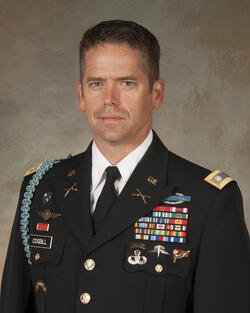 LTC John Cogbill
LTC John Cogbill was commissioned as an Infantry officer from the United States Military Academy in 1994 and has held a variety of positions in both conventional and special operations units. John’s first assignment was as a Platoon Leader and Executive Officer in the 82nd Airborne Division. John then served two years in the 1st Battalion, 75th Ranger Regiment as a Platoon Leader and Civil-Military Affairs Officer. Next, John served three years in Alaska as an Airborne Rifle Company Commander and the Aide-de-Camp to the Commanding General. After earning his MPA from the Harvard Kennedy School, John taught Economics in the Social Sciences Department at West Point. Following the Command and General Staff College, he spent two years as a Combined Arms Battalion Executive Officer in the 1st Cavalry Division. He then served as the Strategic Plans and Requirements Officer for the 75th Ranger Regiment. Most recently, John commanded the Reconnaissance and Surveillance Squadron for the U.S. Army Third Corps. John has deployed on three combat and two peacekeeping missions, including two tours in Iraq, one tour in Afghanistan, one tour in Haiti, and a recent tour in Kosovo. He will be exploring how the Army can encourage innovation and use emerging technologies to achieve and maintain a competitive advantage on the battlefield.
 Lt Col Scott Maytan, U.S. Air Force
Lt Col Scott Maytan was the commander of a B-52H operational bomb squadron, responsible for ensuring combat mission readiness for any worldwide nuclear or conventional tasking. Lt Col Maytan is a navigator with over 2500 flying hours, primarily in the B-52H, and is a graduate of both the Command and General Staff College (U.S. Army) and the U.S. Air Force Weapons School. He has served four operational assignments, as an advanced tactics instructor, and also a tour at the Pentagon where he developed Air Force positions concerning long-range strike and aircraft nuclear requirements. Lt Col Maytan has served three combat deployments for Operations Desert Fox (Southern Watch), Allied Force and Iraqi Freedom and has also deployed four times supporting USPACOM’s Continuous Bomber Presence mission. Maytan will be studying the “red-lines” that shape Western deterrence posture, and how strategic action and deterrence posture in one region affects others.
 LTC John Chu, U.S. Army
LTC John Chu is an active duty officer in the United States Army. Chu has held a variety of leadership and staff positions in his 20 year career. Most recently, he served as the Chief of Intelligence Training at the Department of the Army. Chu has twice been deployed to Iraq and once to Bosnia, with multiple assignments to South Korea, Germany and Turkey. Born in Seoul, he grew up in California and graduated from West Point in 1995. At Stanford, Chu is researching the Korean armistice agreement and the United Nations mission to South Korea. He will also examine U.S. policy toward North Korea, particularly analyzing the “brink of war” tension and developing strategic deterrence measures to reduce risk of unwanted military escalation on the Korean Peninsula. For both research streams, Chu aims to produce analyses and recommendations that could inform a policy audience.
 Lt Col Ryan Blake, U.S. Air Force
Lt Col Ryan Blake is an active duty officer in the United States Air Force. Blake was the commander of a flight test squadron where he was responsible for the flight test of new Air Force programs. He has over 2,400 flying hours in over 40 types of aircraft, and has held two operational F-15E assignments, including combat deployments in support of Operations Southern Watch, Iraqi Freedom and Enduring Freedom. He had also been positioned at the Pentagon in defense acquisition and the Office of Security Cooperation in Baghdad. At Stanford, Blake is researching the U.S. policy toward China and its relation to Northeast Asia. He aims to discover areas of cooperation between the U.S. and Chinese militaries.
 Lt Col Jose “Ed” Sumangil, U.S. Air Force
Lt Col Jose “Ed” Sumangil is an active duty officer in the United States Air Force. During his career, Sumangil has served in a range of operational assignments, including joint staff officer at U.S. Strategic Command where he was a lead planner of the command’s space campaign. Before coming to Stanford, he was the commander of a B-1 squadron and led airmen through combat deployments in support of Operations Enduring Freedom, Inherent Resolve and Freedom’s Sentinel. At Stanford, Sumangil is examining China’s actions in the South China Sea and the Philippines arbitration case regarding Chinese actions there. He seeks to offer perspectives and policy and strategy options to maintain peace and stability in the South China Sea.
Hero Image

All News button
1

David Lee Kuo Chuen
Encina Hall E301616 Serra StreetStanford, CA94305-6055
(650) 796-3699
(650) 723-6530
0
kuochuen@stanford.edu
david_lee.png
Ph.D.
David LEE Kuo Chuen joins the Walter H. Shorenstein Asia-Pacific Research Center (APARC) as visiting scholar for the fall of 2015. He is currently the Director of Sim Kee Boon Institute for Financial Economics. He holds the appointment of Practice Professor of Quantitative Finance, Lee Kong Chian School of Business, in Singapore Management University. He is also the founder of Ferrell Asset Management Group.
His research interests encompass digital and Internet finance, digital banking, Asia finance, impact investing, financial inclusion and asset allocation. During his time as a Fulbright Scholar at Shorenstein APARC, his research will focus on harnessing Silicon Valley technology for connectivity and financial inclusion in ASEAN and Singapore.
David is also an Independent Director of two SGX-listed companies and sits on the Investment Committee and Council of two charitable organizations. He is the Vice President of the Economic Society of Singapore. He was the Founding Vice Chairman of the Alternative Investment Management Association (Singapore Chapter), a member of the SGX Security Committee, and MAS Financial Research Council. He was also the Group Managing Director of OUE Limited and Auric Pacific Limited, as well as the Non-Executive Chairman of MAP Technology Limited.
David speaks frequently in international conferences with occasional appearances in Bloomberg, Reuters and Channel NewsAsia. He has published in Financial Analyst Journal, Journal of Investing, Journal of Wealth Management, Journal of Statistical Computation and Simulation, Applied Financial Economics, and several books and chapters on Household Economics and Hedge Funds. His two books on Asia Finance focus on Banking, Sovereign Wealth Funds, REITs, Financial Trading & Markets, and Fund Performance. His latest book is on Digital Currency.
He graduated from the London School of Economics and Political Science with a BSc (Econs), MSc (Mathematical Economics and Econometrics) and a PhD in Econometrics and Mathematical Economics.
Visiting Scholar, Fulbright Fellow
Ballots, Bullets, and Bargains: American Foreign Policy and Presidential Elections
Paragraphs
Drawing on twenty-four years of experience in government, Michael H. Armacost explores how the contours of the U.S. presidential election system influence the content and conduct of American foreign policy. He examines how the nomination battle impels candidates to express deference to the foreign policy DNA of their party and may force an incumbent to make wholesale policy adjustments to fend off an intra-party challenge for the nomination. He describes the way reelection campaigns can prod a chief executive to fix long-neglected problems, kick intractable policy dilemmas down the road, settle for modest course corrections, or scapegoat others for policies gone awry.
Armacost begins his book with the quest for the presidential nomination and then moves through the general election campaign, the ten-week transition period between Election Day and Inauguration Day, and the early months of a new administration. He notes that campaigns rarely illuminate the tough foreign policy choices that the leader of the nation must make, and he offers rare insight into the challenge of aligning the roles of an outgoing incumbent (who performs official duties despite ebbing power) and the incoming successor (who has no official role but possesses a fresh political mandate). He pays particular attention to the pressure for new presidents to act boldly abroad in the early months of his tenure, even before a national security team is in place, decision-making procedures are set, or policy priorities are firmly established. He concludes with an appraisal of the virtues and liabilities of the system, including suggestions for modestly adjusting some of its features while preserving its distinct character.
All Publications button
1
Publication Type
Books
Publication Date
Journal Publisher
Columbia University Press