-

Co-sponsored by Shorenstein Asia-Pacific Research Center (APARC) and US-Asia Technology Management Center

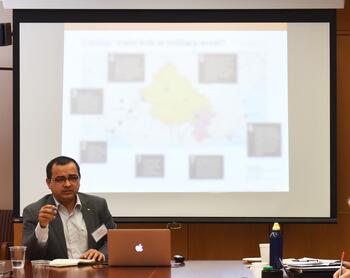
We need alternative metrics to complement GDP in order to get a more comprehensive view of development and ensure informed policy making that doesn’t exclusively prioritize economic growth. As a step in this direction, India is also beginning to focus on the ease of living of its citizens. Ease of living is the next step in the development strategy for India, following the push towards ease of doing business that the country has achieved over the last few years. The Ministry of Housing and Urban Affairs has developed the Ease of Living Index to measuring quality of life of its citizens across Indian cities, as well as economic ability and sustainability. It is as well expected to evolve into a measurement tool to be adopted across districts. The end goal is to have a more just and equitable society that is economically thriving and offering citizens a meaningful quality of life. The talk will focus on how we can bridge the divide between economic objectives and social objectives.

Image
Amit Kapoor
Amit Kapoor, PhD  In addition to the roles listed above, Dr. Kapoor is also president of India Council on Competitiveness, and chair for the Social Progress Imperative & Shared Value Initiative in India. He is also affiliate faculty for the Microeconomics of Competitiveness & Value Based Health Care Delivery courses of Harvard Business School’s Institute of Strategy and Competitiveness, and an instructor with Harvard Business Publishing in the area of Strategy, Competitiveness and Business Models.

Amit is the author of bestsellers Riding the Tiger: How to Execute Business Strategy in India (Random Business) and The Age of Awakening: The Story of the Indian Economy Since Independence (Penguin Books), and editor-in-chief of the quarterly thought leadership magazine Thinkers.

For his full biography, visit amitkapoor.com.

Amit Kapoor, PhD, <i>Honorary Chairman at Institute for Competitiveness, India; Visiting Scholar at Stanford University</i>
Seminars
-

More than 80% of cardiovascular diseases (CVD) and diabetes mellitus (DM) burden now lies in low and middle-income countries. Thus, there is an urgent need to identify and implement the most cost-effective interventions, particularly in the resource-constraint South Asian settings. A 2018 systematic review evaluated the cost-effectiveness of individual-level, group-level and population-level interventions to control CVD and DM in South Asia. Of the 2949 identified studies through a search of 14 electronic databases up to 2016, 42 met full inclusion criteria. Critical appraisal of studies revealed 15 excellent, 18 good and 9 poor quality studies. Most studies were from India (n=37), followed by Bangladesh (n=3), Pakistan (n=2) and Bhutan (n=1). The economic evaluations were based on observational studies (n=9), randomised trials (n=12) and decision models (n=21). Together, these studies evaluated 301 policy or clinical interventions or combination of both. We found a large number of interventions were cost-effective aimed at primordial prevention (tobacco taxation, salt reduction legislation, food labelling and food advertising regulation), and primary and secondary prevention (multidrug therapy for CVD in high-risk group, lifestyle modification and metformin treatment for diabetes prevention, and screening for diabetes complications every 2–5 years). Significant heterogeneity in analytical framework and outcome measures used in these studies restricted meta-analysis and direct ranking of the interventions by their degree of cost-effectiveness. The cost-effectiveness evidence for CVD and DM interventions in South Asia is growing, but most evidence is from India and limited to decision modelled outcomes. There is an urgent need for formal health technology assessment and policy evaluations in South Asia and other low- and middle- income countries using local research data.

Image
kavita
I am Dr. Kavita Singh, interested in global cardiometabolic disease epidemiology and economic evaluations of interventions for prevention and control of chronic diseases in low- and middle- income countries. I am an Epidemiologist by training, and work as a research scientist at the Public Health Foundation of India. My research work has primarily focused on evaluating the long-term effectiveness and cost-effectiveness of a multicomponent quality improvement intervention (consisting of decision-support electronic health records to enhance physician’s responsiveness and care coordinators to improve patient’s adherence to therapy) in 1,146 patients with type 2 diabetes attending 10 tertiary care clinics in India and Pakistan as part of the National Heart Lung Blood Institute funded CARRS Trial. Recently, I have been awarded the Emerging Global Leader Award (K43 grant, 2019-2024), funded by the National Institutes of Health, Fogarty International Centre to conduct a research project that aims to develop and test the feasibility of a multicomponent cardiovascular quality improvement strategy for patients with established cardiovascular diseases (CVD) in India.

Kavita Singh 2019-2020 Walter H. Shorenstein Asia-Pacific Research Center Visiting Scholar
Seminars
-

Given the significant health risks faced by households in developing countries, publicly provided health insurance may confer important benefits. Yet, demand for formal insurance is often found to be low. Since health insurance may be relatively unfamiliar to many households, understanding the factors that shape households’ demand for, and ability to utilize, insurance is important for research and policy. It is also important to understand the health and financial impacts of health insurance. We shed light on these questions using a two-stage randomized control trial in Karnataka, India. Many households are willing to pay for insurance. Households’ ability to successfully utilize the insurance is limited, however, especially when only a small fraction of the community has access to insurance. When a higher share of the community has access, households are more able to benefit, suggesting that harnessing community learning is important in designing the rollout of health insurance.

Image
kinnan photo 4x4
Cynthia Kinnan is an assistant professor of economics at Tufts University and a Research Associate of the NBER. She holds a Ph.D. in economics from MIT. Her research lies in the areas of economic development and social networks, with emphasis on understanding linkages between formal finance (including insurance and microcredit) and informal networks. She has been a recipient of research grants from the International Growth Centre, the Tata Centre for Development, and others. Her work has been featured in outlets including the Economist and the NBER Digest and been published in journals including the American Economic Review and the American Economic Journal – Applied Economics.

Advisory on Novel Coronavirus (COVID-19)

In accordance with university guidelines, if you (or a spouse/housemate) have returned from travel to mainland China in the last 14 days, we ask that you DO NOT come to campus until 14 days have passed since your return date and you remain symptom-free. For more information and updates, please refer to the Stanford Environmental Health & Safety website: https://ehs.stanford.edu/news/novel-coronavirus-covid-19

Cynthia Kinnan Assistant Professor of Economics, Tufts University and Research Associate of the NBER.
Seminars
Shorenstein APARCStanford UniversityEncina Hall E301Stanford, CA 94305-6055
0
Visiting Scholar at APARC
Winter 2020
Ph.D.

Kavita Singh joined the Walter H. Shorenstein Asia-Pacific Research Center (APARC) for the winter quarter of 2020 as a visiting scholar from the Public Health Foundation of India, where she serves as a research scientist at the Centre for Chronic Conditions and Injuries.  At APARC, she will be working with Dr. Karen Eggleston conducting research on diabetes management and health economics in South Asia.

-

In the eyes of China’s neo-authoritarian reformers, Singapore, despite being a tiny city-state, long exemplified a state of affairs for which the PRC should strive: resilient authoritarianism alongside but unweakened by liberalizing steps conducive to economic growth.  On behalf of Beijing’s effort to learn from Singapore, tens of thousands of officials visited the city-state and thousands of articles and books were written about it. Today, however, Xi Jiinping has derided foreign templates and relegated adopting the “Singapore model” to a path not taken by China’s current hard-line leadership and unavailable for authoritarian reformers to pursue. Although the demotion was triggered by Xi’s anti-reformism and China’s rise, Singapore’s loss of “model” character was also path-dependent. Chinese academics studying Singapore had long misunderstood fundamental institutional differences between the two countries that went back to the city-state’s colonial past and China’s Stalinist-Maoist revolution. Efforts to model reforms on the Singaporean “state-party” ran into the prerogatives of the Chinese party-state. Proposals to strengthen market forces, impose limited legal constraints on the party, and introduce semi-competitive elections were seen as threatening the institutional foundations of the CPC. Moreover, despite a (partial) revival of Confucianism in China that imitated the city-state’s attraction to “Asian values,” Singapore’s neo-liberal “pragmatism” and multi-racialism contradicted the CPC’s self-portrayal as an engine of Marxist socialism embodying the Han-Chinese nation.

Image
mark thompson 0120
Mark R. Thompson heads the Southeast Asia Research Centre at the City University of Hong Kong. He is president of the Hong Kong Political Science Association (HKPSA) and a former president of the Asian Political and International Studies Association (2013-14). A comparativist specializing in Southeast Asian politics, his publications include China’s “Singapore Model” and Authoritarian Learning, ed. with Stephan Ortmann (forthcoming 2020); Authoritarian Modernism in East Asia (2019); The Routledge Handbook of the Contemporary Philippines, ed. with Eric Batalla (2018); Dynasties and Female Political Leaders in Asia, ed. with Claudia Derichs (2014); Democratic Revolutions: Asia and Eastern Europe (2004); and The Anti-Marcos Struggle (1995).

Shorenstein APARC
Stanford University
Encina Hall E301
Stanford, CA 94305-6055

(650) 725-6459 (650) 723-6530
0
MarkThompson[1].JPG PhD

Professor Thompson builds on Barrington Moore's insight that there are different "paths to the modern" world. Thompson's manuscript explores alternatives to the familiar South Korean-and Taiwan-based model of "late democratization." According to that model, political pluralism follows a formative period of economic growth during which labor is demobilized and big business, religious leaders, and professionals depend upon and are co-opted by the state.

Thompson argues that even when these preconditions are in place, democratization need not follow. Singapore is an illuminating case in point. The autocratic growth model pays insufficient attention to politics, including the sometimes crucial role of student activists in challenging developmental authoritarianism and triggering a democratic transition, as in Indonesia. As political actors, students (rather than a progressive bourgeoisie) may fill the oppositional vacuum created by the preconditions that characterized predemocratic South Korean and Taiwan.

In his critique of Northeast Asian-style, post-authoritarian "late democratization" and its emphasis on economic growth as the driver of political change, Professor Thompson uses evidence drawn from paired comparisons of Vietnam with China, Hong Kong with Singapore, and between South Korea and Taiwan on the one hand and other major Southeast Asian cases on the other.

Mark R. Thompson is a professor of political science at the University of Erlangen-Nuremberg in Germany.  A Chicago native, he took his first degree in religious studies at Brown University followed by postgraduate work at Cambridge University and the University of the Philippines.  Fascinated by Philippine people power, he wrote his dissertation at Yale University on the anti-Marcos struggle (Yale University Press, 1996). After moving to Germany, he witnessed popular uprisings in East Germany and Eastern Europe, inspiring him to conceptualize democratic revolutions in essays later published as a book (Routledge, 2004).  He is in residence at Stanford as Lee Kong Chian Distinguished Fellow in Southeast Asian Studies from February through April 2009.

Lee Kong Chian NUS-Stanford Distinguished Fellow on Southeast Asia
Head and Professor of Politics, Department of Asian and International Studies, City University of Hong Kong
Seminars
Paragraphs

In Live Long and Prosper?, a new eBook edited by David Bloom, AHPP director Karen Eggleston contributes the chapter "Understanding 'Value for Money' in Healthy Ageing," in which she advocates for and explains the concept of "net value of medical care," a metric that helps quantify the social value of spending on healthcare. Understanding value for money, Eggleston writes, is a way of "determining which services and technologies are unnecessary and which are of high value," a determination that is of increasing importance for aging societies, in which "spending for chronic diseases represents a large and increasing part of public and private budgets." 

All Publications button
1
Publication Type
Books
Publication Date
Authors
Lisa Lee
News Type
News
Date
Paragraphs

Jointly with partners throughout Asia, the Asia Health Policy Program (AHPP) at Shorenstein APARC has developed comparative research on health care use, medical spending, and clinical outcomes for patients with diabetes in the region and other parts of the world as a lens for understanding the economics of chronic disease management. Karen Eggleston, AHPP director and APARC deputy director, recently traveled to South Korea, where she led three project-related events.

On November 29, a workshop on Net Value Diabetes Management was held at Seoul National University (SNU) School of Medicine. This was the third such workshop convened through the project, following two previous ones held in Beijing at the Stanford Center at Peking University. Another workshop, on diabetes modeling, hosted by the Mt. Hood Diabetes Challenge Network, was held at Chung Ang University on December 1. Finally, on December 5, Eggleston held an information session, titled Comparative Economics Research on Diabetes, during the 2019 International Diabetes Federation (IDF) at BEXCO in Busan. These events were also made available through video conferencing to enable remote participation by collaborators who were unable to travel to Korea.

[Learn more about AHPP’s Net Value in Diabetes Management research project]

Diabetes Net Value Workshop

The workshop brought together team members from multiple health systems — including South Korea, Japan, Taiwan, Hong Kong, Thailand, India, the Netherlands, and the United States — to discuss comparative research on the economics of diabetes control. Eggleston shared the results of a study outlined in a working paper on the net value of diabetes management in Japan, the Netherlands, Taiwan, and Hong Kong. This research is part of a broader series of studies aimed to help address the policy challenge of finding the best strategies to improve health through cost effective prevention and healthcare productivity in chronic disease management.

The key to this research was to measure changes in quality or health outcomes over time by predicting mortality risk using blood pressure, blood sugar, and other factors amenable to patient and provider control and improvement (controlling for age and duration of diabetes diagnosis). The research seeks to understand how we can control cost and eliminate waste without cutting out the things that are valuable and improving people’s quality of life. Further studies probe determinants of relative net value of a pay-for-performance program in Taiwan, adherence to medications and vertical integration in Japan, and net value based on a randomized controlled trial in India.

Image
Two women and three men talking with each other in a conference room

Karen Eggleston (left) with workshop participants.

Young Kyung Do of SNU reported that according to his evaluation project for diabetes care, the quality of care and treatment in South Korea has improved and is similar to Hong Kong and Singapore. The goal of the program is to provide more comprehensive care to diabetes patients.

Talitha Feestra of the Netherlands net value team presented her proposal for joint research to develop new prediction models for specific populations as a core component of health economics decision models in Diabetes. Feestra will take the lead to develop the plan and time frame for the continuation of this research in 2020.

Several additional comparative studies were proposed and discussed. Participants who attended the workshop and contributed to discussion included Junfeng Wang from the Netherlands net value team; Jianchao Quan and Carmen Ng from Hong Kong University; Daejung Kim from the Korea Institute for Health and Social Affairs (KIHASA); Taehoon Lee, Eun Sil Yoon, and Hongsoo Kim from SNU; Piya Hanvoravongchai from Chulalongkorn University; and Gregory Ang from National University of Singapore. Remote participants included Vismanathan Baskar from Madras Diabetes Research Foundation; Wasin Laohavinij from Chulalongkorn University (visiting Stanford University autumn quarter); and Rachel Lu from Chang Gung University.

Mt. Hood Diabetes Challenge Workshop on Diabetes Modeling

Philip Clarke from the Health Economics Research Center, University of Oxford, presented the history of insulin as a cure for diabetes and discussed in detail methods for economic modeling of diabetes, including quality of life and diabetes cost, drawing from his rich experience developing the UK Prospective Diabetes Study outcomes model. The second presenter was Andrew Palmer of University of Tasmania, Australia. His presentation included many additional economic modeling pointers, especially regarding drawing in the literature for building models.

Image
Collage of three photos showing people posing to the camera and seated in a lecture hall

Karen Eggleston with participants at the Mt. Hood Diabetes Challenge Workshop; (right hand side) from left to right: Andrew Palmer, Karen Eggleston, Philip Clarke.

We are grateful to Professors Clarke and Palmer for graciously allowing the AHPP network researchers to join the workshop both in person and remotely, adding to their chronic disease modeling skills, and for inviting Karen Eggleston to present a keynote at the Mt Hood conference that took place before the modeling workshop.

Information Session: Comparative Economics Research on Diabetes

The third and final component of the diabetes research events was held on December 5 as part of the International Diabetes Federation congress in Busan, Korea, and presented the network to clinicians and public health researchers. Participants from China, India, and Australia attended. They shared updates on their individual projects and discussed methods and ideas for future collaboration.

Hero Image
A group of people posing to the camera
All News button
1
Authors
Noa Ronkin
News Type
News
Date
Paragraphs

The annual award, which carries a US $10,000 cash prize, is sponsored by Stanford University’s Walter H. Shorenstein Asia-Pacific Research Center. It recognizes outstanding journalists and journalism organizations for excellence in coverage of the Asia-Pacific region. News editors, publishers, scholars, journalism associations, and organizations focused on Asia research and analysis are invited to submit nominations for the 2020 award through Friday, February 14.

STANFORD, CA, December 3, 2019 — The Walter H. Shorenstein Asia-Pacific Research Center (APARC), Stanford University’s hub for interdisciplinary research, education, and engagement on contemporary Asia, invites nominations for the 2020 Shorenstein Journalism Award. The award recognizes outstanding journalists who have spent their careers helping audiences around the world understand the complexities of   the Asia-Pacific region. The 2020 award will honor a journalist whose work has mostly been conveyed through American news media. The deadline for nomination submissions is Friday, February 14, 2020.

An annual tradition since 2002, the Shorenstein Journalism Award is sponsored by APARC and carries a cash prize of US $10,000. It honors the legacy of APARC benefactor, Mr. Walter H. Shorenstein, and his twin passions for promoting excellence in journalism and understanding of Asia. “In the face of a shifting geopolitical landscape and amid global declines of democracy, political rights, and civil liberties, it is more crucial than ever before to support independent journalism that seeks accuracy, deep reporting, and nuanced U.S.-Asia dialogue,” said APARC Director Gi-Wook Shin.

Over the course of its history, the award has recognized world-class journalists who push the boundaries of coverage of the Asia-Pacific region and help advance mutual understanding between audiences in the United States and their Asian counterparts. Recent honorees include Maria Ressa, Anna Fifield, Siddharth Varadarajan, Ian Johnson, and Caixin Media. The award alternates between recipients whose work has mostly been published through Asian news media and those whose work has mostly been conveyed through American news media. The 2020 award will recognize a recipient from the latter category.

For the award, the Asia-Pacific region is defined broadly to include Northeast, Southeast, South, and Central Asia and Australasia. Both individual journalists with considerable body of work and journalism organizations are eligible for the award. Nominees’ work may be in traditional forms of print or broadcast journalism and/or in new forms of multimedia journalism. The Award Selection Committee, whose members are experts in journalism and Asia research and policy, presides over the judging of nominees and is responsible for the selection of honorees.

APARC is seeking 2020 award nomination submissions from news editors, publishers, scholars, journalism associations, and entities focused on researching and interpreting the Asia-Pacific region. The Center will announce the winner by April 2020 and present the award at a public ceremony at Stanford in autumn quarter of 2020.

Nominations are accepted electronically through Friday, February 14, 2020 at 11:59 PM PST. For information about the nomination procedures and to submit nominations please visit the award nomination entry page.

Please direct all inquiries to aparc-communications@stanford.edu.


About the Walter H. Shorenstein Asia-Pacific Research Center
The Walter H. Shorenstein Asia-Pacific Research Center (Shorenstein APARC) addresses critical issues affecting the countries of Asia, their regional and global affairs, and U.S.-Asia relations. As Stanford University’s hub for the interdisciplinary study of contemporary Asia, APARC produces policy-relevant research, provides education and training to students, scholars, and practitioners, and strengthens dialogue and cooperation between counterparts in the Asia-Pacific and the United States. Founded in 1983, APARC today is home to a scholar community of distinguished academics and practitioners in government, business, and civil society, who specialize in trends that cut across the entire Asia-Pacific region. Learn more about APARC and about the Shorenstein Journalism Award.

Hero Image
Announcement of open nominations for the 2020 Shorenstein Journalism Award with a background image of Stanford main quad.
All News button
1
-

The extraordinary achievement of Chinese poverty reduction practice has been well acknowledged. Meanwhile, in similar practices throughout the world, microfinance, as the most widely adopted policy tool, has recently been documented to generate almost nil impacts, a frustrating puzzle for both the academia and policy practitioners. By employing the micro-level data of Chinese households from 2005 to 2010, we investigate the effects of poverty fund injection on incomes and expenditures. The empirical results show that the increased income observed afterwards mainly comes from the fund itself, rather than any increases in households’ business and/or labor income. Next, in order to rule out the possibility that the weak impacts on income comes from the decreased prices as a result of increased supply of agricultural markets, we study the treatment effects on the quantities of 122 agricultural products that households produce and their selling prices, and find that those quantities and prices barely change after the poverty fund injects.

Image
zhang jing 111519
Jing Zhang, Associate Professor, graduated from Peking University (BA, MA) in 2005 and received her PhD in economics from University of Maryland in 2011. After that, she has been working in School of Finance at Renmin University of China. The focus of her research lies in health economics and public finance. Her research has been published in the leading international and Chinese academic journals, including Journal of Development Economics, Journal of Health Economics, China Economic Review, The Journal of World Economy (in Chinese) etc. She was invited to present at many prestigious universities and research institutes, such as Stanford University, the World Bank, the Asian Development Bank, Peking University. She also worked as a consultant at the World Bank (Washington, D.C.) from 2010 to 2011 and in 2015.

Jing Zhang Associate Professor, School of Finance, Renmin University of China
Seminars
Authors
Noa Ronkin
News Type
News
Date
Paragraphs

Around the world, democracy is in retreat. In its Freedom in the World 2019 report, the independent watchdog organization Freedom House records the 13th consecutive year of global declines in political rights and civil liberties. “More authoritarian powers are now banning opposition groups or jailing their leaders, dispensing with term limits, and tightening the screws on any independent media that remain,” and “even long-standing democracies have been shaken by populist political forces,” shows the annual study. Internet freedom, too, continues to decline globally amid the crisis of social media, unveils Freedom House’s newly released Freedom on the Net 2019 report. Social media platforms – once considered liberation technologies – have become a conduit for surveillance, disinformation, and electoral manipulation, and “are now tilting dangerously toward illiberalism, exposing citizens to an unprecedented crackdown on their fundamental freedoms.”

These troubling developments are also manifested throughout the Asia-Pacific, where continuous scaling back in U.S. engagement and leadership is raising doubts about American power and purpose in the region, thus empowering forces that undermine democratic norms and processes.

At Shorenstein APARC, we are committed to building a solid foundation of education, knowledge, and dialogue about the critical challenges facing Asian nations and U.S.-Asia relations. That’s why we are dedicating a major portion of our programming this fall quarter and throughout the entire year to elucidating the threats to rights and liberties in the Asia-Pacific region.


The Battle for Truth and Press Freedom in the Philippines

“This is an existential moment for global power structures, turned upside down by technology. When journalists globally are under attack, democracy is under attack.” With these words, the internationally-esteemed investigative journalist and press freedom champion Maria Ressa opened her keynote address upon receiving the 2019 Shorenstein Journalism Award.

As CEO and executive editor of Rappler, she has led the Philippine independent news platform in shining critical light on the Duterte administration's drug war and unprecedented number of killings in the country. President Duterte in turn has made no secret of his dislike for Ressa and Rappler, accusing the platform for carrying "fake news." Ressa has been arrested twice this year, accused of corporate tax evasion and of violating security laws, and slapped with charges of cyber libel for a report that was published before the libel law came into effect. Since Duterte’s election in summer 2016, the Philippine government has filed at least 11 cases and investigations against Ressa and Rappler. “And all because I’m a journalist,” she says.

Ressa detailed the devastating effects that disinformation has had on press freedom, democracy, and civic discourse in the Philippines. “Our dystopian present is your dystopian future if nothing significant is done,” she cautioned. She was joined on the 18th annual Journalism Award panel by Stanford’s Larry Diamond, senior fellow at FSI and the Hoover Institution, and Raju Narisetti, director of the Knight-Bagehot Fellowship in Economics and Business Journalism and professor of professional practice at Columbia Journalism School.

Watch Ressa’s keynote and the entire panel proceedings:

You can also listen to Ressa’s keynote on our SoundCloud channel and read our complete event recap.


The North Korean Human Rights Problem

North Korea continues to be one of the world’s worst human rights violators, ranking at the bottom of Freedom House’s list of countries designated as Not Free with the worst aggregate scores for political rights and civil liberties. Although North Korea has experienced some degree of social and economic change in recent years, the Kim Jong Un regime continues to tightly control access to information, suppress all dissent, heavily surveil residents, and subject political prisoners to torture, forced labor, and other atrocities.

As momentum for U.S.-DPRK diplomatic negotiations has ebbed and flowed since summer 2018, all eyes have been on the questions surrounding the North Korean nuclear problem, while the human rights problem has received little attention. However, argues APARC’s Koret Fellow in Korean Studies Robert R. King, addressing the North Korean human rights problem is essential to moving the country on denuclearization and security issues.

Ambassador King, former special envoy for North Korean human rights issues at the Department of State, recently spoke at a seminar hosted by APARC’s Korea Program. Creating pressure on the North Korean government from within by its own people is the only way we’re going to make progress on the security front, he claimed. “If we can help generate greater interest on the part of the people in what is happening with their own government, we can create the kind of constraints that democracy imposes on its leadership […] and that is why we need to focus attention, as well as on negotiating with North Korea, on access to information and human rights.”

Listen to highlights from Ambassador King’s talk:


Hong Kong: City in Turmoil

In Hong Kong, millions of people have been protesting for months against rights violations and increasing interference by the Chinese government in local affairs. On October 1, while the People’s Republic of China celebrated its 70th anniversary with a massive National Day parade in Beijing, on the other side of the border, Hong Kong experienced one of its most violent and chaotic days.

With those contrasting images still fresh on everyone’s minds, APARC and the China Program, along with FSI And the Center for East Asian Studies, co-hosted an expert panel that explained the root causes of Hong Kong’s unremitting protests, examined the future of “one country, two systems,” and considered how the United States and the international community should best respond.

Former Chief Secretary for Administration of the Hong Kong Government (1993-2001), the Honorable Anson Chan, delivered a piercing keynote address, followed by a discussion featuring Harry Harding, Professor of Public Policy at the University of Virginia, David M. Lampton, APARC/FSI Oksenberg-Rohlen Fellow, and Professor Ming Sing of Hong Kong University of Science and Technology.

Since 1997, Chan asserted, Hong Kong SAR’s successive chief executives have progressively failed to reassure the Hong Kong people that they would do their utmost to uphold “one country, two systems” and to defend Hong Kong’s autonomy. Instead, she argued, they have increasingly come across as “mouthpieces of the central government, towing the Beijing line.” Chan also suggested that “some years back, Beijing began to both lose confidence in the judgment and competence of the Hong Kong administration and to fear that growing sense of people’s identity as ‘Hong Kongers’ rather than Chinese citizens could pose a threat to the long-term, successful integration of Hong Kong into the motherland.” She closed her speech urging the Beijing leadership “to act with greater confidence and to trust us more completely with stewardship of our own future by allowing us to elect our own leaders.”

Watch the proceedings from this special panel:

You can also listen to Chan’s keynote and panelists’ remarks on our SoundCloud channel and read our complete event recap.


The Assault on Non-Chinese Culture in Xinjiang

China’s mass internment of Uighurs and other Muslims in “reeducation” camps and detention facilities and its deployment of high-tech surveillance and police tactics in Xinjiang Uyghur Autonomous Region have been interpreted as a superpower’s attempt to annihilate the distinct identities of minority groups. Approximately ten million Muslim minorities in the region are under tight control, and over one million Uyghurs and other Turkic Muslims have allegedly disappeared into internment camps. While Beijing characterizes the camps as vocational training centers and has claimed that most of the detainees have been released, evidence for these claims is difficult to verify, as information dissemination regarding the region to the outside world is closely guarded.

To shed light into the crisis in Xinjiang, APARC convened a multidisciplinary panel of experts who provided historical context and critical social scientific analysis of the events unfolding in the region.

Image
From top left, clockwise: Lauren Hansen Restrepo, James Millward, Darren Byler and Gardner Bovingdon speaking at a panel at APARC.

From top left, clockwise: Lauren Hansen Restrepo, James Millward,, Darren Byler and Gardner Bovingdon.

James Millward, professor of Inter-societal history at Georgetown University’s Walsh School of Foreign Service, reviewed the historical background for the PRC assault on non-Han or non-Chinese culture in Xinjiang. Beginning in the early 2000s, the assault has included the razing of old Kashgar; the discouraging and then illegalizing of Muslim symbols such as head gear, prayer, and fasting in Ramadan; the disappearance of Uyghur script; and the securitization of the province by using police patrol, surveillance technologies, facial recognition, and biodata monitoring. The PRC hasn’t applied a single, top-down ethnic policy in Xinjiang, said Millward, but rather has rolled out different tactics it experimented with on local levels in different areas.

Lauren Hansen Restrepo, assistant professor in growth and structure of cities at Bryn Mawr College and an expert on Chinese development planning and urbanization in Xinjiang, explained how we got to the current crisis in the region by connecting seemingly disparate phenomena. She described the shifts in state power in Xinjiang and how, since 2014, “regional planning has broken every logic of urban planning in China,” resulting in the isolation and subordination of Uyghur-dominated urban centers and in the ossification of cities, as control has been seized from local governments and given to socialist land masters.

Anthropologist Darren Byler, whose research focuses on Uyghur dispossession and "terror capitalism" in the city of Ürümchi, the capital of Xinjiang, explained how, amid mass migration of Han people into the resource-rich region, Uyghurs had mostly been excluded from the new economy and how their identity as contemporary Muslims supported a vibrant public sphere not controlled by the state. The Chinese state, in turn, has merged Islamism with radicalism extremism. From the Chinese state and industry perspective, Byler said, the repression of Xinjiang’s Muslims promises stability and the detention camps are used as carriers of economy and new sources of cheap labor.

Indiana University’s Gardner Bovingdon, whose research focuses on politics in contemporary Xinjiang and the region’s modern history, reverted to the question of how we got to the current crisis, which he characterized as “one of the great state-engineered human rights disasters of our time.” He argued that, in the case of Xinjiang, the Chinese party transported and exacerbated a set of policies that had previously been applied to dealing with the Tibet problem. These policies, Bovingdon suggested, “are signs of a flailing, terrified party that doesn’t know what to do with Uighurs, but also feels no constraints from the international community on its behavior. And so the biggest problem now is to find a way to put constraints on a system that has operated untrammeled with devastating consequences.”

The panel "Xinjiang’s Muslims and the PRC" was cosponsored with the Center for Democracy, Development and the Rule of Law.

Hero Image
Relatives of alleged extrajudicial killings protest against the drug war in Manila; workers pass propaganda posters in North Korea; pro-democracy protesters in Hong Kong; ethnic Uyghur and Han shopkeepers are trained in security measures next to Kashgar.
Clockwise from upper left: Relatives of alleged extrajudicial killings wear veils as they take part in a protest versus the drug war killings outside the military and police headquarters on July 17, 2019 in Manila, Philippines (Photo credit: Ezra Acayan/Getty Image); Workers pass propaganda posters as they cycle through Hungnam Fertilizer Complex on February 4, 2019 in Hamhung, North Korea (Photo credit: Carl Court/Getty Images); Pro-democracy protesters react as police fire tear gas during a demonstration on October 20, 2019 in Hong Kong (photo credit: Anthony Kwan/Getty Images); A mix of ethnic Uyghur and Han shopkeepers hold large wooden sticks as they are trained in security measures on June 27, 2017 next to the old town of Kashgar, in the far western Xinjiang province, China (photo credit: Kevin Frayer/Getty Images).
All News button
1
Subscribe to Asia-Pacific