-

This event is held virtually via Zoom. Please register for the webinar via the below link.

Registration Link: https://bit.ly/2SS6DpY


This event is co-sponsored by the Shorenstein APARC Japan Program and China Program.

Japan's economic challenge to the United States in the 1980s aroused more concern in the United States than people now realize. Japan took some very effective steps to stop it. China's challenge plays out across the economic, military, technological, and global influence spheres. China has not yet taken steps to stop it and the tensions are increasingly serious and show no signs of diminishing. Japan has also found better ways to reduce tensions with China than has the United States. While the circumstances are different between the 1980s and today, Japan’s dealings with the United States in the 1980s might offer some lessons for China today. Dr. Ezra Vogel, Professor Emeritus at Harvard University, will discuss these topics and more during this webinar. The event will conclude with an audience Q&A moderated by Japan Program Director Kiyoteru Tsutsui and China Program Director Jean Oi.

SPEAKER

Image
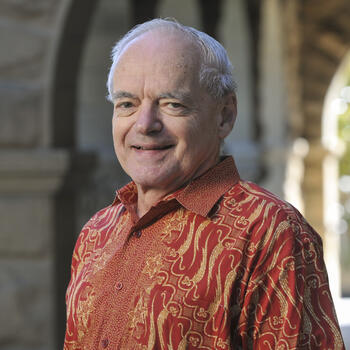
Portrait of Dr. Ezra Vogel, Professor Emeritus at Harvard University

Professor Ezra F. Vogel is Professor Emeritus at Harvard University. Vogel received his PhD at Harvard in 1958 in Sociology in the Department of Social Relations and was a professor at Harvard from 1967-2000. In 1973, he succeeded John Fairbank to become the second Director of Harvard's East Asian Research Center. At Harvard, he served as director of the US-Japan Program, director of the Fairbank Center, and as the founding director of the Asia Center. From fall 1993 to fall 1995, Vogel was the National Intelligence Officer for East Asia at the National Intelligence Council in Washington. His book Japan As Number One (1979), in Japanese translation, became a best seller in Japan, and his book Deng Xiaoping and the Transformation of China (2011), in Chinese translation, became a best seller in China. He lectures frequently in Asia, in both Chinese and Japanese. He has received numerous honors, including eleven honorary degrees.

Via Zoom Webinar.

Registration Link: https://bit.ly/2SS6DpY

Ezra Vogel, Professor Emeritus <br>Harvard University</br>
Seminars
-

This event is part of the Asia Health Policy Program (AHPP) 2020-21 Colloquium series "Health, medicine, and longevity: Exploring public and private roles"

Over the last decade, India has rapidly expanded government health insurance programs that entitle low-income households to free hospital care.  In a major policy shift away from direct public provision of healthcare, these programs contract private hospitals for service delivery. This constitutes a sizeable public subsidy delivered through private agents, but there is relatively little evidence on how private hospitals perform. Using a unique dataset on 6 million insurance claims and 15,000 patient surveys, this talk will present several key insights on the behavior of private hospitals within a large government insurance program. 1) Private hospitals manipulate coding to increase their revenues at the government's expense. 2) They also charge patients out-of-pocket for care that is supposed to be free under program rules. 3) When the government increases hospital reimbursement rates, patient charges decrease substantially. 4) However, hospitals capture approximately half the increased subsidy and this is driven by less competitive markets. The results demonstrate that hospital reimbursement rates are a key policy lever shaping hospital behavior with implications for program outcomes. Improving program performance requires a combination of stronger hospital monitoring and attention to reimbursement rates; focusing on one without the other may reduce the efficiency of public spending or worsen patient welfare. Lastly, market structure, a factor rarely taken into consideration in health policy in India, may play a role in the extent to which public subsidies benefit patients.

https://aparc.fsi.stanford.edu/asiahealthpolicy/news/postdoctoral-spotlight-radhika-jain

Image
Radhika Jain 4X4 022521
Radhika Jain is the Asia Health Policy Postdoctoral Fellow for 2019-2022 at the Walter H. Shorenstein Asia-Pacific Research Center (Shorenstein APARC).  Her research focuses on health care markets, the effectiveness of public health policy, and gender disparities in health.

She completed her doctorate in the Department of Global Health at Harvard University in 2019.  Her dissertation examined the extent to which government subsidies for health care under insurance are captured by private hospitals instead of being passed through to patients, and whether accountability measures can help patients claim their entitlements. Dr. Jain's research has been supported by grants from the Weiss Family Fund and the Jameel Poverty Action Lab (JPAL). She has worked on impact evaluations of health programs in India and on the implementation of HIV programs across several countries in sub-Saharan Africa. She also held a doctoral fellowship at the Center for Global Development.

At Shorenstein APARC, Radhika is starting new work on understanding the factors that contribute to poor female health outcomes and interventions to increase the effectiveness of public health insurance.

Via Zoom Webinar.
Register: https://bit.ly/37218gJ

Shorenstein APARC Stanford University Encina Hall E301 Stanford, CA 94305-6055
1
Asia Health Policy Postdoctoral Fellow, 2019-2022
radhika_jain.jpg Ph.D.

Radhika Jain was the Asia Health Policy Postdoctoral Fellow for 2019-2022 at the Walter H. Shorenstein Asia-Pacific Research Center (Shorenstein APARC).  Her research focuses on health care markets, the effectiveness of public health policy, and gender disparities in health.

She completed her doctorate in the Department of Global Health at Harvard University in 2019.  Her dissertation examined the extent to which government subsidies for health care under insurance are captured by private hospitals instead of being passed through to patients, and whether accountability measures can help patients claim their entitlements. Dr. Jain's research has been supported by grants from the Weiss Family Fund and the Jameel Poverty Action Lab (JPAL). She has worked on impact evaluations of health programs in India and on the implementation of HIV programs across several countries in sub-Saharan Africa. She also held a doctoral fellowship at the Center for Global Development.

At Shorenstein APARC, Radhika began new work on understanding the factors that contribute to poor female health outcomes and interventions to increase the effectiveness of public health insurance.

2019-2022 Asia Health Policy Postdoctoral Fellow
Seminars
-

This is a virtual event. Please click here to register and generate a link to the talk. 
The link will be unique to you; please save it and do not share with others.


Note: This event is off-the-record and will not be recorded for future viewing.
By registering for this webinar, attendees agree to refrain from recording, citing, attributing, or otherwise sharing content from this event.

This event is Co-Sponsored by the Center for South Asia (CSA)

How are India and the United States responding to the growing political and military power of China in the Indian Ocean region? India has traditionally sought to maintain strategic preeminence in the region and sees its influence as being increasingly contested. The United States sees the region as an integral part of the wider “Indo-Pacific,” defined by intensifying strategic competition with China. Military planners at U.S. Indo-Pacific Command are refining their strategy in the region, including their approach to mitigating security risks and deepening the U.S. Major Defense Partnership with India, alongside other allies and partners. In this off-the-record webinar, the Command’s senior policy advisor and two leading experts on the Indian Ocean will share their assessments of the key strategic challenges facing India and the United States in the region.

Speakers:

Image
David Brewster
David Brewster is a Senior Research Fellow at the National Security College at the Australian National University, where he focuses on security in India and the Indian Ocean region, and Indo-Pacific maritime affairs. His books include India as an Asia Pacific Power, about India’s strategic role in the Asia Pacific, India’s Ocean: the Story of India’s Bid for Regional Leadership, which examines India’s strategic ambitions in the Indian Ocean, and the edited volume, India and China at Sea: Competition for Naval Dominance in the Indian Ocean. He is the author of several reports, including The Second Sea, which examines Australia’s role in the Indian Ocean proposes a new roadmap for Australia’s strategic engagement in that region. Brewster holds a PhD from the Australian National University.
 

Image
Shezi Khan
Shehzi Khan is the Senior Policy Advisor in the Strategic Planning and Policy Directorate at Indo-Pacific Command, supporting senior leadership on key regional policy initiatives.  Ms. Khan served on the Secretary of State’s Policy Planning Staff, as Executive Officer to the Principal Deputy Director of National Intelligence, and as senior South Asia analyst at the State Department.  Ms. Khan briefed the President of the United States in 2013.  She has been posted in Pakistan, China, and New Zealand and also lived and worked in India, Egypt, and France. Ms. Khan speaks five foreign languages and holds an MBA in International Finance and an MA in International Relations.  She is a recipient of the National Intelligence Superior Service Medal and was named State Department’s Analyst of the Year in 2014.

Image
Nilanthi Samaranayake
Nilanthi Samaranayake directs the Strategy and Policy Analysis Program at CNA. She has led several studies on Indian Ocean and South Asia security. Recently Samaranayake has worked on U.S.-India naval cooperation, water resource competition in the Brahmaputra River basin, and Sri Lankan foreign policy. She also has conducted research on the navies of Bangladesh and Pakistan, the Maldives Coast Guard, security threats in the Bay of Bengal, and relations between smaller South Asian countries and China, India and the United States. Prior to joining CNA, Samaranayake held positions at the National Bureau of Asian Research and the Pew Research Center. Samaranayake holds an M.Sc. in International Relations from the London School of Economics and Political Science and a B.A. in International Studies from American University.


Image
Arzan Tarapore
Arzan Tarapore (Moderator) is the South Asia research scholar at the Shorenstein Asia-Pacific Research Center at Stanford University, where he leads the newly-restarted South Asia research initiative. He is also a senior nonresident fellow at the National Bureau of Asian Research. Tarapore’s research focuses on Indian military strategy and contemporary Indo-Pacific security issues. This includes a forthcoming paper on “Building Strategic Leverage in the Indian Ocean Region.” He previously held research positions at the RAND Corporation, the Observer Research Foundation, and the East-West Center in Washington. Prior to his scholarly career, he served as an analyst in the Australian Defence Department. Tarapore holds a PhD in war studies from King’s College London.


Via Zoom Webinar
Register at:  https://bit.ly/34xYmgu

David Brewster <br><i>Senior Research Fellow at National Security College, Australian National University</i><br><br>
Shehzi Khan <br><i>Senior Policy Advisor in the Strategic Planning and Policy Directorate, Indo-Pacific Command</i><br><br>
Nilanthi Samaranayake <br><i>Director of Strategy and Policy Analysis Program, CNA</i><br><br>
Arzan Tarapore - Moderator <br><i>South Asia Research Scholar, Stanford University</i><br><br>
Seminars
-

This event is part of the Asia Health Policy Program (AHPP) 2020-21 Colloquium series "Health, medicine, and longevity: Exploring public and private roles"

A quarter century ago in a seminal paper, Hart, Shleifer and Vishny (NBER1996, QJE1997) developed a theory of the ‘Proper Scope of Government.’ In this webinar, Oliver Hart, 2016 Nobel Laureate, reflects on that framework and its place in economics, as well as the inspiration for his more recent work on norms and guiding principles, contracts as reference points, maximizing shareholder welfare, and exit versus voice. In discussion with Karen Eggleston, Hart answers questions posed by economists who have built upon that paper and offers insights on how the theory applies to understanding public and private roles in healthcare, education, and other publicly-financed services. With China, India, and many other emerging markets engaged in decades-long controversies about public and private roles in their health sectors, and international focus on public-private partnerships for COVID-19 response and harnessing innovation to address other global challenges, this is an opportune time to discuss how conceptually rigorous thinking can inform a sometimes divisive and ideological debate with vital implications for human welfare.


Image
Oliver Hart 021021
Oliver Hart is currently the Lewis P. and Linda L. Geyser University Professor at Harvard University, where he has taught since 1993. He is the 2016 co-recipient of the Sveriges Riksbank Prize in Economic Sciences in Memory of Alfred Nobel, a Fellow of the Econometric Society, the American Academy of Arts and Sciences, the British Academy, and the American Finance Association, a member of the National Academy of Sciences, a Distinguished Fellow of the American Economic Association, and has several honorary degrees. Hart works mainly on contract theory, the theory of the firm, corporate finance, and law and economics. His research centers on the roles that ownership structure and contractual arrangements play in the governance and boundaries of corporations. He has published a book (Firms, Contracts, and Financial Structure, Oxford University Press, 1995) and numerous journal articles. He has used his theoretical work on firms and contracts in several legal cases. He has been president of the American Law and Economics Association and a vice president of the American Economic Association.

This keynote is part of the Stanford Asia Health Policy Program colloquium series entitled:  Health, medicine, and longevity: Exploring public and private roles

Governmental agencies and non-state actors interact within health systems in complicated and sometimes controversial ways that are vital for health and well-being. These run the gamut from developing and distributing vaccines and therapeutics for COVID-19 and mitigating the social and economic impact of the pandemic, to achieving and sustaining universal health coverage, addressing the social determinants of health, mitigating disparities, and encouraging innovations for healthy longevity, to name but a few. From the conceptual foundations to the daily reality of practitioners, this colloquium series will explore the evidence and experience of the public-private nexus in health sectors across Asia, in comparative global perspective. With colloquia throughout the academic year, the series features a keynote on February 10, 2021 from Nobel Laureate Oliver Hart, “A quarter century of ‘The Proper Scope of Government’: Theory and Applications” (dating from the 1996 NBER working paper subsequently published in the Quarterly Journal of Economics, QJE).

https://www.youtube.com/watch?v=g9JRhGpXC2Y&feature=emb_title

Via Zoom Webinar.
Register https://bit.ly/3jAvFFQ

Oliver Hart Lewis P. and Linda L. Geyser University Professor, Harvard University
Seminars
-

This event is part of the Asia Health Policy Program (AHPP) 2020-21 Colloquium series "Health, medicine, and longevity: Exploring public and private roles"

Co-sponsored by the Asia Health Policy Program and the Southeast Asia Program

Jakarta time: Friday, October 30, 2020, 7:30am - 9:00am

Apart from the 1998 Asian Financial Crisis (AFC), the current COVID-19 economic crisis is Indonesia’s most serious economic calamity in half a century with adverse impact. In March 2020, Indonesia’s poverty rate increased from 9.41% to 9.78% year on year, the equivalent of 1.28 million new people entering poverty.  By the end of 2020, it is expected that poverty rates will increase above 10%, wiping out two years of Indonesia’s poverty alleviation achievements. Social protection is key for crisis recovery. Indonesia’s social protection system has continually become stronger since the AFC. Over the past two decades, Indonesia has significantly expanded its social protection programs and coverage buttressed by a robust social registry that covers the poorest 40% of the population. The COVID-19 crisis is pushing the system to its limits. Insufficient data on Indonesians vulnerable to falling into poverty (and above the poorest 40%), coupled with response programs with complicated delivery and eligibility mechanisms, has made it challenging to deliver response-focused social protection. Dr. Sumarto will discuss whether the current social protection system is strong enough to weather the storm, especially to protect those working in the informal sector and marginal groups. Today, Indonesian policymakers have the choice to keep on following the same path and continue investing on the same social protection system, or take a radical move to reform it and make it better equipped to face future challenges.

Image
Sudarno Sumarto 102920
Sudarno Sumarto is an economist specializing in poverty reduction, social protection, labor, health, education and political economy of public policy implementation. Before joining the TNP2K, he was previously a visiting scholar at the Shorenstein Asia Pacific Research Center (APARC) at Stanford University as well as Founder and Executive Director of The SMERU Research Institute. Well-versed in leading large-scale research projects, Sudarno also provides intellectual leadership to Indonesia’s RISE country team. His research has been widely published in high-impact journals such as the Journal of Political Economy, Journal of Development Economics, and World Bank Economic Review, and has extensively contributed to policy-making by the Government of Indonesia. Sudarno earned his doctoral and master’s degrees in economics from Vanderbilt University.


Via Zoom Webinar.
Register https://bit.ly/30vi2jJ

Sudarno Sumarto Policy Adviser, National Team for the Acceleration of Poverty Reduction (TNP2K), Senior Research Fellow, The SMERU Research Institute.
Seminars
-

This event is being held virtually via Zoom. Please register for the webinar via the below link.

Registration Link: https://bit.ly/3n4NMpJ


This event is part of the Shorenstein Asia-Pacific Research Center's Shifting Geopolitics and U.S.-Asia Relations webinar series.
 
For Japan’s new Prime Minister Yoshihide Suga, foreign policy might pose a most significant challenge as he faces a shifting geopolitical landscape with a more assertive China, an emboldened North Korea, an ever more ambivalent South Korea, and a seemingly less committed US in the region. In this international environment, what foreign policy options does Japan have and what can we expect from the Suga administration? To answer these questions, panelists Shinichi Kitaoka, President of the Japan International Cooperation Agency, and Susan Thornton, former US assistant secretary for East Asian and Pacific Affairs, will discuss key diplomatic challenges for Japan including its management of the US-China-Japan trilateral relations, its handling of important neighboring countries such as North and South Korea and Russia, its larger strategies in the Indo-Pacific region, and its engagement with global institutions. This event will be moderated by Japan Program Director Kiyoteru Tsutsui.
 

SPEAKERS

Image
Headshot of Shinichi Kitaoka
Dr. Shinichi Kitaoka is President of the Japan International Cooperation Agency. Before assuming the present post, he was President of the International University of Japan. Dr. Kitaoka’s career includes Professor of National Graduate Institute for Policy Studies (GRIPS) (2012-), Professor ofGraduateSchools for Law and Politics, the University of Tokyo(1997-2004, 2006-2012), Ambassador Extraordinary and Plenipotentiary, Deputy Permanent Representativeof Japan to the United Nations (2004-2006), Professor of College of Law and Politics, Rikkyo University (1985-1997). Dr. Kitaoka’s specialty is modern Japanese politics and diplomacy. He obtained his B.A. (1971) and his Ph.D. (1976) both from the University of Tokyo. He is Emeritus Professor of the University of Tokyo. He has numerous books and articles in Japanese and English including A Political History of Modern Japan: Foreign Relations and Domestic Politics (Tokyo: Yuhikaku,2011), Political Dynamics of the United Nations: Where Does Japan Stand? (Tokyo: Chuokoron-Shinsha, 2007) and Japan as a Global Player (Tokyo: NTT Publishing, 2010). He received many honors and awards including the Medal with Purple Ribbon for his academic achievements in 2011.


Image
Headshot of Susan Thornton
Susan A. Thornton is a retired senior U.S. diplomat with almost 30 years of experience with the U.S. State Department in Eurasia and East Asia. She is currently a Senior Fellow and Research Scholar at the Yale University Law School Paul Tsai China Center, Director of the Forum on Asia-Pacific Security at the National Committee on American Foreign Policy, and a Non-Resident Fellow at the Brookings Institution. Until July 2018, Thornton was Acting Assistant Secretary for East Asian and Pacific Affairs at the Department of State and led East Asia policy making amid crises with North Korea, escalating trade tensions with China, and a fast-changing international environment. In previous State Department roles, she worked on U.S. policy toward China, Korea and the former Soviet Union and served in leadership positions at U.S. embassies in Central Asia, Russia, the Caucasus and China. Thornton received her MA in International Relations from Johns Hopkins SAIS and her BA from Bowdoin College in Economics and Russian. She serves on several non-profit boards and speaks Mandarin and Russian.

Via Zoom Webinar.

Registration Link: https://bit.ly/3n4NMpJ

Dr. Shinichi Kitaoka, President Japan International Cooperation Agency
Susan A. Thornton Former US Assistant Secretary for East Asian and Pacific Affairs
Panel Discussions
-

This event is part of Shorenstein APARC’s fall webinar series "Shifting Geopolitics and U.S.-Asia Relations"

Co-sponsored with the Center for South Asia (CSA)

Since May 2020, Chinese troops have crossed the disputed Line of Actual Control (LAC) and occupied positions in the Indian union territory of Ladakh. The Chinese troops crossed in multiple places and in large numbers, and have skirmished with Indian forces. Diplomatic channels are still open, but despite numerous pledges to disengage, this Chinese action appears to be an attempt to revise the LAC. This webinar will examine the crisis’ longer-term implications for China-India-U.S. relations. Can India and China reconcile their relationship or are they destined for a more antagonistic strategic rivalry? What tools and leverage does each side have in strategic competition? How does this affect U.S. policy in the Indo-Pacific region, and what action can Washington take to advance its interests?

Image
Joe Felter 100620
Joseph Felter is a William J. Perry Fellow at the Center for International Security and Cooperation and research fellow at the Hoover Institution.  From 2017 to 2019, Felter served as US deputy assistant secretary of defense for South Asia, Southeast Asia, and Oceania, where he was responsible for defense strategies and plans in the region. He previously taught at West Point and Columbia University. A former US Army Special Forces and Foreign Area officer, Joe served in a variety of special operations and diplomatic assignments, and holds a PhD in political science from Stanford University. 

Image
Madan Tanvi 100620
Tanvi Madan is a senior fellow in the Project on International Order and Strategy in the Foreign Policy program, and director of The India Project at the Brookings Institution in Washington, DC. Madan’s work explores India’s role in the world and its foreign policy, focusing in particular on India's relations with China and the United States. Madan is the author of the book "Fateful Triangle: How China Shaped US-India Relations during the Cold War," and researching her next book on the China-India-US triangle. She holds a PhD in public policy from the University of Texas at Austin.

Image
Yun Sun 100620
Yun Sun is a Senior Fellow and Co-Director of the East Asia Program and Director of the China Program at the Stimson Center. Her expertise is in Chinese foreign policy, U.S.-China relations and China’s relations with neighboring countries and authoritarian regimes. She has previously held positions at the Brookings Institution, where she focused on Chinese national security decision-making processes and China-Africa relations, and at the International Crisis Group, specializing in China’s foreign policy towards conflict countries and the developing world. She earned her master’s degree in international policy and practice from George Washington University.

Moderator:

Image
Arzan Terapore 100620
Arzan Tarapore is the South Asia research scholar at the Shorenstein Asia-Pacific Research Center at Stanford University, where he leads the newly-restarted South Asia research initiative. He is also a senior nonresident fellow at the National Bureau of Asian Research. Tarapore’s research focuses on Indian military strategy and contemporary Indo-Pacific security issues. He previously held research positions at the RAND Corporation, the Observer Research Foundation, and the East-West Center in Washington, and served in the Australian Defence Department. Tarapore holds a PhD in war studies from King’s College London.


Via Zoom Webinar

Register at https://bit.ly/2Hkx3ye

Joseph Felter William J. Perry Fellow, the Center for International Security and Cooperation and research fellow, the Hoover Institution
Tanvi Madan Senior Fellow in the Project on International Order and Strategy in the Foreign Policy program, and director of The India Project, the Brookings Institution, Washington, DC
Yun Sun Senior Fellow and Co-Director of the East Asia Program and Director of the China Program, the Stimson Center
Arzan Tarapore Moderator the South Asia research scholar, the Shorenstein Asia-Pacific Research Center, Stanford University
Seminars
-

This event has been rescheduled to October 14, 2020

It is a good time to be interested in Southeast Asia-China relations. In addition to the three new books referenced in this webinar, additional books on the subject are forthcoming from other authors.  The timing is all the more propitious in view of the current animosity between Beijing and Washington as it may implicate Southeast Asia and American policy toward the region, depending in part on who wins the 3 November US election.  These books are both sweeping and granular.  Hiebert’s and Strangio’s country-focused chapters cover all ten members of the Association of Southeast Asian Nations (ASEAN), while Emmerson and his co-authors mix country studies with thematic arguments about China’s relations with its neighbors.

Given China’s clearly superior size and power, is Beijing’s incremental domination of its neighbors foreordained? Strangio says no: “Southeast Asia’s future will not be one of linear and inexorable Chinese advance, but rather one in which past dynamics and contradictions reproduce themselves over time at varying pitches of tension.” Is he right? Hiebert calls for the US “to support the region as it faces a rising and more assertive China”—to “remain an actively engaged partner that shows up, brings some resources, and rewrites the perception that it is often unreliable and missing in action.” Is that good advice?  For Emmerson, “strategic autonomy necessarily begins at home. Outsiders can help or hurt. But nothing can substitute for the creativity of Southeast Asian states in individual and joint pursuit of their own and their region’s security.” Is that true, and even if it is, so what?

The webinar will explore these and other aspects of Sino-Southeast Asian relations.

Image
Murray Hiebert 100520
Murray Hiebert, in addition to his position at CSIS, is research director for BowerGroup Asia. Before joining CSIS, he was senior director for Southeast Asia at the U.S. Chamber of Commerce. Earlier, he was a journalist in the China bureau of the Wall Street Journal. Prior to his posting to Beijing, he reported from Washingon on US-Asia relations for the Wall Street Journal Asia and the Far Eastern Economic Review. In the 1990s he worked for the Review while based in Kuala Lumpur and, earlier, in Hanoi, having joined the Review's Bangkok bureau in 1986 to cover developments in Vietnam, Cambodia, and Laos. He is also the author of two books on Vietnam, Chasing the Tigers (1996) and Vietnam Notebook (1993). He has a master’s degree in news media studies from American University.


Image
Sebastian Strangio 100520
Sebastian Strangio has written from and on Southeast Asia for many publications including Al Jazeera, The Atlantic, The Economist, Forbes, Foreign Policy, and The New York Times. In addition to living and working in Cambodia, where he spent three years with The Phnom Penh Post, he has reported from Indonesia, Laos, Myanmar, Thailand, Vietnam, and China, among other countries. Other previous affiliations include New America’s International Reporting Project; the Future Forum, a policy institute in Phnom Penh; and Chiang Mai University’s Regional Center for Social Science and Sustainable Development. Foreign Affairs named his first book, Hun Sen’s Cambodia, a 2015 Book of the Year. He has a master’s degree in international politics from the University of Melbourne.


Image
don emmerson 2
Donald K. Emmerson, in addition to his position in APARC, is a faculty affiliate of Stanford’s Center on Democracy, Development, and the Rule of Law. So far in 2019-2020 he has spoken on Southeast Asian topics to audiences in Bangkok, Hanoi, Kuala Lumpur, New York, Singapore, and Washington, DC.  Recent publications include “‘No Sole Control’ in the South China Sea,” Asia Policy (2019) and ASEAN @ 50, Southeast Asia @ Risk: What Should Be Done? (edited, 2018). Before moving to Stanford in 1999, he taught political science at the University of Wisconsin-Madison.  He has held visiting positions at the Institute for Advanced Studies and the Australian National University, among other institutions.  His doctorate in political science is from Yale University.

Via Zoom Webinar

Register at https://bit.ly/35WOb7o

Murray Hiebert senior associate, Southeast Asia Program, Center for Strategic and International Studies (CSIS), Washington, DC, and author of <i>Under Beijing’s Shadow: Southeast Asia’s China Challenge</i> (2020)
Sebastian Strangio journalist, analyst, Southeast Asia editor of The Diplomat, and author of <i>In the Dragon’s Shadow: Southeast Asia in the Chinese Century</i> (2020)
0
Senior Fellow Emeritus at the Freeman Spogli Institute for International Studies
Affiliated Faculty, CDDRL
Affiliated Scholar, Abbasi Program in Islamic Studies
aparc_dke.jpg PhD

At Stanford, in addition to his work for the Southeast Asia Program and his affiliations with CDDRL and the Abbasi Program in Islamic Studies, Donald Emmerson has taught courses on Southeast Asia in East Asian Studies, International Policy Studies, and Political Science. He is active as an analyst of current policy issues involving Asia. In 2010 the National Bureau of Asian Research and the Woodrow Wilson International Center for Scholars awarded him a two-year Research Associateship given to “top scholars from across the United States” who “have successfully bridged the gap between the academy and policy.”

Emmerson’s research interests include Southeast Asia-China-US relations, the South China Sea, and the future of ASEAN. His publications, authored or edited, span more than a dozen books and monographs and some 200 articles, chapters, and shorter pieces.  Recent writings include The Deer and the Dragon: Southeast Asia and China in the 21st Century (ed., 2020); “‘No Sole Control’ in the South China Sea,” in Asia Policy  (2019); ASEAN @ 50, Southeast Asia @ Risk: What Should Be Done? (ed., 2018); “Singapore and Goliath?,” in Journal of Democracy (2018); “Mapping ASEAN’s Futures,” in Contemporary Southeast Asia (2017); and “ASEAN Between China and America: Is It Time to Try Horsing the Cow?,” in Trans-Regional and –National Studies of Southeast Asia (2017).

Earlier work includes “Sunnylands or Rancho Mirage? ASEAN and the South China Sea,” in YaleGlobal (2016); “The Spectrum of Comparisons: A Discussion,” in Pacific Affairs (2014); “Facts, Minds, and Formats: Scholarship and Political Change in Indonesia” in Indonesian Studies: The State of the Field (2013); “Is Indonesia Rising? It Depends” in Indonesia Rising (2012); “Southeast Asia: Minding the Gap between Democracy and Governance,” in Journal of Democracy (April 2012); “The Problem and Promise of Focality in World Affairs,” in Strategic Review (August 2011); An American Place at an Asian Table? Regionalism and Its Reasons (2011); Asian Regionalism and US Policy: The Case for Creative Adaptation (2010); “The Useful Diversity of ‘Islamism’” and “Islamism: Pros, Cons, and Contexts” in Islamism: Conflicting Perspectives on Political Islam (2009); “Crisis and Consensus: America and ASEAN in a New Global Context” in Refreshing U.S.-Thai Relations (2009); and Hard Choices: Security, Democracy, and Regionalism in Southeast Asia (edited, 2008).

Prior to moving to Stanford in 1999, Emmerson was a professor of political science at the University of Wisconsin-Madison, where he won a campus-wide teaching award. That same year he helped monitor voting in Indonesia and East Timor for the National Democratic Institute and the Carter Center. In the course of his career, he has taken part in numerous policy-related working groups focused on topics related to Southeast Asia; has testified before House and Senate committees on Asian affairs; and been a regular at gatherings such as the Asia Pacific Roundtable (Kuala Lumpur), the Bali Democracy Forum (Nusa Dua), and the Shangri-La Dialogue (Singapore). Places where he has held various visiting fellowships, including the Institute for Advanced Study and the Woodrow Wilson International Center for Scholars. 


Emmerson has a Ph.D. in political science from Yale and a BA in international affairs from Princeton. He is fluent in Indonesian, was fluent in French, and has lectured and written in both languages. He has lesser competence in Dutch, Javanese, and Russian. A former slam poet in English, he enjoys the spoken word and reads occasionally under a nom de plume with the Not Yet Dead Poets Society in Redwood City, CA. He and his wife Carolyn met in high school in Lebanon. They have two children. He was born in Tokyo, the son of U.S. Foreign Service Officer John K. Emmerson, who wrote the Japanese Thread among other books.

Selected Multimedia

Date Label
Moderator/Discussant director, Southeast Asia Program, Shorenstein Asia Pacific Research Center (APARC), Stanford University, and editor/co-author of <em>The Deer and the Dragon: Southeast Asia and China in the 21st Century</em> (2020)
Seminars
Authors
Noa Ronkin
News Type
News
Date
Paragraphs

The Walter H. Shorenstein Asia-Pacific Research Center (APARC) invites applications for three types of postdoctoral fellowship in contemporary Asia studies for the 2021-22 academic year. Appointments for all three fellowship offerings are for one year beginning in fall quarter 2021.

APARC is committed to supporting junior scholars in the field of Asia studies to the greatest extent possible and that has become even more important during COVID-19, as graduate students are especially vulnerable to the adverse impacts of the pandemic, facing the loss of funding opportunities and access to field research.

The Center offers postdoctoral fellowships that promote multidisciplinary research on contemporary Japan, contemporary Korea, and contemporary Asia broadly defined. Learn more about each fellowship and its eligibility and specific application requirements:

Postdoctoral Fellowship on Contemporary Japan

The fellowship supports multidisciplinary research on contemporary Japan in a broad range of disciplines including political science, economics, sociology, law, policy studies, and international relations. The application deadline is January 4, 2021.

Korea Foundation-APARC Korea Program Postdoctoral Fellowship

The fellowship supports rising Korea scholars in the humanities and social sciences. The application deadline is January 20, 2021.

Shorenstein Postdoctoral Fellowship on Contemporary Asia

APARC offers two postdoctoral fellowship positions to junior scholars for research and writing on contemporary Asia. The primary research areas focus on political, economic, or social change in the Asia-Pacific region (including Northeast, Southeast, and South Asia), or international relations and international political economy in the region. The application deadline is January 4, 2021.

Read More

A young men sitting at a desk in front of computer monitors
News

Student Documentary Celebrates Transnational Brain Linkages

‘Brain Bridges,’ a documentary produced by senior Dexter Sterling Simpson, illustrates the positive gains of global talent flows.
Student Documentary Celebrates Transnational Brain Linkages
(Left) Yuen Yuen Ang; (Right) Congratulations Yuen Yuen Ang, Winner of the Theda Skocpol Prize from the American Political Science Association
News

Dr. Yuen Yuen Ang Awarded Theda Skocpol Prize for Emerging Scholars

Former China Program postdoc and Stanford Ph.D alumna Yuen Yuen Ang has received the Theda Skocpol Prize for Emerging Scholars from the American Political Science Association for her scholarship on China’s transformation into a global superpower.
Dr. Yuen Yuen Ang Awarded Theda Skocpol Prize for Emerging Scholars
Portrait of Oriana Skylar Mastro and a 3D cover of her book, 'The Costs of Conversation: Obstacles to Peace Talks in Wartime'
News

FSI Center Fellow Wins Best Book in Security Studies Award

The American Political Science Association recognizes Oriana Skylar Mastro for her work on military strategy and mediation.
FSI Center Fellow Wins Best Book in Security Studies Award
Hero Image
Encina Hall
All News button
1
Subtitle

The Center’s commitment to supporting young Asia scholars remains strong during the COVID-19 crisis.

Subscribe to Asia-Pacific