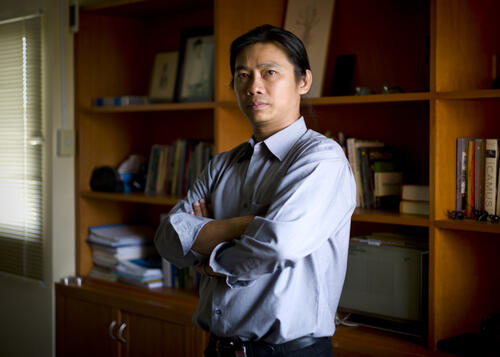
Film screening & discussion: Academy Award nominee "The Act of Killing"
Sponsored and Organized by Sasakawa Peace Foundation (SPF) and Shorenstein Asia-Pacific Research Center (S-APARC) in Association with U.S.-Japan Council
Japan Studies Program at Shorenstein APARC, Stanford University has launched a three-year project from 2013 to create new channels of dialogue between experts and leaders of younger generations from the United States, mostly from the West Coast, and Japan under a name of "New Channels: Reinvigorating U.S.-Japan Relations," with the goal of reinvigorating the bilateral relationship through the dialogue on 21st century challenges faced by both nations, with a grant received from the Sasakawa Peace Foundation.
Financial reform is one of the key priorities identified at the Third Plenum in November while state-owned enterprises got little mention. But will financial reform possibly lead to a fundamental reform of state-owned companies?
Nicholas R. Lardy, Anthony M. Solomon Senior Fellow, joined the Peterson Institute for International Economics in March 2003. Previously, he was a senior fellow in the Foreign Policy Studies Program from 1995 until 2003. Before Brookings, he served at the University of Washington, where he was the director of the Henry M. Jackson School of International Studies from 1991 to 1995. From 1997 through the spring of 2000, he was also the Frederick Frank Adjunct Professor of International Trade and Finance at the Yale University School of Management. He is an expert on Asia, especially the Chinese economy.
Lardy is a member of the Council on Foreign Relations and is a member of the editorial boards of the China Quarterly, Journal of Asian Business,China Review, and China Economic Review. He received his BA from the University of Wisconsin in 1968 and his PhD from the University of Michigan in 1975, both in economics.
This event is co-sponsored with CEAS and is part of the China under Xi Jinping series.
Philippines Conference Room
Stephen W. Bosworth, a former diplomat and expert on Korea, will spend the winter quarter at Stanford as a visiting lecturer.
Bosworth was a United States ambassador to three countries: South Korea (from 1997 to 2001); the Philippines (from 1984 to 1987); and Tunisia (from 1979 to 1981).
He was the President Barack Obama’s Special Representative for North Korea Policy between 2009 and 2011 and held several other senior positions at the State Department. He was a dean of the Fletcher School of Law and Diplomacy at Tufts University and is currently a senior fellow at Harvard’s Belfer Center for Science and International Affairs.
At Stanford, he will be a Payne Distinguished Lecturer at the Freeman Spogli Institute for International Studies, in residence at FSI’s Walter H. Shorenstein Asia-Pacific Research Center.
Prior to his arrival at Stanford University, Bosworth also served as the Director of Policy Planning, Principal Deputy Assistant Secretary of State for Inter-American Affairs, and Deputy Assistant Secretary for Economic Affairs, among other senior level positions at the State Department. Bosworth co-authored Chasing the Sun, Rethinking East Asian Policy in 2006, and focuses on U.S.-Asia foreign policy, energy security and inter-governmental relations.
The Payne lectureship, named after Frank and Arthur Payne, presents prominent speakers chosen for their international reputation as leaders who emphasize visionary thinking, a broad grasp of a given field, and the capacity to engage the larger community in important issues. Former FBI Director Robert Mueller is also spending this academic year as a Payne lecturer.
Bosworth will deliver three public lectures at Stanford. His first talk will focus on his extensive experience in the diplomatic service. The public lecture and reception will take place in the Bechtel Conference Center in Encina Hall on Feb. 3. The two other lectures will address negotiations and relations between North Korea and the U.S. management of its alliance with Japan and South Korea.
Ambassador Bosworth looks back on a career spanning five decades and foreign service assignments in Panama, Madrid, Paris, Tunis, Manila, Seoul and Washington. Drawing on his involvement in issues ranging from control of the Panama Canal to the Arab oil embargo, North Korea's nuclear weapons program, the Asian financial crisis, the end of the Marcos regime in the Philippines, and how to deal with the opportunities and challenges of the rise of China, Bosworth tries to identify some basic principles and guidelines for the conduct of American foreign policy and relates stories about his personal experiences with leaders foreign and domestic.
Stephen W. Bosworth is a Senior Fellow at The Belfer Center for Science and International Affairs at the John F. Kennedy School of Government, Harvard University. He is also the Chairman of the U.S.-Korea Institute at the Johns Hopkins University Paul H. Nitze School of Advanced International Studies (SAIS). From 2001-2013, he served as Dean of The Fletcher School of Law and Diplomacy at Tufts University, where he now serves as Dean Emeritus. He has also served as the United States Ambassador to the Republic of Korea from 1997-2001.
From 1995-1997, Mr. Bosworth was the Executive Director of the Korean Peninsula Energy Development Organization [KEDO], an inter-governmental organization established by the United States, the Republic of Korea, and Japan to deal with North Korea. Before joining KEDO, he served seven years as President of the United States Japan Foundation, a private American grant-making institution. He also taught International Relations at Columbia University’s School of International and Public Affairs from 1990 to 1994. In 1993, he was the Sol Linowitz Visiting Professor at Hamilton College. He has co-authored several studies on public policy issues for the Carnegie Endowment and the Century Fund, and, in 2006, he co-authored a book entitled Chasing the Sun, Rethinking East Asian Policy.
Bechtel Conference Center
Stephen W. Bosworth was a Payne Distinguished Lecturer at the Walter H. Shorenstein Asia-Pacific Research Center in Freeman Spogli Institute for International Studies. He was a Senior Fellow at The Belfer Center for Science and International Affairs at the John F. Kennedy School of Government, Harvard University. He was also the Chairman of the U.S.-Korea Institute at the Johns Hopkins University Paul H. Nitze School of Advanced International Studies (SAIS). From 2001-2013, he served as Dean of The Fletcher School of Law and Diplomacy at Tufts University, where he then served as Dean Emeritus. He also served as the United States Ambassador to the Republic of Korea from 1997-2001.
From 1995-1997, Bosworth was the Executive Director of the Korean Peninsula Energy Development Organization [KEDO], an inter-governmental organization established by the United States, the Republic of Korea, and Japan to deal with North Korea. Before joining KEDO, he served seven years as President of the United States Japan Foundation, a private American grant-making institution. He also taught International Relations at Columbia University’s School of International and Public Affairs from 1990 to 1994. In 1993, he was the Sol Linowitz Visiting Professor at Hamilton College. He co-authored several studies on public policy issues for the Carnegie Endowment and the Century Fund, and, in 2006, he co-authored a book entitled Chasing the Sun, Rethinking East Asian Policy.
Ambassador Bosworth had an extensive career in the United States Foreign Service, including service as Ambassador to Tunisia from 1979-1981 and Ambassador to the Philippines from 1984-1987. He served in a number of senior positions in the Department of State, including Director of Policy Planning, Principal Deputy Assistant Secretary of State for Inter-American Affairs, and Deputy Assistant Secretary for Economic Affairs. Most recently, from March 2009 through October 2011, he served as U.S. Special Representative for North Korea Policy for the Obama Administration.
He was the recipient of many awards, including the American Academy of Diplomacy’s Diplomat of the Year Award in 1987, the Department of State’s Distinguished Service Award in 1976 and again in 1986, and the Department of Energy’s Distinguished Service Award in 1979. In 2005, the Government of Japan presented him with the Order of the Rising Sun, Gold and Silver Star.
Bosworth was a graduate of Dartmouth College where he was a member of the Board of Trustees from 1992 to 2002 and served as Board Chair from 1996 to 2000. He was married to the former Christine Holmes; they have two daughters and two sons.
Stephen W. Bosworth was a Payne Distinguished Lecturer at the Walter H. Shorenstein Asia-Pacific Research Center in Freeman Spogli Institute for International Studies. He was a Senior Fellow at The Belfer Center for Science and International Affairs at the John F. Kennedy School of Government, Harvard University. He was also the Chairman of the U.S.-Korea Institute at the Johns Hopkins University Paul H. Nitze School of Advanced International Studies (SAIS). From 2001-2013, he served as Dean of The Fletcher School of Law and Diplomacy at Tufts University, where he then served as Dean Emeritus. He also served as the United States Ambassador to the Republic of Korea from 1997-2001.
From 1995-1997, Bosworth was the Executive Director of the Korean Peninsula Energy Development Organization [KEDO], an inter-governmental organization established by the United States, the Republic of Korea, and Japan to deal with North Korea. Before joining KEDO, he served seven years as President of the United States Japan Foundation, a private American grant-making institution. He also taught International Relations at Columbia University’s School of International and Public Affairs from 1990 to 1994. In 1993, he was the Sol Linowitz Visiting Professor at Hamilton College. He co-authored several studies on public policy issues for the Carnegie Endowment and the Century Fund, and, in 2006, he co-authored a book entitled Chasing the Sun, Rethinking East Asian Policy.
Ambassador Bosworth had an extensive career in the United States Foreign Service, including service as Ambassador to Tunisia from 1979-1981 and Ambassador to the Philippines from 1984-1987. He served in a number of senior positions in the Department of State, including Director of Policy Planning, Principal Deputy Assistant Secretary of State for Inter-American Affairs, and Deputy Assistant Secretary for Economic Affairs. Most recently, from March 2009 through October 2011, he served as U.S. Special Representative for North Korea Policy for the Obama Administration.
He was the recipient of many awards, including the American Academy of Diplomacy’s Diplomat of the Year Award in 1987, the Department of State’s Distinguished Service Award in 1976 and again in 1986, and the Department of Energy’s Distinguished Service Award in 1979. In 2005, the Government of Japan presented him with the Order of the Rising Sun, Gold and Silver Star.
Bosworth was a graduate of Dartmouth College where he was a member of the Board of Trustees from 1992 to 2002 and served as Board Chair from 1996 to 2000. He was married to the former Christine Holmes; they have two daughters and two sons.
After the critical Third Plenum meeting in Beijing last November, China indicated impending changes to its economic and security policy in a 60-point resolution. Now the challenge is determining just how the Chinese government will attempt to implement its directives, leaving analysts to ask how significant and in what direction reform will go. As economic growth remains a priority, China will consider initiating realistic, long-standing policy changes to maintain its status as a global leader.
Barry J. Naughton, So Kuanlok professor of Chinese economy in the School of International Relations and Pacific Studies at the University of California, San Diego, considered this question and related topics during his visit to the Walter H. Shorenstein Asia-Pacific Research Center on January 9, 2014. His lecture was the first in a series on the meaning of the reforms coming out of the recent Third Plenum of the 18th Party Congress.
After introducing the context of the Third Plenum, Naughton evaluated what the resolution signals and offered his view on what it all adds up to. He posed the questions: did the Third Plenum succeed? and should we understand the place of the Third Plenum in China’s future development?
Naughton put forth a guarded, but optimistic view of the November resolution by pointing out that while individual reforms might not seem major, putting all the reforms together, there is a lot of substance. He stressed the breadth of the document, its inclusion of measurable policy targets, and its willingness to tackle the most complex and controversial subjects. However, Naughton also warned that the large agenda is one of the risks.
Focusing on the need for further SOE reform, Naughton ended his talk with a proposal. He argued that, indeed, the reform agenda is plausibly achievable if new institutions are created to implement economic restructuring. This could include the abolition of existing supervisory organizations and the creation of competing wealth management agencies assigned with the task of turning the remaining unreformed SOEs into modern joint-stock corporations. Naughton proposed that a national wealth-restructuring task force be created to address these major problems facing China.
Having recently spent time at Tsinghua University in Beijing, Naughton draws from extensive hands-on experience with China’s political economy. Many of his publications, including his book The Chinese Economy: Transitions and Growth, remain standards in the canon of scholarship on China. Most recently, Naughton is the editor of Wu Jinglian: Voice of Reform in China released in 2013 by the MIT Press.
Co-sponsored with the Center for East Asian Studies, the Stanford China Program series, entitled “China under Xi Jinping,” will engage distinguished academics, policymakers, and thought leaders in discussion throughout the next few months. Noted experts will provide thoughtful conversation on the new era initiated under Xi’s leadership.
Jean C. Oi, director of the China Program, says of the series “The 3rd Plenum of the 18th Party Congress unveiled details of the reforms to come under Xi Jinping’s rule of China. But how significant are they? Are the proposed reforms sufficient to tackle the challenges that China faces? Can they be achieved? Are they contradictory? These questions are all the more pressing given Xi Jinping’s seemingly divergent policy directions in the economic and political realms. This series brings leading scholars to help untangle the 3rd Plenum reforms and shed light on where Xi Jinping is taking China.”
The event series “China under Xi Jinping” will be reoccurring throughout spring, please refer to the Stanford China Program calendar of events to learn more and RSVP.
A year has passed since the Japanese government embarked on the new economic policy package called “Abenomics” with three “arrows”: aggressive monetary easing, flexible fiscal policy, and a growth strategy. The package is designed to bring the Japanese economy out of 20 years of stagnation and 15 years of deflation, and put it on a sustainable growth path. How effective has the policy package been during the first year of the Abe administration? Will it succeed in bringing sustainable growth to Japan? Professor Takatoshi Ito, a prominent expert on the Japanese economy, tackles these questions.
Takatoshi Ito, Professor at Faculty of Economics and Dean of Graduate School of Public
Policy, University of Tokyo, has taught extensively both in the United States and Japan,
including at University of Minnesota, Hitotsubashi University, and Harvard University.
He held visiting professor positions at Harvard University (1986-87 and 1992-94), Stanford
University (as National Fellow; 1984-85); Columbia Business School (fall semester, 2009),
and Tun Ismail Ali Chair Professor at University of Malaya (summer semester, 2008). His
public sector experiences include Senior Advisor in the Research Department, IMF
(1994-97); Deputy Vice Minister for International Affaires at Ministry of Finance
(1999-2001); and a member of the Prime Minister’s Council of Economic and Fiscal
Policy (2006-08). He is an author of many books including The Japanese Economy (MIT
Press), The Political Economy of the Japanese Monetary Policy (MIT Press), and
Financial Policy and Central Banking in Japan (MIT Press), and more than 50
refereed academic journal articles on international finance and the Japanese economy,
including ones in American Economic Review and Econometrica. He has distinguished
academic and research appointments such as President of the Japanese Economic
Association in 2004; Fellow of Econometric Society, since 1992; Research Associate at
National Bureau of Economic Research since 1985; and Faculty Fellow, Centre for
Economic Policy Research, since 2006. His research interest includes capital flows and
currency crises, microstructures of the foreign exchange rates, and inflation targeting. He
contributes frequently op-ed columns and articles to Financial Times, Nihon Keizai Shinbun,
Mainichi Shinbun, and Toyo Keizai Weekly.
Philippines Conference Room
This talk explores the work of Swiss diplomats and Red Cross delegates to explain the experience of Allied POWs and civilian internees in the Pacific War. As the only foreigners allowed into both POW and internee camps, and the only ones to work in Japan as well as Allied countries, they were uniquely positioned to record the flow of information between the two sides, the attempts to deliver material and financial aid, and the intensifying exchange of recrimination and threats. Washington and Tokyo made claims and counter-claims about the observance or non-observance of the Geneva Conventions. Both sides threatened and carried out reprisals and made their observance of international law conditional on the conduct of the enemy. While life was far worse for Allied captives than for their Japanese counterparts, it was not because of a deliberate policy of cruelty. Instead, senior Japanese officials never developed clear policy guidance for POWs and failed to provide adequate logistical and administrative support. The few Japanese officials who oversaw the camp system lacked any authority over individual commanders. Even so, the Swiss may well have helped prevent a bad situation from becoming even worse.
Sarah Kovner is a graduate of Princeton University (A.B.) and Columbia University (Ph.D), associate professor of history at the University of Florida, and is currently a Chauncey Fellow in International Security Studies at Yale. She works on modern Japanese history, international history, and the history of war and society. Kovner's first book, Occupying Power: Sex Workers and Servicemen in Postwar Japan, won the Southeast Conference Association for Asian Studies book prize. It is available in paperback from Stanford University Press. She is now writing a history of Allied prisoners in the Pacific War.
Philippines Conference Room
By any measure, China’s economy and defense budget are second only to those of the United States. Yet tremendous uncertainties persist concerning China’s military development and national trajectory, and areas with greater information available often conflated misleadingly. Fortunately, larger dynamics elucidate both areas. Particularly since the 1995-96 Taiwan Strait Crisis, China has made rapid progress in aerospace and maritime development, greatly facilitating its military modernization. The weapons and systems that China is developing and deploying fit well with Beijing’s geostrategic priorities. Here, distance matters greatly: after domestic stability and border control, Beijing worries most about its immediate periphery, where its unresolved disputes with neighbors and outstanding claims lie primarily in the maritime direction. Accordingly, while it would vastly prefer pressuring concessions to waging war, China is already capable of threatening potential opponents’ military forces should they intervene in crises over islands and maritime claims in the Yellow, East, and South China Seas and the waterspace and airspace around them. Far from mainland China, by contrast, it remains ill-prepared to protect its own forces from robust attack. Fortunately for Beijing, the non-traditional security focus of its distant operations makes conflict unlikely; remedying their vulnerabilities would be difficult and expensive. Despite these larger patterns, critical unknowns remain concerning China’s economic development, societal priorities, industrial efficiency, and innovation capability. Dr. Erickson will examine these and related issues to probe China’s development trajectory and future place in the international system.
The views expressed by Dr. Erickson are his alone, and do not represent the policies or estimates of any organization with which he is affiliated.
Dr. Andrew S. Erickson is an Associate Professor in the Strategic Research Department at the U.S. Naval War College and a core founding member of the department’s China Maritime Studies Institute (CMSI). He is an Associate in Research at Harvard University’s John King Fairbank Center for Chinese Studies (2008-). Erickson also serves as an expert contributor to the Wall Street Journal’s China Real Time Report (中国实时报), for which he has authored or coauthored 25 articles. In spring 2013, he deployed in the Pacific as a Regional Security Education Program scholar aboard USS Nimitz (CVN68), Carrier Strike Group 11.
Erickson received his Ph.D. and M.A. in international relations and comparative politics from Princeton University and graduated magna cum laude from Amherst College with a B.A. in history and political science. He has studied Mandarin in the Princeton in Beijing program at Beijing Normal University’s College of Chinese Language and Culture and Japanese language, politics, and economics in the year-long Associated Kyoto Program at Doshisha University.
Erickson’s research, which focuses on Asia-Pacific defense, international relations, technology, and resource issues, has been published widely in English- and Chinese-language edited volumes and in such peer-reviewed journals as China Quarterly, Asian Security, Journal of Strategic Studies, Orbis, Asia Policy (forthcoming January 2014), and China Security; as well as in Foreign Affairs, The National Interest, The American Interest, Foreign Policy, Joint Force Quarterly, China International Strategy Review (published in Chinese-language edition, forthcoming in English-language edition January 2014), and International and Strategic Studies Report (Center for International and Strategic Studies, Peking University). Erickson has also published annotated translations of several Chinese articles on maritime strategy. His publications are available at <www.andrewerickson.com> and <www.chinasignpost.com>.
This event is co-sponsored with CEAS and is part of the China under Xi Jinping series.
Philippines Conference Room