Agriculture
News Type
Blogs
Date
Paragraphs

The world’s health systems face a complex and interconnected set of challenges that threaten to outpace our capacity to respond. Geopolitical fragmentation, climatic breakdown, technological disruption, pandemic threats, and misinformation have converged to strain the foundations of global health.  Building resilient global health systems requires five urgent reforms: sharpening the mandate of the World Health Organization (WHO), operationalizing the One Health concept, modernizing procurement, addressing the climate–health nexus, and mobilizing innovative financing. Together, these shifts can move the world from fragmented, reactive crisis management to proactive, equitable, and sustainable health security.

Emerging and Escalating Threats

While the global community demonstrated remarkable resilience in weathering the COVID-19 pandemic, the crisis also exposed profound structural weaknesses in global health governance and architecture. Chronic underinvestment in health systems led to coverage gaps, workforce shortages, and inadequate surveillance systems. The pandemic also revealed a fragmented global health architecture, plagued by institutional silos among key agencies (Elnaiem et al. 2023).

Years later, the aftershocks of the pandemic still resonate worldwide, with the ongoing triple burden of disease—the unfinished agenda of maternal and child health, the rising silent pandemic of noncommunicable diseases, and the reemergence of communicable diseases. These challenges, combined with the persistent challenge of malnutrition, unmet needs in early childhood development, growing concerns around mental health, and the threat of other emerging diseases, as well as the rising toll of trauma, injury, and aging populations, have placed countries across the world under immense strain. Health systems face acute infrastructure gaps, critical workforce shortages, and persistent inequities in service delivery, making it increasingly difficult to address the complex and evolving health needs of their populations. Post-pandemic fiscal tightening has constrained health budgets with debt-to-GDP ratios exceeding 70–80% in parts of the region (UN ESCAP 2023).

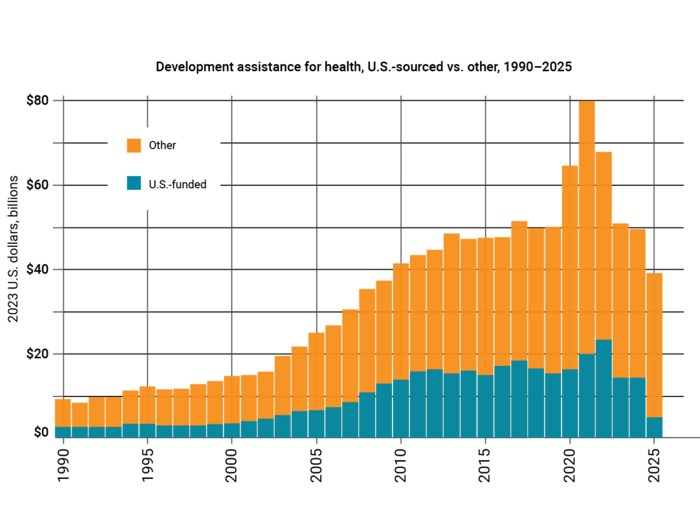
Global development assistance for health has significantly declined by more than $10 billion, with sharp cuts driven by the United States. This decline is likely to continue over the next five years.

 Furthermore, climate change is fundamentally redefining the risk landscape. Rising temperatures, more frequent floods, intensifying storms, and shifting vector ranges for organisms like mosquitoes and ticks are disrupting food systems, displacing populations, and driving new patterns of disease transmission. Over the next 25 years in low- and middle-income countries, climate change could cause over 15 million excess deaths, and economic losses related to health risks from climate change could surpass $20.8 trillion (World Bank 2024). The cost of inaction has never been higher.

Meanwhile, deepening political polarization is amplifying conflict and weakening the global cooperation essential for scientific progress. The number of geopolitical disturbances worldwide is at an all-time high, displacing over 122 million people and eroding access to essential health services (UNHCR 2024). In 2023, false and conspiratorial health claims amassed over 4 billion views across digital platforms, compromising vaccine uptake and fueling health-related conspiracy theories. (Kisa and Kisa 2025). Furthermore, exponential technological advances in artificial intelligence are outpacing public health governance systems, creating new ethical and equity dilemmas. Global development assistance for health has significantly declined by more than $10 billion, with sharp cuts driven by the United States. This decline is likely to continue over the next five years (Institute for Health Metrics and Evaluation 2025).
Image
Graph showing total development assistance for health, 1990-2025
Note: Development assistance for health is measured in 2023 real US dollars; 2025 data are preliminary estimates.
Source: Institute for Health Metrics and Evaluation 2025.
 

Sign up for APARC newsletters to receive our experts' updates >


Five Critical Reform Directions for Future-Proofing Global Health Systems


1.    WHO matters more than ever — but only if it sharpens its focus.

The World Health Organization remains the technical backbone of global health, with a mandate to set norms and standards, shape research agendas, monitor health trends, coordinate emergency responses and regulation, and provide technical assistance. COVID-19 underscored both its indispensability and its limitations. During the pandemic, WHO convened states, disseminated guidance, and spearheaded initiatives like the Solidarity Trial and COVAX to promote vaccine equity, illustrating why it remains vital as the only neutral platform where 194 member states can cooperate on pandemics, antimicrobial resistance, or climate-related health risks. Its work on universal health coverage, the “triple burden” of disease, and global health data continues to anchor policy across countries.

At the same time, the crisis exposed structural weaknesses: WHO lacks enforcement authority, relies heavily on voluntary donor-driven funding, and sometimes stretches beyond its comparative strengths. When it shifts from convening and technical guidance into direct fund management, logistics, or large-scale program delivery, it risks diluting its mandate and eroding trust. Critics argue this reflects a broader challenge of an expansive mandate and donor-driven mission creep, pushing WHO beyond what 7,000 staff and a modest budget can realistically deliver. The way forward lies in sharpening focus: leveraging its convening power and legitimacy, providing technical expertise and evidence-based guidance, coordinating emergencies under the International Health Regulations, and advocating for equity in access to medicines and care. Anchored in these core strengths, a more agile WHO can better lead during crises, sustain credibility, and ensure that global health standards are consistently applied across diverse national contexts.

2.    Animal Health as the Next Frontier

More than 70 percent of emerging infectious diseases are zoonotic in origin, with roughly three-quarters of newly detected pathogens in recent decades spilling over from animals into humans (WHO 2022; Jones, Patel, Levy, et al. 2008). The economic costs are staggering: the World Bank estimates that zoonotic outbreaks have cost the global economy over $120 billion between 1997 and 2009 through crises such as Nipah, SARS, H5N1, and H1N1 (World Bank 2012). The drivers of spillover are intensifying due to deforestation and land-use change, industrial livestock farming, wildlife trade, and climate change. These are further accelerating the emergence of novel pathogens. 

However, the governance of animal health remains fragmented. While WHO, the Food and Agriculture Organization (FAO), and the World Organization for Animal Health (WOAH) each hold mandates, they often operate in silos. The Quadripartite, expanded in 2021 to include the United Nations Environment Programme, launched a One Health Joint Plan of Action (2022–26), but it remains underfunded and lacks strong political commitment. 

There is an urgent need to move One Health from principle to practice. To fill this governance gap, the world should consider establishing an independent intergovernmental alliance for animal health with a clear mandate. This could strengthen global One Health response by augmenting joint surveillance, building veterinary workforce capacity, and integrating environmental data into early warning systems. Such an alliance should avoid creating new bureaucratic layers and instead leverage the Quadripartite as its operational backbone. Embedding One Health into national health strategies and cross-sectoral policies would enable animal, human, and environmental health systems to work in tandem and address risks at their source. Preventive investments are also very cost-effective; the World Bank estimates that annual One Health prevention investments of $10–11 billion could save multiple times that amount in avoided pandemic losses (World Bank 2012). Strengthening One Health is both a health and economic necessity. 

COVID-19 revealed how vital procurement and financial management are to global health security [...] Reform must begin by making procurement agile, transparent, and equitable.

3.    Agile Procurement: The Missing Link in Global Health Security

COVID-19 revealed how vital procurement and financial management are to global health security. A system built for routine procurement was suddenly called upon to handle crisis response on a worldwide scale, and it struggled to keep up. When vaccines became available, strict procedures, fragmented supply chains, and export restrictions meant access was uneven and often delayed. Developed countries’ advance purchase agreements stockpiled most of the supply, leaving many low- and middle-income countries waiting for doses. Within the UN system and its partners, overly complex procurement rules slowed the speed to market, and the lack of harmonized regulatory recognition caused further delays. As a result, those least able to handle shocks faced the longest waits and highest costs.

Reform must begin by making procurement agile, transparent, and equitable. Emergency playbooks should be pre-cleared to ensure that indemnity clauses and quality assurance requirements can be activated immediately when the next crisis arises. Regional pooled procurement mechanisms, like the Pan American Health Organization’s Revolving Fund or the African Union’s pooled initiatives, should be expanded to diversify supply sources and anchor distributed manufacturing. End-to-end e-procurement platforms would provide real-time shipment tracking, facility-level stock visibility, and open dashboards to strengthen accountability. Financial management must be integrated with procurement so that contingency funds, countercyclical reserves, and fast-disbursing credit lines can release resources in tandem with purchase orders. Together, these reforms would ensure that in future health emergencies, these procurement systems act as lifelines rather than bottlenecks.

4.    Addressing the Health–Climate Nexus

Climate change poses severe health risks, disproportionately affecting women and vulnerable populations in developing countries through heatwaves, poor air quality, food and water insecurity, and the spread of infectious diseases. Climate-related disasters are increasing in frequency and severity worldwide, reshaping both economies and health systems. In 2022, there were 308 climate-related disasters worldwide, ranging from floods and storms to droughts and wildfires (ADRC 2022). These events generated an estimated $270 billion in overall economic losses, with only about $120 billion insured—underscoring the disproportionate burden on low- and middle-income countries where resilience and coverage remain limited (Munich Re 2023). Over the past two decades, Asia and the Pacific have consistently been the most disaster-prone regions, accounting for nearly 40% of all global events, but every continent is now affected, from prolonged droughts in Africa and mega storms in North America to record-breaking heatwaves in Europe (UNEP n.d.).

Meeting this challenge requires a dual agenda of adaptation and mitigation. Health systems must be made climate-resilient by hardening infrastructure against floods and storms, ensuring reliable, clean energy in clinics and hospitals, and building climate-informed surveillance and early-warning systems that can anticipate disease outbreaks linked to environmental change. Supply chains need redundancy and flexibility to withstand shocks, and frontline workers require training to manage climate-driven health crises. At the same time, health systems must rapidly decarbonize. This means greening procurement and supply chains, phasing out high-emission medical products like certain inhalers and anesthetic gases, upgrading buildings and transport fleets, and embedding sustainability into financing and governance. Momentum is growing. The 2023 G20 Summit in Delhi, supported by the Asian Development Bank (ADB), recognized the health–climate nexus as a global priority, and institutions such as WHO, the World Bank, and ADB have begun to advance this agenda. The next step is to translate commitments into operational change by embedding climate-health strategies into national health plans, financing frameworks, and cross-sectoral policies. Climate action, sustainability, and resilience need to be integrated into the foundation of health systems.

5.    Mobilizing Innovative Financing

Strengthening health systems and preventing future pandemics will require massive financing, but global health funding is in decline. Innovative mechanisms to mobilize new resources are essential. This requires stronger engagement with finance ministries, development financing institutions, and the private sector to design models that attract and de-risk investment while enabling rapid disbursement during emergencies. International financing institutions (IFIs) need to unlock innovative financial pathways to amplify health investments. They need to deploy blended finance initiatives, public-private partnerships, guarantees, debt swaps, and outcome-based financing tools to mobilize private capital for health. Over the past few years, IFIs have committed billions in health-related financing worldwide. This has included landmark support for vaccine access facilities, delivery of hundreds of millions of COVID-19 vaccine doses, and mobilization of large-scale response packages that combine grants, loans, and technical assistance. 

Embedding health into climate policies and climate resilience into health strategies will ensure that future systems are both sustainable and resilient to shocks.

There is a need to broaden the financing mandate beyond investing in universal health coverage and mobilize capital for emerging areas, including the climate-health nexus, mental health, nutrition, rapid urbanization, demographic shifts, digitization, and non-communicable diseases. By leveraging their balance sheets, IFIs can generate a multiplier effect in fund mobilization and attract new financing actors. Innovative instruments are already demonstrating potential. For example, the International Finance Facility for Immunisation (IFFIm), which issues “vaccine bonds” backed by donor pledges, has raised over $8 billion for Gavi immunization programs (IFFIm 2022; Moody’s 2024).  Debt-for-health and debt-for-nature swaps have redirected debt service into social outcomes. For example, El Salvador’s 2019 Debt2Health agreement with Germany channeled approximately $11 million into strengthening its health system, while Seychelles’ debt-for-nature swap created SeyCCAT to finance marine conservation, yielding social and resilience co-benefits for coastal communities (Hu, Wang, Zhou, et al. 2024). Similarly, contingent financing facilities—such as the Innovative Finance Facility for Climate in Asia and the Pacific (IF-CAP) and the International Financing Facility for Education (IFFEd)—also hold significant potential for health (IFFEd n.d.; ADB n.d.).  These examples demonstrate how contingent financing and swaps can expand fiscal space without exacerbating debt distress.

This can create a virtuous cycle of facilitating investments that create regional cooperation for sustainable and scalable impact. In this vein, the G20 Pandemic Fund is a beacon of catalytic multilateralism funding in a fragmented world. Launched in 2022 with over $2 billion pooled from governments, philanthropies, and multilaterals, it strengthens pandemic preparedness in low- and middle-income countries. Every $1 awarded from the Pandemic Fund has mobilized an estimated $7 in additional financing. The fund demonstrates that nations can still unite around shared threats, offering hope and a template for collective action on global challenges.

Equally important is the ability to deploy funds rapidly in emergencies. During the COVID-19 pandemic, reserve and countercyclical funds, used by countries such as Germany, the Netherlands, and Lithuania, along with the Multilateral Development Bank’s fast-track financing facilities with streamlined approval and disbursement processes, provided urgent and timely financing support (Sagan, Webb, Azzopardi-Muscat, et al. 2021; Lee and Aboneaaj 2021). These mechanisms should be institutionalized in national financial management systems as well as IFIs to ensure rapid funding disbursement in future health emergencies

Moving Forward

Delivering on this reform agenda requires more than technical fixes—it demands political will, sustained financing, and cross-sectoral collaboration. Member states must empower WHO to lead within its comparative strengths, while reinforcing One Health through stronger mandates and funding. Governments, IFIs, and the private sector should jointly design agile procurement and financing mechanisms that can be activated at speed during crises. Embedding health into climate policies and climate resilience into health strategies will ensure that future systems are both sustainable and resilient to shocks. Above all, reform efforts must be anchored in equity, so that the most vulnerable are protected first.

The opportunity before the global community is to reimagine health as the backbone of resilience and prosperity in the 21st century. A whole-of-systems approach is necessary to clarify mandates, integrate animal and environmental health, develop agile and fair procurement systems, embed climate action into health systems, and mobilize innovative financing. The steps taken in the next few years can lead to a more connected, cooperative, and future-ready global health architecture. 


Works Cited

ADB (Asia Development Bank). n.d. “IF-CAP: innovative Finance Facility for Climate in Asia and the Pacific.”

ADRC (Asian Disaster Reduction Center). Natural Disasters Data Book 2022

Elnaiem, Azza, Olaa Mohamed-Ahmed, Alimuddin Zumla, et al. 2023. “Global and Regional Governance of One Health and Implications for Global Health Security.” The Lancet 401 (10377): 688–704. 

Hu, Yunxuan, Zhebin Wang, Shuduo Zhou, et al. 2024. “Redefining Debt-to-Health, a Triple-Win Health Financing Instrument in Global Health.” Globalization and Health 20 (1): 39. 

Institute for Health Metrics and Evaluation. 2025. “Financing Global Health.” 

IFFEd (International Financing Facility for Education). n.d. “A Generation of Possibilities.” 

IFFIm (International Finance Facility for Immunisation). 2022. “How the World Bank Built Trust in Vaccine Bonds.” October 21. 

Jones, Kate E., Nikkita G. Patel, Marc A. Levy, et al. 2008. “Global Trends in Emerging Infectious Diseases.” Nature 451: 990–93. 

Kisa, Adnan, and Sezer Kisa. 2025. “Health Conspiracy Theories: A Scoping Review of Drivers, Impacts, and Countermeasures.” International Journal for Equity in Health 24 (1): 93.  

Lee, Nancy, and Rakan Aboneaaj. 2021. “MDB COVID-19 Crisis Response: Where Did the Money Go?” CGD Note, Center for Global Development, November. 

Moody’s. 2024. "International Finance Facility for Immunisation—Aa1 Stable” Credit opinion. October 29. 

Munich Re. 2023. “Climate Change and La Niña Driving Losses: The Natural Disaster Figures for 2022.” January 10. 

Sagan, Anna, Erin Webb, Natasha Azzopardi-Muscat, et al. 2021. Health Systems Resilience During COVID-19: Lessons for Building Back Better. World Health Organization and the European Observatory on Health Systems and Policies. 

UN ESCAP (United Nations Economic and Social Commission for Asia and the Pacific). 2023. “Public Debt Dashboard.” 

UNEP (United Nations Environment Programme). n.d. “Building Resilience to Disasters and Conflicts.” Accessed September 1, 2025. 

UNHCR (United Nations High Commissioner for Refugees). 2024. Global Trends Report. Copenhagen, Denmark. 

WHO (World Health Organization). 2022. Zoonoses and the Environment

World Bank. 2012. People, Pathogens and Our Planet: The Economics of One Health.  

World Bank. 2024. The Cost of Inaction: Quantifying the Impact of Climate Change on Health in Low- and Middle-Income Countries. Washington D.C. 

Read More

Two farmers discuss a crop issue; one is referring to a digital tablet.
Blogs

The Green Revolution 2.0

Why We Need to Invest in Agricultural Education Now
The Green Revolution 2.0
A man walks past a bear-like sculpture at Evergrande City Plaza shopping center on September 22, 2021 in Beijing, China.
News

When the Storm Hit: How COVID Exposed China’s Flawed Fiscal System

A co-authored study by a team including Stanford political scientist Jean Oi traces how the Chinese central government’s shifting policies during the COVID pandemic exposed its fiscal fault lines and created a local government liquidity crisis.
When the Storm Hit: How COVID Exposed China’s Flawed Fiscal System
Close-up on coloured medication capsules and a stethoscope on the background of Korean won bills.
News

Spending More, Gaining Less: Lowest-Income Koreans Derive the Least Value from Health Care Investment, New Research Reveals

Despite rising health care spending, adults in South Korea’s lowest-income quintile experience the smallest relative improvement in life expectancy and well-being, according to a new study. The co-authors, including Stanford health economist Karen Eggleston, call for the country’s health policy to prioritize both equity and value, and highlight lessons for other health systems.
Spending More, Gaining Less: Lowest-Income Koreans Derive the Least Value from Health Care Investment, New Research Reveals
Hero Image
In Keny, a doctor administers to an AIDs patient holding her child.
Lab technician Martin Agunda tests a viral load sample from Ruth Gweyi, a mother living with HIV, in Kisumu, Kenya, where U.S. funding cuts to HIV programs strain local health services.
Michel Lunanga/Getty Images
All News button
1
Subtitle

Why Now Is the Time for Fundamental Reform
Date Label
News Type
Blogs
Date
Paragraphs

The world stands at a critical juncture. Today, about 2.3 billion people are living with moderate or severe food insecurity worldwide (FAO, IFAD, UNICEF, WFP and WHO 2024). By 2050, our planet will be home to nearly 10 billion people, requiring at least a 50% increase in food production from 2011 levels (FAO 2017). This challenge is not simply about producing more food. It is about doing so on degraded land, with less water, under extreme weather conditions in the face of climate change. 

The traditional, resource-intensive farming that sustained the global human population for decades is no longer a viable path forward. Reliance on labor inputs and intensive use of resources cannot meet these complex, interconnected challenges. We must transform our agricultural systems into climate-smart, high-tech agriculture—driven by data and Industry 4.0 technologies, such as AI, robotics, remote sensing, and big data. These tools hold the promise of a “quantum leap” in sustainable food productivity. Yet this transformation cannot happen without investing in agricultural education and training.

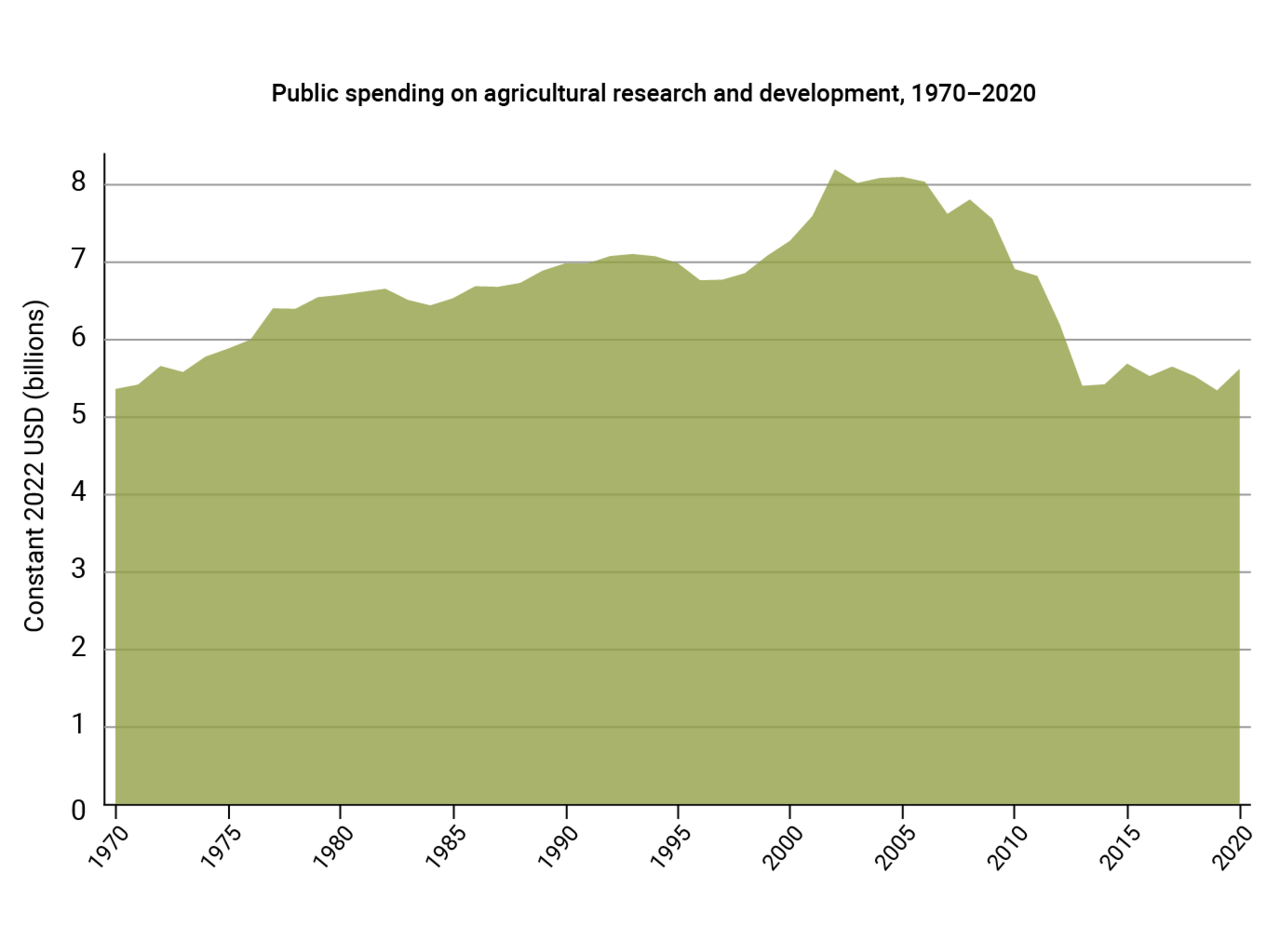
From the 1950s to the 1970s, institutions such as the Rockefeller and Ford foundations, USAID and its precursors, and multilateral development banks made significant global investments in agricultural research, education, and training. These investments laid the foundation for the Green Revolution, demonstrating that human capital and agricultural research and development (R&D) are as critical as physical inputs in driving productivity growth and food security. Since then, however, global public investment in agricultural education and R&D has declined or stagnated, except in a few countries, such as China (Ruane and Ramasamy 2023). For example, in the United States, public agricultural R&D spending—adjusted for inflation—fell by nearly one-third between its 2002 peak and 2019, returning to levels last seen in the 1970s. 

Chart of public spending on agriculture from 1970-2020. 2020 levels are as low as 1970 levels.
USDA, Economic Research Service (ERS) using data from National Science Foundation; USDA's Research, Education, and Economics Information System (REEIS); USDA's Current Research Inventory System (CRIS); and various private sector data sources.

Why Investing in Agricultural Education Is a Global Necessity


There is now an urgent need for a renewed commitment to build agricultural human resources that can lead the next transformation. This is not just about teaching farming. It is about cultivating a new generation of innovators, scientists, policymakers, and agro-entrepreneurs who can lead the Green Revolution 2.0. Here are seven compelling reasons why investing in agricultural education is a global necessity.

1. The times call for a quantum leap in sustainable productivity

The first Green Revolution helped avert mass famine through high-yield varieties, but at great environmental cost (see, inter alia, Tilman 1999 and Yang 2024). Now, we need a  Green Revolution 2.0 to drive a "quantum leap" in food production. This next revolution must be “smart” and sustainable. Agricultural education is the engine of this revolution. It will educate scientists, policymakers, and high-tech farmers, enabling them to develop new climate-resilient crops and adopt sustainable practices. Furthermore, the digital technologies driving the Green Revolution 2.0 can improve market access and help ensure fair prices for smallholder farmers.

2. Innovation adoption must be accelerated

Innovation is meaningless if it does not reach those who need it most. However, farmers, especially smallholders (e.g., small-scale and family farmers) and those with limited education, are often risk-averse in adopting new practices. Worse, the traditional systems supporting technology adoption have become ineffective. Government extension services struggle to keep up with the latest technologies, while farmers increasingly rely on commercial vendors for advice. Recent studies suggest that newer approaches, like social networks and farmer-to-farmer learning, have proven far more effective. Investing in education helps create "agropreneurs" who can champion innovation within farming communities, thereby accelerating the adoption of new technologies.

3. The agriculture workforce needs upskilling

The nature of work in agriculture is rapidly changing—vertical farms, AI-driven analytics, automated systems, and climate-resilient practices are redefining food production. Farmers need new skills in data, systems management, digital operations, and climate-resilient methods. Without education, millions risk being left behind, especially in developing countries, resulting in worsening inequality. Investment in upskilling enables farmers to collaborate with technology, thereby avoiding a poverty trap.

4. Empowering smallholder and family farmers will create opportunities and aid their survival

Unlike past mechanization that favored large farms, today’s advances in precision and digital agriculture can empower smallholders. And it creates new opportunities for smallholder farmers to serve growing niche, diverse markets. With supportive policies and education, smallholders can become key drivers of inclusive agricultural transformation.

5. Agriculture needs new, young blood

Farmers are aging worldwide, while youth are leaving rural areas to seek careers in other fields. Traditional agricultural curricula and programs fail to spark their interest. By integrating robotics, AI, biotechnology, and data science into agricultural education, coupled with the use of app-based market-access solutions, we can redesign agricultural systems and make farming an attractive, future-oriented career. Investing in high-tech agricultural education is the key to filling the labor gap with skilled, motivated, next-generation farmers

6. Greenhouse gas reduction

Agriculture is the second-largest contributor to greenhouse gas emissions and consumes 70% of global fresh water. Climate-smart farming practices can reduce emissions, store carbon, and build resilience against droughts, pests, and diseases. Education is the gateway to equipping farmers with the knowledge to implement such solutions at scale.

7. Agricultural investment boosts national prosperity and global collaboration

The benefits of investing in agricultural education extend far beyond farms. Past investments in the 1950s–70s powered the Green Revolution, saving over a billion people from starvation, reducing rural poverty, and fueling industrial development. A notable example of a successful investment is the US-funded Seoul National University (SNU) Minnesota Project (1954–1962). Under the project, the University of Minnesota helped rebuild SNU’s College of Agriculture and train a generation of agricultural scientists. These scientists not only transformed Korea from a food-deficit to a food-secure nation, but are today contributing to agricultural advancements globally. Replicating such initiatives worldwide could deliver similar results in today’s food-insecure countries.

Moving Forward


Momentum for significant investments in agriculture is building. The G20 has committed to food security, emphasizing investment in sustainable productivity. The World Bank has invested $45 billion in food and nutrition security programs since 2022, exceeding its target of $30 billion. The Asian Development Bank (ADB) pledged $40 billion (2022–2030), including $26 billion in new financing. It is encouraging that more than 50 countries have launched programs to nurture young and next-generation farmers, recognizing their vital role in food security, as well as in ensuring the future sustainability and competitiveness of the agricultural sector (although the outcomes of these programs remain mixed). Countries are also stepping up their investment in agricultural education and training. For example, Bangladesh is developing a $150 million project with ADB and the Korean Eximbank to upgrade its agricultural tertiary education, while Thailand is developing a $120 million investment project in agricultural technical and vocational education.

However, to avert a coming food crisis, these efforts need to be scaled, and to achieve that, concerted global action is necessary. One such initiative, now being proposed by ADB in partnership with a consortium of agricultural universities, is the establishment of a global climate-smart, high-tech agricultural education network to mobilize public and private investments, accelerate knowledge sharing and technology adoption, and prepare the next generation of agriculture leaders and entrepreneurs globally.

The challenges are immense, but so are the opportunities. Investing in agricultural education and training is not just about farming—it is about building a sustainable, food-secure, and climate-resilient future.


Works Cited


FAO. 2017. The Future of Food and Agriculture—Trends and Challenges.

FAO, IFAD, UNICEF, WFP, and WHO. 2024. The State of Food Security and Nutrition in the World 2024—Financing to End Hunger, Food Insecurity and Malnutrition in All Its Forms.

Ruane, John, and Selvaraju Ramasamy. 2023. Global Investments in Agricultural Research: Where Are We and Where Are We Going? Food and Agriculture Organization of the United Nations.

Tilman, David. 1999. “Global Environmental Impacts of Agricultural Expansion: The Need for Sustainable and Efficient Practices.” Proceedings of the National Academy of Sciences of the United States of America 96 (11): 5995-6000.

Yang, Yi, David Tilman, Zhenong Jin et al. 2024. “Climate Change Exacerbates the Environmental Impacts of Agriculture.” Science 385 (6713).
 

Read More

Close-up on coloured medication capsules and a stethoscope on the background of Korean won bills.
News

Spending More, Gaining Less: Lowest-Income Koreans Derive the Least Value from Health Care Investment, New Research Reveals

Despite rising health care spending, adults in South Korea’s lowest-income quintile experience the smallest relative improvement in life expectancy and well-being, according to a new study. The co-authors, including Stanford health economist Karen Eggleston, call for the country’s health policy to prioritize both equity and value, and highlight lessons for other health systems.
Spending More, Gaining Less: Lowest-Income Koreans Derive the Least Value from Health Care Investment, New Research Reveals
Gi-Wook Shin seated in his office, speaking to the camera during an interview.
News

Sociologist Gi-Wook Shin Illuminates How Strategic Human Resource Development Helped Build Asia-Pacific Economic Giants

In his new book, The Four Talent Giants, Shin offers a new framework for understanding the rise of economic powerhouses by examining the distinct human capital development strategies used by Japan, Australia, China, and India.
Sociologist Gi-Wook Shin Illuminates How Strategic Human Resource Development Helped Build Asia-Pacific Economic Giants
Sustainability Dialogue 2025 participants gather for a group photo
News

At Mongolia Sustainability Dialogue, APARC Advances Regional Cooperation on Climate Action

The Sustainability Dialogue 2025 on “Climate Action: Billions of Trees” gathered policymakers, academics, private sector leaders, and civil society representatives in Ulaanbaatar to expedite the implementation of Sustainable Development Goal 13 by strengthening Asia-Pacific regional cooperation and facilitating research-policy partnerships.
At Mongolia Sustainability Dialogue, APARC Advances Regional Cooperation on Climate Action
Hero Image
Two farmers discuss a crop issue; one is referring to a digital tablet.
All News button
1
Subtitle

Why We Need to Invest in Agricultural Education Now

Date Label
-

Image
csa-aparc_may_12

Abstracts

Navyug Gill: Despite government repression and a resurgent pandemic, the farmer and laborer struggle in India remains a potent force of transformative politics. It has been ongoing for nearly six months at the Delhi borders, eleven months in Panjab, and many decades in the making. This struggle has captured the attention of millions of people in India and across the world. And it has unsettled a variety of assumptions as well as thrown up profound questions for understandings of societal change and collective wellbeing. Why did this struggle emerge in Panjab at this time? What are its internal faultlines and fissures as well as potential sutures? And how does it challenge the common sense of capitalist progress? By offering new insights into agriculture, hierarchy and neoliberalism, this struggle has become one of global dimensions as much as of imaginations.
Mallika Kaur: The massive agrarian protest in Punjab is unprecedented, but the underlying agrarian plight is not. Over the past several decades, this plight has manifested in a downward social spiral. Yet the protestors today seem to be insisting on the return to a status quo in which thousands kill themselves out of desperation every year. Discussing this seeming paradox, the presentation will focus on how agrarian distress has been decidedly gendered and how the current protests have in fact also become a site of feminist action and challenge to the gender status quo. Women’s participation, contribution, and leadership, cannot be ignored just because it might not meet dominant feminist rhetoric or frameworks. 
Protesting women are demanding ‘others’ stop expecting them to play weeping subjects when they've always been agents of change, stop peddling women’s lack of independent political astuteness. At the same time, they demand ‘their’ men listen—to stories of victimhood & survivorship and build respectful partnerships with no place for sexual discrimination and harassment. The protesting women are raising important questions and illustrating essential ways of organizing, relating, and strengthening inside-out—thus making an undeniable contribution to women’s empowerment across India, South Asia and beyond.
 
Speakers:
Navyug Gill
 is a scholar of modern South Asia and global history. He is Assistant Professor in the Department of History at William Paterson University. He received a PhD from Emory University, and a BA from the University of Toronto. His research explores questions of agrarian change, labor politics, caste hierarchy, postcolonial critique and global capitalism. Currently, he is completing a book on the emergence of the peasant and the rule of capital in colonial Panjab. His academic and popular writings have appeared in venues such as the Journal of Asian Studies, Economic and Political Weekly, Al Jazeera, Law and Political Economy Project, Borderlines and Trolley Times.
Mallika Kaur is a lawyer and writer who focuses on gender and racial justice. She is the co-founder and Acting Executive Director of the Sikh Family Center, the only Sikh American organization focused on gender-based violence. Her book, Faith, Gender, and Activism in the Punjab Conflict: The Wheat Fields Still Whisper, was recently published by Palgrave MacMillan. Kaur holds a Master in Public Policy from Harvard and a Juris Doctorate from UC Berkeley School of Law where she now teaches skills-based and experiential social justice classes, including "Negotiating Trauma, Emotions and the Practice of Law."

This virtual event is sponsored by:  Center for South Asia, Shorenstein Asia-Pacific Research Center, and Institute for South Asia Studies, UC Berkeley
 
 
On-Line via Zoom webinar    REGISTER    
                         
Navyug Gill William Paterson University
Mallika Kaur Sikh Family Center
-

Co-sponsored by the Stanford Center for International Development

Recent scholarship has documented an alarming increase in the sex ratio at birth in parts of East Asia, South Asia and the Caucuses. In this paper, I argue that parents in these regions engage in sex selection because of patrilocal norms that dictate elderly coresidence between parents and sons. Sex ratios and coresidence rates are positively correlated when looking across countries, within countries across districts, and within districts across ethnic groups. The paper then examines the roots of patrilocality and biased sex ratios using the Ethnographic Atlas (Murdock 1965). I find that ethnic groups in areas with land conducive to intensive agriculture have stronger patrilocal norms, higher modern coresidence rates, and higher sex ratios at birth. The paper concludes with an examination of the expansion to old age support in South Korea. Consistent with the paper’s argument, I find that the program was associated with a normalization in the sex ratio at birth.

Avi Ebenstein received his Ph.D. in economics from the University of California, Berkeley in 2007 is a Lecturer at the Hebrew University of Jerusalem in the Department of Economics. His fields of interest include environmental economics, economic demography, and international trade. Avi's past research has focused primarily on issues related to  China, including the health impacts of air and water pollution, causes and consequences for the country’s high sex ratio at birth, internal migration, and the impact of China’s entry into the global economy on wage patterns domestically and in the United States. He is currently a Visiting Research Scholar at the Center for Health and Wellbeing at Princeton University.

Philippines Conference Room

Avraham Ebenstein Lecturer Speaker The Hebrew University of Jerusalem in the Department of Economics
Seminars
Authors
News Type
Q&As
Date
Paragraphs

For several decades, Southeast Asia’s tracts of dense, old-growth rainforest have served as fertile ground for lumber, and much land has been converted to agriculture. Now, palm oil plantations are being planted where forests once stood.

In 2011, Indonesia, one of the region’s most prosperous countries, instituted a two-year moratorium on clearing new areas of forest, which is set to expire this May and has been criticized as having several loopholes. Other countries, including Cambodia and Myanmar, are losing forests rapidly.

Out of concern for climate change, international initiatives such as Reduced Emissions from Deforestation and forest Degradation (REDD+) have aimed to promote conservation and sustainable development in countries with significant forest cover. But these efforts do not always support local needs, and can inadvertently have negative impacts.

Tim Forsyth, a Lee Kong Chian NUS-Stanford Distinguished Fellow, speaks about the gap between conservation efforts and economic and social development in Southeast Asia. He is visiting Stanford this quarter from the London School of Economics and Political Science where he is a reader in environment and development at the Department of International Development.

What major types of forest management do we see across Southeast Asia today?

A number of countries have put laws in place to restrict illegal logging, and have established national park areas. These are usually old-growth rainforests that restrict logging and agriculture. The problem with national parks is that they put so many restrictions on land use that the vulnerable populations living around them either suffer or are forced to cut other trees. I have spent some years working in poorer villages in Indonesia and Thailand on the edge of protected forests, and usually conservation policies avoid the fact that people need to get livelihoods somehow. Government policy should acknowledge how these people are vulnerable to changes in crop prices and the availability of land, or else these people might be forced into breaking the rules of national parks.

There is also production forest, which usually includes forest plantations. These can include softwoods such as pine, or hardwoods such as teak — and increasingly oil palm for food and biofuels. Forest plantations are attractive to governments and businesses because they earn money and can provide timber for construction and exports. Sometimes, plantations also gain carbon credits, although this is not a lot of money so far. In terms of conservation, destroying old-growth forest and replacing it with a monoculture plantation is not good for biodiversity. It also does not benefit those local people who want to harvest forest products or use part of the land for agriculture.

Finally, there are community forests that are supposed to be places where people can grow food, live, and have forest cover. The definition of “community forest,” however, varies from place to place. In Thailand, for example, the way the government defines it is not very different from a conservation area, and consequently there is not much space for agriculture. The Philippines, on the other hand, is more decentralized and local people can shape the nature of the forest landscape more. Corruption, however, is a problem.

Is there an ideal model that successfully supports sustainable development? How does your research approach this issue?

There has been much progress in collaborations that involve willing governments, international advisors, and local actors — often in accordance with an international agreement such as the Convention on Biological Diversity. These collaborations are more useful than a single actor working alone, and they acknowledge a wider range of objectives.

A new initiative is Reducing Emissions from Deforestation and forest Degradation (REDD+). This is meant to encourage governments to slow down deforestation by rewarding them financially through carbon credits. But REDD+ has a number of challenges. The main problem is that the value of the credits is so low at the moment. REDD+ also overemphasizes forest cover, rather than forest quality. This means that if a satellite image of a country shows a lot of forest cover, that is good according to REDD+. But this gives no indication as to the biodiversity or the diversity of livelihoods inside a forest. It is a green light to all of the people who want fast-growing tree plantations, which makes them money and supplies them with wood for construction. In addition, it keeps a government happy because it supplies their country with timber and tax revenue, but this is not necessarily what you would call sustainable development.

There are elements of good models in different places, and it really depends on one’s viewpoint. Nepal offers a good example of community forestry because, in principle, it aims to engage local people more effectively and equally, and so can combine local development with the protection of national forests. From a development perspective, some forms of conservation can hurt poorer people and actually undermine conservation efforts. Therefore, in my work, I try to promote policy that acknowledges the needs of the more vulnerable populations. My research tries to make climate change policy more relevant to development processes in Southeast Asia. In my current project, I am seeing how policy recommendations about forests can be reshaped and reinterpreted locally in developing countries in order to address local interests. My goal is to understand how expert knowledge about climate change can be governed more effectively in order to enhance both development and conservation in Asia with better outcomes for everybody.

Image
What can people do in their everyday lives to help combat climate change?

The practical problem of dealing with forest destruction and climate change in Southeast Asia is also a function of social and economic trends. As countries become more prosperous, more and more people live in megacities, drive cars, live in air-conditioned apartments, and frequent shopping malls.

A couple of years ago in Bangkok, I took lots of photographs of t-shirts printed with global warming messages and of people carrying reusable bags. When I was there recently, all of these things had disappeared. In other words, there is a tendency for people to think of conservation efforts as a fashion trend.

I do not think that any city in Asia is doing enough. We have to start planning cities in ways that use fewer greenhouse gases, and also to encourage people to realize that they can be real agents of change. At the moment, many urban citizens believe they can implement climate change policy by managing rural and forested landscapes. Instead, they need to realize the problems of these approaches, and to see what they can do themselves.

Hero Image
Sumatra TF compressed Mar07 LOGO
Tim Forsyth stands in a cleared section of national parkland in Sumatra, Indonesia.
Courtesy Tim Forsyth
All News button
1
0
Former Henri H. and Tomoye Takahashi Senior Fellow in Japanese Studies at the Freeman Spogli Institute for International Studies
Former Professor, by courtesy, of Finance at the Graduate School of Business
takeo_hoshi_2018.jpg PhD

Takeo Hoshi was Henri and Tomoye Takahashi Senior Fellow at the Freeman Spogli Institute for International Studies (FSI), Professor of Finance (by courtesy) at the Graduate School of Business, and Director of the Japan Program at the Shorenstein Asia-Pacific Research Center (APARC), all at Stanford University. He served in these roles until August 2019.

Before he joined Stanford in 2012, he was Pacific Economic Cooperation Professor in International Economic Relations at the Graduate School of International Relations and Pacific Studies (IR/PS) at University of California, San Diego (UCSD), where he conducted research and taught since 1988.

Hoshi is also Visiting Scholar at Federal Reserve Bank of San Francisco, Research Associate at the National Bureau of Economic Research (NBER) and at the Tokyo Center for Economic Research (TCER), and Senior Fellow at the Asian Bureau of Finance and Economic Research (ABFER). His main research interest includes corporate finance, banking, monetary policy and the Japanese economy.

He received 2015 Japanese Bankers Academic Research Promotion Foundation Award, 2011 Reischauer International Education Award of Japan Society of San Diego and Tijuana, 2006 Enjoji Jiro Memorial Prize of Nihon Keizai Shimbun-sha, and 2005 Japan Economic Association-Nakahara Prize.  His book titled Corporate Financing and Governance in Japan: The Road to the Future (MIT Press, 2001) co-authored with Anil Kashyap (Booth School of Business, University of Chicago) received the Nikkei Award for the Best Economics Books in 2002.  Other publications include “Will the U.S. and Europe Avoid a Lost Decade?  Lessons from Japan’s Post Crisis Experience” (Joint with Anil K Kashyap), IMF Economic Review, 2015, “Japan’s Financial Regulatory Responses to the Global Financial Crisis” (Joint with Kimie Harada, Masami Imai, Satoshi Koibuchi, and Ayako Yasuda), Journal of Financial Economic Policy, 2015, “Defying Gravity: Can Japanese sovereign debt continue to increase without a crisis?” (Joint with Takatoshi Ito) Economic Policy, 2014, “Will the U.S. Bank Recapitalization Succeed? Eight Lessons from Japan” (with Anil Kashyap), Journal of Financial Economics, 2010, and “Zombie Lending and Depressed Restructuring in Japan” (Joint with Ricardo Caballero and Anil Kashyap), American Economic Review, December 2008.

Hoshi received his B.A. in Social Sciences from the University of Tokyo in 1983, and a Ph.D. in Economics from the Massachusetts Institute of Technology in 1988.

Former Director of the Japan Program at the Shorenstein Asia-Pacific Research Center
CV
-

The lost decades for China in the 1950s, 1960s and 1970s look remarkably like the lost decades of Africa in the 1980s and 1990s. Poor land rights, weak incentives, incomplete markets and inappropriate investment portfolios. However, China burst out of its stagnation in the 1980s and has enjoyed three decades of remarkable growth. In this talk Rozelle examines the record of the development of China’s food economy and identifies the policies that helped generate the growth and transformation of agriculture. Incentives, markets and strategic investments by the state were key. Equally important, however, is what the state did not do. Policies that worked and those that failed (or those that were ignored) are addressed. Most importantly, Rozelle tries to take an objective, nuanced look at the lessons that might be learned and those that are not relevant for Africa. Many parts of Africa have experienced positive growth during the past decade. Rozelle examines if there are any lessons that might be helpful in turning ten positive years into several more decades of transformation.

Scott Rozelle (main speaker). Scott Rozelle is the Helen F. Farnsworth Senior Fellow and the co-director of the Rural Education Action Program in the Freeman Spogli Institute for International Studies at Stanford University. His research focuses almost exclusively on China and is concerned with: agricultural policy, including the supply, demand, and trade in agricultural projects; the emergence and evolution of markets and other economic institutions in the transition process and their implications for equity and efficiency; and the economics of poverty and inequality, with an emphasis on rural education, health and nutrition.

Alain de Janvry (commentator). Alain de Janvry is an economist working on international economic development, with expertise principally in Latin America, Sub-Saharan Africa, the Middle-East, and the Indian subcontinent. Fields of work include poverty analysis, rural development, quantitative analysis of development policies, impact analysis of social programs, technological innovations in agriculture, and the management of common property resources. He has worked with many international development agencies, including FAO, IFAD, the World Bank, UNDP, ILO, the CGIAR, and the Inter-American Development Bank as well as foundations such as Ford, Rockefeller and Kellogg. His main objective in teaching, research, and work with development agencies is the promotion of human welfare, including understanding the determinants of poverty and analyzing successful approach to improve well-being and promote sustainability in resource use.

Bechtel Conference Center

Encina Hall East, E404
Stanford, CA 94305-6055

0
Faculty Co-director of the Stanford Center on China's Economy and Institutions
Helen F. Farnsworth Endowed Professorship
Senior Fellow at the Freeman Spogli Institute for International Studies
Senior Fellow at the Stanford Institute for Economic Policy Research
scott_rozelle_new_headshot.jpeg PhD

Scott Rozelle is the Helen F. Farnsworth Senior Fellow and the co-director of Stanford Center on China's Economy and Institutions in the Freeman Spogli Institute for International Studies and Stanford Institute for Economic Policy Research at Stanford University. He received his BS from the University of California, Berkeley, and his MS and PhD from Cornell University. Previously, Rozelle was a professor at the University of California, Davis and an assistant professor in Stanford’s Food Research Institute and department of economics. He currently is a member of several organizations, including the American Economics Association, the International Association for Agricultural Economists, and the Association for Asian Studies. Rozelle also serves on the editorial boards of Economic Development and Cultural Change, Agricultural Economics, the Australian Journal of Agricultural and Resource Economics, and the China Economic Review.

His research focuses almost exclusively on China and is concerned with: agricultural policy, including the supply, demand, and trade in agricultural projects; the emergence and evolution of markets and other economic institutions in the transition process and their implications for equity and efficiency; and the economics of poverty and inequality, with an emphasis on rural education, health and nutrition.

Rozelle's papers have been published in top academic journals, including Science, Nature, American Economic Review, and the Journal of Economic Literature. His book, Invisible China: How the Urban-Rural Divide Threatens China’s Rise, was published in 2020 by The University of Chicago Press. He is fluent in Chinese and has established a research program in which he has close working ties with several Chinese collaborators and policymakers. For the past 20 years, Rozelle has been the chair of the International Advisory Board of the Center for Chinese Agricultural Policy; a co-director of the University of California's Agricultural Issues Center; and a member of Stanford's Walter H. Shorenstein Asia-Pacific Research Center and the Center on Food Security and the Environment.

In recognition of his outstanding achievements, Rozelle has received numerous honors and awards, including the Friendship Award in 2008, the highest award given to a non-Chinese by the Premier; and the National Science and Technology Collaboration Award in 2009 for scientific achievement in collaborative research.

Faculty affiliate at the Center on Democracy, Development, and the Rule of Law
Faculty Affiliate at the Walter H. Shorenstein Asia-Pacific Research Center
Date Label
Scott Rozelle Speaker
Alain de Janvry Professor of Agricultural and Resource Economics, Goldman School of Public Policy, UC-Berkeley Speaker
Symposiums
-

Analyzing official economic and demographic data of China, Japan, and Korea, Aoki identifies the four phases of economic development that these economies have been passing through and are expected to face. Each phase is characterized by a particular pattern of relationships between demographic factors, such as labor participation rates and rural-urban migration on one hand, and economic performances measured by per capita GDP and labor productivity on the other. There is expected to be a remarkable commonality in this demographic-economic dynamic among those economies, stemming from the common historical legacy of monsoon agriculture dominated by small family-managed farms in pre-industrialization time. Together with this commonality, however, there are differences in the timing of transitions from one phase to the next, conditioned by political events and so on, as well as in institutional arrangements facilitating the transitions. Aoki characterizes these patterns of demographic-economic-institutional dynamics as "Flying Geese Paradigm Version 2.0," distinguishing it from the original Flying Geese Paradigm, once popular in the development economics literature, that focused on the historical pattern of technological transfer in Asia from the 1930s to the 1960s. Aoki then goes on to discuss its policy implications in terms of possible strategic complementarities

Philippines Conference Room

0
Henri and Tomoye Takahashi Professor of Japanese Studies, Department of Economics, Emeritus
Senior Fellow at the Freeman Spogli Institute for International Studies, Emeritus
Senior Fellow at Stanford Institute for Economic Policy Research (SIEPR)
2011_MasaAoki2_Web.jpg PhD

Masahiko Aoki was the Henri and Tomoye Takahashi Professor Emeritus of Japanese Studies in the Department of Economics, and a senior fellow of the Stanford Institute of Economic Policy Research and the Freeman Spogli Institute for International Studies at Stanford University.

Aoki was a theoretical and applied economist with a strong interest in institutional and comparative issues. He specialized in the theory of institutions, corporate architecture and governance, and the Japanese and Chinese economies.

His most recent book, Corporations in Evolving Diversity: Cognition, Governance, and Institutions, based on his 2008 Clarendon Lectures, was published in 2010 by Oxford University Press. It identifies a variety of corporate architecture as diverse associational cognitive systems, and discusses their implications to corporate governance, as well their modes of interactions with society, polity, and financial markets within a unified game-theoretic perspective. His previous book, Toward a Comparative Institutional Analysis, was published in 2001 by MIT Press. This work developed a conceptual and analytical framework for integrating comparative studies of institutions in economics and other social science disciplines using game-theoretic language. Aoki's research has been also published in the leading journals in economics, including the American Economic Review, Econometrica, the Quarterly Journal of Economics, Review of Economic Studies, the Journal of Economic Literature, Industrial and Corporate Change, and the Journal of Economic Behavior and Organizations.

Aoki was the president of the International Economic Association from 2008 to 2011, and is also a former president of the Japanese Economic Association. He is a fellow of the Econometric Society and the founding editor of the Journal of Japanese and International Economies. He was awarded the Japan Academy Prize in 1990, and the sixth International Schumpeter Prize in 1998. Between 2001 and 2004, Aoki served as the president and chief research officer of the Research Institute of Economy, Trade, and Industry, an independent administrative institution specializing in public policy research in Japan.

Aoki graduated from the University of Tokyo with a B.A. and an M.A. in economics, and earned a Ph.D. in economics from the University of Minnesota in 1967. He was formerly an assistant professor at Stanford University and Harvard University and served as both an associate and full professor at the University of Kyoto before rejoining the Stanford faculty in 1984.

CV
Masahiko Aoki Senior Fellow, Freeman Spogli Institute for International Studies Speaker Stanford University
Seminars
Date Label
Subscribe to Agriculture