Health and the Environment
Authors
Noa Ronkin
News Type
News
Date
Paragraphs

Southeast Asia, home to over 640 million people across 10 countries, is one of the world’s most dynamic and fastest growing regions. APARC just concluded the year 2019 with a Center delegation visit to two Southeast Asian capital cities, Hanoi and Bangkok, where we spent an engaging week with stakeholders in the academic, policy, business, and Stanford alumni communities.

Led by APARC Director Gi-Wook Shin, the delegation included APARC Deputy Director and Asia Health Policy Program Director Karen Eggleston, Southeast Asia Program Director Donald Emmerson, and APARC Associate Director for Communications and External Relations Noa Ronkin. Visiting Scholar Andrew Kim joined the delegation in Bangkok.

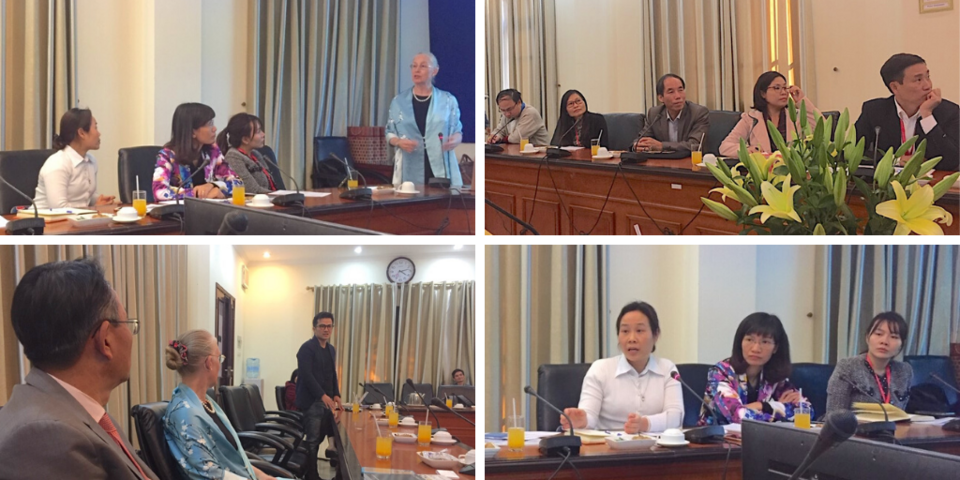
With a focus on health policy, our first day in Hanoi included a visit to Thai Nguyen University, a meeting with government representatives at the Vietnam Ministry of Health, and a seminar on healthy aging and innovation jointly with Hanoi Medical University.
Image
Collage of four images showing participants at a roundtable held at Hanoi Medical University with APARC delegation members

Karen Eggleston and participants at the roundtable held at Hanoi Medical University, December 9, 2019.

Throughout the day, Eggleston presented some of her collaborative research that is part of two projects involving international research teams: one that assesses public-private roles and institutional innovation for healthy aging and another that examines the economics of caring for patients with chronic diseases across diverse health systems in Asia and other parts of the world. We appreciated learning from our counterparts about the health care system and health care delivery in Vietnam.

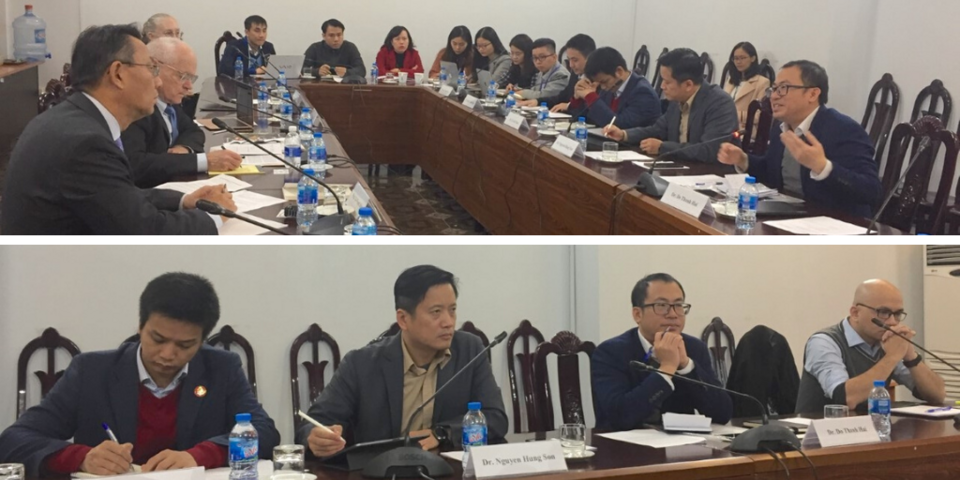
Shifting focus to international relations and regional security, day 2 in Hanoi opened with a roundtable, “The Rise of the Indo-Pacific and Vietnam-U.S. Relations,” held jointly with the East Sea Institute (ESI) of the Diplomatic Academy of Vietnam (DAV). Following a welcome by ESI Director General Nguyen Hung Son, the program continued with remarks by Shin, Emmerson, ESI Deputy Director General To Anh Tuan, and Assistant Director General Do Thanh Hai.
Image
Participants at a roundtable held at the Diplomatic Academy of Vietnam with APARC delegation members

Roundtable at the Diplomatic Academy of Vietnam, December 10, 2019.

The long-ranging conversation with DAV members included issues such as the future of the international order in Asia; the U.S. withdrawal from multilateralism; the concern about a lack of U.S. engagement in Southeast Asia, sparked by President Trump’s absence from the November 2019 summit of the Association of Southeast Asian Nations (ASEAN) at a time when China is bolstering its influence in the region and when ASEAN hopes to set a code of conduct with China regarding disputed waters in the South China Sea; the priorities for Vietnam as it assumes the role of ASEAN chair in 2020; and the challenges for the Vietnam-U.S. bilateral relationship amid the changing strategic environment in Southeast Asia.

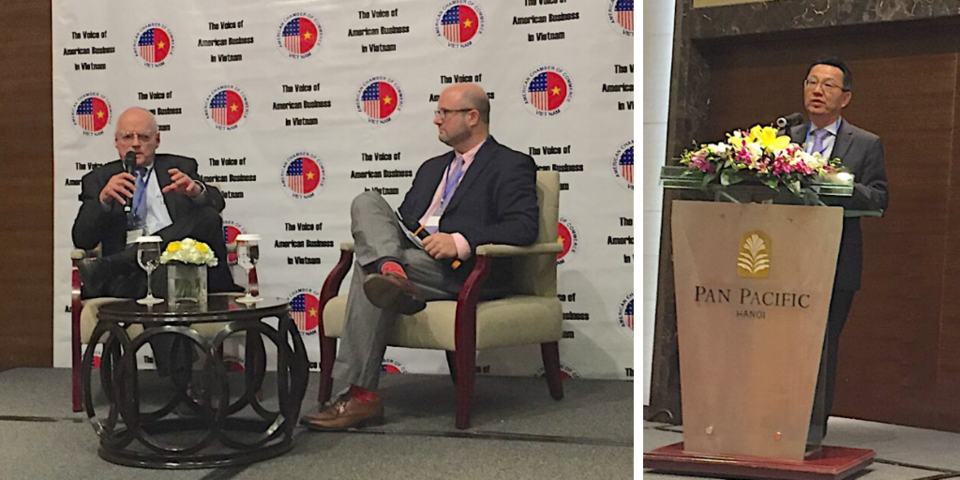
In the afternoon we were joined by members of the American Chamber of Commerce in Hanoi at an AmCham-hosted Lunch ‘n’ Learn session on Vietnam's challenges and opportunities amid the U.S.-China rivalry. The event featured Emmerson in conversation with AmCham Hanoi Executive Director Adam Sitkoff.
Image
Two men in conversation seated on stage and a man speaking at a podium

(Left) Donald Emmerson in conversation with Adam Sitkoff; (right) Gi-Wook Shin welcomes AmCham Hanoi members; December 10, 2019. 

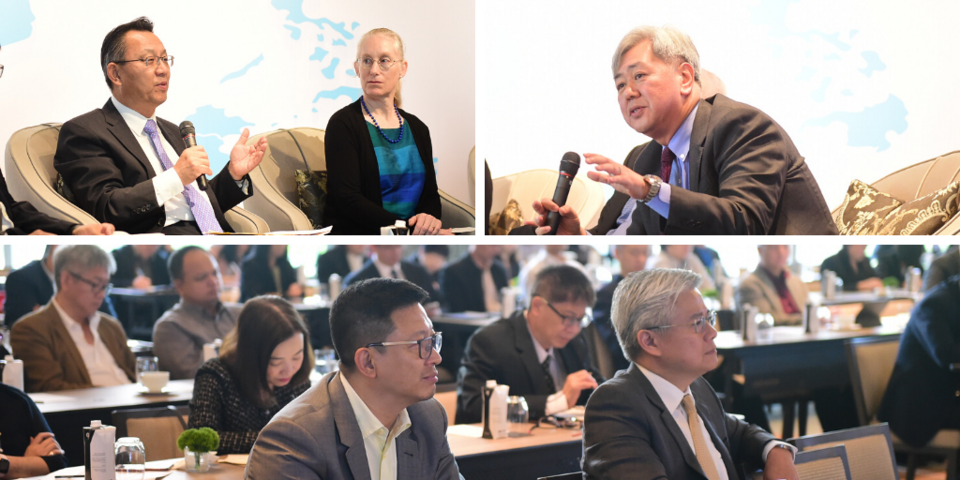
Moving to Bangkok, delegation members Shin, Eggleston, Emmerson, and Kim spoke on a panel for executives of the Charoen Pokphand Group (C.P. Group), one of Thailand’s largest private conglomerates, addressing some of the core issues that lie ahead for Southeast Asia in 2020 and beyond in the areas of geopolitics, innovation, and health.
Image
Participants at a panel discussion with APARC delegation hosted by the C.P. Group, Thailand

Top, from left to right: Gi-Wook Shin, Karen Eggleston, Andrew Kim; bottom: C.P. Group executive listening to the panel, December 12, 2019.

We also enjoyed a tour at True Digital Park, Thailand’s first startup and tech entrepreneur’s campus. Developed by the C.P. Group, True Digital Park aspires to be an open startup ecosystem that powers Thailand to become a global hub for digital innovation.

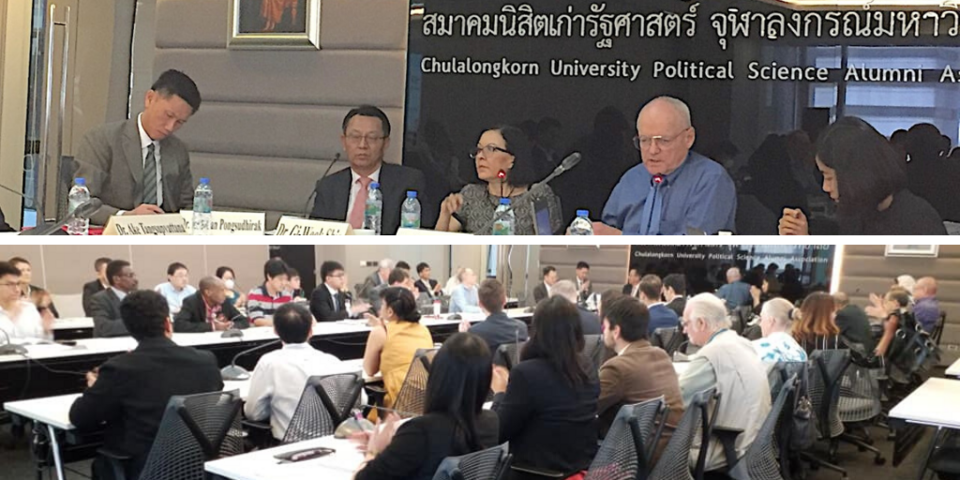
The following day, Shin and Emmerson participated in a public forum hosted by Chulalongkorn University’s Institute of Security and International Studies (ISIS Thailand), "Where Northeast Asia Meets Southeast Asia: The Great Powers, Global Disorder and Asia’s Future.” They were joined by ISIS Thailand Director Thitinan Pongsudhirak and Chulalongkorn University Faculty of Political Science Associate Dean for International Affairs and Graduate Studies Kasira Cheeppensook. The panel was moderated by Ms. Gwen Robinson, ISIS Thailand senior fellow and editor-at-large of the Nikkei Asian Review.
Image
Panelists and participants at a public forum held at Chulalongkorn University

ISIS Thailand forum participants and panelists, from left: Pngsukdhirak, Shin, Robinson, Emmerson, Cheeppensook; December 13, 2019.

As part of that discussion, Emmerson speculated that – driven by deepening Chinese economic and migrational involvement in Southeast Asia’s northern tier – Cambodia and Laos, less conceivably Myanmar, and still less conceivably Thailand could become incorporated de facto into an economically integrated “greater China” that could eventually reduce ASEAN to a more-or-less maritime membership in the region’s southern tier. Emmerson’s speculation was made in the context of his critique of ASEAN’s emphasis on its own “centrality” to the neglect of its lack of the proactivity that would serve as evidence of centrality and of a desire not to be rendered peripheral by the growing centrality-cum-proactivity of China. The event was covered by the Bangkok Post (although that report’s headline and quote of Emmerson are inaccurate, as neither the panel nor Emmerson predicted the “break-up of ASEAN.”)

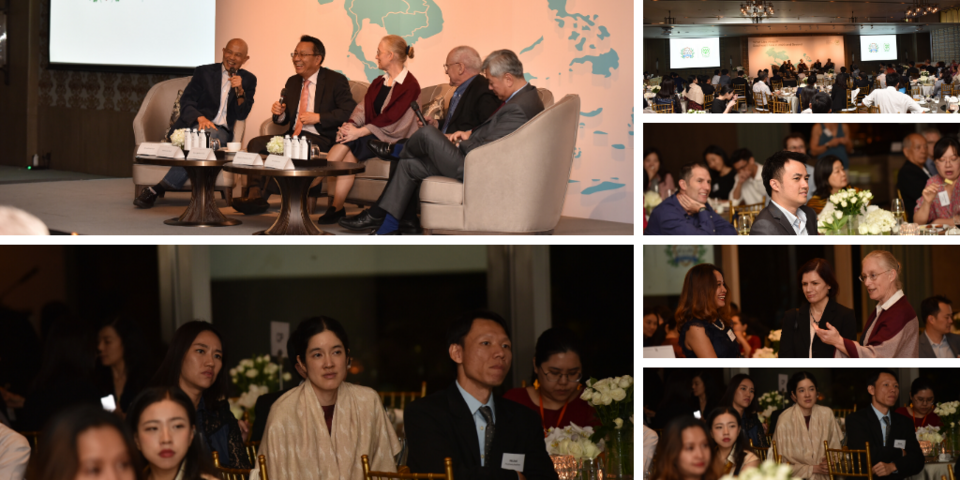
Our delegation visit in Bangkok concluded with a buffet dinner reception and panel discussion jointly with the Stanford Club of Thailand.
Image
alumni event

Stanford and IvyPlus alumni listening to the panel, December 13, 2019.

Moderated by Mr. Suthichai Yoon, a veteran journalist and founder of digital media outlet Kafedam Group, the conversation focused on the changing geopolitics of Southeast Asia, innovation and health in the region, and the opportunities and challenges facing Thailand-U.S. relations. It was a pleasure to meet many new and old friends from the Stanford and IvyPlus alumni communities.

APARC would like to thank our partners and hosts in Hanoi and Bangkok for their hospitality, collaboration, and the stimulating discussions throughout our visit. We look forward to keeping in touch!

Hero Image
APARC delegation speaking to Stanford and IvyPlus alumni, Bangkok
All News button
1
Authors
Karen Eggleston
News Type
News
Date
Paragraphs

China’s recent initiatives to deepen health reform, control antimicrobial resistance, and strengthen primary health services are the topics of ongoing collaborative research by the Asia Health Policy Program (AHPP) at Stanford’s Shorenstein Asia-Pacific Research Center and Chinese counterparts. For example, with generous support from ACON Biotechnology and in partnership with the ACON Biotech Primary Care Research Center in Hangzhou, China, AHPP hosts an annual conference on community health services and primary health care reform in China.

The conference, titled Forum on Community Health Services and Primary Health Care Reform, was held in June at the Stanford Center at Peking University (SCPKU) in Beijing. It featured distinguished policymakers, providers and researchers who discussed a wide-range of topics from China’s emerging “hierarchical medical system” for referring patients to the appropriate level of care (fenji zhenliao), as well as the practice and challenges of innovative approaches to primary care and integrated medical care systems. Yongquan Chen, director of Yong’an City Hospital and representative for the mayor’s office of Sanming, talked about health reforms in Sanming City, Fujian Province, a famous example within China. He discussed the incentives and reasoning behind the reforms, which focus on removing incentives for over-prescription of medications, demonstrating government leadership for comprehensive reforms, consolidating three agencies into one, monitoring implementation and easing tensions between doctors and patients. He pointed out the feasibility and early successes of reform by comparing public hospitals in the city in terms of their revenues and costs, reduced reliance on net revenue from medication sales, and other dimensions of performance. Finally, he addressed reform implementation and future plans on both the hospital's and the government's part.

Xiaofang Han, former director of the Beijing Municipal Development and Reform Commission, shared her personal views on the challenges patients face in navigating China’s health system (kan bing nan) and the need to improve the structure of the delivery system, including a revision to the incentives driving over-prescription in China’s fee-for-service payment system. She emphasized that patients’ distrust of primary care providers can only be overcome by demonstrating improved quality (e.g. with a systematic training program for general practitioners, GPs), and that referral systems should be based on the actual capabilities of the clinicians, not their formal labels. To reach China’s goal of over 80 percent of patients receiving management and first-contact care within their local communities will require improved training and incentive programs for newly-minted MDs, a more flexible physician labor market, and innovations in e-health and patient choice regarding gatekeeping or “contract physician services” (qianyue fuwu).        

Guangde County People's Hospital Director Mingliang Xu spoke about practices and exploration of healthcare alliances and initiatives to provide transparent incentives linking medical staff bonuses to metrics of quality. Ping Zhu from Community Healthcare Service Development and Research Center in Ningbo addressed building solid relationships between doctors and residents and providing more patient-centered services.        

Professor Yingyao Chen from Fudan University School of Public Health discussed performance assessment of community health service agencies based on his research in Shanghai. He introduced the strengths and weaknesses of the incentives embedded in the assessment system for China’s primary care providers, and concluded with suggestions for future research. Dr. Linlin Hu, associate professor at Peking Union Medical College, discussed China's progress and challenges of providing universal coverage of national essential public health services.

Professor Hufeng Wang of Renmin University of China discussed China’s vision for a “hierarchical medical system”– bearing resemblance to “integrated care,” “managed care,” or NHS-like coordination of primary and specialized care – with examples of pilot reforms from Xiamen, Zhenjiang and Dalian cities. Dr. Zuxun Lu, professor of Tongji Medical College of Huazhong University of Science and Technology, also discussed hierarchical medical systems and declared that China currently had a “discounted gatekeeper system.”

Dr. Yaping Du of Zhejiang University presented his research on mobile technology for management of lipid levels and with the help of a volunteer, demonstrated “Dyslipidemia Manager,” a mobile app-based product for both patients and doctors. Innovative strategies for primary prevention of cardiovascular diseases in low- and middle-income countries were the focus of remarks by Dr. Guanyang Zou from the Institute for Global Health and Development at Queen Margaret University, including its connections to international experiences with China’s current efforts in that area.  

In sum, the 2016 Forum elicited lively, evidence-based discussions about the opportunities and challenges in improving primary care and sustaining universal coverage for China.  Plans are underway for convening the third annual ACON Biotech-Stanford AHPP Forum on Community Health Services and Primary Health Care Reform in June 2017 at SCPKU. Anyone with original research or innovative experiences with primary care in China may contact Karen Eggleston regarding participation in next year’s Forum. 

Hero Image
groupphotoscpku062216
Policymakers, healthcare providers and researchers gathered at Stanford Center at Peking University to discuss community health services and primary healthcare reform, Beijing, June 2016.
All News button
1
Authors
News Type
News
Date
Paragraphs

For Matthew Kohrman and his students, the war against tobacco needs a new communications strategy.

After all, he noted, three times as many cigarettes are currently manufactured and sold worldwide than were in the 1960s. And the global cigarette industry is the greatest cause of preventable death on the planet today.

That’s why the Stanford associate professor of anthropology decided to teach an introductory seminar this spring, Anthro 182N, titled Smoke and Mirrors in Global Health. Kohrman led his 10 students on a journey into the “strange optics” that the global tobacco industry uses – and what to do about them.

As noted in the syllabus, “entrenched challenges” to global health require society to develop “new methods” to communicate the real truth about tobacco.

Just what are those “new methods?” At the culmination of the class, the students presented some variations on that theme. Their end-of-the-quarter projects were web-based efforts profiling various features of global tobacco. They included exposés on how academicians in China assist the industry in that country, humorous parodies and critiques of Philip Morris, and flawed approaches to tobacco control in South Korea.

They tackled big-picture questions, Kohrman said. For example, they asked what exactly constitutes cigarette manufacturing and how new strategies could help slow the spread of tobacco-related diseases worldwide.

Kohrman, the director of Stanford’s Cigarette Citadels project, envisioned his class as a way for students to offer some thought-provoking and original ideas grounded in solid data. After viewing the student projects, he was astounded – and proud.

“My overall impression has been a feeling of awe,” he said. “Mostly freshmen and sophomores, the students who enrolled in this new course quickly synthesized complex intellectual concepts introduced early in the quarter, conceived their own innovative project ideas, collected relevant data, generously worked with each other, designed apt strategies for evocatively visualizing their messages, and chose and implemented strong interactive media tools – most of which were utterly new to me.”

One of those students was Minkee Sohn, a communication major, who created a video, “Fresh Recruits,” to highlight what he believes is the hypocrisy in the language of some cigarette manufacturers’ recruitment efforts.

“While cigarette manufacturers,” Sohn said, “often frame smoking as an act of free choice, that choice is just an illusion. Free choice is denied to people in all stages of cigarette manufacturing and consumption.”

For example, he explained that children in the African country of Malawi are coerced to work with their families in tobacco fields. “It’s deeply disturbing to hear companies associate freedom with high-paying jobs in cigarette manufacturing.”

For biology major Annabel Chen, the most important thing she learned was to analyze information skeptically. “Industries like big tobacco have influences in unexpected places, so you always need to do sleuthing to find out the truth,” she said.

She chose to examine the links between tobacco and academic research in China. “Seeing as China is the biggest tobacco market in the world, this was a problem we needed to address.”

Kohrman appreciates how students like Sohn and Chen were willing to try an experimental course, never taught before, and which for many was outside of their comfort zone. He said the course will be taught again in 2015-16.

“Looking back, it was the perfect-size group for all the work and one-on-one teaching we did,” he said.

The course was a classic collaboration, according to Kohrman, who also credits Claudia Engel, a lecturer in the Anthropology Department who helped with the technology and his own experiences mentoring undergraduate research, all of which proved instrumental to designing Smoke and Mirrors in Global Health.

“It was a great success today,” he said after seeing the student projects on the last day of class. Tom Glynn, a top adviser to the American Cancer Society, was on hand to see the presentations.

Kohrman added, “Students got tremendous feedback, and there was lots of enthusiasm about how this experimental course unfolded.”

Clifton Parker is a writer for the Stanford News Service.

Hero Image
flickr shizhao smokingarea
Smoking area sign.
Flickr/Shizhao
All News button
1
Subscribe to Health and the Environment