Conflict
Authors
Callista Wells
News Type
News
Date
Paragraphs

On February 24, 2021, the China Program at Shorenstein APARC hosted Dr. Thomas Wright, director of the Center on the United States and Europe and a senior fellow in the Project on International Order and Strategy at the Brookings Institution. Professor Jean Oi, William Haas Professor of Chinese Politics and director of the APARC China Program, moderated the event.

The program, entitled "U.S.-China Relations in the Biden Era," explored the future of US-China relations based on experience from past administrations. Under former President Trump, U.S. relations with China evolved into outright rivalry. In his talk, Dr. Wright discussed whether this rivalry will continue and evolve during a Biden administration by analyzing the roots of strategic competition between the two countries and various strands of thinking within the Biden team. According to Wright, the most likely outcome is that the competition between the two countries will evolve into a clash of governance systems and the emergence of two interdependent blocs where ideological differences become a significant driver of geopolitics. Cooperation is possible but it will be significantly shaped by conditions of rivalry. Watch now:

Read More

Min Ye speaking
News

Domestic or International? The Belt and Road Initiative Is More Internally Focused Than We Think, Says Expert Min Ye

Domestic or International? The Belt and Road Initiative Is More Internally Focused Than We Think, Says Expert Min Ye
Banner of Hau L. Lee
News

The Pandemic, U.S.-China Tensions and Redesigning the Global Supply Chain

The Pandemic, U.S.-China Tensions and Redesigning the Global Supply Chain
Photograph of Xi Jinping and Vladmir Putin walking in front of two lines of armed Chinese soldiers
News

Military Competition with China: Harder to Win Than During the Cold War?

On February 10th, the APARC China Program hosted Professor Oriana Mastro to discuss military relations between the US and China, and why deterrence might be even more difficult than during the Cold War.
Military Competition with China: Harder to Win Than During the Cold War?
Hero Image
American and Chinese flags
All News button
1
Subtitle

Dr. Thomas Wright examines the recent history of US-China relations and what that might mean for the new administration.

-

This is a virtual event. Please click here to register and generate a link to the talk. 
The link will be unique to you; please save it and do not share with others.

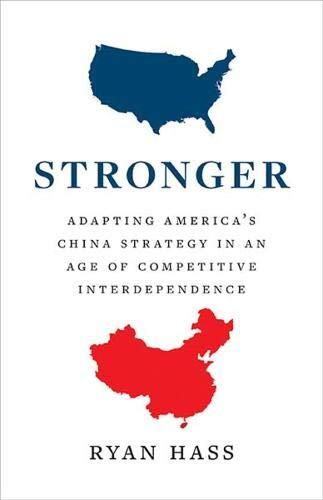
How can the U.S. best manage its relationship with China? The country is at once a major and increasingly hostile competitor to the U.S., a formidable challenger to U.S.’ regional and global leadership, and an important partner on a range of transnational challenges. Will it be possible for both sides to coexist amidst intensifying competition? How great is the risk of US-China conflict, including over Taiwan? Ryan Hass, author of Stronger: Adapting America’s China Strategy in an Age of Competitive Interdependence, will address these questions and more in opening comments before engaging in an open Q&A on the future of the world’s most consequential bilateral relationship.


Image
Portrait of Ryan Hass
Ryan Hass is a senior fellow and the Michael H. Armacost Chair in the Foreign Policy program at Brookings, where he holds a joint appointment to the John L. Thornton China Center and the Center for East Asia Policy Studies. He is also the Interim Chen-Fu and Cecilia Yen Koo Chair in Taiwan Studies. Hass focuses his research and analysis on enhancing policy development on the pressing political, economic, and security challenges facing the United States in East Asia. He is the author of Stronger: Adapting America’s China Strategy in an Age of Competitive Interdependence, published by Yale University Press.

Image
"Stronger" Book Cover
From 2013 to 2017, Hass served as the director for China, Taiwan and Mongolia at the National Security Council (NSC) staff. In that role, he advised President Obama and senior White House officials on all aspects of U.S. policy toward China, Taiwan, and Mongolia, and coordinated the implementation of U.S. policy toward this region among U.S. government departments and agencies. He joined President Obama’s state visit delegations in Beijing and Washington respectively in 2014 and 2015, and the president’s delegation to Hangzhou, China, for the G-20 in 2016, and to Lima, Peru, for the Asia-Pacific Economic Cooperation (APEC) Leaders Meetings in 2016. Prior to joining NSC, Hass served as a Foreign Service Officer in U.S. Embassy Beijing, where he earned the State Department Director General’s award for impact and originality in reporting. Hass also served in Embassy Seoul and Embassy Ulaanbaatar, and domestically in the State Department Offices of Taiwan Coordination and Korean Affairs. 


Image
American and Chinese flags
This event is part of the 2021 Winter/Spring Colloquia series, Biden’s America, Xi’s China: What’s Now & What’s Next?, sponsored by APARC's China Program.


Via Zoom Webinar. Register at: https://bit.ly/3c3v10W

Ryan Hass Senior Fellow, Michael H. Armacost Chair in Foreign Policy Studies, Brookings Institution
Seminars
Authors
Callista Wells
News Type
News
Date
Paragraphs

On February 10, 2021, the China Program at Shorenstein APARC hosted Professor Oriana Skylar Mastro, Center Fellow at the Freeman Spogli Institute for International Studies​ for the virtual program "Military Competition with China: Harder to Win Than During the Cold War?" Professor Jean Oi, William Haas Professor of Chinese Politics and director of the APARC China Program, moderated the event.

As US-China competition intensifies, experts debate the degree to which the current strategic environment resembles that of the Cold War. Those that argue against the analogy often highlight how China is deeply integrated into the US-led world order. They also point out that, while tense, US-China relations have not turned overtly adversarial. But there is another, less optimistic reason the comparison is unhelpful: deterring and defeating Chinese aggression is harder now than it was against the Soviet Union. In her talk, Dr. Mastro analyzed how technology, geography, relative resources and the alliance system complicate U.S. efforts to enhance the credibility of its deterrence posture and, in a crisis, form any sort of coalition. Mastro and Oi's thought-provoking discussion ranged from the topic of why even US allies are hesitant to take a strong stance against China to whether or not Taiwan could be a catalyst for military conflict. Watch now: 

Read More

Min Ye speaking
News

Domestic or International? The Belt and Road Initiative Is More Internally Focused Than We Think, Says Expert Min Ye

Domestic or International? The Belt and Road Initiative Is More Internally Focused Than We Think, Says Expert Min Ye
Concept of U,S.-China technology competition: brain-shaped boxing gloves covered in U.S. and China flags facing against each other on a background of a motherboard
News

Caught in the Crossfire: The Future Of U.S.-China Science Collaboration and Its Impact on University Education

Caught in the Crossfire: The Future Of U.S.-China Science Collaboration and Its Impact on University Education
Banner of Hau L. Lee
News

The Pandemic, U.S.-China Tensions and Redesigning the Global Supply Chain

The Pandemic, U.S.-China Tensions and Redesigning the Global Supply Chain
Hero Image
Photograph of Xi Jinping and Vladmir Putin walking in front of two lines of armed Chinese soldiers Getty Images
All News button
1
Subtitle

On February 10th, the APARC China Program hosted Professor Oriana Mastro to discuss military relations between the US and China, and why deterrence might be even more difficult than during the Cold War.

Authors
News Type
Q&As
Date
Paragraphs

This article was originally written by Melissa De Witte on behalf of Stanford News.

As Monday’s coup in Myanmar demonstrates, democracy is often fragile and subject to setbacks, says former U.S. ambassador to Myanmar and Stanford visiting scholar, Scot Marciel.

Here, Marciel discusses how in a country like Myanmar (formerly Burma), which was under military rule from 1962 to 2011, establishing a democracy takes time. Despite democratic reforms over the past decade, the military in Myanmar has held onto a considerable amount of power, said Marciel, noting that it is difficult to build not only a representative parliament but other democratic institutions including an independent judicial system, a fair police force and a free press.

While Monday’s coup is a major setback in Myanmar’s fight for democracy, Marciel said that there are many people in the country who will do what they can to restore their elected government and build the foundations of democracy.

Marciel is a visiting scholar at the Walter H. Shorenstein Asia-Pacific Research Center (APARC), Stanford’s hub for interdisciplinary research, education and engagement on contemporary Asia that is run under the auspices of the Freeman Spogli Institute for International Studies. Marciel served as U.S. Ambassador to Myanmar from March 2016 through May 2020. From 2010 to 2013, Scot Marciel served as U.S. Ambassador to Indonesia.

[Subscribe to APARC's newsletters to get the latest updates from our scholars.]


What do people who have not spent extensive time studying or living in Myanmar need to know about its history to better understand Monday’s coup?

A couple of things. First, as historian Thant Myint-U has written, Myanmar is an unfinished nation, in the sense that the diverse communities that make up the country have never truly solidified as a unified nation. The country has been in near-constant conflict, mostly between the majority Bamar ethnic group and the many ethnic minority communities that inhabit much of Myanmar’s border areas. Second, the military staged a coup in 1962 and ran the country for nearly 50 years before allowing some movement toward representative democracy beginning in 2011-2012. So the military has long been a dominant force in the country, and – even after the reforms of the past decade – retained substantial power.

Is there anything that is often misunderstood about its history and its people?

In the West, many people have tended to view Myanmar mostly through the prism of a struggle for democracy between the military and the civilian opposition, led by Aung San Suu Kyi. That is a critically important part of the story, for sure. Perhaps equally important, however, has been the struggle of the many ethnic minority communities for equality, a degree of autonomy, and respect for their own histories, cultures and languages. This struggle has produced widespread conflict, significant human rights abuses, and large numbers of refugees and displaced people for decades.

What are some of the difficulties in establishing, and maintaining, democratic rule in a country like Myanmar?

First, persuading the military to give up power, depart from politics, and play a more appropriate role in the country. Second, it is very difficult to build the institutions of democracy, including not only parliament, but also a strong, independent judicial system, an effective and fair police force, and respect for the critical role of civil society and the independent media. In Myanmar, another essential aspect is to shift from historically centralized rule to a federal structure that would allow the various communities across the country to have more of a say in how they are governed.

As ambassador to Myanmar, what was it like working with not only the country’s policymakers but also its people? What did you learn from them about how democracy is established? And how did those experiences shape your perspective?

In Myanmar, I met so many people, all over the country, from many different walks of life, who had sacrificed and continued to sacrifice to try to build democracy and respect for human rights. Some operated at the national level, others at the local level. It was a good reminder that democracy isn’t just imposed from the top; it requires careful building at the community and state level, with intensive involvement by the various communities. It also takes time and, as we have seen this week, is often fragile and subject to setbacks. In other words, it is a long-term effort that requires persistence, courage, and participation by large numbers of people. Establishing a democracy is a lengthy, painstaking effort that can be upended, particularly if the armed forces are politicized and pursue their own agenda.

Is there anything else you would like to add? 

This week’s military takeover constitutes a major setback, but the story of Myanmar’s struggle for democracy is not over. Many people there will continue to do what they can to restore elected government and build, brick by brick, the foundations of democracy.

Read More

Portrait of Paul Schuler and the cover of his book, 'United Front'
Q&As

A Balance of Power: The Role of Vietnam’s Electoral and Legislative Institutions

As the 13th National Congress of Vietnam's Communist Party is selecting a new leadership team that will set the country’s course for the next five years, Vietnamese politics expert Paul Schuler discusses his new book on the state’s single-party legislature.
A Balance of Power: The Role of Vietnam’s Electoral and Legislative Institutions
President Biden walks past a row of Chinese and American flags.
News

APARC Experts on the Outlook for U.S.-Asia Policy Under the Biden Administration

Ahead of President-elect Biden’s inauguration and on the heels of the attack on the U.S. Capitol by a pro-Trump mob that has left America shaken, an APARC-wide expert panel provides a region-by-region analysis of what’s next for U.S. policy towards Asia and recommendations for the new administration.
APARC Experts on the Outlook for U.S.-Asia Policy Under the Biden Administration
Stanford campus, main quad with cloudy sky
News

APARC Offers Fellowship and Funding Opportunities to Support, Diversify Stanford Student Participation in Contemporary Asia Research

The Center has launched a suite of offerings including a predoctoral fellowship, a diversity grant, and research assistant internships to support Stanford students interested in the area of contemporary Asia.
APARC Offers Fellowship and Funding Opportunities to Support, Diversify Stanford Student Participation in Contemporary Asia Research
Hero Image
Protesters opposing the February 1 coup in Myanmar
People protest the February 1 coup in Myanmar outside the Myanmar embassy in Bangkok, Thailand.
Lauren DeCicca, Getty
All News button
1
Subtitle

According to Scot Marciel, former U.S. ambassador to Myanmar and Stanford visiting scholar at APARC, building a democracy is a difficult process that can be upended, particularly when the military is politicized and has its own agenda.

-

This is a virtual event. Please click here to register and generate a link to the talk. 
The link will be unique to you; please save it and do not share with others.


U.S. relations with China evolved into outright rivalry during the Trump administration. In this talk, Thomas Wright will look at whether this rivalry will continue and evolve during a Biden administration. To answer this question, he will look at the roots of strategic competition between the two countries and various strands of thinking within the Biden team. The most likely outcome is that the competition will evolve into a clash of governance systems and the emergence of two interdependent blocs where ideological differences become a significant driver of geopolitics. Cooperation is possible but it will be significantly shaped by conditions of rivalry.


Image
Portrait of Thomas Wright
Thomas Wright is the director of the Center on the United States and Europe and a senior fellow in the Project on International Order and Strategy at the Brookings Institution. He is also a contributing writer for The Atlantic and a nonresident fellow at the Lowy Institute for International Policy. He is the author of “All Measures Short of War: The Contest For the 21st Century and the Future of American Power” which was published by Yale University Press in May 2017. His second book "Aftershocks: Pandemic Politics and the End of the Old International Order" will be published by St Martin's Press in 2021. Wright also works on U.S. foreign policy, great power competition, the European Union, Brexit, and economic interdependence.

Wright has a doctorate from Georgetown University, a Master of Philosophy from Cambridge University, and a bachelor's and master's from University College Dublin. He has also held a pre-doctoral fellowship at Harvard University's Belfer Center for Science and International Affairs and a post-doctoral fellowship at Princeton University. He was previously executive director of studies at the Chicago Council on Global Affairs and a lecturer at the University of Chicago's Harris School for Public Policy.


Image
American and Chinese flags
This event is part of the 2021 Winter/Spring Colloquia series, Biden’s America, Xi’s China: What’s Now & What’s Next?, sponsored by APARC's China Program.


Via Zoom Webinar. Register at: https://bit.ly/3r1glp7

Thomas Wright Director, Center on the United States and Europe, Brookings Institution; Senior Fellow, Foreign Policy, Project on International Order and Strategy, Brookings Institution
Seminars
-

This is a virtual event. Please click here to register and generate a link to the talk. 
The link will be unique to you; please save it and do not share with others.

As US-China competition intensifies, experts debate the degree to which the current strategic environment resembles that of the Cold War. Those that argue against the analogy often highlight how China is deeply integrated into the US-led world order. They also point out that, while tense, US-China relations have not turned overtly adversarial. But there is another, less optimistic reason the comparison is unhelpful: deterring and defeating Chinese aggression is harder now than it was against the Soviet Union. In this talk, Dr. Mastro analyzes how technology, geography, relative resources and the alliance system complicate U.S. efforts to enhance the credibility of its deterrence posture and, in a crisis, form any sort of coalition.


Photo of Oriana MastroOriana Skylar Mastro is a Center Fellow at Stanford University’s Freeman Spogli Institute for International Studies (FSI). Within FSI, she works primarily in the Shorenstein Asia-Pacific Research Center (APARC) and the Center for International Security and Cooperation (CISAC) as well. She is also a fellow in Foreign and Defense Policy Studies at the American Enterprise Institute and an inaugural Wilson Center China Fellow.

Mastro is an international security expert with a focus on Chinese military and security policy issues, Asia-Pacific security issues, war termination, and coercive diplomacy. Her research addresses critical questions at the intersection of interstate conflict, great power relations, and the challenge of rising powers. She has published widely, including in Foreign Affairs, International Security, International Studies Review, Journal of Strategic Studies, The Washington Quarterly, The National Interest, Survival, and Asian Security, and is the author of The Costs of Conversation: Obstacles to Peace Talks in Wartime (Cornell University Press, 2019).

She also continues to serve in the United States Air Force Reserve, for which she works as a Strategic Planner at INDOPACOM. Prior to her appointment at Stanford in August 2020, Mastro was an assistant professor of security studies at the Edmund A. Walsh School of Foreign Service at Georgetown University. She holds a B.A. in East Asian Studies from Stanford University and an M.A. and Ph.D. in Politics from Princeton University.


Image
American and Chinese flags
This event is part of the 2021 Winter/Spring Colloquia series, Biden’s America, Xi’s China: What’s Now & What’s Next?, sponsored by APARC's China Program.


Via Zoom Webinar. Register at: bit.ly/2MYJAdw

Oriana Skylar Mastro Center Fellow at the Freeman Spogli Institute for International Studies
Seminars
News Type
Commentary
Date
Paragraphs

India-China border tensions along the disputed Line of Actual Control show no signs of letting up and the prospects of peace in the conflict between the nuclear-armed rivals are daunting. How do the Indian and Chinese militaries compare against each other?

FSI Center Fellow at APARC Oriana Skylar Mastro and our South Asia Research Scholar Arzan Tarapore join the Observer Research Foundation’s ‘Armchair Strategist’ podcast to discuss the Indian and Chinese strategic power postures, military modernization and reform by the two Asian neighbors, the ways they can marshal both military and non-military forces, and the possible outcomes of a confrontation along their Himalayan border. Listen here:

Based in Delhi, the Observer Research Foundation (ORF) is a leading South Asian nonprofit policy research institution whose work spans a wide range of topics, including national security, economic development, cyber issues and media, and climate and energy.

Read More

Chinese President Xi Jinping (R) talks with India's Prime Minister Manmohan Singh (L) during a meeting at the Diaoyutai State Guesthouse in 2013.
Commentary

China-India: Talk is Cheap, But Never Free

Nations often hesitate to negotiate with opponents during conflict. But Oriana Skylar Mastro urges that this is precisely what India and China need to do in order to curb the potential for a protracted, costly war with devastating geopolitical implications.
China-India: Talk is Cheap, But Never Free
An Indian army soldier watches a fighter plane from a convoy of trucks in Gagangir, India.
Commentary

India and China are Taking New Risks Along Their Border

Will diplomacy help defuse the current tensions brewing along the India-China border? Arzan Tarapore analyzes why restoring peace between the two countries may prove difficult.
India and China are Taking New Risks Along Their Border
An Indian Army soldier looking through a military monocular over hills in the background
News

U.S. Policymakers Cannot Assume the Fixity of Indian Strategic Preferences, Argues South Asia Research Scholar Arzan Tarapore

In a special report published by the National Bureau of Asian Research, Tarapore analyzes possible scenarios for India’s strategic future that expose risks and tensions in current U.S. policy.
U.S. Policymakers Cannot Assume the Fixity of Indian Strategic Preferences, Argues South Asia Research Scholar Arzan Tarapore
Hero Image
Logo of the Observer Research Foundation's 'Armchair Strategist' podcast with portraits of Oriana Skylar Mastro and Arzan Tarapore
All News button
1
Subtitle

Oriana Skylar Mastro and Arzan Tarapore join the Observer Research Foundation’s ‘Armchair Strategist’ podcast to discuss how the Indian and Chinese militaries stack up as tensions between the two Asian neighbors continue to heat up.

0
APARC Predoctoral Fellow, 2020-2021
anna_zhang.jpg

Anna Zhang joined the Walter H. Shorenstein Asia-Pacific Research Center (APARC) as APARC Predoctoral Fellow for the 2020-2021 academic year. She is a PhD candidate at the political science department. Her research interests include civil conflict, state building, and internal migration. Her dissertation studies China's institutional solution to the challenges of territorial control. 

Authors
Noa Ronkin
News Type
News
Date
Paragraphs

We are pleased to share that Oriana Skylar Mastro, FSI Center Fellow at APARC, has won the 2020 International Security Section of the American Political Science Association Best Book by an Untenured Faculty Member Award for her book The Costs of Conversation: Obstacles to Peace Talks in Wartime (Cornell University Press, 2019).

Each year, APSA recognizes excellence in the political science profession and its various subfields. Mastro has won the Association’s award for an untenured scholar who has published the highest quality book in Security Studies in the previous calendar year.

[To receive the latest updates on our scholars' research sign up for APARC’s newsletters]

Mastro is an international security expert with a focus on Chinese military and security policy issues, Asia-Pacific security, war termination, and coercive diplomacy. Her research addresses critical questions at the intersection of interstate conflict, great power relations, and the challenge of rising powers. In The Costs of Conversation, she argues that states are primarily concerned with the strategic costs of conversation, and these costs need to be low before combatants are willing to engage in direct talks with their enemy. She examines two factors leaders look to when determining the strategic costs of demonstrating a willingness to talk: the likelihood the enemy will interpret openness to diplomacy as a sign of weakness, and how the enemy may change its strategy in response to such an interpretation. A state will be open to talking with the enemy only if it thinks it has demonstrated adequate strength and resiliency to avoid the inference of weakness and if it believes that its enemy has limited capacity to escalate or intensify the war.

Mastro uses four primary case studies — North Vietnamese diplomatic decisions during the Vietnam War, those of China in the Korean War and Sino-Indian War, and Indian diplomatic decision making in the latter conflict — to demonstrate that the costly conversations thesis best explains the timing and nature of countries' approach to wartime talks, and therefore when peace talks begin. Her findings have significant theoretical and practical implications for war duration and termination, as well as for military strategy, diplomacy, and mediation.

Read More

[left: image] Oriana Skylar Mastro, [right: text] Congratulations, Oriana Skylar Mastro, Recipient of the 2020 America in the World Consortium Prize for 'Best Policy Article' from Duke University, Johns Hopkins SAIS, and Texas University at Austin
News

Oriana Skylar Mastro Awarded America in the World Consortium Prize for Best Policy Article

Mastro, who begins her role as FSI Center Fellow on August 1, has won the AWC Best Policy Article on U.S. Foreign Policy and Grand Strategy award for her insights on how China leverages ambiguity to gain global influence and what the United States can do to counter the PRC’s ambitions.
Oriana Skylar Mastro Awarded America in the World Consortium Prize for Best Policy Article
Portrait of Oriana Mastro with text: "Q&A with Oriana Skylar Mastro"
Q&As

FSI’s Incoming Center Fellow Oriana Skylar Mastro Discusses Chinese Ambitions, Deteriorating U.S.-China Relations

Mastro, whose appointment as a Center Fellow at Shorenstein APARC begins on August 1, considers the worsening relations between the world’s two largest economies, analyzes Chinese maritime ambitions, and talks about her military career and new research projects.
FSI’s Incoming Center Fellow Oriana Skylar Mastro Discusses Chinese Ambitions, Deteriorating U.S.-China Relations
Portrait of Arzan Tarapore and text: "Q&A with Arzan Tarapore"
Q&As

Internal Balancing Will Determine India’s Relationships with the US and China, Argues APARC’s Newest Research Scholar

Indo-Pacific security expert Arzan Tarapore, whose appointment as a research scholar at APARC begins on September 1, discusses India’s military strategy, its balancing act between China and the United States, and his vision for revitalizing the Center’s research effort on South Asia.
Internal Balancing Will Determine India’s Relationships with the US and China, Argues APARC’s Newest Research Scholar
Hero Image
Portrait of Oriana Skylar Mastro and a 3D cover of her book, 'The Costs of Conversation: Obstacles to Peace Talks in Wartime'
All News button
1
Subtitle

The American Political Science Association recognizes Oriana Skylar Mastro for her work on military strategy and mediation.

Stanford CISAC
Stanford University
Encina Hall
Stanford,  CA  94305-6055

0
Center Fellow at the Freeman Spogli Institute for International Studies
Courtesy Assistant Professor of Political Science
Faculty Affiliate at the Walter H. Shorenstein Asia-Pacific Research Center
OrianaSkylarMastro_2023_Headshot.jpg PhD

Oriana Skylar Mastro is a Center Fellow at the Freeman Spogli Institute for International Studies and Courtesy Assistant Professor of Political Science at Stanford University, where her research focuses on Chinese military and security policy, Asia-Pacific security issues, war termination, and coercive diplomacy. She is also a nonresident scholar at the Carnegie Endowment for International Peace and a member of the Council on Foreign Relations. She was previously an assistant professor of security studies at Georgetown University. Mastro continues to serve in the United States Air Force Reserve, for which she currently works at the Pentagon as Deputy Director of Reserve Global China Strategy. For her contributions to U.S. strategy in Asia, she won the Individual Reservist of the Year Award in 2016 and 2022 (FGO).

She has published widely, including in International Security, Security Studies, Foreign Affairs, the Journal of Strategic Studies, The Washington Quarterly, the Economist, and the New York Times. Her most recent book, Upstart: How China Became a Great Power (Oxford University Press, 2024), evaluates China’s approach to competition. Her book, The Costs of Conversation: Obstacles to Peace Talks in Wartime (Cornell University Press, 2019), won the 2020 American Political Science Association International Security Section Best Book by an Untenured Faculty Member.

She holds a B.A. in East Asian Studies from Stanford University and an M.A. and Ph.D. in Politics from Princeton University.

Her publications and commentary can be found at orianaskylarmastro.com and on Twitter @osmastro.

Selected Multimedia

CV
Date Label
Subscribe to Conflict