Information Technology
-

Please note the event time has been changed to 10:30AM (PT) to 12:00PM (PT).


This is a virtual event. Please click here to register for the talk. 


This event is presented in partnership with Global:SF and the State of California Governor’s Office of Business and Economic Development.
 

U.S.-China economic relations have grown increasingly fraught and competitive.  Even amidst intensifying tensions, however, our two major economies remain intertwined.  While keeping alert to national security concerns, the economic strength of the United States will depend on brokering a productive competition with China, the world’s fastest growing economy.  Precipitous decoupling of trade, investment, and human talent flows between the two nations will inflict unnecessary harm to U.S. economic interests -- and those of California.  

Chinese trade and investments into California have grown exponentially over the last decade.  But they have come under increasing pressure following geopolitical and economic tensions between the two nations, particularly in the science and technology sectors.  This session will explore the role of Chinese economic activity in California in the context of the greater US-Chinese relationship. 


Portrait of Ambassador Craig AllenCraig Allen began his tenure in Washington, DC, as the sixth President of the United States-China Business Council, a private, nonpartisan, nonprofit organization representing over 200 American companies doing business with China. Ambassador Allen began his government career in 1985 at the Department of Commerce’s International Trade Administration (ITA) where, from 1986 to 1988, he worked as an international economist in ITA’s China Office. In 1988, Allen transferred to the American Institute in Taiwan, where he served as Director of the American Trade Center in Taipei. He returned to the Department of Commerce for a three-year posting at the US Embassy in Beijing as Commercial Attaché in 1992. In 1995, Allen was assigned to the US Embassy in Tokyo where he was promoted to Deputy Senior Commercial Officer in 1998. Allen became a member of the Senior Foreign Service in 1999. Starting from 2000, he served a two-year tour at the National Center for APEC in Seattle where he worked on the APEC Summits in Brunei, China, and Mexico. In 2002, Allen first served as the Senior Commercial Officer in Beijing where he was later promoted to the Minister Counselor rank of the Senior Foreign Service. After a four-year tour in South Africa, Ambassador Allen became Deputy Assistant Secretary for Asia at the US Department of Commerce’s International Trade Administration. He later became Deputy Assistant Secretary for China. Ambassador Allen was sworn in as the United States ambassador to Brunei Darussalam on December 19, 2014 where he served until he transitioned to take up his position as President of the US-China Business Council.
 

Image
Portrait of David Cheng
David Cheng is the chair and managing partner of Nixon Peabody’s China and Asia-Pacific practice. He is qualified in both the United States and Hong Kong. He focuses on cross-border transactions, litigations and investigations, advising on issues ranging from acquisitions, capital financing (initial public offering), intellectual property protection and disputes to fraud, FCPA and SEC investigations. He has a client portfolio from all over the world, including the United States, Middle East, Europe, Japan, Singapore, Taiwan, mainland China and Hong Kong.
 

james greenJames Green has worked for over two decades on U.S.-Asia relations. For five years, Green was the Minister Counselor for Trade Affairs at the U.S. Embassy in Beijing (2013-2018).  As the senior official in China from the Office of the United States Trade Representative (USTR), Green was deeply involved in all aspects of trade negotiations, trade enforcement, and in reducing market access barriers for American entities.  In prior government service, Green worked on the Secretary of State’s Policy Planning Staff and at the State Department’s China Desk on bilateral affairs. He also served as the China Director of the White House’s National Security Council.  In the private sector, Green was a senior vice president at the global strategy firm founded by former Secretary of State Madeleine Albright and was the founding government relations manager at the American Chamber of Commerce in Shanghai, Asia’s largest AmCham.  Currently, Green is a Senior Research Fellow at Georgetown University's Initiative for U.S.-China Dialogue on Global Issues and hosts a U.S.-China Dialogue Podcast.  He was most recently named as APARC's inaugural China Policy Fellow
 

Image
Portrait of Anja Manuel
Anja Manuel is Co-Founder and Principal, along with former Secretary of State Condoleezza Rice, former National Security Advisor Stephen Hadley and former Secretary of Defense Robert Gates, in Rice, Hadley, Gates & Manuel LLC, a strategic consulting firm that helps US companies navigate international markets. She currently serves on two corporate boards: Overseas Shipping Group, Inc., a NYSE listed energy transportation company, and Ripple Labs Inc., a leading blockchain payments company. Manuel also serves on several advisory boards, including Former Governor Brown’s California Export Council. From 2005-2007, she served as an official at the U.S. Department of State, responsible for South Asia Policy. She is a frequent commentator on foreign policy and technology policy, for TV and radio (NBC/MSNBC, Fox Business, BBC, Bloomberg, Charlie Rose, NPR, etc.) and writes for publications ranging from the New York Times, to the Financial Times, Fortune, The Atlantic, and Newsweek, among others. She is the author of the critically acclaimed This Brave New World: India, China and the United States, published by Simon and Schuster in 2016. A graduate of Harvard Law School and Stanford University, Manuel now also lectures and is a Research Affiliate at Stanford University. She is the Director of the Aspen Strategy Group and Aspen Security Forum -- the premier bipartisan forum on foreign policy in the U.S. -- and is a member of the Council on Foreign Relations.


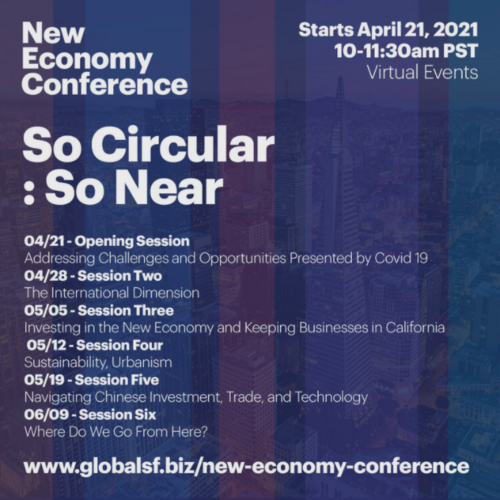
This Session is part of a larger conference series titled “The New Economy Conference – California’s Place in the New Global Economy”.   The New Economy Conference will broadcast public programs from April 21-May 25 on a weekly basis, designed to inform and identify the impact of COVID-19 on the economic competitiveness and resilience of the State of California.  Topics addressed will include Challenges and Opportunities Post-COVID in California (4/21); the International Dimension (4/28), Investing in the New Economy and Keeping Businesses in California (5/5); Sustainability and Urbanism (5/12); Navigating Chinese Investment, Trade and Technology (5/19); and Where do We Go from Here? (6/09).


Via Zoom Webinar. Register at: https://www.globalsf.biz/session-5-nec 

Amb. Craig Allen <br><i>President of US-China Business Council</i><br><br>
David K. Cheng <br><i>Chair and Managing Partner of China & Asia Pacific Practice, Nixon Peabody LLP</i><br><br>
James Green <br><i>Senior Research Fellow, Initiative for U.S.-China Dialogue on Global Issues, Georgetown University</i><br><br>
Anja Manuel <br><i>Co-Founder and Principal, Rice, Hadley, Gates & Manuel LLC</i><br><br>
Seminars
-

This is a virtual event. Please click here to register and generate a link to the talk. 
The link will be unique to you; please save it and do not share with others.

As US-China competition intensifies, experts debate the degree to which the current strategic environment resembles that of the Cold War. Those that argue against the analogy often highlight how China is deeply integrated into the US-led world order. They also point out that, while tense, US-China relations have not turned overtly adversarial. But there is another, less optimistic reason the comparison is unhelpful: deterring and defeating Chinese aggression is harder now than it was against the Soviet Union. In this talk, Dr. Mastro analyzes how technology, geography, relative resources and the alliance system complicate U.S. efforts to enhance the credibility of its deterrence posture and, in a crisis, form any sort of coalition.


Photo of Oriana MastroOriana Skylar Mastro is a Center Fellow at Stanford University’s Freeman Spogli Institute for International Studies (FSI). Within FSI, she works primarily in the Shorenstein Asia-Pacific Research Center (APARC) and the Center for International Security and Cooperation (CISAC) as well. She is also a fellow in Foreign and Defense Policy Studies at the American Enterprise Institute and an inaugural Wilson Center China Fellow.
Mastro is an international security expert with a focus on Chinese military and security policy issues, Asia-Pacific security issues, war termination, and coercive diplomacy. Her research addresses critical questions at the intersection of interstate conflict, great power relations, and the challenge of rising powers. She has published widely, including in Foreign Affairs, International Security, International Studies Review, Journal of Strategic Studies, The Washington Quarterly, The National Interest, Survival, and Asian Security, and is the author of The Costs of Conversation: Obstacles to Peace Talks in Wartime (Cornell University Press, 2019).

She also continues to serve in the United States Air Force Reserve, for which she works as a Strategic Planner at INDOPACOM. Prior to her appointment at Stanford in August 2020, Mastro was an assistant professor of security studies at the Edmund A. Walsh School of Foreign Service at Georgetown University. She holds a B.A. in East Asian Studies from Stanford University and an M.A. and Ph.D. in Politics from Princeton University.


Image
American and Chinese flags
This event is part of the 2021 Winter/Spring Colloquia series, Biden’s America, Xi’s China: What’s Now & What’s Next?, sponsored by APARC's China Program.


Via Zoom Webinar. Register at: bit.ly/2MYJAdw

Oriana Skylar Mastro Center Fellow at the Freeman Spogli Institute for International Studies
Seminars

In recent years, we have witnessed a worldwide trend of "democratic depression" in both young and established democracies, where the backsliding from democracy is facilitated by various forces such as populism, nationalism, partisan polarization, and post-truth. Korea is no exception. While the signs of democratic decline are subtle and disguised under the rule of law, they are producing piecemeal erosions of liberal democracy and pluralism in many corners of the Korean society. As a timely warning against the gradual decline of democratic norms and values, this 3-part conference seeks to examine the forces that endanger the Korean democracy and aims to offer some concrete policy prescriptions to remedy the existing and growing signs of democratic decline.

Topics Discussed:

Day 1: November 12, 2020 (4PM-7PM)

  • Political culture and polarization: Pitfall of political over-participation or “street-democracy"
  • Underdevelopment of party politics: Factionalism, weak institutionalization, and poor appreciation
  • Erosion in balance of power: Courts losing legitimacy and respect with politicization
  • Uses and misuses of nationalism in politics

Day 2: November 13, 2020 (4PM-6PM)

  • Two divergences in South Korea’s Economy: Regional and generational disparities
  • Challenges of post-truth: Politicization and polarization of the press, social media, disinformation
  • Education and its impact on civic value and generational gap

Day 3: November 19, 2020 (4PM-6:15PM)

  • Politicization of civil society: Losing function as watchdog of power, former democratic activists becoming new authoritarian leaders
  • How the rise of populist regime affects foreign policy
  • Korean democracy in comparative perspectives

The conference papers will be published as an edited volume.

Via Zoom

Conferences
-

This is a virtual event. Please click here to register and generate a link to the talk. 
The link will be unique to you; please save it and do not share with others.

Data-intensive technologies such as AI may reshape the modern world. We propose that two features of data interact to shape innovation in data-intensive economies: first, states are key collectors and repositories of data; second, data is a non-rival input in innovation. We document the importance of state-collected data for innovation using comprehensive data on Chinese facial recognition AI firms and government contracts. Firms produce more commercial software and patents, particularly data-intensive ones, after receiving government public security contracts. Moreover, effects are largest when contracts provide more data. We then build a directed technical change model to study the state's role in three applications: autocracies demanding AI for surveillance purposes, data-driven industrial policy, and data regulation due to privacy concerns. When the degree of non-rivalry is as strong as our empirical evidence suggests, the state's collection and processing of data can shape the direction of innovation and growth of data-intensive economies.

Image
Portrait of David Yang
David Yang’s research focuses on political economy, behavioral and experimental economics, economic history, and cultural economics. In particular, David studies the forces of stability and forces of changes in authoritarian regimes, drawing lessons from historical and contemporary China. David received a B.A. in Statistics and B.S. in Business Administration from University of California at Berkeley, and PhD in Economics from Stanford. David is currently a Prize Fellow in Economics, History, and Politics at Harvard and a Postdoctoral Fellow at J-PAL at MIT. He also joined Harvard’s Economics Department as an Assistant Professor as of 2020.

Via Zoom Webinar.
Register at: https://bit.ly/2VlhaMm

David Yang Prize Fellow in Economics, History, and Politics; Department of Economics, Harvard University
Seminars
News Type
News
Date
Paragraphs

The headlines about the United States and China have been dominated by the spread of COVID-19 and trade deal negotiations. Experts in U.S.-China relations have warned against preemptive disengagement in a time of increased need for international cooperation and coordination, even as tensions between the two countries continue to escalate in the media.

From Adam Segal's perspective, as an expert in security issues, technology development, and Chinese domestic and foreign policy at the Council on Foreign Relations, one of the emerging considerations that will prominently affect the tone and timbre of the relationship between the United States and China in the coming years is how the two nations compete with one another in technological and scientific research and innovation. He delved further into this topic in a lecture as part of the China Program's winter/spring colloquia series.

[To get more stories like this delivered to your inbox, sign up for our newsletters]

As Segal and others describe, both the United States and China benefitted immensely from the globalization of scientific research and collaboration, but in recent years, both have also become wary of sharing talent and resources too broadly or across too many sectors. As a result, each country has taken various measures in an attempt to gain and regain perceived advantages over the other.

As China has tried to move up the so-called economic value chain from being an overwhelmingly manufacturing and heavy industry-based economy to being a leader in tech and digital economies, it has simultaneously tried to wean itself from a dependence on foreign technological infrastructure. In its efforts to create indigenous innovation and technological growth, it has openly tried to court talent and intelligence from overseas. To the United State's rising concern, however, the Chinese government has been less open about the means used to accomplish this aim.

On its part, the United States has upped its efforts to expand cybersecurity research and initiatives. The Trump administration has very vocally critiqued companies such as Huawei and urged allies to step back from business with the telecom and networking giant. Similarly, allegations of espionage against native Chinese and Chinese-American scientists and academics have escalated in recent months.

Segal argues that these simmering tensions signify the growing awareness each country has of the other's increasing capabilities in the cybersphere, as well as a heightened understanding and awareness of the shortcomings of their own systems.

"I think technology, which had usually been a fifth, sixth, seventh on the agenda in the U.S.-China relationship, is going to continue to be one of the defining issues that structure the relationship, and increasingly is one not just about concerns about national security, but about values and how we think about how technology is applied, and governance issues."

To watch Segal's full lecture, click the video below or find it on our YouTube channel. A transcript of his remarks is available

Hero Image
Adam Segal lectures at APARC
All News button
1
-

IMPORTANT EVENT UPDATE: 

In keeping with Stanford University's March 3 message to the campus community on COVID-19 and current recommendations of the CDC, the Asia-Pacific Research Center is electing to postpone this event until further notice. We apologize for any inconvenience this may cause, and appreciate your understanding and cooperation as we do our best to keep our community healthy and well. 


Data-intensive technologies such as AI may reshape the modern world. We propose that two features of data interact to shape innovation in data-intensive economies: first, states are key collectors and repositories of data; second, data is a non-rival input in innovation. We document the importance of state-collected data for innovation using comprehensive data on Chinese facial recognition AI firms and government contracts. Firms produce more commercial software and patents, particularly data-intensive ones, after receiving government public security contracts. Moreover, effects are largest when contracts provide more data. We then build a directed technical change model to study the state's role in three applications: autocracies demanding AI for surveillance purposes, data-driven industrial policy, and data regulation due to privacy concerns. When the degree of non-rivalry is as strong as our empirical evidence suggests, the state's collection and processing of data can shape the direction of innovation and growth of data-intensive economies.

Image
Portrait of David Yang
David Yang’s research focuses on political economy, behavioral and experimental economics, economic history, and cultural economics. In particular, David studies the forces of stability and forces of changes in authoritarian regimes, drawing lessons from historical and contemporary China. David received a B.A. in Statistics and B.S. in Business Administration from University of California at Berkeley, and PhD in Economics from Stanford. David is currently a Prize Fellow in Economics, History, and Politics at Harvard and a Postdoctoral Fellow at J-PAL at MIT. He also joined Harvard’s Economics Department as an Assistant Professor as of 2020.

David Yang Prize Fellow in Economics, History, and Politics; Department of Economics, Harvard University
Seminars
-

WE HAVE REACHED VENUE CAPACITY AND ARE NO LONGER ACCEPTING RSVPS


Authoritarian governments around the world are developing increasingly sophisticated technologies for controlling information. In the digital age, many see these efforts as futile, as they are easily thwarted by savvy Internet users who quickly find ways to evade and circumvent them. In this talk, Professor Roberts demonstrates that even censorship that is easy to circumvent is enormously effective. Censorship acts like a tax on information, requiring those seeking information to spend more time and money if they want access. By creating small inconveniences that are easy to explain away, censorship powerfully influences the spread of information and, in turn, what people know about politics. Through analysis of Chinese social media data, online experiments, nationally representative surveys, and leaks from China’s Propaganda Department, Professor Roberts find that when Internet users notice blatant censorship they are willing to compensate for better access.  But subtler censorship, such as burying search results or introducing distracting information on the web, is more effective because users are less aware of it. Roberts challenges the conventional wisdom that online censorship is undermined when it is incomplete and shows instead how censorship’s porous nature is used strategically to divide the public and target influencers. 

Image
Portrait of Margaret E. Roberts
Margaret E. Roberts is an Associate Professor at the U.C. San Diego Department of Political Science. Her research interests lie in the intersection of political methodology and the politics of information, specifically focused on automated text analysis and understanding censorship and propaganda in China. Her work has appeared in venues such as the American Journal of Political Science, American Political Science Review, Political Analysis and Science. Her recent book Censored: Distraction and Diversion Inside China’s Great Firewall was listed as one of the Foreign Affairs Best Books of 2018, was honored with the Goldsmith Book Award, and has been awarded the Best Book Award in the Human Rights Section and Information Technology and Politics Section of the American Political Science Association.  She received her Ph.D. from Harvard University, an M.S. in statistics from Stanford University, and a B.A. in Economics and International Relations from Stanford.

Advisory on Novel Coronavirus (COVID-19)

In accordance with university guidelines, if you (or a spouse/housemate) have returned from travel to mainland China in the last 14 days, we ask that you DO NOT come to campus until 14 days have passed since your return date and you remain symptom-free. For more information and updates, please refer to the Stanford Environmental Health & Safety website: https://ehs.stanford.edu/news/novel-coronavirus-covid-19


Image
Image of red flag over the Shanghai Bund
This event is part of the 2020 Winter/Spring Colloquia series, The PRC at 70: The Past, Present – and Future?, sponsored by APARC's China Program.


Margaret E. Roberts Associate Professor, Department of Political Science, U.C. San Diego
Seminars
Authors
Noa Ronkin
News Type
News
Date
Paragraphs

As a U.S.-China trade deal hangs in the balance and the world’s two largest economies are locked in a race for technological supremacy, concerns have arisen about China’s counterintelligence threat to the United States. In July 2019, FBI Director Christopher Wray told members of the U.S. Senate Judiciary Committee that China poses the most severe counterintelligence threat to the United States than any other country, and described that national security and economic espionage threat as “deep and diverse and wide and vexing.” He noted that the FBI has to contend not only with Chinese officials but also with “nontraditional collectors,” including Chinese scientists and students who are looking to steal American innovation. There are currently multiple legislative proposals in Congress, all of which, in one way or another, are aimed at limiting university collaboration with Chinese nationals and the education of Chinese nationals in “strategic” research fields by U.S. higher education institutions.

These legislative endeavors, however, argues Arthur Bienenstock, co-chair of the American Academy of Arts and Sciences’ Committee on International Scientific Partnerships, may endanger the U.S. science and technology workforce and limit the effectiveness of U.S. academic research, thus weakening the very fields the nation is most anxious to protect.

Bienenstock is also a member of the National Science Board, the governing body of the National Science Foundation, and former associate director for science of the White House Office of Science and Technology Policy. At Stanford, he is special assistant to the President for federal research policy, associate director of the Wallenberg Research Link, and professor emeritus of photon science. At a recent lecture hosted by APARC’s China Program, Bienenstock discussed some of the proposed legislation and federal acts regarding international scientific collaboration with China and their implications for the U.S. scientific workforce. He cautioned U.S policymakers against an expansive interpretation of what constitutes “sensitive research” in strategic areas, such as artificial intelligence and quantum science, and offered a framework for determining when scientific research should be subject to greater control.

[To get more stories like this delivered to your inbox sign up for APARC newsletters]

Image
Arthur Bienenstock and Gi-Wook Shin seated at a conference room.
Indeed, said Bienenstock, “China is the only nation in the world that can and plans to challenge U.S. economic, military and ideological leadership” – a challenge that is partly based on its becoming a major scientific and technological power. He agreed that the concerns of FBI Director Wray and others are valid and must be considered carefully, but noted, based on his observations at informative sessions and a meeting with an FBI officer, that the overall number of documented misdeeds involving Chinese nationals is over 100 – far from a deep and wide threat – and that he has not seen evidence of significant student participation in those misdeeds.

We must come to terms with reality, claimed Bienenstock, presenting evidence that the United States is no longer the dominant funder of science and technology research; that Chinese nationals constitute a very significant portion of the U.S. workforce in computer science, engineering, and mathematics; and that the U.S. science and technology workforce is highly dependent on Chinese graduate students.

The United States must maintain and strengthen its scientific and technological efforts if it is to maintain a leadership position, Bienenstock said. To do so, he emphasized, U.S. universities must maintain their openness, and lawmakers, in turn, must thoughtfully understand the benefits of collaboration with Chinese scientists and engineers as well as keep the country attractive for Chinese students.

Listen to highlights from Bienenstock’s presentation on our SoundCloud channel. A transcript is available below.

Photo: Arthur Bienenstock (right) and APARC DIrector Gi-Wook Shin (credit: Andrea Brown).

Hero Image
Concept of U,S.-China technology competition: brain-shaped boxing gloves covered in U.S. and China flags facing against each other on a background of a motherboard Just Super/ Getty Images
All News button
1
Authors
Noa Ronkin
News Type
News
Date
Paragraphs

“Our dystopian present is your dystopian future if nothing significant is done,” cautioned Ressa, urging the Stanford community to pressure technology platforms and social media to stop disinformation spread.

“This is an existential moment for global power structures, turned upside down by technology. When journalists globally are under attack, democracy is under attack.” With these words, the internationally-esteemed investigative journalist and press freedom champion Maria Ressa, winner of the 2019 Shorenstein Journalism Award, opened her keynote address at a lunchtime ceremony, held at Stanford on October 21.

Ressa knows first-hand the terrifying reality of continuously being subject to online attacks and politically motivated attempts by the government to silence and intimidate. As CEO and executive editor of Rappler, she has led the Philippine independent news platform in shining critical light on the Duterte administration's policies and actions. President Duterte in turn has made no secret of his dislike for Ressa and Rappler, accusing the platform for carrying "fake news." Ressa has been arrested twice this year, accused of corporate tax evasion and of violating security laws, and slapped with charges of cyber libel for a report that was published before the libel law came into effect. Since Duterte’s election in summer 2016, the Philippine government has filed at least 11 cases and investigations against Ressa and Rappler.

“And all because I’m a journalist,” she says.

Speaking at the Shorenstein Award’s eighteenth annual panel discussion, Ressa detailed the devastating effects that disinformation has had on democracy and societal cohesion in the Philippines. She vividly explained why each and every one of us should be gravely concerned about the breaking down of the information ecosystem in a country halfway around the world. The Philippines, she said, is a case study of how attacks on truth and facts rip the heart out of civic engagement and gradually kill democracy, “a death by a thousand cuts.”

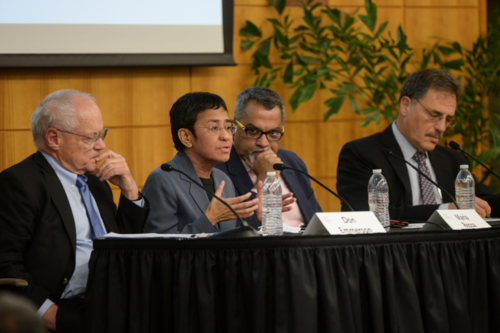
Ressa was joined on the panel by Stanford’s Larry Diamond, senior fellow at the Hoover Institution and the Freeman Spogli Institute for International Studies, and Raju Narisetti, director of the Knight-Bagehot Fellowship in Economics and Business Journalism and professor of professional practice at Columbia Journalism School, who also serves on the selection committee for the Shorenstein Journalism Award. Shorenstein APARC’s Southeast Asia Program Director Donald K. Emmerson chaired the discussion.

[To get more stories like this delivered directly to your inbox sign up to receive our newsletters.] 

A Cautionary Tale

Modern authoritarians follow a familiar playbook, noted Ressa, for they know well that “If you can make people believe lies are the facts, then you can control them.” Their first step is to lie all the time. The second is to argue their opponents and the journalists are the ones who lie. Then finally everyone looks around and says, "What's truth?" And when there is no truth resistance is impossible.

Ressa went on to describe detailed examples of patriotic trolling in the Philippines, that is, how state-sponsored online hate and harassment campaigns silence and intimidate journalists and others who voice criticism of the Duterte administration. Instead of censoring, she said, state agents now flood the information ecosystem with lies, blurring the line between fact and fiction. These information operations are conducted through the weaponization of technology and social media platforms, first and foremost Facebook. Ressa’s team at Rappler uses network analysis methods to unveil the flow and spread of online disinformation and harassment campaigns on Facebook and from there to other platforms as well as traditional and state media.

Ressa urged the packed audience of campus and community members to remember that “Without facts you cannot have truth, without truth you cannot have trust, and without any of these three democracy as we know it is dead. The public sphere is dead […] our Philippine dystopian present is your dystopian future, if nothing significant is done.”

She closed her keynote by pleading: “Please push tech platforms and social media to do something to stop the lies from spreading. Lies laced with anger and hate spread faster than facts. Fight  for your rights.”

Watch Ressa’s keynote and the entire panel proceedings here or on our YouTube channel. You can also listen to Ressa’s keynote below and on our SoundCloud channel. A transcript of the keynote address is available below.

No Ministry of Truth

Is the attack on truth a technological problem, and can it have a technological solution? It's naïve, said Diamond, to think that there is a purely technological solution or that we can rein in the alarming developments in the Philippines and elsewhere without addressing their technological elements and the economic incentives underlying these elements. “There has to be a macro political element of response,” argued Diamond, “which obviously has to involve advanced liberal democracies condemning and drawing boundaries around the murderous authoritarianism of Rodrigo Duterte.”

Image
2019 Shoresntein Journalism panelists, from left to right: Donald K. Emmerson, Maria Ressa, Raju Narisetti, Larry Diamond.

Left to right: Donald K. Emmerson, Maria Ressa, Raju Narisetti, Larry Diamond.

Narisetti emphasized the need to look at the problem and its potential solutions holistically and bear in mind that solutions must come from multiple areas. “We must remember that technology has value, but it has no values. It's a matter of who is using it and how they're using it.” And while we certainly don't want Facebook to be the Ministry of Truth, continued Narisetti, by no means do we want Congress to take on that role. He pointed to specific possible regulatory solutions, such as insisting Facebook enable its users to port their complete data outside of the platform if they wish to do so, or establishing a system of data and privacy courts.

Commitment to Journalism that Courageously Seeks Accuracy

The Shorenstein Journalism Award, which is sponsored by APARC, was presented to Ressa at a private evening ceremony. “You would be hard pressed to find a person whose work more fully embodies the ideals that define journalism than Maria Ressa,” said James Hamilton, Stanford’s Hearst Professor of Communication, Chair of the Department of Communication, Director of the Stanford Journalism Program, who also serves on the selection committee for the award. Shorenstein APARC Director Gi-Wook Shin joined Hamilton in co-presenting Ressa the award.

The Shorenstein Award, which carries a cash prize of $10,000, recognizes accomplished journalists committed to critical reporting on and exploring the complexities of Asia through their writing. It alternates between honoring recipients from the West, who mainly address American audiences, and recipients from Asia, who often work on the frontline of the battle for freedom of the press in their countries. Established in 2002, the award honors the legacy of APARC benefactor Mr. Walter H. Shorenstein, who was passionate about promoting both excellence in journalism and a deeper understanding of Asia.

Hero Image
Maria Ressa speaking at Stanford Rod Searcey
All News button
1
0
Global Affiliate Visiting Scholar, 2019-20
PetroChina / China National Petroleum Corporation
huasheng_zheng.jpeg MBA

Huasheng Zheng is a global affiliate visiting scholar at the Walter H. Shorenstein Asia-Pacific Research Center (Shorenstein APARC) for 2019-20.

Subscribe to Information Technology