History
Authors
Noa Ronkin
News Type
News
Date
Paragraphs

hallenges and Possibilities of Korean Studies in North America — Social Science panel
Future Visions: Challenges and Possibilities of Korean Studies in North America — Social Science panel. From left to right: UC Berkeley's Laura Nelson, University of Michigan's Jordan Siegel, Stanford's Yong Suk Lee, USC's David Kang, Harvard's Paul Chang.


How can Korean studies faculty cultivate supportive and critical scholarly communities with graduate students? What can be done to overcome the severe constraints on Korean language training in North America? Why is there a dearth of Korea scholarship in academic literature? And how should Korean studies librarians prepare for the future in the light of new technologies and young researchers’ increasing interest in digital scholarship?

These were some of the questions examined at a two-day conference, “Future Visions: Challenges and Possibilities of Korean Studies in North America,” convened by the Korea Program of Stanford’s Shorenstein Asia-Pacific Research Center (APARC) on November 1-2. Co-sponsored by the Seoul-based Foundation Academia Platonica, the conference, the first of its kind, gathered distinguished Korean studies scholars from twelve North American institutions to consider the state of the field, assess its challenges, and carry forward a vision for its future direction and potential. Its six unique panels focused not only on the major disciplines of Korean studies—history, literature, and the social sciences—but also on language education, library collections and services, and Korean Wave.

“The presentations and discussions by our fellow experts reflected the breadth and depth of Korean studies in North America,” says APARC Director and the Korea Program Director Gi-Wook Shin. “Our program was established at Stanford in 2001 and has since become a leader in Korean studies in North America, so it is a special privilege for us to bring together colleagues from eminent institutions around the continent to further advance Korean studies education and research in the academic and policy worlds, and to build upon our track record of action and achievements.”

“The field of Korean studies, however,” notes Shin, “has significantly changed over the past seventeen years and it isn’t without its challenges. This is our opportunity to consider frankly where we go next and how we could explore the path ahead together.”

Conference participants indeed engaged in deep conversations and shared ideas and dilemmas regarding teaching in the different disciplines of Korean studies in North America. Harvard sociologist Paul Chang listed three types of challenges facing the field: publication, academic, and professional challenges. David C. Kang, professor of international relations and director of the Korean Studies Institute at the University of Southern California, emphasized the publication challenge: why is it, asked Kang, that top academic journals in the discipline of political science and international relations publish so much more scholarship about Europe than they do about Korea and Asia at large, even while the rise of Asian nations is surely one of the most consequential issues of the twenty-first century? The onus, Kang argued, comes back to East Asia scholars “to produce better and more compelling scholarship, and to better train graduate students.”

University of British Columbia's Ross King and conference participants.

Yet complex issues surround the question of how to broaden graduate coursework—and whether to do so. Korean language and linguistics expert Ross King, head of the department of Asian Studies at the University of British Columbia in Vancouver, Canada, was one of several panelists who considered the obstacles to graduate training, among different aspects of academic challenges facing the field of Korean studies. King probed into how Sinocentrism and what he called the “Mandarin conceit”—that is, the notion that training in Literary Sinitic should be predicated on a near-native proficiency in modern Mandarin Chinese—are emerging as a major stumbling block to the study of premodern Korean literary culture. He also pointed to the constraints on language training in both Korean and hanmun in North America, which, he claimed, is why we can probably anticipate continued decrease in the number of ethnically non-Korean (non-Korea-educated) graduate students undertaking graduate study in Korean literature.

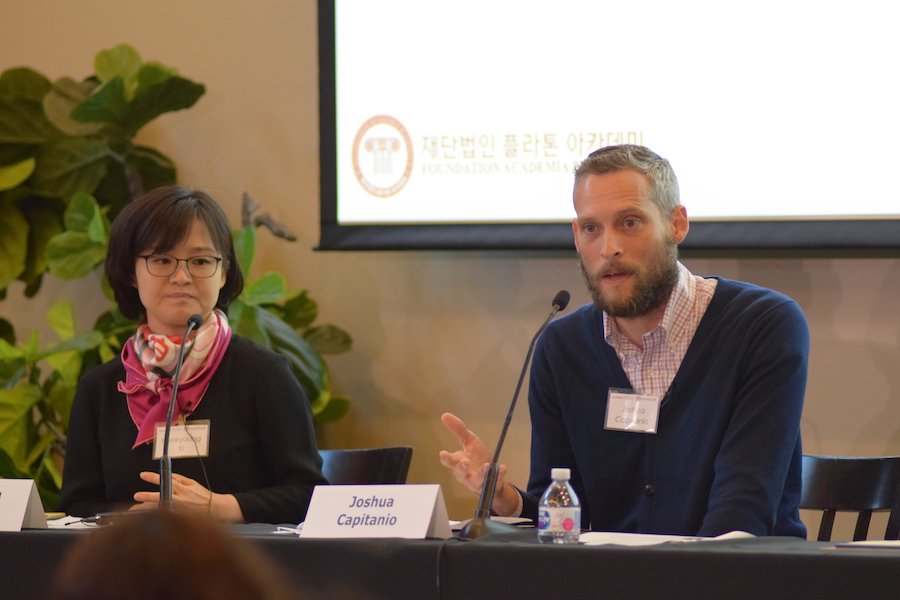
University of Washington's Hyokyoung Yi (left) and Stanford's Joshua Capitanio at a panel on library collections and service.

Sung-Ock Sohn, who coordinates the Korean language program in the department of Asian languages and cultures at the University of California – Los Angeles, further shed light on King’s prediction. She explained that while enrollments in Korean language classes have shown a sharp increase in American higher education institutions in the past decade, particularly at the introductory level and among ethnically non-Korean students, there is a high attrition rate of students from an introductory to advanced Korean classes nationwide.

How should the field move forward?

Participants proposed a host of ideas to that end. These included helping graduate students collaborate with colleagues in Korea; dedicating funding for junior faculty to spend periods of time before tenure conducting research and honing language skills in Korea at appropriate institutions, and for mid-career scholars to spend a year in Korea; emphasizing the application of social science theories and methods to premodern and modern East Asia; motivating scholars to apply a comparative lens to the study of the historical and contemporary experience of East Asia; and integrating linguistic and cultural diversity in Korean language classes by, for example, incorporating service learning in authentic contexts and extending the content spectrum to include topics such as Korean popular culture.


Image
K-pop star Siwon Choi (left) highlights closing panel on Korean Wave.

K-pop star Siwon Choi (left) highlights closing panel on Korean Wave.

Korean Wave was the focus of the conference’s widely attended closing panel that featured K-pop star Siwon Choi, a member of Korean boy band Super Junior, and multi-platinum music producer Dominique Rodriguez, managing director of SM Entertainment USA. They spoke about the global reach of Korean pop music and some of the ways in which Korean popular culture could stimulate interest in Korean studies. Dafna Zur, assistant professor in Stanford’s department of East Asian languages and cultures, who chaired the panel, challenged her students to consider “what it means not just to monetize culture but to design culture with specific markets and audience in mind.” The Stanford Daily published a detailed article on the panel.

“We are grateful to Foundation Academia Platonica for its generous support of Stanford’s Korea Program at Shorenstein APARC and for making this conference possible through our shared vision for the future of Korean studies in North America,” said Gi-Wook Shin. “Our thanks also go to our many other friends and partners, including the Korea Foundation that has helped achieve great results through its commitment to promoting understanding of Korea in academia and beyond and its support of the overseas Korean Studies Program since its establishment in 1991.”

South Korean TV company SBS NBC filmed the conference that will be featured in an upcoming documentary about Korean studies in the United States.

Read the conference report or listen to the audio recordings of the sessions, below.

Hero Image
Audience listens to panel during the conference "Future Visions: Challenges and Possibilities of Korean Studies in North America" Thom Holme, APARC
All News button
1
News Type
News
Date
Paragraphs

The Korea Program invites junior faculty, post-doctoral fellows, and graduate students to apply for travel awards to attend an upcoming two-day conference organized by the Korea Program at Stanford' Asia-Pacific Research Center. The workshop titled "Future Visions: Challanges and Possibilities of Korean Studies in North America" will be held on November 1st and 2nd, 2018 at Stanford University.

The awards will cover accepted applicants' lodging, domestic airfares, and/or ground transportation. To apply for the travel awards, please submit your CV and 2-page statement as a single file by July 15 here.

About the conference:

“Future Visions: Challenges and Possibilities of Korean Studies in North America,” is designed to bring together leading scholars in the fields of language education, literature, history, social sciences, and library studies. Each panel will consist of three-four scholars who will be tasked with presenting a report on the state of the field. The purpose of the panels is to generate discussion around some of the following questions: 

  • What are the research trends in each field?
  • What kinds of directions can we expect in the near future?
  • What are some of the disciplinary or other challenges in each field?
  • How does each field interact with related fields?
  • What are some of the limitations and possibilities around graduate student training?
  • How can faculty with graduate students cultivate supportive and critical scholarly communities?
  • ​How are junior faculty encouraged, and what institutional structures may offer better support?

Accepted applicants are expected to actively participate in discussion sessions and to engage in networking with other scholars during the 2-day conference.

Please direct questions on the conference to hjahn@stanford.edu.

Hero Image
encina columns
All News button
1
News Type
News
Date
Paragraphs

Dafna Zur, assistant professor of East Asian Languages and Cultures at Stanford, discusses her current research on literary and scientific education in postwar North and South Korea.

The complete discussion is available on the Stanford News.


Hero Image
zur
Dafna Zur and a science fiction book "The Stars Will Return" by North Korean writer Pak Chong Ryol
Steve Casto (left); Book cover courtesy of Dafna Zur (right)
All News button
1
Authors
Lisa Griswold
News Type
News
Date
Paragraphs

China is encountering a religious resurgence. Its revival symbolizes tension between the past and the present, as people search for purpose in a country that’s been shaken by expansive reforms and modernization efforts over the past four decades.

That was the message shared by veteran journalist Ian Johnson, the 2016 winner of the Shorenstein Journalism Award, who gave a keynote speech followed by panel discussion titled “Religion after Mao,” part of the Award’s 15th anniversary ceremony at the Shorenstein Asia-Pacific Research Center on Monday.

Johnson, who has spent 30 years as a journalist, has written extensively about Chinese history, religion and culture, and is also a teacher and published author, most recently releasing the book The Souls of China: The Return of Religion after Mao.

“Ian is maybe one of the most remarkable awardees we’ve had in recent years,” said Daniel Sneider, Shorenstein APARC associate director for research, who introduced the event by talking about Johnson’s distinguished career, which has included writing for the New York TimesWall Street Journal and New York Review of Books and led to a Pulitzer Prize win in 2001.

Xueguang Zhou, a Stanford professor of sociology and senior fellow at the Freeman Spogli Institute, and Orville Schell, the director of the Asia Society’s Center on U.S.-China Relations and former dean of the Graduate School of Journalism at U.C. Berkeley, joined Johnson on the panel, while Sneider moderated the discussion.

In a wide-ranging conversation, the panelists discussed the varied history of religion in Chinese society during the 20th and 21st centuries, offering stories of their experiences living and working in China.

According to Johnson, religious persecution in China is often thought to be associated with the anti-religious campaigns of Mao Zedong following the Chinese Communist Party’s assumption of power in 1949, but in reality, it existed decades before and has lingered in national memory.

Into the late 1980s and early 1990s, the Chinese government remained superstitious of religion, trying to redefine religious groups as “culture” alone, under the assumption that religion could be desensitized enough to eventually disappear, Johnson said.

But that did not happen, he said, and instead an opposite trend did. Reaching a high point in the 2000s, China’s economic reforms – both sweeping and fast-paced – brought growing angst and anxiety and prompted people across every socioeconomic background to turn to religion as an outlet.

Johnson, who has spent weeks at a time living among religious groups, noted a shift from the time he was in China in the mid-1980s to the past decade, where now “the government sees that religious groups can provide some sort of moral framework for some people.”


Image
shorenstein journalism award panel discussion


Chinese people today are searching for meaning, the panelists said, and are driven to join religious groups amid resource competition and mass migration that has usurped traditional family structures and disquieted many people who have moved from close-knit rural towns to alienating urban centers.

“Everybody is out there…trying to reify that part of life which isn’t filled by bread alone, by commerce alone,” said Schell, who has written about China since the 1970s as an author and journalist. “It’s a pretty chaotic quest and it’s very hard to know where it will all end.”

At the moment, religious groups in China remain heterogeneous and fragmented, Zhou said, but cohesion is growing in some regions and participation of local government leaders has drawn greater attention to the practice of faith.

“In grassroots China, religion, spiritual life and the Party, really go hand-in-hand – they’re intertwined,” said Zhou, whose research focuses on Chinese bureaucracy and economic development. “Local elites are involved both in the spiritual world and the Party world, and they shift back and forth simultaneously.”

However, the future of the relationship between religion and the government remains to be seen, according to the panelists.

Religious groups could fracture, or the government could continue to favor “native” religious groups, which if exacerbated over time, could lead to quasi-state religions, Johnson said. (Today, China recognizes five religions: Buddhism, Catholicism, Daoism, Islam and Protestantism).

While religious groups increasingly provide a service to some people, the Chinese government continues to be wary of them as an alternative source of knowledge and values, Johnson said, which hold the potential to coalesce into a nascent civil society.

“Every dynasty in China knows that one way dynasties usually ended was with some millenarian movement,” Schell added of the government’s apprehension. “They are afraid of religious movements because they do bespeak of higher values, higher loyalties and different organizational structures that don’t owe fealty to the Party.”

A video of the keynote speech is posted at this link.

Hero Image
shorenstein journalism award panel discussion
All News button
1
News Type
Commentary
Date
Paragraphs

South Korean culture has long held ethnic homogeneity as an integral part of national identity, but attitudes toward multiculturalism are slowly beginning to change amid the country’s shifting demographics, Gi-Wook Shin, professor of sociology and director of the Shorenstein Asia-Pacific Research Center, said in an interview with Al Jazeera English. Read the article.

Hero Image
crowd seoul
People walking on the streets in Myeongdong, Seoul, South Korea.
iStock Editorial/Getty Images Plus
All News button
1
News Type
News
Date
Paragraphs

Protecting freedom of expression is essential to vibrant democracies and to meet the needs of people now and into the future, Indian historian Ramachandra Guha said at a Stanford event seeking to draw people together for policy-relevant discussions about India’s growth following 25 years of reforms.

Guha’s remarks were part of a colloquium titled “Eight Threats to Freedom of Expression in India,” and one in a series, co-hosted by the Shorenstein Asia-Pacific Research Center (APARC) and Center for South Asia.

The colloquia, which continue this spring, are motivated by an opportunity to garner reflections and expertise from Kathleen Stephens, the William J. Perry Fellow in the Freeman Spogli Institute, who served as chargé d'affaires at the U.S. Embassy New Delhi in 2014.

“As I was preparing to go to India, I read Ram’s extraordinary book India after Gandhi, which provided much-needed historical, cultural and political context,” Stephens said. “When I visited Bangalore, we met and instantly clicked as we talked about U.S.-India relations. It’s a pleasure to welcome him back to Stanford.”

Guha, a renowned author and scholar, has written numerous critically acclaimed books about India’s history and culture as well as social ecology, and is a frequent commentary contributor to publications such as The Telegraph and Hindustan Times. In 2000, Guha was a visiting professor at Stanford, where he taught courses on the politics and culture of South Asia and cross-cultural perspectives on the global environmental debate.

India is often referred to as the world’s largest democracy for its population size of 1.3 billion and system of governance since partition and independence in 1947. Guha said that, while India is “solidly and certifiably democratic,” there are serious flaws, including growing threats to freedom of expression of Indian artists, filmmakers and writers.

Indian society, Guha said, has become too sensitive to criticism, wherein “somebody will take objection” to any message. This kind of environment has encouraged newspaper editors to self-censor, for example, and led public figures to, at times, neglect to protect artists, filmmakers and writers.

In total, Guha detailed eight threats to freedom of expression in contemporary India: 1) archaic colonial laws affecting the first amendment, 2) imperfections in the judicial system, 3) rising importance of identity politics, 4) complicity of the police force, 5) pusillanimity of politicians, 6) dependence of media on government-sponsored advertisements, 7) dependence of media on commercially-sponsored advertisements and 8) ideologically–driven writers.

Would an absence of those threats imply freedom of expression? Responding to the question from the audience, Guha lamented that the answer wasn’t simple. His task was to offer a diagnosis of the challenges, he said, and not provide instruction on how to solve them, but in general, focused efforts bear change.

“Building democracies is about quiet persistent work,” Guha said of next steps in the process to extinguish threats to freedom of expression. “I think quiet persistent work in repairing our institutions, modernizing our laws and improving civil society institutions can still mitigate some of the threats.”

Guha expressed optimism about India’s civil society, noting an expansion in the supply of non-governmental organizations working on social issues and private philanthropists funding projects in that sector. But he tempered: “we could do more.”

Stephens ended the event by thanking Guha for leading the discussion, and referenced America’s first president George Washington, who at the end of his term in office, called upon citizens to be “‘anxious, jealous guardians of our democracy.’”

“And, I see that today in Ram and in the many people here – very jealous, anxious and passionate guardians of our democracy – who we can learn a lot from,” she said.

Listen to an audio recording of the colloquium.

Hero Image
guha news headline
Indian historian Ramachandra Guha speaks to an audience of nearly 100 faculty, students and community members about freedom of expression in contemporary India, Oksenberg Conference Room, April 5, 2017.
Debbie Warren
All News button
1
Subscribe to History