
 FSI researchers work to understand continuity and change in societies as they confront their problems and opportunities. This includes the implications of migration and human trafficking. What happens to a society when young girls exit the sex trade? How do groups moving between locations impact societies, economies, self-identity and citizenship? What are the ethnic challenges faced by an increasingly diverse European Union? From a policy perspective, scholars also work to investigate the consequences of security-related measures for society and its values.
The Europe Center reflects much of FSI’s agenda of investigating societies, serving as a forum for experts to research the cultures, religions and people of Europe. The Center sponsors several seminars and lectures, as well as visiting scholars.
Societal research also addresses issues of demography and aging, such as the social and economic challenges of providing health care for an aging population. How do older adults make decisions, and what societal tools need to be in place to ensure the resulting decisions are well-informed? FSI regularly brings in international scholars to look at these issues. They discuss how adults care for their older parents in rural China as well as the economic aspects of aging populations in China and India.


Huan Yang
616 Serra StreetEncina Hall E301Stanford, CA 94305-6055
(650) 723-9741
(650) 723-6530
0
yanghuan@stanford.edu
huan_yang.jpg
Ph.D.
Huan Yang joins the Walter H. Shorenstein Asia-Pacific Research Center (Shorenstein APARC) for the 2016-17 year as a visiting scholar from Southwest Jiaotong University, where he serves as a lecturer.
His research interests include local governance, community construction.
Huan Yang obtained his Ph.D. at Central China Normal University in 2014, focusing on Political Space Theory.
Visiting Scholar
Hiroki Morishige
0
Corporate Affiliate Visiting Fellow, 2016-18
Hiroki Morishige is a corporate affiliate visiting fellow at the Walter H. Shorenstein Asia-Pacific Research Center (Shorenstein APARC) for 2016-18. He has worked for the Shizuoka Prefectural Government in Japan for over 10 years, representing Shizuoka, the "home of Mt. Fuji". He has experience in municipal finance and accounting. During his fellowship at Shorenstein APARC, his research will focus on population analysis, innovation and work-style revolution.
Hide publication sections
Off
How the United States views Japan's election results
News Type
Commentary
Date
Paragraphs
Japanese Prime Minister Shinzo Abe and his Liberal Democratic Party won by a landslide in the national election for the upper house of parliament on July 10. Writing for Toyo Keizai, Shorenstein APARC Associate Director for Research Daniel Sneider said American policymakers hope the Prime Minister will use the fresh mandate to kick-start stalled economic reforms and to move ahead on implementation of Japan’s new security legislation. Read the article here.
Hero Image

All News button
1
Failed Democratization in Prewar Japan: Breakdown of a Hybrid Regime
Paragraphs
Failed Democratization in Prewar Japan presents a compelling case study on change in political regimes through its exploration of Japan's transition to democracy. Within a broad-ranging examination of Japan's "semi-democratic" political system from 1918 to 1932, when political parties tended to dominate the government, the book analyzes in detail why this system collapsed in 1932 and discusses the implications of the failure.
By reference to comparable cases—prewar Argentina, prewar Germany, postwar Brazil, and 1980s Thailand—Harukata Takenaka reveals that the factors responsible for the breakdown of the Taisho democracy in Japan replicated those that precipitated the collapse of democracy in Europe, Latin America, and elsewhere in Asia.
While most literature on these transitions focuses on successful cases, Takenaka explores democratic failure to answer questions about how and why political parties and their leaders can behave in ways that undermine the democratic institutions that serve as the basis for their formal authority.
This book is part of the Studies of the Walter H. Shorenstein Asia-Pacific Research Center series at Stanford University Press.
All Publications button
1
Publication Type
Books
Publication Date
Journal Publisher
Stanford University Press
Rebranding Islam: Piety, Prosperity, and a Self-Help Guru
Paragraphs
Kyai Haji Abdullah Gymnastiar, known affectionately by Indonesians as "Aa Gym" (elder brother Gym), rose to fame via nationally televised sermons, best-selling books, and corporate training seminars. In Rebranding Islam James B. Hoesterey draws on two years' study of this charismatic leader and his message of Sufi ideas blended with Western pop psychology and management theory to examine new trends in the religious and economic desires of an aspiring middle class, the political predicaments bridging self and state, and the broader themes of religious authority, economic globalization, and the end(s) of political Islam.
At Gymnastiar's Islamic school, television studios, and MQ Training complex, Hoesterey observed this charismatic preacher developing a training regimen called Manajemen Qolbu into Indonesia's leading self-help program via nationally televised sermons, best-selling books, and corporate training seminars. Hoesterey's analysis explains how Gymnastiar articulated and mobilized Islamic idioms of ethics and affect as a way to offer self-help solutions for Indonesia's moral, economic, and political problems. Hoesterey then shows how, after Aa Gym's fall, the former celebrity guru was eclipsed by other television preachers in what is the ever-changing mosaic of Islam in Indonesia. Although Rebranding Islam tells the story of one man, it is also an anthropology of Islamic psychology.
This book is part of the Studies of the Walter H. Shorenstein Asia-Pacific Research Center series at Stanford University Press.
All Publications button
1
Publication Type
Books
Publication Date
Journal Publisher
Stanford University Press
Call for papers: Conference on the economics of ageing
News Type
News
Date
Paragraphs
The Asia Health Policy Program at Stanford’s Shorenstein Asia-Pacific Research Center, in collaboration with scholars from Stanford Health Policy's Center on Demography and Economics of Health and Aging, the Stanford Institute for Economic Policy Research, and the Next World Program, is soliciting papers for the third annual workshop on the economics of ageing titled Financing Longevity: The Economics of Pensions, Health Insurance, Long-term Care and Disability Insurance held at Stanford from April 24-25, 2017, and for a related special issue of the Journal of the Economics of Ageing.
The triumph of longevity can pose a challenge to the fiscal integrity of public and private pension systems and other social support programs disproportionately used by older adults. High-income countries offer lessons – frequently cautionary tales – for low- and middle-income countries about how to design social protection programs to be sustainable in the face of population ageing. Technological change and income inequality interact with population ageing to threaten the sustainability and perceived fairness of conventional financing for many social programs. Promoting longer working lives and savings for retirement are obvious policy priorities; but in many cases the fiscal challenges are even more acute for other social programs, such as insurance systems for medical care, long-term care, and disability. Reform of entitlement programs is also often politically difficult, further highlighting how important it is for developing countries putting in place comprehensive social security systems to take account of the macroeconomic implications of population ageing.
The objective of the workshop is to explore the economics of ageing from the perspective of sustainable financing for longer lives. The workshop will bring together researchers to present recent empirical and theoretical research on the economics of ageing with special (yet not exclusive) foci on the following topics:
- Public and private roles in savings and retirement security
- Living and working in an Age of Longevity: Lessons for Finance
- Defined benefit, defined contribution, and innovations in design of pension programs
- Intergenerational and equity implications of different financing mechanisms for pensions and social insurance
- The impact of population aging on health insurance financing
- Economic incentives of long-term care insurance and disability insurance systems
- Precautionary savings and social protection system generosity
- Elderly cognitive function and financial planning
- Evaluation of policies aimed at increasing health and productivity of older adults
- Population ageing and financing economic growth
- Tax policies’ implications for capital deepening and investment in human capital
- The relationship between population age structure and capital market returns
- Evidence on policies designed to address disparities – gender, ethnic/racial, inter-regional, urban/rural – in old-age support
- The political economy of reforming pension systems as well as health, long-term care and disability insurance programs
Submission for the workshop
Interested authors are invited to submit a 1-page abstract by Sept. 30, 2016, to Karen Eggleston at karene@stanford.edu. The authors of accepted abstracts will be notified by Oct. 15, 2016, and completed draft papers will be expected by April 1, 2017.
Economy-class travel and accommodation costs for one author of each accepted paper will be covered by the organizers.
Invited authors are expected to submit their paper to the Journal of the Economics of Ageing. A selection of these papers will (assuming successful completion of the review process) be published in a special issue.
Submission to the special issue
Authors (also those interested who are not attending the workshop) are invited to submit papers for the special issue in the Journal of the Economics of Ageing by Aug. 1, 2017. Submissions should be made online. Please select article type “SI Financing Longevity.”
About the Next World Program
The Next World Program is a joint initiative of Harvard University’s Program on the Global Demography of Aging, the WDA Forum, Stanford’s Asia Health Policy Program, and Fudan University’s Working Group on Comparative Ageing Societies. These institutions organize an annual workshop and a special issue in the Journal of the Economics of Ageing on an important economic theme related to ageing societies.
More information can be found in the PDF below.
Hero Image

All News button
1
Divergent Memories: Opinion Leaders and the Asia-Pacific War
Paragraphs
No nation is free from the charge that it has a less-than-complete view of the past. History is not simply about recording past events—it is often contested, negotiated, and reshaped over time. The debate over the history of World War II in Asia remains surprisingly intense, and Divergent Memories examines the opinions of powerful individuals to pinpoint the sources of conflict: from Japanese colonialism in Korea and atrocities in China to the American decision to use atomic weapons against Japan.
Rather than labeling others' views as "distorted" or ignoring dissenting voices to create a monolithic historical account, Gi-Wook Shin and Daniel Sneider pursue a more fruitful approach: analyzing how historical memory has developed, been formulated, and even been challenged in each country. By identifying key factors responsible for these differences, Divergent Memories provides the tools for readers to both approach their own national histories with reflection and to be more understanding of others.
"A well-written investigation on the legacy of World War II in Asia, greatly contributes to the field of cultural and military history.” —Mel Vasquez, H-War
"This book is an important counterweight to prevailing tendencies that promote uncritical nationalism and is thus an invaluable resource for this generation’s Asian and American youth to gain a critical understanding of their national histories...[T]he authors’ non-judgmental approach, coupled with persistence in pursuing the multiple interpretations and experiences of these traumatic events, provoke a reconsideration of our notions of justice, equality, and humanity within our nationalist thinking."—Grace Huang, Journal of American-East Asian Relations, Vol. 26.2
This book is part of the Studies of the Walter H. Shorenstein Asia-Pacific Research Center series at Stanford University Press.
All Publications button
1
Publication Type
Books
Publication Date
Journal Publisher
Stanford University Press
Contested Embrace: Transborder Membership Politics in Twentieth-Century Korea
Paragraphs
Scholars have long examined the relationship between nation-states and their "internal others," such as immigrants and ethno-racial minorities. Contested Embrace shifts the analytic focus to explore how a state relates to people it views as "external members" such as emigrants and diasporas. Specifically, Jaeeun Kim analyzes disputes over the belonging of Koreans in Japan and China, focusing on their contested relationship with the colonial and postcolonial states in the Korean peninsula.
Extending the constructivist approach to nationalisms and the culturalist view of the modern state to a transnational context, Contested Embrace illuminates the political and bureaucratic construction of ethno-national populations beyond the territorial boundary of the state. Through a comparative analysis of transborder membership politics in the colonial, Cold War, and post-Cold War periods, the book shows how the configuration of geopolitics, bureaucratic techniques, and actors' agency shapes the making, unmaking, and remaking of transborder ties. Kim demonstrates that being a "homeland" state or a member of the "transborder nation" is a precarious, arduous, and revocable political achievement.
This book is part of the Studies of the Walter H. Shorenstein Asia-Pacific Research Center series at Stanford University Press.
All Publications button
1
Publication Type
Books
Publication Date
Journal Publisher
Stanford University Press
Policy Challenges from Demographic Change in China and India
Paragraphs
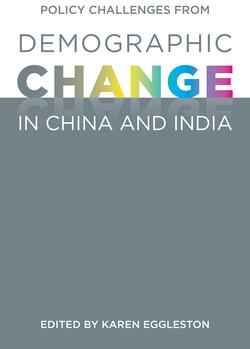
The world’s two most populous countries face numerous policy challenges from rapid demographic change. Drawing on social science expertise from China, India, and the United States, the contributors examine the social and economic challenges for policies across a range of domains, from China’s changed family planning policies and India’s efforts to address gender imbalance, to both countries’ policies regarding old-age support, human capital investment, poverty alleviation, and broader issues of governance.
Sections focus on:
- Policy Challenges and Economic Impact
- Fertility and Sex Imbalance
- Human Capital and Urbanization
- Population Aging
Desk or examination copies can be ordered from Stanford University Press.
All Publications button
1
Publication Type
Books
Publication Date
Book Publisher
Shorenstein APARC
Book Publisher External URL