看微信网页:https://bit.ly/3gRDy8Q
View this page on WeChat: https://bit.ly/3gRDy8Q
This is a virtual event. Please click here to register and generate a link to the talk.
The link will be unique to you; please save it and do not share with others.
Sponsored by the Stanford China Program and the Stanford Center at Peking University.
The ravages of COVID-19 are now global. But the pandemic first struck in China, and the nation suffered a 6.8% decline in its first-quarter GDP. China is also the first country to move towards a recovery, however, rolling out government measures, re-opening businesses, and re-starting its economy. In this key moment, the Stanford China Program, in collaboration with alumni members of the Stanford Graduate School of Business, surveyed senior executives in China as their companies reboot their operations. In this two-part program, we first unveil potential trends and key takeaways from the survey. In the second half, we host a panel of prominent CxOs from China who give their insights and experiences rebooting their businesses. What are short-term challenges that companies in China currently face? What are some long-term implications of COVID-19 for their operational model, supply chain strategies, technology, and business digitization? What might they also mean, if any, for global trade relations and the future of globalization?
Agenda (in Pacific Time)
5:00-5:30 PM Survey Presentation: Key Takeaways
5:30-6:15 PM China CxO Panel: Discussion
6:15-6:45 PM Audience Q&A
Agenda (in China)
8:00-8:30 AM Survey Presentation: Key Takeaways
8:30-9:15 AM China CxO Panel: Discussion
9:15-9:45 AM Audience Q&A
PANEL SPEAKERS
 Alvin Shiqi Wang (王世琪) has served as CEO and President of 21Vianet Group, Inc. since February 2018. Currently, Mr. Wang serves as Vice President of TUS Digital Group, a subsidiary of TUS Holdings, and serves on the board of directors of Beijing CIC Technology Co., Ltd. and Guangzhou Tuwei Technology Co., Ltd. . Mr. Wang has nearly 20 years of experience in the telecommunications industry, working at various renowned international companies, including 11 years with Ericsson, focusing primarily on strategy development and execution, corporate management, and equity investments. Mr. Wang received a bachelor's degree from Tsinghua University and an MBA from Peking University-Vlerick MBA Programme (BiMBA).
 Xiang Wang (王翔) is President and Acting CFO of Xiaomi Corporation, responsible for platform functions and for assisting the CEO with Group operations. Mr. Wang joined Xiaomi Corporation in July 2015 served as its Senior Vice President and President for International Business, responsible for global expansion, IP strategy, and strategic partner relationship management. Mr. Wang has more than 20 years of experience in the semiconductor and communications fields, with great vision and comprehensive understanding of next-generation wireless communications. He has played an integral role in shaping Xiaomi’s international business operations including with respect to its intellectual property compliance, management and strategy throughout the world. In 2016, Mr. Wang put together an international team of sales and marketing teams to expand into more markets outside of China. Within just 3 years, he led his teams into over 90 markets. As of Q3 2019, Xiaomi’s international revenue accounted for 48.7% of its total revenue. Today, Xiaomi is ranked among top 5 smartphone brands in over 40 markets. Mr. Wang previously served as the Senior Vice President of Qualcomm and President of Qualcomm Greater China, leading the company’s business and operations in Greater China. Prior to that role, he was Vice President of Qualcomm CDMA Technology, responsible for Qualcomm chipset business and customer service in China. Under his leadership, Qualcomm rapidly extended and strengthened its partnerships with increasing numbers of Chinese manufacturing customers. Before joining Qualcomm, Mr. Wang held key positions in sales and marketing at internationally leading companies, including Motorola and Lucent/Agere. Mr. Wang earned his BSEE from Beijing Polytechnic University.
Simon Yang (杨士宁) is the CEO of Yangtze Memory Technologies Co., Ltd. (YMTC), who brings YMTC to a new height in 3D NAND industry. As an experienced executive in the semiconductor industry for over 30 years, Dr. Yang served as the CEO of XMC, COO/CTO of SMIC, and CTO/SVP of Chartered Semiconductor (Now GlobalFoundries), in charge of fab operation and technical R&D. Before that, he was in the Portland Technology Development sector of Intel for more than 10 years, in which he led a series of technical R&D projects. Dr. Yang obtained a Bachelor’s Degree from Shanghai University of Science & Technology, and a Master’s Degree and a Doctoral Degree from Rensselaer Polytechnic Institute.
 Zhiqiang (ZZ) Zhang (张志强) is President of ABB in China since October 2018. He has extensive management experience and a deep understanding of the Chinese market, developed during his career at several large global companies over the past three decades. He joined ABB from Sandvik where he was Asia- Pacific Regional Holding Officer and President of Sandvik China, and Member of Sandvik Group Executive Committee. Prior to that, he held leadership positions at several other companies, including Nokia Siemens Networks, where he was President of the Greater China Region, and Siemens VDO Automotive, China, where he was President and CEO. Mr. Zhang is Non-Executive Board member of Georg Fischer AG (Switzerland) and Daetwyler Holding AG (Switzerland). He holds a bachelor’s degree in electronic engineering from Beijing Jiaotong University, China, and a master’s degree in business administration from the Smith School of Business at Queen’s University in Canada.
SURVEY PRESENTERS
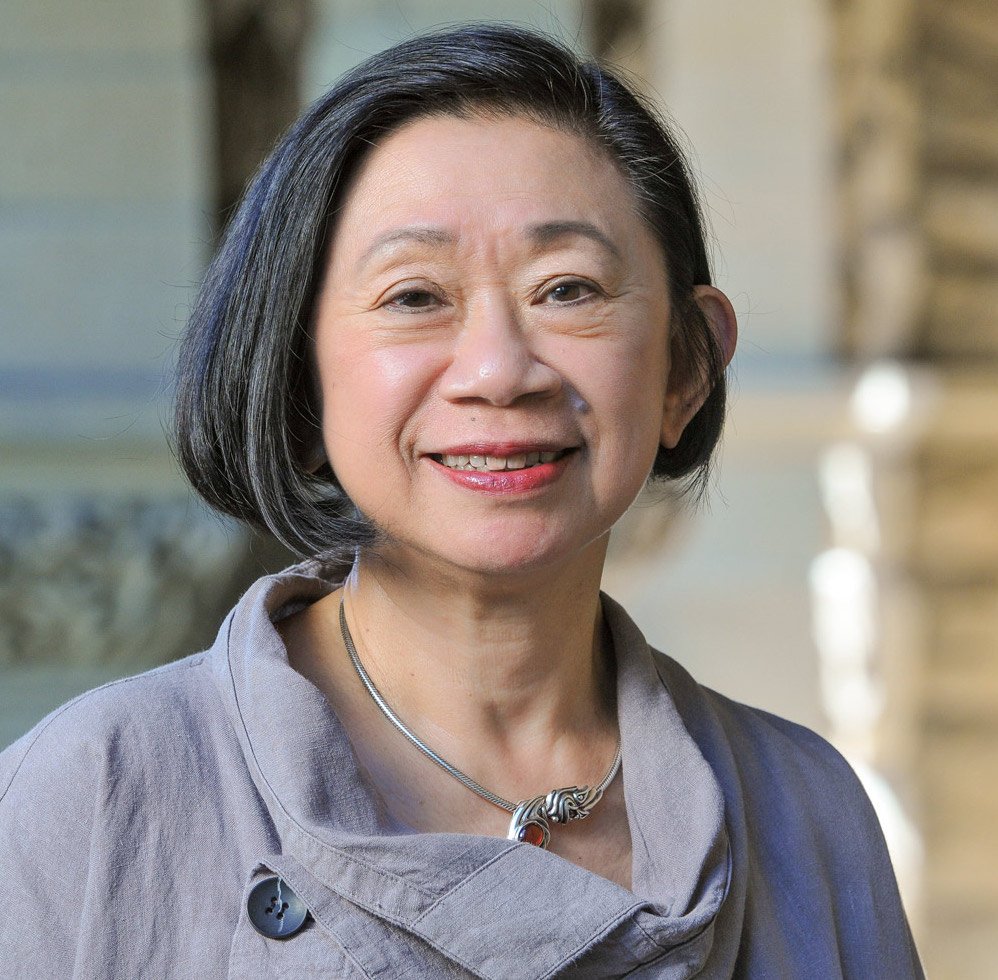 Jean C. Oi is the William Haas Professor of Chinese Politics in the Department of Political Science and a senior fellow in the Freeman Spogli Institute for International Studies at Stanford University. She directs the China Program at the Walter H. Shorenstein Asia-Pacific Research Center and is the Lee Shau Kee Director of the Stanford Center at Peking University. Professor Oi has published extensively on China’s reforms. Recent books include Zouping Revisited: Adaptive Governance in a Chinese County, coedited with Steven Goldstein (Stanford University Press, 2018), and Challenges in the Process of China’s Urbanization, coedited with Karen Eggleston and Yiming Wang (2017). Current research is on fiscal reform and local government debt, continuing SOE reforms, and the Belt and Road Initiative.
 Christopher Thomas was most recently a partner with McKinsey & Company. He served as co-Managing Partner for the Firm’s Global Digital Strategy service line as well as its Global IoT service line; and as the leader of its Asia Semiconductor Practice. Prior to McKinsey, Mr. Thomas spent ten years at Intel. He was the General Manager of Intel China, with joint ownership for the region’s $5 billion-plus P&L. In this role, he grew revenues by more than 50% and oversaw China’s successful elevation from a sales unit to an independent regional P&L business reporting directly into headquarters. Mr. Thomas began his career as a private equity investor at The Blackstone Group in New York City. He is currently a Visiting Professor at Tsinghua University, China’s leading educational institution. He received an MBA from Stanford Business School, where he was an Arjay Miller scholar; a Master of Arts in Political Science from Stanford University; and a Bachelor of Science in Economics, summa cum laude, from the Wharton School.
Xander Wu (吴雪) oversees industry development and builds partnerships with the world’s top cloud computing companies for China Mobile International (USA). He helps clients expand their global footprint and advises companies on best practices for digital transformation. Mr. Wu has 13 years' experience in the global 4G and 5G industry, with a track record of achieving a number of the world’s first milestones in 5G and several de-facto standards for 4G and data networks. Mr. Wu graduated from Stanford Graduate School of Business, where he researched digital transformation and advised startups in the energy sector. He serves as a mentor at several incubators such as Plug and Play, helping startups find the right product/market fit and tailor go-to-market strategy.

 FSI researchers work to understand continuity and change in societies as they confront their problems and opportunities. This includes the implications of