
The Green Revolution 2.0
The Green Revolution 2.0
Why We Need to Invest in Agricultural Education Now

The world stands at a critical juncture. Today, about 2.3 billion people are living with moderate or severe food insecurity worldwide (FAO, IFAD, UNICEF, WFP and WHO 2024). By 2050, our planet will be home to nearly 10 billion people, requiring at least a 50% increase in food production from 2011 levels (FAO 2017). This challenge is not simply about producing more food. It is about doing so on degraded land, with less water, under extreme weather conditions in the face of climate change.
The traditional, resource-intensive farming that sustained the global human population for decades is no longer a viable path forward. Reliance on labor inputs and intensive use of resources cannot meet these complex, interconnected challenges. We must transform our agricultural systems into climate-smart, high-tech agriculture—driven by data and Industry 4.0 technologies, such as AI, robotics, remote sensing, and big data. These tools hold the promise of a “quantum leap” in sustainable food productivity. Yet this transformation cannot happen without investing in agricultural education and training.
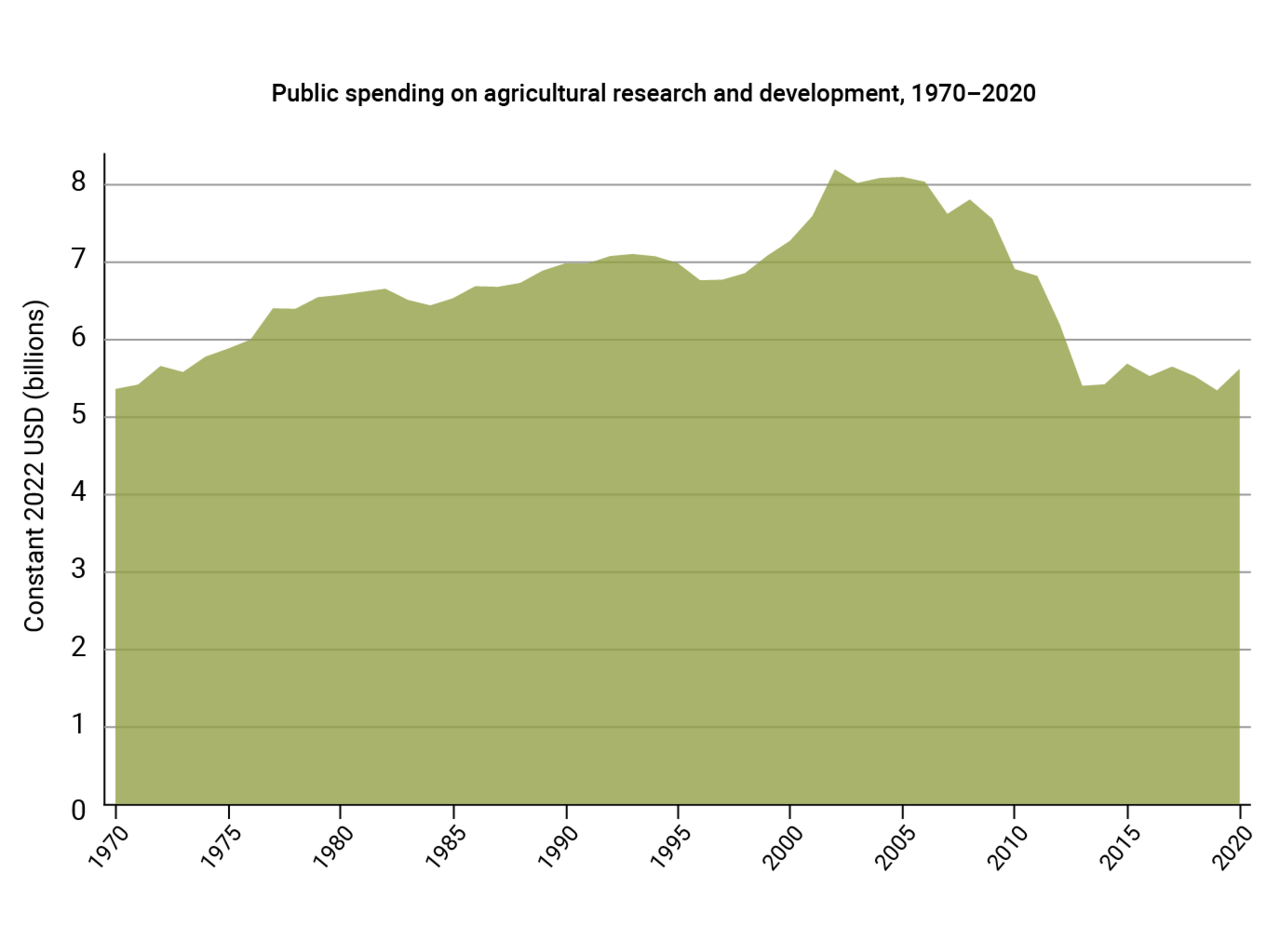
From the 1950s to the 1970s, institutions such as the Rockefeller and Ford foundations, USAID and its precursors, and multilateral development banks made significant global investments in agricultural research, education, and training. These investments laid the foundation for the Green Revolution, demonstrating that human capital and agricultural research and development (R&D) are as critical as physical inputs in driving productivity growth and food security. Since then, however, global public investment in agricultural education and R&D has declined or stagnated, except in a few countries, such as China (Ruane and Ramasamy 2023). For example, in the United States, public agricultural R&D spending—adjusted for inflation—fell by nearly one-third between its 2002 peak and 2019, returning to levels last seen in the 1970s.
Why Investing in Agricultural Education Is a Global Necessity
There is now an urgent need for a renewed commitment to build agricultural human resources that can lead the next transformation. This is not just about teaching farming. It is about cultivating a new generation of innovators, scientists, policymakers, and agro-entrepreneurs who can lead the Green Revolution 2.0. Here are seven compelling reasons why investing in agricultural education is a global necessity.
1. The times call for a quantum leap in sustainable productivity
The first Green Revolution helped avert mass famine through high-yield varieties, but at great environmental cost (see, inter alia, Tilman 1999 and Yang 2024). Now, we need a Green Revolution 2.0 to drive a "quantum leap" in food production. This next revolution must be “smart” and sustainable. Agricultural education is the engine of this revolution. It will educate scientists, policymakers, and high-tech farmers, enabling them to develop new climate-resilient crops and adopt sustainable practices. Furthermore, the digital technologies driving the Green Revolution 2.0 can improve market access and help ensure fair prices for smallholder farmers.
2. Innovation adoption must be accelerated
Innovation is meaningless if it does not reach those who need it most. However, farmers, especially smallholders (e.g., small-scale and family farmers) and those with limited education, are often risk-averse in adopting new practices. Worse, the traditional systems supporting technology adoption have become ineffective. Government extension services struggle to keep up with the latest technologies, while farmers increasingly rely on commercial vendors for advice. Recent studies suggest that newer approaches, like social networks and farmer-to-farmer learning, have proven far more effective. Investing in education helps create "agropreneurs" who can champion innovation within farming communities, thereby accelerating the adoption of new technologies.
3. The agriculture workforce needs upskilling
The nature of work in agriculture is rapidly changing—vertical farms, AI-driven analytics, automated systems, and climate-resilient practices are redefining food production. Farmers need new skills in data, systems management, digital operations, and climate-resilient methods. Without education, millions risk being left behind, especially in developing countries, resulting in worsening inequality. Investment in upskilling enables farmers to collaborate with technology, thereby avoiding a poverty trap.
4. Empowering smallholder and family farmers will create opportunities and aid their survival
Unlike past mechanization that favored large farms, today’s advances in precision and digital agriculture can empower smallholders. And it creates new opportunities for smallholder farmers to serve growing niche, diverse markets. With supportive policies and education, smallholders can become key drivers of inclusive agricultural transformation.
5. Agriculture needs new, young blood
Farmers are aging worldwide, while youth are leaving rural areas to seek careers in other fields. Traditional agricultural curricula and programs fail to spark their interest. By integrating robotics, AI, biotechnology, and data science into agricultural education, coupled with the use of app-based market-access solutions, we can redesign agricultural systems and make farming an attractive, future-oriented career. Investing in high-tech agricultural education is the key to filling the labor gap with skilled, motivated, next-generation farmers
6. Greenhouse gas reduction
Agriculture is the second-largest contributor to greenhouse gas emissions and consumes 70% of global fresh water. Climate-smart farming practices can reduce emissions, store carbon, and build resilience against droughts, pests, and diseases. Education is the gateway to equipping farmers with the knowledge to implement such solutions at scale.
7. Agricultural investment boosts national prosperity and global collaboration
The benefits of investing in agricultural education extend far beyond farms. Past investments in the 1950s–70s powered the Green Revolution, saving over a billion people from starvation, reducing rural poverty, and fueling industrial development. A notable example of a successful investment is the US-funded Seoul National University (SNU) Minnesota Project (1954–1962). Under the project, the University of Minnesota helped rebuild SNU’s College of Agriculture and train a generation of agricultural scientists. These scientists not only transformed Korea from a food-deficit to a food-secure nation, but are today contributing to agricultural advancements globally. Replicating such initiatives worldwide could deliver similar results in today’s food-insecure countries.
Moving Forward
Momentum for significant investments in agriculture is building. The G20 has committed to food security, emphasizing investment in sustainable productivity. The World Bank has invested $45 billion in food and nutrition security programs since 2022, exceeding its target of $30 billion. The Asian Development Bank (ADB) pledged $40 billion (2022–2030), including $26 billion in new financing. It is encouraging that more than 50 countries have launched programs to nurture young and next-generation farmers, recognizing their vital role in food security, as well as in ensuring the future sustainability and competitiveness of the agricultural sector (although the outcomes of these programs remain mixed). Countries are also stepping up their investment in agricultural education and training. For example, Bangladesh is developing a $150 million project with ADB and the Korean Eximbank to upgrade its agricultural tertiary education, while Thailand is developing a $120 million investment project in agricultural technical and vocational education.
However, to avert a coming food crisis, these efforts need to be scaled, and to achieve that, concerted global action is necessary. One such initiative, now being proposed by ADB in partnership with a consortium of agricultural universities, is the establishment of a global climate-smart, high-tech agricultural education network to mobilize public and private investments, accelerate knowledge sharing and technology adoption, and prepare the next generation of agriculture leaders and entrepreneurs globally.
The challenges are immense, but so are the opportunities. Investing in agricultural education and training is not just about farming—it is about building a sustainable, food-secure, and climate-resilient future.
Works Cited
FAO. 2017. The Future of Food and Agriculture—Trends and Challenges.
FAO, IFAD, UNICEF, WFP, and WHO. 2024. The State of Food Security and Nutrition in the World 2024—Financing to End Hunger, Food Insecurity and Malnutrition in All Its Forms.
Ruane, John, and Selvaraju Ramasamy. 2023. Global Investments in Agricultural Research: Where Are We and Where Are We Going? Food and Agriculture Organization of the United Nations.
Tilman, David. 1999. “Global Environmental Impacts of Agricultural Expansion: The Need for Sustainable and Efficient Practices.” Proceedings of the National Academy of Sciences of the United States of America 96 (11): 5995-6000.
Yang, Yi, David Tilman, Zhenong Jin et al. 2024. “Climate Change Exacerbates the Environmental Impacts of Agriculture.” Science 385 (6713).


