This event is made possible by generous support from the Korea Foundation and other friends of the Korea Program.
Since 2013, women's higher education enrollment rate has outpaced men's enrollment rate in South Korea. Despite this increase in educational attainment, gender inequalities remain deeply rooted in Korean higher education, including gender gaps in STEM, doctoral program enrollment, and faculty diversity. Universities have also fallen short in including gender-related topics in curricular content and ensuring safe campuses for women. The panel will reflect on these educational disparities and the social, cultural, and economic forces shaping Korean women's lives during and after higher education. It will also place Korea's experience in a comparative context by discussing global trends in gender and higher education.
Speakers:
Image
Namhee Kim has a 20-year research and teaching career in higher education in South Korea and the U.S. She is currently an Associate Professor of Education at Ewha Womans University in South Korea. She has previously worked for Korean Education Development Institute and Korean Women’s Development Institute in the areas of education policy development and conducting research on women workforce issues. Her earlier teaching career includes many graduate classes at Texas A & M and Northcentral University in the US. Kim holds a PhD in Education majoring in Adult Education and Human Resource Development from the University of Minnesota-Twin Cities and MEd and BA from Ewha Womans University. Her research interests include women’s career development, critical human resource development, and international education.
Image
Christine Min Wotipka is an Associate Professor (Teaching) of Education and (by courtesy) Sociology at Stanford University. Her research centers around two main themes examined from cross-national and longitudinal approaches. One line of work seeks to understand how marginalized groups and topics have been incorporated into school textbooks. Another contributes to the comparative scholarship in gender, diversity, leadership, and higher education. Her articles have appeared in Social Forces, Sociology of Education, Gender & Society, American Journal of Education, AERA Open, Journal of LGBT Youth, Comparative Education Review, Compare, Comparative Education, and International Journal of Comparative Sociology. Wotipka earned her BA in International Relations and French at the University of Minnesota-Twin Cities, and MA in Sociology and PhD in International Comparative Education at Stanford University. Between her undergraduate and graduate studies, she proudly served as a United States Peace Corps volunteer in rural northeast Thailand and worked in South Korea at an economic research firm. Among her professional activities, Dr. Wotipka has consulted on girls education policies for the Ministry of Education in Afghanistan.
Moderator: Dafna Zur, associate professor of East Asian Languages and Cultures; director of Center for East Asian Studies, Stanford University
Like in many other states worldwide, democracy is in trouble in South Korea, entering a state of regression in the past decade, barely thirty years after its emergence in 1987. The society that recently had ordinary citizens leading “candlelight protests” demanding the impeachment of Park Geun-hye in 2016-17 has become polarized amid an upsurge of populism, driven by persistent structural inequalities, globalization, and the rise of the information society.
The symptoms of democratic decline are increasingly hard to miss: political opponents are demonized, democratic norms are eroded, and the independence of the courts is whittled away. Perhaps most disturbing is that this all takes place under a government dominated by former pro-democracy activists.
The contributors to this volume trace the sources of illiberalism in today’s Korea; examine how political polarization is plaguing its party system; discuss how civil society and the courts have become politicized; look at the roles of inequality, education, and social media in the country’s democratic decline; and consider how illiberalism has affected Korea’s foreign policy.
Table of Contents
Introduction
Korea’s Democratic Decay: Worrisome Trends and Pressing Challenges Gi-Wook Shin and Ho-Ki Kim
1. Why Is Korean Democracy Majoritarian but Not Liberal? Byongjin Ahn
2. Uses and Misuses of Nationalism in the Democratic Politics of Korea Aram Hur
3. The Weakness of Party Politics and Rise of Populism in Korea Kwanhu Lee
4. The Politicization of Civil Society: No Longer Watchdogs of Power, Former Democratic Activists Are Becoming New Authoritarian Leaders Myoung-Ho Park
5. The Politicization of the Judiciary in Korea: Challenges in Maintaining the Balance of Power Seongwook Heo
6. Two Divergences in Korea’s Economy and Democracy: Regional and Generational Disparities Jun-Ho Jeong and Il-Young Lee
7. Democracy and the Educational System in Korea Seongsoo Choi
8. Social Media and the Salience of Polarization in Korea Yong Suk Lee
9. Illiberalism in Korean Foreign Policy Victor Cha
10. The Democratic Recession: A Global and Comparative Perspective Larry Diamond
Epilogue
Korea’s 2022 Presidential Election: Populism in the Post-Truth Era Ho-Ki Kim and Gi-Wook Shin
Media Coverage
To celebrate the publication of South Korea's Democracy in Crisis, APARC held a book launch seminar in Seoul on June 14, 2022. The event received extensive coverage in Korean media, including the following:
Innovation and entrepreneurship rank highly on the strategic agenda of most countries today. As global economic competition intensifies, many national policymakers now recognize the central importance of entrepreneurship education and the building of financial institutions to promote long-term innovation, entrepreneurship, and economic growth. Drivers of Innovation brings together scholars from the United States and Asia to explore those education and finance policies that might be conducive to accelerating innovation and developing a more entrepreneurial workforce in East Asia.
Some of the questions covered include: How do universities in China and Singapore experiment with new types of learning in their quest to promote innovation and entrepreneurship? Is there a need to transform the traditional university into an “entrepreneurial university”? What are the recent developments in and outstanding challenges to financing innovation in China and Japan? What is the government’s role in promoting innovative entrepreneurship under the shadow of big business in South Korea? What can we learn about the capacity of services to drive innovation-led growth in India?
Drivers of Innovation will serve as a valuable reference for scholars and policymakers working to develop human capital for innovation in Asia.
Contents
Educating Entrepreneurs and Financing Innovation in Asia Fei Yan, Yong Suk Lee, Lin William Cong, Charles Eesley, and Charles Lee
Fostering Entrepreneurship and Innovation: Education, Human Capital, and the Institutional Environment Charles Eesley, Lijie Zhou, and You (Willow) Wu
Entrepreneurial Scaling Strategy: Managerial and Policy Considerations David H. Hsu
Innovation Policy and Star Scientists in Japan Tatsuo Sasaki, Hiromi S. Nagane, Yuta Fukudome, and Kanetaka Maki
Financing Innovation in Japan: Challenges and Recent Progress Takeo Hoshi and Kenji Kushida
Promoting Entrepreneurship under the Shadow of Big Business in Korea: The Role of the Government Hicheon Kim, Dohyeon Kim, and He Soung Ahn
The Creativity and Labor Market Performance of Korean College Graduates: Implications for Human Capital Policy Jin-Yeong Kim
Financing Innovative Enterprises in China: A Public Policy Perspective Lin William Cong, Charles M. C. Lee, Yuanyu Qu, and Tao She
Forging Entrepreneurship in Asia: A Comparative Study of Tsinghua University and the National University of Singapore Zhou Zhong, Fei Yan, and Chao Zhang
Education and Human Capital for Innovation in India’s Service Sector Rafiq Dossani
In Need of a Big Bang: Toward a Merit-Based System for Government-Sponsored Research in India Dinsha Mistree
The Implications of AI for Business and Education, and Singapore’s Policy Response Mohan Kankanhalli and Bernard Yeung
Stanford Asia-Pacific Innovation
The volume 'Drivers of Innovation' is the third in three publications that are the product of APARC's multi-year research project Stanford Asia-Pacific Innovation. This project helps promote innovation and entrepreneurship in the region by providing critical academic and policy research into the severe challenges to East Asia's continued growth and development.
Yong Suk Lee and Charles Eesley examine how university entrepreneurship programs affect entrepreneurial activity using a unique entrepreneurship‐focused survey of Stanford alumni. OLS regressions find a positive relationship between program participation and entrepreneurship activities. However, endogeneity hinders causal interpretation. They utilize the fact that the entrepreneurship programs were implemented at the school level.
Using the introduction of each school's program as an instrument for program participation, they find that the Business School program has a negative to zero impact on entrepreneurship rates. Participation in the Engineering School program has no impact on entrepreneurship rates. However, the Business School initiative decreases startup failure and increases firm revenue. University entrepreneurship programs may not increase entrepreneurship rates, but help students better identify their potential as entrepreneurs and improve the quality of entrepreneurship.
Entrepreneurship classes and programs in colleges around the world have proliferated over the last quarter of a century, yet the literature examining the impacts and effectiveness of such initiatives is still relatively sparse and limited. Do these initiatives make a difference in the long-term entrepreneurial activity and success of their students and alumni?
Yong Suk Lee, SK Center Fellow and APARC’s Korea Program deputy director, and Charles Eesley, an associate professor and W.M. Keck Foundation Faculty Scholar at Stanford’s Department of Management Science and Engineering, have been collaborating on research that aims to fill in some of the information gaps in assessing the efficacy of entrepreneurship education programs.
In a new article published in Strategic Management Journal, Lee and Eesley examine the entrepreneurship consequences of Stanford University’s two major entrepreneurship education programs that were founded in the mid-1990s. Their findings are sobering but offer lessons for improving such efforts. Lee provides a synopsis of their findings in the video below.
Using a unique entrepreneurship-focused survey of Stanford alumni, Lee and Eesley investigated how the Stanford Center for Entrepreneurial Studies (CES) at the Business School and the Stanford Technology Ventures Program (STVP) at the Engineering School affect entrepreneurial activity. They administered the survey to a well-defined population of comparable individuals from multiple industries, in total generating 27,783 responses. Respondents reported information on their entrepreneurial status, participation in angel investing and venture capital, and on the founding, duration, and success of start-up ventures. Respondents also indicated to what degree, if any, they had participated in the CES or STVP programs.
The survey results reveal that overall participation in the Stanford Business School CES had a negative to zero impact on entrepreneurship rates and participation in the Engineering School STVP had no impact on entrepreneurship rates. However, the data suggests that participation in the Business School initiative decreased startup failure and increased firm revenue in the long-term. “University entrepreneurship programs may not increase entrepreneurship rates,” Lee and Eesley conclude, “but help students better identify their potential as entrepreneurs and improve the quality of entrepreneurship.”
These findings provide important context to broader questions about entrepreneurship development and incubation, such as whether entrepreneurship is an intrinsic or acquired trait, and as such, whether firms should seek to develop entrepreneurial capabilities internally or acquire them from external sources. This question equally concerns universities and the strategies institutions of higher education employ to foster entrepreneurial talent.
Lee and Eesley note that it is important to take into account variation in entrepreneurship training programs in course content, emphasis, and other dimensions. Their research suggests that general entrepreneurship education that targets a broader spectrum of startups, rather than one that solely focuses on technology startups, may be more effective in reducing the uncertainty in entrepreneurial ability or improving startup performance.
These findings may generalize to other samples of selective-admission college-educated alumni, although there is certainly need for future work that explores the effects of entrepreneurship education in different institutional environments.
Entrepreneurship, Technology, and Economic Development
The advent of how new technologies, such as artificial intelligence, automation, and cloud computing are opening up new possibilities for businesses and societies. New technologies also support entrepreneurial activity, while risk-taking, ambitious entrepreneurs are fundamental to harnessing these news technologies and to creating new innovations and growth pathways. Yong Suk Lee and Charle's Eesley's research effort evaluates the ways in which these new technologies affect regional entrepreneurship and employment.
A study by Yong Suk Lee, the deputy director of APARC’s Korea Program, and Management Science and Engineering professor Charles Eesley investigates the efficacy of two major Stanford entrepreneurship education initiatives, suggesting they may not increase entrepreneurial activity.
This paper examines how social isolation in a non-Anglophone context where English is not the main language of instruction for local students but is for international students, has unintended consequences for social capital formation among the latter. What factors influence international student network formation in such places where linguistic barriers are institutionalised and what are their consequences not only during college but beyond, in shaping students’ career plans? Using qualitative interview data with 67 international (originating from Asian countries) and domestic students in Japanese universities, we find that such institutional barriers negatively promote greater isolation of international students but positively encourage the formation of diverse multinational ties – a process through which international students gain ideas, confidence and direction regarding their post-graduation career plans to work transnationally.
On November 1-2, 2018, the two-day conference "Future Visions: Opportunities and Challenges of Korean Studies in North America" was convened by Shorenstein APARC's Korea Program to examine the current state of Korean studies and consider the current challenges and opportunities. This report summarizes the discussions of the six panels on history, literature, the social sciences, language education, library collections and services, and the Korean Wave.
Gi-Wook Shin, director of APARC, was quoted in South China Morning Post. “These young people spend the first 25 to 30 years of their life studying for exams, and when they finally move out of their shell into the real world and realise life is not a multiple choice test, and there isn’t always a clear-cut answer to every problem, that’s already a mid-life crisis for them in a way,” he said. “It is both physically draining and mentally not healthy to spend one’s young adulthood studying for exams after exams.”
Future Visions: Challenges and Possibilities of Korean Studies in North America — Social Science panel. From left to right: UC Berkeley's Laura Nelson, University of Michigan's Jordan Siegel, Stanford's Yong Suk Lee, USC's David Kang, Harvard's Paul Chang.
How can Korean studies faculty cultivate supportive and critical scholarly communities with graduate students? What can be done to overcome the severe constraints on Korean language training in North America? Why is there a dearth of Korea scholarship in academic literature? And how should Korean studies librarians prepare for the future in the light of new technologies and young researchers’ increasing interest in digital scholarship?
These were some of the questions examined at a two-day conference, “Future Visions: Challenges and Possibilities of Korean Studies in North America,” convened by the Korea Program of Stanford’s Shorenstein Asia-Pacific Research Center (APARC) on November 1-2. Co-sponsored by the Seoul-based Foundation Academia Platonica, the conference, the first of its kind, gathered distinguished Korean studies scholars from twelve North American institutions to consider the state of the field, assess its challenges, and carry forward a vision for its future direction and potential. Its six unique panels focused not only on the major disciplines of Korean studies—history, literature, and the social sciences—but also on language education, library collections and services, and Korean Wave.
“The presentations and discussions by our fellow experts reflected the breadth and depth of Korean studies in North America,” says APARC Director and the Korea Program Director Gi-Wook Shin. “Our program was established at Stanford in 2001 and has since become a leader in Korean studies in North America, so it is a special privilege for us to bring together colleagues from eminent institutions around the continent to further advance Korean studies education and research in the academic and policy worlds, and to build upon our track record of action and achievements.”
“The field of Korean studies, however,” notes Shin, “has significantly changed over the past seventeen years and it isn’t without its challenges. This is our opportunity to consider frankly where we go next and how we could explore the path ahead together.”
Conference participants indeed engaged in deep conversations and shared ideas and dilemmas regarding teaching in the different disciplines of Korean studies in North America. Harvard sociologist Paul Chang listed three types of challenges facing the field: publication, academic, and professional challenges. David C. Kang, professor of international relations and director of the Korean Studies Institute at the University of Southern California, emphasized the publication challenge: why is it, asked Kang, that top academic journals in the discipline of political science and international relations publish so much more scholarship about Europe than they do about Korea and Asia at large, even while the rise of Asian nations is surely one of the most consequential issues of the twenty-first century? The onus, Kang argued, comes back to East Asia scholars “to produce better and more compelling scholarship, and to better train graduate students.”
University of British Columbia's Ross King and conference participants.
Yet complex issues surround the question of how to broaden graduate coursework—and whether to do so. Korean language and linguistics expert Ross King, head of the department of Asian Studies at the University of British Columbia in Vancouver, Canada, was one of several panelists who considered the obstacles to graduate training, among different aspects of academic challenges facing the field of Korean studies. King probed into how Sinocentrism and what he called the “Mandarin conceit”—that is, the notion that training in Literary Sinitic should be predicated on a near-native proficiency in modern Mandarin Chinese—are emerging as a major stumbling block to the study of premodern Korean literary culture. He also pointed to the constraints on language training in both Korean and hanmun in North America, which, he claimed, is why we can probably anticipate continued decrease in the number of ethnically non-Korean (non-Korea-educated) graduate students undertaking graduate study in Korean literature.
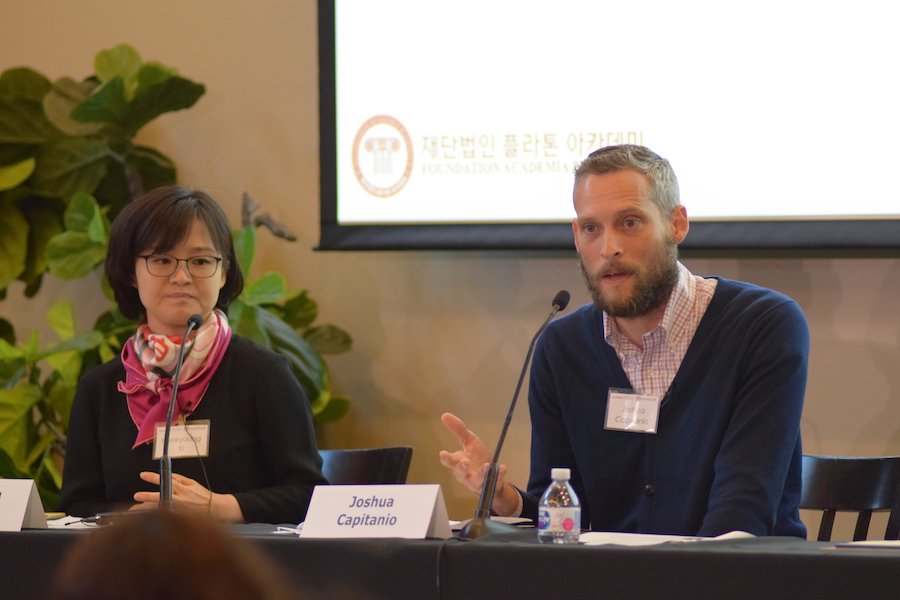
University of Washington's Hyokyoung Yi (left) and Stanford's Joshua Capitanio at a panel on library collections and service.
Sung-Ock Sohn, who coordinates the Korean language program in the department of Asian languages and cultures at the University of California – Los Angeles, further shed light on King’s prediction. She explained that while enrollments in Korean language classes have shown a sharp increase in American higher education institutions in the past decade, particularly at the introductory level and among ethnically non-Korean students, there is a high attrition rate of students from an introductory to advanced Korean classes nationwide.
How should the field move forward?
Participants proposed a host of ideas to that end. These included helping graduate students collaborate with colleagues in Korea; dedicating funding for junior faculty to spend periods of time before tenure conducting research and honing language skills in Korea at appropriate institutions, and for mid-career scholars to spend a year in Korea; emphasizing the application of social science theories and methods to premodern and modern East Asia; motivating scholars to apply a comparative lens to the study of the historical and contemporary experience of East Asia; and integrating linguistic and cultural diversity in Korean language classes by, for example, incorporating service learning in authentic contexts and extending the content spectrum to include topics such as Korean popular culture.
Image
K-pop star Siwon Choi (left) highlights closing panel on Korean Wave.
Korean Wave was the focus of the conference’s widely attended closing panel that featured K-pop star Siwon Choi, a member of Korean boy band Super Junior, and multi-platinum music producer Dominique Rodriguez, managing director of SM Entertainment USA. They spoke about the global reach of Korean pop music and some of the ways in which Korean popular culture could stimulate interest in Korean studies. Dafna Zur, assistant professor in Stanford’s department of East Asian languages and cultures, who chaired the panel, challenged her students to consider “what it means not just to monetize culture but to design culture with specific markets and audience in mind.” The Stanford Daily published a detailed article on the panel.
“We are grateful to Foundation Academia Platonica for its generous support of Stanford’s Korea Program at Shorenstein APARC and for making this conference possible through our shared vision for the future of Korean studies in North America,” said Gi-Wook Shin. “Our thanks also go to our many other friends and partners, including the Korea Foundation that has helped achieve great results through its commitment to promoting understanding of Korea in academia and beyond and its support of the overseas Korean Studies Program since its establishment in 1991.”
South Korean TV company SBS NBC filmed the conference that will be featured in an upcoming documentary about Korean studies in the United States.
Read the conference report or listen to the audio recordings of the sessions, below.
"I do think that there is a certain digital language that will be beneficial to young people, students, in the very near future," says Yong Suk Lee, deputy director of the Korea Program, in a recent interview with head of Friedrick Nauman Foundation Global Innovation Hub.