Innovation
Authors
Gi-Wook Shin
News Type
News
Date
Paragraphs

A variety of media outlets have recently highlighted Stanford research efforts focused on the value of global talent and diversity policy in South Korea led by Professor Gi-Wook Shin, director of the Walter H. Shorenstein Asia-Pacific Research Center (APARC).

On Arirang, Shin discussed why South Korea should seek to recruit and retain foreign skilled workers in a moderated conversation with Rennie Moon, an assistant professor at Yonsei University. Together, the scholars work on a research project that examines diversity programs and policies of universities and companies in South Korea.

Shin and Moon wrote an editorial for Conversation UK that recognizes Korea’s failure to embrace diversity and says the country’s ethnic nationalism is largely to blame. They call upon Korean universities and the government to work closely together to tackle diversity issues. A similar message was relayed in a Q&A conducted by Shorenstein APARC and on a podcast episode recorded for "Korea and the World." Shin and Moon also wrote an editorial for the East Asia Forum that broadens the analysis to include the challenges of attracting foreign talent across Northeast Asia. 

Shin also told Maeil Shinmun that South Korea needs concrete and strategic policies to compete globally in its recruitment of foreign skilled workers. One of his policy suggestions is to offer a 2-year visa period for foreign college graduates to encourage them to work and stay in South Korea.

Dong-a Ilbo also covered an event where Shin presented findings from his co-authored publication, Global Talent: Skilled Labor as Social Capital. He said South Korea must embrace the value of social capital and diasporas as seen in the United States example, or else the country risks losing global competitiveness. Shin leads a research project on this topic with Joon Nak Choi, 2015-16 Koret Fellow at Shorenstein APARC and an assistant professor at Hong Kong University of Science and Technology. An earlier Nikkei Asian Review editorial highlights some of their studies.

Related links will be added to this news item as they arrive.

Hero Image
gettyimages 187172376
Students prepare to take an exam at a high school in Seoul.
AFP/Getty Images - Jung Yeon-Je
All News button
1
Date Label
Authors
Lisa Griswold
News Type
News
Date
Paragraphs

Four scholars from Stanford University participated in a public panel discussion on Silicon Valley and Asian economies last month, part of a filming for an NHK Broadcasting series that aims to bring opinion leaders together to discuss issues facing contemporary Japan. The panel event will debut online this Friday.

“Silicon Valley is known worldwide as a place for many new innovative ideas, individuals and companies,” said Takeo Hoshi, director of the Japan Program at the Shorenstein Asia-Pacific Research Center (APARC). “Such economic dynamism is what many countries and regions across the world want to imitate. This is especially true for Asian economies.”

During the hour-long event, Hoshi moderates a discussion between William Barnett, a professor of business leadership, strategy and organizations at the Graduate Business School; Francis Fukuyama, the director of the Center on Democracy, Development and the Rule of Law; and Kenji Kushida, a research associate of Shorenstein APARC’s Japan Program.

The panel set out to consider how Silicon Valley realized success and its implications for Asian countries that seek to develop similar innovation-based economies. Panelists started by offering a single keyword that represents Silicon Valley in their own definition. They are: harness, social capital, and failure.

“The question that everyone is interested in is how to make use of Silicon Valley,” Kushida said. “How to ‘harness’ the innovation ecosystem that works fairly well here.”

A key component of Silicon Valley’s success is the high level of social capital found in the region, the panelists said.

“The level of informal cooperation…is higher than in other parts of the country,” Fukuyama explained. Silicon Valley has a norm of reciprocity and lacks extensive business contracts that impede fluidity of ideas, he said.

The panelists also explored the impact of government policy. They said that it provides an essential service in supplying a framework – at least initially – from which innovation-based economic activities can emerge.

“The government needs to set up a playing field upon which firms and entrepreneurs…can do the unimaginable,” Barnett said.

The U.S. government played an important role in a number of defense-related projects that led to the formation of new technologies, including the Internet. However, a government role “cannot smother and be too directive,” Fukuyama said.

Kushida notes that he leads a research project that looks at the institutional foundations of Silicon Valley and offers lessons applicable to Japan. Last year, Kushida and Hoshi authored a report with three other scholars that identifies six institutional factors that encourage innovation, and what the Japanese government can do to encourage development of a more effective innovation ecosystem.

Culture can play a powerful role, too, the panelists explained. They described how both organizational and national cultures can foster or impinge upon innovation.

Barnett said it may be “cool” to be an entrepreneur in Silicon Valley, but in Japanese culture, for example, it is the opposite. Barnett has studied entrepreneurs in Japan and has written many publications about how organizations and industries evolve globally.

Approaches to overcoming hard-fastened barriers to innovation include developing a culture of trust and acceptance toward failure, the panelists explained. Yet, they also cautioned against attempts to copy Silicon Valley too closely.

“I don’t think we should take this Silicon Valley gospel for granted – that disruption is always great and that things will always be necessarily better in social terms,” Fukuyama said.

The panelists recognize the outgrowth of high-tech areas in other areas around the world, and note that it is impossible to predict what innovations will come next and their impact on humanity.


The panel event was broadcast and live-tweeted with #SVAsia on Friday, March 4, from 4:10-5:00 p.m. (PST). The video can be viewed on demand here.

Hero Image
img 1422a headline
Stanford's Takeo Hoshi (far left) moderates a panel discussion between Kenji Kushida, Francis Fukuyama and William Barnett focused on Silicon Valley and Asian economies. The event was filmed for the NHK Broadcasting program, Global Agenda, and will air in March.
All News button
1
-

Image
Hiroshi “Hiro” Saijou is CEO and Managing Director at Yamaha Motor Ventures & Laboratory Silicon Valley. Prior to founding YMVSV, Hiro was a Division Manager at Yamaha Motor Corporation, USA where he led exploratory efforts in Silicon Valley.  Hiro started his career at Yamaha Motor Co., Ltd. (Iwata, Japan) where he worked for almost two decades on a broad array of surface mount technology and robotics efforts in addition to new business development efforts. Hiro enjoys exploring the California Bay Area, sometimes with his golf clubs.  He speaks at conferences frequently on bold, ambitious, sometimes crazy corporate innovation. Hiro earned a software engineering degree from Kyushu University, one of Japan’s National Seven Universities.

SEMINAR DESCRIPTION

The introduction of Yamaha Motor's business development effort utilizing Silicon Valley Ecosystem. Growth of business and corporation to deliver more value to the society is essential desire for all of us, but there are so many options to be taken. In this presentation, we will share our thoughts and experience; what is our objectives, how Yamaha Motor started this business development tasks, why we need to incorporate Yamaha Motor Ventures and how we did it, what are our ongoing ambitious / unique / crazy projects.

AGENDA

4:15pm: Doors open
4:30pm-5:30pm: Talk and Discussion
5:30pm-6:00pm: Networking

RSVP REQUIRED
 
For more information about the Silicon Valley-New Japan Project please visit: http://www.stanford-svnj.org/
Hiro Saijou, CEO and Managing Director, Yamaha Motor Ventures & Laboratory Silicon Valley Inc.
Seminars
-

Image
Masa ISHII is founder and a Managing Director of AZCA, Inc., a management consulting firm specializing in US-Japan corporate development for high technology companies.  To date, AZCA has helped numerous companies in Japan and US in developing their new business across the Pacific Ocean.  Masa is also a Managing Director of AZCA Venture Partners, a venture capital firm whose most recent fund specializes in the domain where IT/Electronics and Life science converge.  Formerly, Masa worked at McKinsey & Company, Inc. and at IBM. Masa is a frequent speaker and writer on issues involving international business development in the high technology industry. He is a visiting professor at Waseda University Business School and at Graduate School of Engineering, Shizuoka University.  Masa holds a Bachelor of Engineering in mathematical engineering and instrumentation physics from the University of Tokyo and a Master of Science in computer science from Stanford University.


SEMINAR DESCRIPTION:

It was in early 1970s that Japanese companies first started interacting with Silicon Valley.  As Silicon Valley grew, many Japanese companies started trying to work with high-tech start-ups in Silicon Valley with the purpose of innovating and developing new businesses. More recently, start-up companies and SMEs from Japan have started taking root in Silicon Valley by fully taking advantage of its high technology infrastructure.  In doing so, however, many Japanese companies failed to achieve their strategic goals.  These hard-learned lessons over time are bound to be forgotten as the new generation of Japanese companies attempt to enter the Silicon Valley’s ecosystem unless they are recorded and the memory is institutionalized. Having lived and worked between Japan and Silicon Valley over the past 30 years, the speaker will share an insider's view of large firms, start-ups and entrepreneurs since the 1970s and his direct experience and reminiscence in dealing with companies in Japan and Silicon Valley, so that the long-built up experience of firms entering this region for the last 40 years can prove to be of benefit to others in the future.

RSVP REQUIRED:

AGENDA:
4:15pm: Doors open
4:30pm-5:30pm: Lecture, followed by discussion
5:30pm-6:00pm: Networking

For more information about the Silicon Valley-New Japan Project please visit: http://www.stanford-svnj.org/

Philippines Conference RoomEncina Hall, 3rd Floor616 Serra SteetStanford, CA 94305
Masa Ishii, Managing Director of AZCA, Inc and Visiting Professor, WASEDA Business School; Graduate School of Engineering, Shizuoka University
Seminars
-

This event is co-sponsored by NHK WORLD, Global Agenda, and the Center on Democracy, Development, and the Rule of Law.

About NHK and Global Agenda

NHK WORLD is NHK's international broadcast service. NHK is Japan’s national public broadcasting corporation and operates international television, radio, and internet services; together, they are known as NHK WORLD.

The aims of NHK WORLD are:

  • To provide both domestic and international news to the world accurately and promptly
  • To present information on Asia from various perspectives, making the best use of NHK's global network
  • To serve as a vital information lifeline in the event of major accidents and natural disasters
  • To present broadcasts with great accuracy and speed on many aspects of Japanese culture and lifestyles, recent developments in society and politics, the latest scientific and industrial trends, and Japan's role and opinions regarding important global issues
  • To foster mutual understanding between Japan and other countries and promote friendship and cultural exchange

Global Agenda” is a new program within NHK WORLD TV where world opinion leaders discuss various issues facing Japan and the rest of the world today.

Symposium Overview

Innovation is essential for economic growth, especially in advanced economies. As the catch-up phase of economic growth is ending or has ended for many Asian economies, they face the challenge of transforming their economic systems to ones that encourage innovations and use those as the most important source for growth. The panel will discuss various issues surrounding the economic system that is favorable for innovations. Silicon Valley, where Stanford University is located, has an ecosystem that is conducive to innovations. The panel will pay special attention to implications for Japan and other Asian economies.

Panelists

William Barnnett, Professor of Business Leadership, Strategy, and Organizations, Stanford Graduate School of Business

Francis Fukuyama, Director, Center on Democracy, Development, and the Rule of Law, Freeman Spogli Insititute for International Studies

Takeo Hoshi, Director, Japan Program, Shorenstein Asia-Pacific Research Center

Kenji Kushida, Research Associate, Japan Program, Shorenstein Asia-Pacific Research Center

Note

This event will be recorded and broadcast worldwide. By registering to attend you hereby grant Stanford University and NHK World permission to use encode, digitize, copy, edit, excerpt, transmit, and display the audio or videotape of your participation in this event as well as use your name, voice, likeness, biographic information, and ancillary material in connection with such audio or videotape. You understand that this event will be broadcast worldwide, which will be available to the general public. This event may also be webcast over one or more websites. By registering to attend you grant, without limitations, perpetual rights for the use and transmission and display of audio or videotape of this event. This permission is irrevocable and royalty free, and you understand that the University and NHK will act in reliance on this permission.

RSVP

RSVP for this event is mandatory as seating is limited. Doors will open at 3:00pm and the event will begin promptly at 3:30pm. Since the event is being recorded, we ask that participants arrive on time.

William Barnnett Professor of Business Leadership, Strategy, and Organizations- Graduate School of Business
Francis Fukuyama Director, Center on Democracy, Development, and the Rule of Law- FSI
Takeo Hoshi Director, Japan Program- Shorenstein APARC
Kenji Kushida Research Associate, Japan Program- Shorenstein APARC
Symposiums
-


Image
Joseph Z. Perkins, a partner in Orrick's Silicon Valley office, is a member of the Technology Companies Group, which advises emerging companies and venture capital firms. Mr. Perkins focuses his practice on providing private venture financing and merger and acquisition services to Internet, high tech, and clean technology companies in the United States and Japan.


Some of Mr. Perkins's current and former clients include the following:
• Bleacher Report (Sports media; acquired by Turner Broadcasting)
• Doki Doki (stealth)
• FOVE (Virtual reality hardware)
• Getaround (Car sharing community)
• Instagram (Photo social media; acquired by Facebook)
• iSpace (Robotics)
• Life360 (Family connectivity and safety)
• Orchestra - aka Mailbox (e-mail management; acquired by Dropbox)
• Ooma (VoiP hardware)
• Pinterest (Social Media)
• Say Media - fka VideoEgg (Advertising)
• Social Finance (social lending)
• UniversityNow (Online education)
• WHILL (Personal Mobility)

Prior to receiving his Juris Doctor from Harvard Law School, Mr. Perkins spent four years as an officer of a company that provides language and travel services to Japanese travelers.

Seminar Description

The idea of raising money through venture capital can be daunting if you’ve never gone through that process before.  In this presentation, we will discuss various aspects of the fundraise process, including how to choose your investor and prepare for a term sheet, key terms to look for in the financing, and how to get to close as quickly as possible.  Learn about different types of investors, what they look for in their potential investments, and what they bring to the table in accelerating a startup’s growth.  We’ll also review specific scenarios and how various liquidation preferences can impact your company’s exit.

 
RSVP Required

NOTE: The date for this seminar has changed to February 23, 2016.

Agenda
4:15pm: Doors open
4:30pm-5:30pm: Lecture, followed by discussion
5:30pm-6:00pm: Networking

For more information about the Silicon Valley-New Japan Project please visit: http://www.stanford-svnj.org/

Philippines Conference RoomEncina Hall, 3rd Floor616 Serra SteetStanford, CA 94305
Joseph Z. Perkins, Partner, Technology Companies Group, Orrick, Herrington & Sutcliffe LLP
Seminars
-

Kenji Kushida will provide an overview of canonical works of Silicon Valley, including work of Martin Kenney and his classic co-edited volume "Understanding Silicon Valley" and other more recent work drawn from the Stanford Silicon Valley - New Japan project’s "Top Ten Reading List of Silicon Valley." He will also share insights from a recent report co-authored with Richard Dasher, Nobuyuki Harada, Takeo Hoshi, and Tetsuji Okazaki entitled "Institutional Foundations for Growth" which partially draws from research on Silicon Valley.   

Kanetaka Maki will present his new research from a paper entitled "Milestones to University-Based Startup Success: What Is the Impact of Academic Inventor Involvement?” Based on the data analysis of 533 University of California startups, he will explain the impact of inventor involvement in the growth and success of university-based startups.

RSVP Required


Agenda
4:15pm: Doors open
4:30pm-5:30pm: Lecture, followed by discussion
5:30pm-6:00pm: Networking


For more information about the Silicon Valley-New Japan Project please visit: http://www.stanford-svnj.org/

Philippines Conference RoomEncina Hall, 3rd Floor616 Serra StStanford, CA 94305
Kenji Kushida, Research Associate, Shorenstein APARC Japan Program and Stanford Silicon Valley - New Japan Project leader
Kanetaka Maki, Research Associate, Shorenstein APARC Japan Program
Seminars
-
Image
Kan Suzuki
holds professorships at both the Graduate School of Public Policy at The University of Tokyo and the Graduate School of Media and Governance at Keio University. He has also served as a visiting researcher at the University of Sydney, part-time lecturer in policy studies at Chuo University and associate professor at Keio University’s Faculty of Environment and Information Studies.

Mr. Suzuki received his bachelor’s degree in law from The University of Tokyo in 1986 and worked at Japan’s Ministry of Economy, Trade and Industry (METI). After leaving METI, he was a member of Japan’s House of Councilors for 12 years. He served two terms as senior vice minister of Japan's Ministry of Education, Culture, Sports, Science and Technology (MEXT), and is currently an executive committee member of the Japan Football Association.

Mr. Suzuki’s publications include “Advice on Deliberation Processes” (2013), “Policy Formulation Process in Japan’s Central Government” (1999) and “The Birth of the Voluntary Economy” (1998).
 
 
RSVP Required


Agenda
4:15pm: Doors open
4:30pm-5:30pm: Lecture, followed by discussion
5:30pm-6:00pm: Networking


For more information about the Silicon Valley-New Japan Project please visit: http://www.stanford-svnj.org/


Philippines Conference RoomEncina Hall, 3rd Floor616 Serra StStanford, CA 94305
Kan Suzuki, Professor, University of Tokyo and Keio University
Seminars
News Type
News
Date
Paragraphs

Stanford students worked together to pitch marketing ideas to a major Japanese airline at an event last Tuesday. The event, called an “ideathon,” is part of a series of events seeking to strengthen the U.S.-Japan relationship through exchange of ideas.

The ideathon was the first of its kind at the Shorenstein Asia-Pacific Research Center, led by the Japan Program under the rubric of the Stanford Silicon Valley-New Japan Project (SV-NJ). The project is supported in part by All Nippon Airways (ANA), the Japanese airline featured at the event.

Nineteen students participated, from both undergraduate and graduate levels and across disciplines – including students from the Graduate School of Business, and other majors including economics, mathematics, computer science, philosophy and East Asian studies.

Placed on a team with others they had just met, students were encouraged to assemble quickly and generate solutions to the challenge: how can ANA strengthen its brand awareness in the United States?

ANA is seeking to double in size in the next three years, yet it faces a few obstacles in this endeavor, including a customer base that is mostly in Japan and low brand visibility internationally, according to a senior employee that presented at the event.

“Who had heard of ANA before this event?” asked Hiroyuki Miyagawa, a marketing executive at ANA. Few hands raised in the audience.

Organized into four teams, each student team was joined by an ANA employee who listened in and offered guidance and a chance to learn from a longtime practitioner.

One and a half hours later, with Post-it notes and scribbled diagrams sprinkled across tables, each team emerged ready to present their 3-minute pitch to a panel of judges. The panel included executives from ANA, the World Innovation Lab (WiL), a venture capital firm in Palo Alto, and bTrax, a San Francisco based design firm.

Below are a few pictures from the event.


Image
ideathon team three

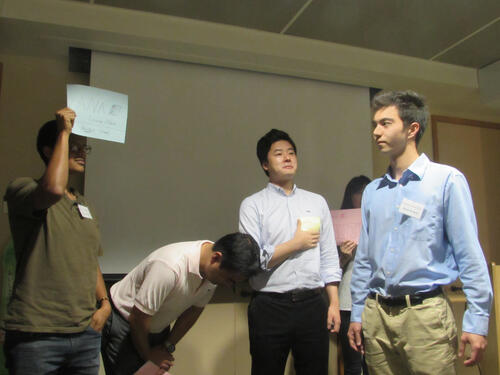
Team Three acts out a skit.  |  They proposed that ANA establish lounges for the general public to gather in and purchase goods from Uniqlo and Muji, two Japanese lifestyle retailers. The lounges would offer a place to reinforce ANA's brand outside of the airport, they said.


Image
ideathon team four

Team Four puts their heads together to generate ideas.  |  In their pitch, the team noted that baseball is a popular sport among Americans and Japanese. They recommended baseball be a focus of the marketing campaign, and said television and social media would best reach the target audience.


Image
ideathon team five

Team Five explains their marketing approach.  |  Flying can lead to some unpleasant experiences, and a way ANA can set itself apart is to make those experiences manageable, and even enjoyable, they said. Their proposal was to bring new amenities to the in-flight experience such as a care package for people who sit in the middle seat.


Image
ideathon team one

Team One poses for a picture after their presentation.  |  In their pitch, they recommended using ANA’s association with Japan to differentiate from other global airlines. Their approach included creating a film that features an American celebrity traveling on ANA.


The winning team was Team One whose concept was to use a celebrity figure – Ellen DeGeneres – in their advertising. They said that the target audience could relate to DeGeneres, and her already-established following would be an advantage.

The judges commended Team One for the creativity of their idea and its level of feasibility. Team One consisted of students Yaqian Fan, Michael Hong, Sam Ide, Lu Li and Adelbert Tan.

Kenji Kushida, a Stanford alumnus and project leader of SV-NJ, said:

“When I was a student, I craved for an opportunity to brainstorm solutions to real-world challenges and to do it in an environment that provided instant feedback,” he said, “We were able to make that happen here with the support of ANA and WiL, and are thrilled with the outcome."

Hero Image
ideathon headline cropped
All News button
1
Subscribe to Innovation