
Burma's Democracy: How Real?
The opening up of Myanmar (Burma) and the steps undertaken taken toward political reform in that formerly isolated dictatorship have been among Asia's most dramatic and least expected events. But the establishment of full democracy is still on the agenda and faces many challenges. How willing is the current government in Burma to allow a full and free exercise of political rights, including media freedom? A panel of experts, including Aung Zaw, the editor and founder of The Irrawaddy and this year's recipient of the Shorenstein Award for Journalism in Asia, will address that question in discussing "Burma's Democracy: How Real?"
Stanford University’s Walter H. Shorenstein Asia-Pacific Research Center (Shorenstein APARC) is pleased to announce Aung Zaw as the 2013 recipient of the Shorenstein Journalism Award. Zaw has been selected for his leadership in establishing independent media in Myanmar (Burma) and his dedication to integrity in reporting on Southeast Asia.
| Image
|
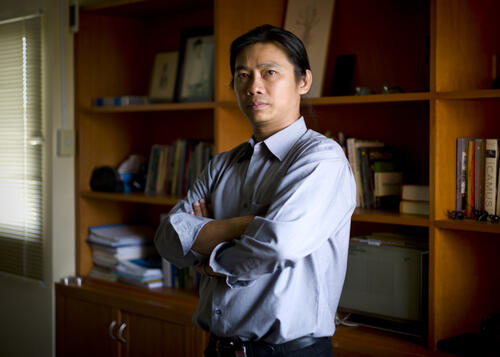
| Aung Zaw |
Aung Zaw is the founding editor-in-chief and executive director of The Irrawaddy, an independent Burmese media organization operating in Myanmar and northern Thailand. Zaw has been an active campaigner for democratic reform in Burma/Myanmar over the last two decades. He was awarded the 2010 Prince Claus Fund Award for journalism along with two journalists from Iran and Cuba – and is recognized for his active dedication to achieving democratic governance in Burma and his work to uphold press freedom.
Zaw studied Botany at Rangoon University. As a student activist in Burma, he was part of the 1988 protests in Rangoon against the Burmese military regime of General Ne Win. He was arrested and detained for a week in Rangoon’s notorious Insein prison where he was severely tortured during interrogation about his pro-democracy activities. Upon release Aung Zaw continued to work with the resistance movement until the military staged a coup in September that year and he was forced to leave the country for neighboring Thailand.
Two years later, Aung Zaw founded the Burma Information Group (BIG) in Bangkok, to document human rights violations in Burma. He began to write political commentaries for national newspapers in Thailand and internationally, and in late 1993 launched The Irrawaddy News Magazine in Bangkok, covering Burma affairs. He worked in Bangkok for two years producing The Irrawaddy Magazine until relocating to the more secure position in Chiang Mai in the north of Thailand.
In February 2012, Aung Zaw was able to return to his homeland for the first time in more than 20 years for a temporary visit as an independent journalist. By the end of 2012, The Irrawaddy was able to establish a media and news office in central Yangon, returning to Burma/Myanmar to practice independent journalism, whilst retaining a regional office in Thailand.
In 2013, the government lifted ban on The Irrawaddy and other exiled websites, the Irrawaddy English magazine and the Irrawaddy Dateline Current Affairs TV program is available for audiences in Myanmar. Aung Zaw writes for New York Times, International Herald Tribune, Time, The Guardian, Bangkok Post, The Nation and several publications in the Europe. His interviews have also appeared on CN, BBC and Al Jazeera. He is the author of the Face of Resistance and is a recent Visiting Scholar at UC Berkeley, School of Journalism.
Bechtel Conference Center
Donald K. Emmerson
At Stanford, in addition to his work for the Southeast Asia Program and his affiliations with CDDRL and the Abbasi Program in Islamic Studies, Donald Emmerson has taught courses on Southeast Asia in East Asian Studies, International Policy Studies, and Political Science. He is active as an analyst of current policy issues involving Asia. In 2010 the National Bureau of Asian Research and the Woodrow Wilson International Center for Scholars awarded him a two-year Research Associateship given to “top scholars from across the United States” who “have successfully bridged the gap between the academy and policy.”
Emmerson’s research interests include Southeast Asia-China-US relations, the South China Sea, and the future of ASEAN. His publications, authored or edited, span more than a dozen books and monographs and some 200 articles, chapters, and shorter pieces. Recent writings include The Deer and the Dragon: Southeast Asia and China in the 21st Century (ed., 2020); “‘No Sole Control’ in the South China Sea,” in Asia Policy (2019); ASEAN @ 50, Southeast Asia @ Risk: What Should Be Done? (ed., 2018); “Singapore and Goliath?,” in Journal of Democracy (2018); “Mapping ASEAN’s Futures,” in Contemporary Southeast Asia (2017); and “ASEAN Between China and America: Is It Time to Try Horsing the Cow?,” in Trans-Regional and –National Studies of Southeast Asia (2017).
Earlier work includes “Sunnylands or Rancho Mirage? ASEAN and the South China Sea,” in YaleGlobal (2016); “The Spectrum of Comparisons: A Discussion,” in Pacific Affairs (2014); “Facts, Minds, and Formats: Scholarship and Political Change in Indonesia” in Indonesian Studies: The State of the Field (2013); “Is Indonesia Rising? It Depends” in Indonesia Rising (2012); “Southeast Asia: Minding the Gap between Democracy and Governance,” in Journal of Democracy (April 2012); “The Problem and Promise of Focality in World Affairs,” in Strategic Review (August 2011); An American Place at an Asian Table? Regionalism and Its Reasons (2011); Asian Regionalism and US Policy: The Case for Creative Adaptation (2010); “The Useful Diversity of ‘Islamism’” and “Islamism: Pros, Cons, and Contexts” in Islamism: Conflicting Perspectives on Political Islam (2009); “Crisis and Consensus: America and ASEAN in a New Global Context” in Refreshing U.S.-Thai Relations (2009); and Hard Choices: Security, Democracy, and Regionalism in Southeast Asia (edited, 2008).
Prior to moving to Stanford in 1999, Emmerson was a professor of political science at the University of Wisconsin-Madison, where he won a campus-wide teaching award. That same year he helped monitor voting in Indonesia and East Timor for the National Democratic Institute and the Carter Center. In the course of his career, he has taken part in numerous policy-related working groups focused on topics related to Southeast Asia; has testified before House and Senate committees on Asian affairs; and been a regular at gatherings such as the Asia Pacific Roundtable (Kuala Lumpur), the Bali Democracy Forum (Nusa Dua), and the Shangri-La Dialogue (Singapore). Places where he has held various visiting fellowships, including the Institute for Advanced Study and the Woodrow Wilson International Center for Scholars.
Emmerson has a Ph.D. in political science from Yale and a BA in international affairs from Princeton. He is fluent in Indonesian, was fluent in French, and has lectured and written in both languages. He has lesser competence in Dutch, Javanese, and Russian. A former slam poet in English, he enjoys the spoken word and reads occasionally under a nom de plume with the Not Yet Dead Poets Society in Redwood City, CA. He and his wife Carolyn met in high school in Lebanon. They have two children. He was born in Tokyo, the son of U.S. Foreign Service Officer John K. Emmerson, who wrote the Japanese Thread among other books.


