Security

FSI scholars produce research aimed at creating a safer world and examing the consequences of security policies on institutions and society. They look at longstanding issues including nuclear nonproliferation and the conflicts between countries like North and South Korea. But their research also examines new and emerging areas that transcend traditional borders – the drug war in Mexico and expanding terrorism networks. FSI researchers look at the changing methods of warfare with a focus on biosecurity and nuclear risk. They tackle cybersecurity with an eye toward privacy concerns and explore the implications of new actors like hackers.

Along with the changing face of conflict, terrorism and crime, FSI researchers study food security. They tackle the global problems of hunger, poverty and environmental degradation by generating knowledge and policy-relevant solutions. 

-

Announced earlier this year, Yoichi Funabashi is the 2015 Shorenstein Journalism Award recipient. As part of the annual ceremonies, Funabashi will deliver remarks on the U.S.-Japan alliance, followed by comments from three Japan experts.


The postwar alliance of the United States and its former wartime foe, Japan, is one of the most enduring relationships of the postwar era. It remains a cornerstone of the foreign policy of both nations. But it is also an alliance in the midst of change. In both countries, domestic politics affects the security alliance, as well as the impact of economic turmoil and the challenges of slowing growth. Populism in the United States is already challenging the need for the alliance. Similar questions are raised by the hollowing out of Japan’s postwar moderative conservativism which long supported the alliance. Both the U.S. rebalance to Asia and Japan’s “proactive pacifism” are now in question. 


Featuring:

Image

Yoichi Funabashi

Co-founder and Chairman, Rebuild Japan Initiative Foundation

former Editor-in-Chief, Asahi Shimbun (2007-2010) 


Commentators:

Image
Susan Chira

Deputy Executive Editor, former Foreign Editor and Tokyo Correspondent

New York Times


Michael Armacost, Shorenstein Distinguished Fellow

Michael Armacost

Shorenstein APARC Distinguished Fellow, Shorenstein Asia-Pacific Research Center, Stanford University

former U.S. Ambassador to Japan


Moderator:

Image

Daniel Sneider

Associate Director for Research, Shorenstein Asia-Pacific Research Center, Stanford University

former Foreign Correspondent, San Jose Mercury News


Yoichi Funabashi is an award-winning Japanese journalist, columnist and author. He has written extensively on foreign affairs, the U.S.-Japan Alliance, economics and historical issues in the Asia-Pacific.

He has a distinguished career as a journalist. He served as correspondent for the Asahi Shimbun in Beijing (1980-81) and Washington (1984-87), and as U.S. General Bureau Chief (1993-97). In 2013 he won the Oya Soichi Nonfiction Award for his book on the Fukushima Daiichi Nuclear Accident ‘Countdown to Meltdown,’ he won the Japan Press Award known as Japan’s “Pulitzer Prize” in 1994 for his columns on international affairs, his articles in Foreign Affairs and Foreign Policy won the Ishibashi Tanzan Prize in 1992 and in 1985 he received the Vaughn-Ueda Prize for his reporting on international affairs.

As co-founder and chairman of the Rebuild Japan Initiative Foundation (RJIF) he oversaw the “Independent Investigation Commission on the Fukushima Daiichi Nuclear Accident” (Routledge, 2014) that was ranked in the top 24 policy reports produced by a think-tank in the ‘2012 Global Go-to Think Tank Ranking.’ Since its establishment in 2012, RJIF has published several influential reports on a broad range of key policy challenges facing Japan and the Asia-Pacific.

He received his bachelor of arts from the University of Tokyo in 1968 and his doctorate from Keio University in 1992. He was a Nieman Fellow at Harvard University (1975-76), a visiting Fellow at the Institute for International Economics (1987), a Donald Keene Fellow at Columbia University (2003), a visiting professor at the University of Tokyo Public Policy Institute (2005-2006) and a distinguished guest professor at Keio University (2011-2014). He previously served on the board of The International Crisis Group, and is a member of the Trilateral Commission. He is a former contributing editor of Foreign Policy, and sits on the editorial board of The Washington Quarterly.

Funabashi’s complete profile can be found here.

The Shorenstein Journalism Award, which carries a cash prize of $10,000, honors a journalist not only for a distinguished body of work, but also for the particular way that work has helped American readers to understand the complexities of Asia. The award, established in 2002, was named after Walter H. Shorenstein, the philanthropist, activist, and businessman who endowed two institutions that are focused respectively on Asia and on the press: the Walter H. Shorenstein Asia-Pacific Research Center (Shorenstein APARC) in the Freeman Spogli Institute at Stanford University, and the Joan Shorenstein Center on the Press, Politics, and Public Policy in the Kennedy School of Government at Harvard University.

Event media contact: Lisa Griswold, lisagris@stanford.edu
Authors
Lisa Griswold
News Type
Q&As
Date
Paragraphs

In a Q&A, Stanford postdoctoral fellow Darika Saingam explains why Thailand's battle against drugs continues and what is needed to introduce good policy that works to prevent illegal drug trade and supports recovering addicts.

Despite Thailand’s decade-long crackdown on drugs, demand for illegal substances has risen. A green leaf drug known as ‘kratom’ is a symbol of this rise as young people eagerly adopt the drug for entertainment and join an older generation of laborers who chewed it to survive long hours of work in the fields—and are now heavily addicted. Curtailing substance abuse and its consequences takes good public policy and solutions must be area-specific and evidence-based, according to a Stanford postdoctoral fellow.

Darika Saingam, the 2015-16 Developing Asia Health Policy Postdoctoral Fellow, has conducted two cross-sectional surveys and more than 1,000 interviews with drug users, recovered addicts, and local public officials in an effort to better understand the evolution of substance abuse in southern Thailand.

At Stanford, she is preparing two papers that offer policy options suitable for Thailand and other developing countries in Southeast Asia. Saingam spoke with the Shorenstein Asia-Pacific Research Center (APARC) where she will give a public talk on May 17. The interview text below was edited for brevity.

For decades, Thailand has been an epicenter of drugs. Can you describe the extent of the problem today?

According to a 2014 report, 1.2 million people were involved in illegal drug activities across Thailand. The total number of drug cases saw a 41 percent increase from 2013 to 2014. New groups of drug traffickers are mobilizing while existing groups are still active. Drug users who are young become drug dealers as they get older. The number of drug users below 15 years of age has increased dramatically.

According to your research, what drives Thais toward illegal drug use and the trafficking business?

Adults in Thailand use drugs to relieve stress and counteract the effects of work. Adolescents use them for entertainment. Historically, farmers and laborers from rural areas of Thailand would use opium for pain relief. More recently, a consumable tablet known as yaba has become popular along with crystal methamphetamine and marijuana. Young people are increasingly using yaba and kratom.

Thailand is still a developing country, but it is industrializing quickly. Social and cultural norms have been shifting and people want an improved quality of life. A lot of young people are unemployed and lack social support and are therefore more likely to turn to drug trafficking for economic opportunity. The economic recession and political strife in countries bordering Thailand have exacerbated the situation.


Image
drug policy 1a
    
Image
drug policy 2

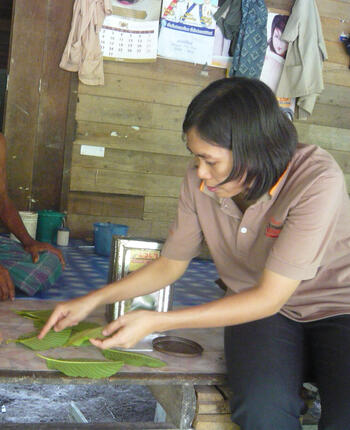
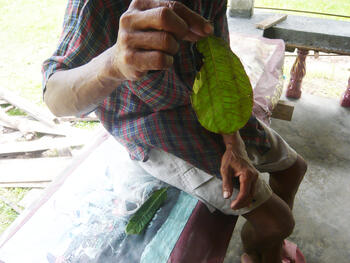
Photos (left to right): A man holds up a kratom leaf. / Saingam examines kratom leaves as part of her research to understand illegal cultivation practices.


What is kratom and why is it popular?

For nearly a century, the native people of Thailand have chewed kratom. It is a leaf that grows on trees resembling a coffee plant. Historically, kratom was used to reduce strain following physical labor, to be able to work harder and longer, and to better tolerate heat and sunlight. Kratom is also embedded in Thai culture and given as a spiritual offering in religious ceremonies. My field research in the southern province of Nakhon Si Thammarat has shown that these motivations are still true today.

Within the past seven years, kratom use has skyrocketed and people are using it in increasingly harmful ways. Chewing kratom is not immediately harmful to health, but combining it with other substances is. This is the recent trend. Users have created new ways to consume it such as in a drink known as a ‘4x100.’ It contains boiled kratom leaves, cough syrup and soft drinks. Additional methamphetamines and benzodiazepines are sometimes added to that mixture.

What strategies must be employed to control substance abuse?

The first step is to realize that the patterns of substance abuse are specific to each location therefore solving the problem must also be. Drug usage is also dynamic. Placing hard control measures on one substance often provokes the emergence of another in its place therefore a holistic approach is important.

Thailand should employ multiple strategies toward effective prevention and control of substance abuse. These strategies include examining the problem and creating policies from an economic perspective (supply and demand), an institutional perspective (national and international drug control cooperation), and a social perspective (structural supports for recovered addicts and mobilization of public participation).


What is the Thai government doing to address the drug problem, and what could they be doing better?

Politicians in Thailand must do a better job at representing the people. Government health workers are often gathering information, assessing needs, and reporting findings to politicians, but these needs are not being accurately addressed. An example of this is politicians ordering to cut down kratom trees – a public display that does not get at the root cause of the problem. The reality is that drug users will quickly find substitutes. According to my study, of the regular users that stopped using kratom, more than 50 percent turned to alcohol instead and did so on a daily basis. This is merely a shift from one substance to another.

On the upside, a crop substitution program created under King Bhumibol Adulyadej offers a successful working model. The program works to replace opium poppy farming with cash crop production. It began in 1969 and is cited for helping an estimated 100,000 people convert their drug crop production to sustainable agricultural activities. Crops cultivated can be sold for profit in nearby towns. The program has also introduced a wide variety of crops and discouraged the slash-and-burn technique of clearing land. It is win-win because it stymies drug trade and provides economic opportunity while also being ecologically sound. This type of program should continue to be scaled up.

Can this model be co-opted elsewhere? What lessons from other countries could inform Thailand’s approach?

Yes, the model could plausibly be implemented in other areas in Thailand and in other Southeast Asian nations.

I think a judicial mechanism such as the kind seen in France could benefit the rural areas in Thailand. The French government has established centers across the country that act as branches of the court that try delinquency cases of minor to moderate severity, and also recommend support services for drug users. Members of the magistrate and civil society actors manage center operations thus placing some responsibility back onto the local community.

I believe an opportunity also exists for Thailand to legalize kratom. Legalization would show a respect for the cultural tradition of chewing kratom leaves and allow the government to suggest safer ways of using it. Bolivia has created a successful model of this through its legalization of coca leaves. Coca in its distilled form is cocaine, but left as a leaf, it is not a narcotic. Indigenous peoples are allowed to chew coca leaves. The government policy is being credited for a decrease in cocaine production as well.

Hero Image
drug policy headline
Stanford postdoctoral fellow Darika Saingam conducts interviews and collects data in southern Thailand.
All photos courtesy of Darika Saingam
All News button
1
News Type
Commentary
Date
Paragraphs

Stanford experts from the Shorenstein Asia-Pacific Research Center (APARC) spoke with media in Asia and the United States about the dynamics on the Korean Peninsula following recent provocations by North Korea; a roundup of those citations is below.

The United Nations imposed a new set of sanctions against North Korea on March 2 in response to the country’s fourth nuclear test in January and subsequent rocket launch in February of this year. Shorenstein APARC Director Gi-Wook Shin offered his view in an interview with Dong-a Ilbo:

“The new sanctions are unprecedentedly strong and comprehensive, but the dominant view is pessimistic,” he said, emphasizing that the sanctions’ effectiveness stands largely on the shoulders of China, which is North Korea’s largest trading partner.

“Only if China doesn't fizzle out after a few months – but continuously enforces the sanctions – will we see any meaningful effect,” he said.

Shin also called upon South Korea to play a leadership role in dealing with North Korea because the United States has only limited interest in solving the nuclear problem, and China, will not change its approach and continue to move according to its own interests.

Shin relayed a similar message in an interview with Maeil Shinmun last December. South Korea must break from its own perception that it is the “balancer” between China and the United States. South Korea, often described as a “shrimp among whales,” should instead strive to play a larger role as a “dolphin,” he said.

Furthermore, Shin told Maeil that the U.S.-Korea relationship and the U.S.-China relationship are very different from each other, and should be viewed as they are. He pointed out that the U.S.-Korea relationship is an alliance where the two countries act accordingly as one body, whereas the China-Korea relationship is a strategic partnership insofar as the two countries cooperate on selective issues of mutual interest.

In a separate interview with the Associated Press, David Straub, associate director of the Korea Program, was asked about the possibility of peace talks with North Korea as an alternative to or parallel with the U.N. sanctions. Straub said “it would not make sense” and that “there is no support for such an approach in Washington” because of the strategic partnership between China and North Korea. He also told Voice of America that the new sanctions will significantly increase the political, diplomatic, and psychological pressures on North Korea's leaders to rethink their pursuit of nuclear weapons.

Hero Image
665980
The U.N. Security Council unanimously adopts resolution 2270, imposing additional sanctions on North Korea in response to that country’s continued pursuit of a nuclear weapons and ballistic missile program, March 2, 2016.
United Nations
All News button
1
Paragraphs

While power asymmetry typically defines security relationships between allies, there exist other forms of asymmetry that influence alliance politics. In order to illustrate how they can shape policy outcomes that cannot be explained solely through the lens of power capabilities, the authors examine the role of relative attention that each side pays to the alliance. It is their central argument that since the client state has a greater vested interest in the alliance and given that attention depends on interest/need, the client state can leverage attention to get its way. By analysing two specific cases, the 2002 South Korean schoolgirls tragedy and the 2008 beef protests—instances where the South Koreans succeeded in compelling U.S. concessions—the authors show that because the alliance was more central to the client state’s agendas, there existed an asymmetry of attention that offered leveraging opportunities for the weaker ally. In this study, the authors emphasise the role of media attention as a key variable, and seek to contribute to debates on weaker party leverage in asymmetrical alliances.

All Publications button
1
Publication Type
Journal Articles
Publication Date
Journal Publisher
Australian Journal of International Affairs
Authors
Gi-Wook Shin
Authors
Donald K. Emmerson
News Type
Commentary
Date
Paragraphs

It was meant to be a sunny summit. Welcoming ASEAN’s leaders at the Sunnylands estate, President Obama said he had invited them to southern California, not cold and snowy Washington, to reciprocate the warm welcomes he had received in their own countries on his seven presidential trips to Southeast Asia. Appreciative laughter ensued.

Naturally Obama ignored the futility implied by the name of the city where Sunnylands sits: Rancho Mirage. But as a metaphor for ASEAN’s hopes of moderating China’s behavior in the South China Sea, and the summit’s efficacy in that regard, the name of the city is more apt than that of the estate. Rancho Mirage lies in the northern tip of the Sonoran Desert. In the driver’s seat on a desert road in the shimmering heat, ASEAN might be fooled into seeing a geopolitical oasis – a meaningful agreement with China on the South China Sea – finally near and achievable with continuing patience and faith in the “ASEAN Way” of regional diplomacy by consensus and declaration.

The Sunnylands Declaration, released on 16 February at the end of the two-day summit, lays out 17 principles to guide US-ASEAN cooperation going forward. The fifth of these reaffirms “respect and support for ASEAN Centrality and ASEAN-led mechanisms in the evolving regional architecture of the Asia-Pacific.”

On the day the declaration was announced, news broke that China had just deployed surface-to-air missile batteries on a land feature in the South China Sea controlled by China but also claimed by Vietnam and Taiwan – Woody Island in the Paracels. So much for the efficacy of the declaration’s eighth principle of “shared commitment” to “non-militarization and self-restraint in the conduct of activities.”

After “activities,” the Sunnyland drafters could not even agree to add “in the South China Sea,” let alone mention China, its encompassing “nine-dash line,” or the dredging, up-building, and runway-laying that Beijing has being doing at a breakneck, unilateral, mind-your-own-business pace on the contested features that it controls. Missile launchers on Woody? Score another point for the “PRC Way” of creating lethal facts while the “ASEAN Way” drafts wishful norms.

To its credit, the summit did convey “shared commitment” to “freedom of navigation and overflight” in and above the South China Sea, and twice endorsed the UN Convention on the Law of the Sea. But those phrases will not soften China’s refusal to allow international rules to restrain its maritime ambitions.

A mirage that gained false credibility at the summit: a notion that announcing principles will change behavior.

The notion that announcing principles will change behavior is the main mirage that gained false credibility in Rancho Mirage, at least among Southeast Asians who are disposed to value lowest-common-denominator diplomacy. They hope that China will be influenced by ASEAN-propagated norms to moderate its maritime ambition and behavior.

More than a few of Obama’s guests at Sunnylands retain faith in a single should-be, will-be solution: a Code of Conduct, or COC, in the South China Sea. The declaration does not refer to this illusion. But allegiance to such a code was evident in conversations among participants at the summit and in interviews afterwards.

For well over a decade in Southeast Asia and beyond, diplomats have been discussing the need for a – still non-existent – COC. In 2002 China and the ASEAN governments did sign a Document on Conduct of Parties in the South China Sea, or DOC  But its hortatory spirit and provisions were violated almost from the outset by nearly all six claimants – Brunei, China, Malaysia, the Philippines, Taiwan, and Vietnam. China’s placement of missile launchers on Woody Island, cheekily on the eve of the Sunnylands summit, was but the latest nail in the DOC’s coffin.

China and ASEAN signed a Document on Conduct for the South China Sea. Provisions were soon violated.

China and the ASEAN states undertook in the DOC “to exercise self-restraint in the conduct of activities that would complicate or escalate disputes and affect peace and stability” in the South China Sea. China’s leaders could have observed this principle. Instead they chose to bully Manila and Hanoi, respectively, by seizing Scarborough Shoal and stationing a huge oil rig in waters claimed by Vietnam. They chose to harass and expel Southeast Asians from a vast nine-sided fishing zone unilaterally drawn and appropriated for China’s own priority use. They chose to complicate and escalate disputes, damage peace, and cause instability by unilaterally enlarging, outfitting, and militarizing land features under Beijing’s contested control in a manner that dwarfs in scale and lethality the up-building efforts of other claimants.

It is not in China’s expansionist interest to implement a mere declaration, the DOC. Still less attractive in Beijing’s eyes is a code with teeth – a COC whose enforcing mechanism might actually punish violations. To encourage delay, Beijing insists that the DOC must be implemented first, before a COC can be drawn up and signed. To avoid commitment and to maximize the divide et impera asymmetry of separate bilateral talks between China and each Southeast Asian claimant, Beijing calls the discussions with ASEAN “consultations,” not “negotiations.”

In 2004 China did agree with the ASEAN states to establish a Joint Working Group on the Implementation of the DOC. In October 2015 in Chengdu, China, the group met for the 15th time. Afterwards, a Chinese foreign ministry spokeswoman assured listeners that the participants had reaffirmed “their commitment to fully and effectively implementing the DOC” and their readiness “to “work toward the early conclusion of a COC on the basis of consensus” [emphasis added].

Dissensus helps China ensure that the mirage of a code of conduct remains in sight, motivating ASEAN. 

In Southeast Asia, views of China’s behavior range from acquiescence (Cambodia, Laos) to antipathy (the Philippines, Vietnam). Manipulating this dissensus helps China ensure that the mirage of a COC remains in sight, motivating ASEAN, but continues to recede, protecting China.

ASEAN’s faith in its own centrality and the validation of that credence in Rancho Mirage reinforce passivity and complacence in Southeast Asia, including the idea that because ASEAN is indispensable, it need not be united, proactive, or original.

Southeast Asian officials and analysts who excuse ASEAN’s inertia argue that the grouping isn’t a government; China’s not that much of a threat; and geography has, after all, put China permanently next door. Coaxing the four Southeast Asian claimants to settle their own overlapping claims, some say, is just too hard to do. Brainstorming alleviations and ameliorations, let alone solutions, for the South China Sea? That’s too daunting as well. Isn’t the problem really a Sino-American struggle for power? Why get involved? Why not prolong the happy combination of American ships for deterrence and Chinese markets for profit? China’s leaders at least say that they want an eventual COC. Why not keep believing in that and them and avoid rocking the boat?

By its actions, China is signaling its intent to dominate some, most, or all of the South China Sea – the heartwater of Southeast Asia. If and when China manages to coopt and cow the ASEAN states into deference and resignation, Beijing will likely “disinvite” the US Navy from accessing what China controls. If this happens, the “Centrality” of ASEAN that was lauded in Rancho Mirage will have merited that city’s name, and China’s centrality will be all too real.


Donald Emmerson is director of the Southeast Asia Program at the Shorenstein Asia-Pacific Research Center and a senior fellow emeritus at the Freeman Spogli Institute for International Studies.

This article was originally carried by YaleGlobal Online on Feb. 23, 2016, and reposted with permission.

Hero Image
asean flags
Flags of nations within the Asia-Pacific region fly side-by-side June 18, 2013, outside of the Multinational Coordination Centre in Muara, Brunei.
U.S. Marines
All News button
1
-

- This event is jointly sponsored by the Center for International Security and Cooperation (CISAC) and the Walter H. Shorenstein Asia-Pacific Research Center (APARC) - 

Five years to the day after a massive earthquake and ensuing tsunami caused an accident at three of the reactors of the Fukushima Daiichi nuclear power plant in Fukushima, Japan, a panel of Stanford experts will convene in Encina Hall to reflect on the lessons learned from the disaster that unfolded starting on March 11, 2011. Panelists will include:

  • Steven Chu, 12th U.S. Secretary of Energy (2009-2013), Laureate of the 1997 Nobel Prize in Physics,  William R. Kenan, Jr., Professor of Physics and Professor of Molecular & Cellular Physiology in the Medical School at Stanford University - Focus: Perspective from the Department of Energy on the role of the department in helping mitigate the consequences and the lessons learned
  • Phillip Lipscy, Thomas Rohlen Center Fellow at the Freeman Spogli Institute for International Studies and Assistant Professor of Political Science at Stanford University - Focus: Fukushima in comparative perspective and how the Japanese nuclear power industry has reacted since the accident.
  • Scott Sagan, Caroline S.G. Munro Professor of Political Science, Mimi and Peter Haas University Fellow in Undergraduate Education, and Senior Fellow at the Center for International Security and Cooperation and the Freeman Spogli Institute at Stanford University. Focus: the effects of the accident on efforts to improve nuclear safety and security, based on the upcoming book Learning from a Disaster.
  • Takeo Hoshi, Senior Fellow at the Freeman Spogli Institute for International Studies (FSI) and director of APARC's Japan Program, will chair the session and act as moderator.

This event will also serve as a book launch for the book Learning from A Disaster: Improving Nuclear Safety and Security After Fukushima, co-edited by Edward Blandford, a former Stanton Nuclear Security Fellow at CISAC and Scott Sagan. the book is being published by Stanford University Press and will be available for purchase at the event. Pre-orders can be taken here.

Panel Discussions
-

The recent US-ASEAN summit at Sunnylands in California is just the latest high-profile instance of Washington's efforts to strengthen its relations with Asia. Through a MacArthur Foundation-supported project he is leading, Bates Gill has explored a range of old and new security ties between the US and its partners in the Asia-Pacific region, including Indonesia, Myanmar, Vietnam, and Australia. Each of these governments seeks to strike the right balance between Washington and Beijing, but the domestic and foreign policies they employ for that purpose differ greatly. Basing his findings and analysis on extensive field research in these countries, Prof. Gill will offer recommendations for Washington and its regional partners as they look to engage with and hedge against a rising China.

Image
bates4x6
Bates Gill has a 30-year international career as a China watcher, having held teaching, research, and executive leadership positions in the United States, China, Europe, and Australia. He is currently a board director of China Matters, a not-for-profit advisory based in Sydney, Australia. In 2012-15 he was CEO of the United States Studies Centre at the University of Sydney. He directed the Stockholm International Peace Research Institute from 2007 to 2012 and previously held the Freeman Chair in China Studies at the Center for Strategic and International Studies and served as the inaugural director of the Center for Northeast Asian Policy Studies at the Brookings Institution. 

Prof. Gill has authored or edited seven books including Rising Star: China's New Security Diplomacy and Asia's New Multilateralism: Cooperation, Conflict and the Search for Community (co-edited with Michael Green). His professional affiliations include service on the editorial boards of China Quarterly and the Journal of Contemporary China, the international advisory board of the Shanghai Institutes of International Studies, and the board of governors of the Rajaratnam School of International Studies (Singapore). His PhD is from the Woodrow Wilson Department of Government and Foreign Affairs at the University of Virginia.

The US, China and the Balance of Influence in and around Southeast Asia
Download pdf
Bates Gill Professor of Asia Pacific Strategic Studies, Australia National University
Seminars
Authors
Lisa Griswold
News Type
News
Date
Paragraphs

Globalization has lifted more than one billion people out of extreme poverty, but as inequality and barriers to trade remain worldwide, improved trade standards are needed and the Trans-Pacific Partnership promises to be a primary conduit of those standards, America’s top trade official told a Stanford audience on Tuesday.

Ambassador Michael Froman, the U.S. Trade Representative, spoke of the merits of the multilateral trade agreement, known as the ‘TPP,’ in a speech given at the Freeman Spogli Institute for International Studies (FSI).

The TPP seeks to liberalize trade and investment between 12 Pacific Rim countries. Signed earlier this month, the document now faces the path to ratification through its members.

“In today’s rapidly globalizing world, the alternative to the TPP is not the status quo,” Froman told nearly one hundred affiliates and guests at the Bechtel Conference Center.

Froman cited efforts by various countries to build up alternative frameworks that promote free trade, but said they miss some components of stability and longevity that the TPP offers. For example, China’s 'one belt, one road' initiative and the Regional Comprehensive Economic Partnership, a negotiation between 16 Asian countries.

The TPP would serve as an important benchmark for countries seeking to expand economic gains from trade and to level up on common “rules of the road.” He said increase in exports to the United States alone is estimated at $350 billion a year.

“Smart trade agreements like the TPP are how we shape globalization the right way,” Froman said with a call for continued U.S. leadership on the matter.

President Obama has been a strong advocate of the agreement, in line with the administration’s ‘rebalance to Asia’ strategy. The rebalance is a regional strategy that aims to recognize the growing importance of the Asia-Pacific region to U.S. national interests.

Successful passage of the TPP will reassure allies in the region of American staying power, he said.

Countries outside of the TPP have begun to express interest in becoming a party to the agreement. South Korea, Taiwan, the Philippines and Indonesia are among them. Application to join the TPP is now closed, but we can “expect over time” that its membership would grow, he said.

At a 2013 conference, FSI scholars examined the potential impact on Taiwan should it seek membership. Outcomes from the conference are published in this report.

Froman said the TPP supports “commerce without borders” among key sectors in the United States, in particular, those found in and around Silicon Valley.

“No state stands to benefit more from the TPP than California,” he said.

Froman announced the release of a report that details TPP provisions focused exclusively on technology and intellectual property.

The event was hosted by the U.S.-Asia Security Initiative in association with FSI, the Shorenstein Asia-Pacific Research Center and the Stanford Institute for Economic Policy Research. The Initiative aims to facilitate constructive interaction between academic and governmental experts on security challenges facing the Asia-Pacific region.

Video from the event including Froman’s speech and the Q&A is available here.

Hero Image
dsc 2025a
Ambassador Michael Froman, the U.S. Trade Representative, delivers remarks on the Trans-Pacific Partnership at Stanford on Feb. 16, 2016.
Rod Searcey
All News button
1
-

Incompetent and dishonest politicians are common in developing countries. Scholars who write about corruption and poor governance tend to take the existence of bad politicians as a given and focus on the damage that they do. Few study the ways in which politicians are recruited in order to improve that process. Some scholars acknowledge the need to encourage the creation of a political class that is competent and honest. But none have gone further by conducting real-world experiments to evaluate the efficacy of screening and incentivizing competent and virtuous citizens to stand for public office, that is, how to nudge good people to become politicians in the first place.

Dr. Ravanilla will describe a policy intervention designed to attract able and ethical candidates to public service. Can a leadership-training workshop and non-monetary status rewards be used to screen and motivate good people to serve the public good? His answer is yes. The results of a randomized field experiment among youth running for an elective post in the Philippines show that such an intervention is indeed feasible and can be effective in motivating able and moral individuals to seek public office while at the same time discouraging candidates who do not meet these criteria.

Image
rnico
Nico Ravanilla will begin an assistant professorship in the School of Global Policy and Strategy at the University of California, San Diego, in September 2016.  The Southeast Asia Research Group named him a Young Southeast Asia Fellow for 2015-16.  He earned his PhD in political science and public policy at the University of Michigan in 2015.

Nico Ravanilla 2015-16 Shorenstein APARC Postdoctoral Fellow, Stanford University
Seminars
-
The United States and India continue to expand strategic ties and areas of collaboration in unprecedented ways. This of course has not come without constraints or significant obstacles. Under the Obama Administration, the relationship has arguably been elevated to a new level of cooperation, but space remains for a potentially significant further expansion of both ties and collaboration on all levels. This will have strategic implications for both nations, their neighbors, and the overall region itself. 
 

As the U.S.-India relationship continues to grow into the 21st century, a new regional construct has the potential for developing along with it. At the confluence of India's Act East foreign policy and the United States' strategic rebalance to Asia lies the relatively undefined domain of the Indo-Pacific. This seminar will touch upon the efforts of the Obama Administration to further this "defining partnership of the 21st century", and then delve into the potential future of the Indo-Pacific and the strategic implications and challenges of a developing Indo-Pacific reality from political, economic, security, and technological perspectives


Image
Philip James Reiner is an Affiliate at Stanford University’s Center for International Security and Cooperation, an Adjunct Senior Fellow with the Asia-Pacific Security Program at the Center for a New American Security, and serves as a consultant to both the private and public sectors. He previously served as Senior Director for South Asia at the National Security Council (NSC), where he successfully led U.S. government efforts to revitalize the U.S.-India bilateral relationship, and oversaw two head-of-state level engagements including the groundbreaking visit of President Obama as Chief Guest at India’s Republic Day celebrations in January 2015. Prior to his appointment as Senior Director, Mr. Reiner served at the NSC for three years, first as Director for Pakistan and then as Senior Advisor for Afghanistan and Pakistan. In these capacities, he helped to manage the war-time requirements of effectively staffing the President, the National Security Advisor, and senior White House and NSC leadership, while helping to lead team efforts to sustain an international coalition of more than 40 countries in Afghanistan, with functional focus on both counterterrorism and countering the proliferation of weapons of mass destruction. He also played an instrumental role in managing significant bilateral and regional crises and helping to reset and rebalance U.S.-Pakistan relations after the tensions of 2011.

Prior to joining the White House, Mr. Reiner worked in the Office of the Under Secretary of Defense for Policy at the Pentagon, where he received the Office of the Secretary of Defense Medal for Exceptional Civilian Service; and at Raytheon Space and Airborne Systems. Mr. Reiner holds a Master’s degree in International Relations from the Johns Hopkins School of Advanced International Studies, and a Bachelor of Arts in Comparative Religions with a minor in History from the University of California at Santa Barbara. He currently resides in the San Francisco Bay Area with his wife and daughter.


This event is co-sponsored by the Shorenstein Asia-Pacific Research Center and the Center for International Security and Cooperation 

 
Philip James Reiner Former Senior Director for South Asia, National Security Council
Seminars
Date Label
Subscribe to Security