Authors
Lisa Griswold
News Type
News
Date
Paragraphs

A new course jointly taught by Stanford and Peking University brought together students and scholars in China and the United States in dialogue using videoconferencing.

Each week during the past spring quarter, students at Stanford and Peking University (PKU) gathered in a classroom to learn, just as they would for any other course. The only difference was these students were neither in the same classroom nor on the same continent.

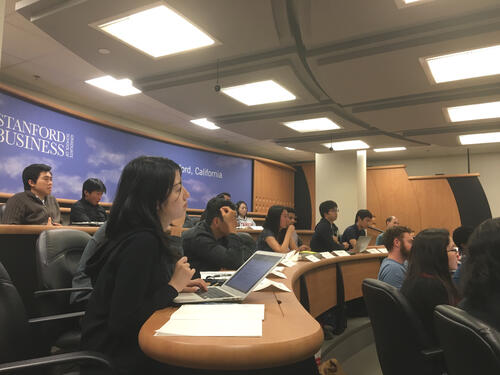
Despite being separated by nearly 6,000 miles, 18 students in Palo Alto and 28 students in Beijing held ‘face-to-face’ conversations via high definition videoconference in a course taught by American and Chinese scholars. On each side, they sat in a three-rowed amphitheater and looked directly ahead – not at a whiteboard – but at a screen that projects a video ‘wall’ of their colleagues at the other campus. The venue, known as a ‘Highly Immersive Classroom,’ enabled the distance learning experience between the two universities, using advanced software to create a cross-Pacific virtual classroom. The course titled The United States, China, & Global Security, led by former U.S. Ambassador to Afghanistan Karl Eikenberry and PKU professor Fan Shiming, was organized under the auspices of the U.S.-Asia Security Initiative whose research focuses on security challenges in Asia with teaching as one of its core activities.

“We set out to host a course that addressed topics critical to China and the United States in a new type of classroom format,” said Eikenberry, the Oksenberg-Rohlen Distinguished Fellow in the Shorenstein Asia-Pacific Research Center and director of the Initiative. “What resulted was a truly unique academic exchange that considered topics even beyond the bilateral relationship and carried a certain ‘Silicon Valley spirit’ being divided by an ocean yet connected through technology.”

“I loved the cybersecurity class because there was a lot of candor on both sides.”

-Shan Jee Chua, PKU graduate student

Over eight weeks, a select group of graduate students from the two universities explored a wide array of subjects related to international security, ranging from terrorism to trade and energy and the environment. The course aimed to provide students with a forum to discuss current issues in U.S.-China relations and to analyze areas that could be applied to other case studies. 

“Because each week was a different topic, it didn’t feel like I was just thinking about the United States and China again every Wednesday night,” said Sam Ide, a Stanford graduate student who studies China’s relations with Central Asia. “Each session was very interesting to me in a different way.”

Guest-taught by prominent scholars and former senior government officials from the United States and China, the course sessions allocated thirty minutes for each lecturer to present, followed by a thirty minute question-and-answer period in which students were given the opportunity to interact with the lecturers and their peers on the other campus. Lecturers from Stanford included nuclear scientist Siegfried Hecker, former U.S. Secretary of Energy Steven Chu, and Thomas Fingar, a former deputy director at the U.S. Office of the Director of National Intelligence; and from PKU, Dean of the School of International Studies Jia Qingguo, and arms control and disarmament expert Han Hua. All discussions were off-the-record to encourage candid exchange of ideas. 


Image
course 3

At Stanford's Highly Immersive Classroom in Palo Alto, students look ahead at their counterparts in Beijing.


One course session in particular resonated with students. The session, taught by Zha Daojiong, a professor of political economy at PKU and Herbert Lin, a senior research scholar at Stanford’s Freeman Spogli Institute for International Studies, focused on the changing nature and future of cybersecurity relations between China and the United States.

“I loved the cybersecurity class because there was a lot of candor on both sides,” PKU student Shan Jee Chua recalled.

Kimberly Chang, a second year Stanford graduate student in management science and engineering, noted that it was beneficial to hear the Chinese view on cyber “because most of the talk within the United States has been from an American perspective.”

“Hopefully, I'll be able to meet some of these people in real life who I've met on the 'wall.'”

-Sam Ide, Stanford graduate student

The course revealed a broader range of perspectives and provided a chance to interact first-hand with international colleagues while remaining at their home campus. Discussion amongst peers uncovered the “behind the scenes stories” and added context to media reports found online or in print, said Seung Kim, a student in Stanford’s East Asian studies program.

Besides the technology, a unique aspect of the course was its diversity. More than half of the course participants were international, representing 15 countries beyond China and the United States. That setting encouraged debate and reinforced the notion that “neither the United States nor China is the center of the universe,” said Zhu Jun Zhao, a PKU international relations student.

When students were asked what could bring about better understanding between China and the United States, continued dialogue was a common answer. The future of U.S.-China relations rests in the hands of people talking to one another: “I think we need more honest conversations,” Chang said.

And for some students, an opportunity to hold those conversations in-person may be close. Ide said he anticipates traveling to Beijing over the summer and plans to try and meet with a few of his counterparts whom he met through the course.

“Hopefully, I’ll be able to meet some of these people in real life who I’ve met on the ‘wall.’”

Related Links:

Video showcases SCPKU's Highly Immersive Classroom enabling co-teaching across the Pacific

Hero Image
course 2
At the Stanford Center at Peking University in Beijing, Peking University professor Fan Shiming presents his remarks during a session of "The United States, China, & Global Security," a joint course taught by Stanford and Peking University via videoconference; Palo Alto, May 2016.
All News button
1
News Type
Commentary
Date
Paragraphs

Alliances serve an important purpose in international relations, but the attention given by each country to each other is rarely equal. This kind of asymmetry is apparent in the U.S.-South Korea alliance; however, South Korea as the weaker ally can work to garner greater attention from the United States by leveraging the news media, according to Stanford professor Gi-Wook Shin and Yonsei University professor Rennie Moon.

Their co-authored editorial can be viewed on the AIIA blog. More on the subject can be found in an extended journal article by Shin, Moon and Hilary Izatt in the Australian Journal of International Affairs, and the Stanford University Press book One Alliance, Two Lenses: U.S.-Korea Relations in a New Era.

Hero Image
obama parkgeunhye flickr whitehouse
U.S. President Barack Obama and South Korean President Park Geun-hye walk around Blue House in Seoul, April 2014.
Flickr/White House - Pete Souza
All News button
1
Paragraphs

An analysis of the foundations and future of the trilateral relationship from a U.S. perspective, highlighting the critical role the United States has played in mediating tensions between the Republic of Korea and Japan.

The essay is also part of an expanded NBR Special Report with co-authors Yul Sohn and Yoshihide Soeya that offers insights into both the past and future of trilateral cooperation and provides recommendations for leaders in all three nations to move relations foward.

All Publications button
1
Publication Type
Policy Briefs
Publication Date
Journal Publisher
National Bureau of Asian Research (NBR)
Authors
News Type
Commentary
Date
Paragraphs

Stanford experts from the Shorenstein Asia-Pacific Research Center (APARC) spoke with media in Asia and the United States about the dynamics on the Korean Peninsula following recent provocations by North Korea; a roundup of those citations is below.

The United Nations imposed a new set of sanctions against North Korea on March 2 in response to the country’s fourth nuclear test in January and subsequent rocket launch in February of this year. Shorenstein APARC Director Gi-Wook Shin offered his view in an interview with Dong-a Ilbo:

“The new sanctions are unprecedentedly strong and comprehensive, but the dominant view is pessimistic,” he said, emphasizing that the sanctions’ effectiveness stands largely on the shoulders of China, which is North Korea’s largest trading partner.

“Only if China doesn't fizzle out after a few months – but continuously enforces the sanctions – will we see any meaningful effect,” he said.

Shin also called upon South Korea to play a leadership role in dealing with North Korea because the United States has only limited interest in solving the nuclear problem, and China, will not change its approach and continue to move according to its own interests.

Shin relayed a similar message in an interview with Maeil Shinmun last December. South Korea must break from its own perception that it is the “balancer” between China and the United States. South Korea, often described as a “shrimp among whales,” should instead strive to play a larger role as a “dolphin,” he said.

Furthermore, Shin told Maeil that the U.S.-Korea relationship and the U.S.-China relationship are very different from each other, and should be viewed as they are. He pointed out that the U.S.-Korea relationship is an alliance where the two countries act accordingly as one body, whereas the China-Korea relationship is a strategic partnership insofar as the two countries cooperate on selective issues of mutual interest.

In a separate interview with the Associated Press, David Straub, associate director of the Korea Program, was asked about the possibility of peace talks with North Korea as an alternative to or parallel with the U.N. sanctions. Straub said “it would not make sense” and that “there is no support for such an approach in Washington” because of the strategic partnership between China and North Korea. He also told Voice of America that the new sanctions will significantly increase the political, diplomatic, and psychological pressures on North Korea's leaders to rethink their pursuit of nuclear weapons.

Hero Image
665980
The U.N. Security Council unanimously adopts resolution 2270, imposing additional sanctions on North Korea in response to that country’s continued pursuit of a nuclear weapons and ballistic missile program, March 2, 2016.
United Nations
All News button
1
-

This event is sponsored by the Freeman Spogli Institute for International Studies (FSI), the Shorenstein Asia-Pacific Research Center (APARC), the Center for Russian, East European, and Eurasian Studies (CREEES), and the Stanford Music Department.

Movie Screening: 7:30pm-8:35pm

FREE TO ROCK is a feature length documentary film telling the story of how western rock music contributed to ending the Cold War.  Prohibited by the Soviet and Eastern Bloc authorities as propaganda, the “soft power” of western rock music infected the youth behind the Iron Curtain, spreading like a virus.  This forbidden music was distributed and sold as “bone records” (etched on x-ray paper for 20 or fewer plays) and cassettes by Black market entrepreneurs and fledgling pop-culture capitalists.  In the eyes of the Soviet Ministry of Culture, western rock music combined the twin evils of spreading the English language - undermining a Russification initiative in the 15 Republics of the USSR extending from Kazakhstan to the Baltics - and encouraging illicit free enterprise.

The film, narrated by Kiefer Sutherland, features interviews with former President, Jimmy Carter, Mikhail Gorbachev (former Premier of the Soviet Union), Billy Joel, the Beach Boys, rock and roll pioneers from the Soviet Union, and is directed and produced by Jim Brown, four time Emmy Award winning director. 

Panel discussion, 8:35-9:30pm

Power of Music and Political Change

Moderator

Michael McFaul, Former Ambassador to Russia and Director of the Freeman Spogli Institute for International Studies

Panelists

Mark Applebaum, Associate Professor of Music, Stanford University

Nick Binkley, Free to Rock, Producer

Jim Brown, Free to Rock, Director

Valery Saifudinov, founder of the first Soviet Rock n' Roll band, the Revengers

Joanna Stingray, first American producer of Soviet Rock n' Roll

Kathryn Stoner, Director of the Ford Dorsey Program in International Policy Studies, Stanford University

Campbell Recital Hall471 Lagunita DriveStanford, CA 94305


Film Screenings
Paragraphs

While power asymmetry typically defines security relationships between allies, there exist other forms of asymmetry that influence alliance politics. In order to illustrate how they can shape policy outcomes that cannot be explained solely through the lens of power capabilities, the authors examine the role of relative attention that each side pays to the alliance. It is their central argument that since the client state has a greater vested interest in the alliance and given that attention depends on interest/need, the client state can leverage attention to get its way. By analysing two specific cases, the 2002 South Korean schoolgirls tragedy and the 2008 beef protests—instances where the South Koreans succeeded in compelling U.S. concessions—the authors show that because the alliance was more central to the client state’s agendas, there existed an asymmetry of attention that offered leveraging opportunities for the weaker ally. In this study, the authors emphasise the role of media attention as a key variable, and seek to contribute to debates on weaker party leverage in asymmetrical alliances.

All Publications button
1
Publication Type
Journal Articles
Publication Date
Journal Publisher
Australian Journal of International Affairs
Authors
Gi-Wook Shin
Subscribe to United States