Asian Immigration to the United States
Daniel and Nancy Okimoto Conference Room
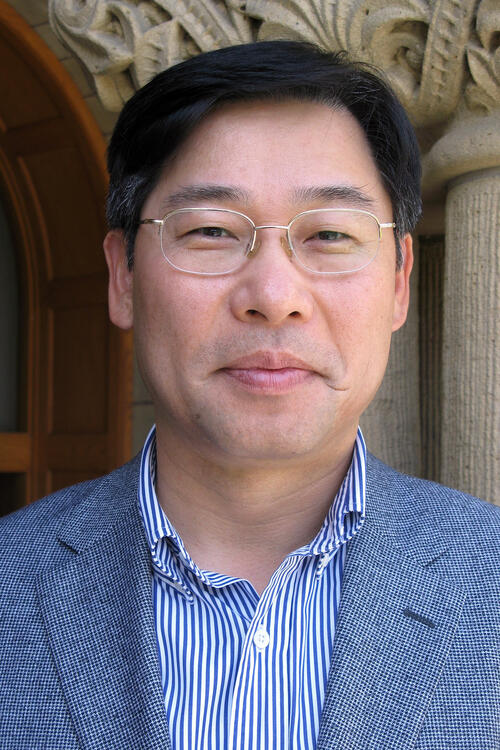
Joo is currently researching ways for Samsung to maintain its market lead. Even as the current leader, he said, market changes could affect the company's success. Joo is studying the case of Sony, a previous electronics market leader, and the factors that led to the loss of its position. His advisor for the project is Gi-Wook Shin, director of Shorenstein APARC and the Korean Studies Program.
In addition to his research project, Joo is taking advantage of his time at Stanford University to improve his English-language skills. He is proficient at reading English, and is using the opportunity to strengthen his speaking ability. He also hopes in the coming months to attend more events, especially in order to learn about the systems of other companies. Joo has already participated in site visits to Cisco, the Federal Reserve Bank of San Francisco, and Palo Alto Utilities.
Joo, who has previously not had the experience of living abroad and has had few opportunities to engage with people from other countries, says, "This is a very good time for me to widen my global perspective." He wants to interact as much as possible with the other fellows-who come from diverse work sectors and different countries in Asia-to exchange information, including best practices, based on each fellow's unique professional experience.
After he returns to Korea, Joo plans to take some of the information he has gained from his research and his exchange of knowledge with other fellows and share it with different development and marketing teams at Samsung, in addition to applying it in his own job. Samsung, Joo believes, is in need of creativity now and he is exploring ways it can develop this in its employees.
In between research and company visits, Joo has been able to spend valuable time with his family, which has traveled with him from Korea. They are planning to visit as many places as possible in the United States and have already visited Yellowstone National Park and are planning a trip to Alaska.
As the new academic year is about to get underway, the Corporate Affiliates Program of Shorenstein APARC welcomes its new class of fellows for the 2010-2011 academic year:
During their stay at Stanford University, the fellows will audit classes, study English, and conduct individual research projects, which they will then present about at the end of the year. They will have the opportunity to consult with Shorenstein APARC's scholars and attend events featuring visiting experts from around the world. The fellows will also participate in special events and site visits to gain a first-hand understanding of business, society, and culture in the United States.
The Corporate Affiliates website will feature interviews with of each of the 2010-2011 fellows throughout the coming year.
The Republic of the Philippines began on the path to universal coverage with the passage of the National Health Insurance Act of 1995 (Republic Act 7875) which established the Philippine Health Insurance Corporation (PhilHealth) . Building on the Philippine Medicare program which began in 1971, PhilHealth has expanded coverage to more than 80% of the population with basic benefits, but accounts for only 10% of total health financing—wide population coverage with thin public benefits. An extensive system of private insurance provides additional benefits for high-income Filipino households. While the Philippines is pursuing a public insurance approach with private add-ons, Hawaii has mandated private employment-based coverage through the Pre-paid Health Care Act of 1974 and operates under a Congressionally granted ERISA exemption as well as an exemption from the Affordable Care Act of 2010. Combining the employer mandate with generous Medicaid and SCHIP programs, Hawaii has achieved a coverage rate exceeding 90% of the resident population with extensive benefit packages. The presenter will provide an overview of the two systems and present original research on the labor market effects and public insurance effects of the Hawaii system.
Daniel and Nancy Okimoto Conference Room
How will population aging impact the economies and social protection systems of Japan, South Korea, China, and India? This colloquium showcases research addressing that question by contributors to a new Shorenstein APARC book, Aging Asia, co-edited by Karen Eggleston and Shripad Tuljapurkar. Dr. Bloom discusses how aging of the baby boom generation, declines in fertility rates, and an increase in life expectancy imply several changes for the economies of the region. Notwithstanding the potential challenges, Bloom argues that population aging may have less of a negative effect on economic growth than some have predicted. Bloom will also discuss the longitudinal aging study in India.
David Bloom is Clarence James Gamble Professor of Economics and Demography at Harvard University, Chair of the Department of Global Health and Population at the Harvard School of Public Health, and Director of Harvard University’s Program on the Global Demography of Aging (funded by the National Institute of Aging). He is Research Associate at the National Bureau of Economic Research, where he serves as a member of three research programs: Labor Studies, Aging, and Health Economics. He co-chairs the Public Policy Committee of the American Foundation for AIDS Research. Bloom received a B.S. in Industrial and Labor Relations from Cornell University in 1976, an M.A. in Economics from Princeton University in 1978, and a Ph.D. in Economics and Demography from Princeton University in 1981.
Philippines Conference Room
Michael Armacost recently gave a talk, examining the “rise” of China, at a gathering of international affairs experts. “How should we think of China,” asked Armacost, saying, “Some portray Beijing as a looming military threat; some regard it as our most promising global partner; some expect it to compete fiercely with us for global economic leadership.” Armacost looked at China’s military, trade, economics, and education in relation to the United States and shared thoughts for preparing the United States to become more competitive for the future.
Michael Armacost (April 15, 1937 – March 8, 2025) was a Shorenstein APARC Fellow at the Walter H. Shorenstein Asia-Pacific Research Center (Shorenstein APARC) from 2002 through 2021. In the interval between 1995 and 2002, Armacost served as president of Washington, D.C.'s Brookings Institution, the nation's oldest think tank and a leader in research on politics, government, international affairs, economics, and public policy. Previously, during his twenty-four-year government career, Armacost served, among other positions, as undersecretary of state for political affairs and as ambassador to Japan and the Philippines.
Armacost began his career in academia, as a professor of government at Pomona College. In 1969, he was awarded a White House Fellowship and was assigned to the Secretary and Deputy Secretary of State. Following a stint on the State Department's policy planning and coordination staff, he became a special assistant to the U.S. ambassador in Tokyo from 1972 to 74, his first foreign diplomatic post. Thereafter, he held senior Asian affairs and international security posts in the State Department, the Defense Department, and the National Security Council. From 1982 to 1984, he served as U.S. ambassador to the Philippines and was a key force in helping the country undergo a nonviolent transition to democracy. In 1989, President George Bush tapped him to become ambassador to Japan, considered one of the most important and sensitive U.S. diplomatic posts abroad.
Armacost authored four books, including, Friends or Rivals? The Insider's Account of U.S.–Japan Relations (1996), which draws on his tenure as ambassador, and Ballots, Bullets, and Bargains: American Foreign Policy and Presidential Elections (2015). He also co-edited, with Daniel Okimoto, the Future of America's Alliances in Northeast Asia, published in 2004 by Shorenstein APARC. Armacost served on numerous corporate and nonprofit boards, including TRW, AFLAC, Applied Materials, USEC, Inc., Cargill, Inc., and Carleton College, and he currently chairs the board of The Asia Foundation.
A native of Ohio, Armacost graduated from Carleton College and earned his master's and doctorate degrees in public law and government from Columbia University. He received the President's Distinguished Service Award, the Defense Department's Distinguished Civilian Service Award, the Secretary of State's Distinguished Services Award, and the Japanese government’s Grand Cordon of the Order of the Rising Sun.
The fourth Korea-U.S. West Coast Strategic Forum was held on June 18th at Stanford to discuss current developments in North Korea and North Korea policy, the future of the U.S.-South Korean alliance, and a strategic vision for Northeast Asia. Former senior government officials and other leading experts from the United States and South Korea participated. The forum agenda and the executive summary available.
Participants from the United States included: