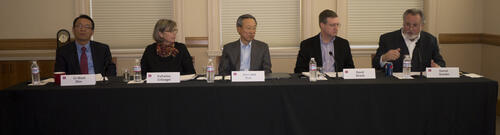
-

Energy geopolitics in East Asia have reflected strong competition among major energy consuming countries (China, Japan and Korea) despite the alleged necessity of energy cooperation to cope with uncertainties in the global energy market and to prevent potential conflicts regarding energy supply. Lacking abundant energy resources, South Korea has to face the tough challenges of energy supply and climate change as well as the North Korean energy and nuclear crisis. In recent years, South Korea has actively pursued overseas energy development to guarantee the stable procurement of hydrocarbon energy resources and introduced a Green Growth policy to deal with the challenges of climate change and clean energy. The Green Growth policy symbolizes a paradigm shift to cope with climate change, fossil fuel depletion, and global economic recession by creating new engines of economic growth through green technology and clean energy. Based on strong political support and policy measures, it has showed noticeable progress in a short period of time, but the transition from a hydrocarbon-based to a renewable-based economy faces enormous uncertainties and challenges. South Korea has also been active in participating East Asian energy cooperation, which is also important in dealing with the serious North Korean energy crisis.

Jae-Seung Lee is a visiting scholar with the Korean Studies Program (KSP) for the 2011–12 academic year, and he is also currently a professor of international studies at Korea University. Before joining the faculty of Korea University, he had served as a professor at the Institute of Foreign Affairs and National Security (IFANS) of Ministry of Foreign Affairs and Trade.  His current research includes energy security and energy diplomacy of Korea.

Jae-Seung Lee has authored a series of books and articles on East Asian energy security. He is a Managing Director of the Center for Energy and Environment at the Institute of Sustainable Development (ISD) at Korea University and has organized the Korea Energy Forum (KEF) since 2005. Professor Lee is editor-in-chief of Korea Review of International Studies and serves as a Member of the Policy Advisory Board of the Presidential Secretariat (Foreign and Security Affairs) and Vice Director of Ilmin International Relations Institute (IIRI). Professor Lee holds a BA in political science from Seoul National University and an MA and a PhD in political science from Yale University. He has taught at Yale University, Seoul National University, and Korea University. 

This event is made possible by the generous support from the Koret Foundation.

Philippines Conference Room

Shorenstein APARC
Encina Hall, Room E301
Stanford University
Stanford, CA 94305-6055

(650) 724-6710
0
2011-2012 Visiting Scholar
Jae-SeungLee_WEB.jpg

Jae-Seung Lee is a visiting scholar with the Korean Studies Program (KSP) for the 2011–12 academic year, and he is also currently a professor of international studies at Korea University. Before joining the faculty of Korea University, he served as a professor at the Institute of Foreign Affairs and National Security (IFANS) and at the Ministry of Foreign Affairs and Trade.

As a scholar in international political economy, Lee has authored a number of books and articles on Korea, East Asia, and Europe. His current research also includes the energy security and energy diplomacy of Korea, among others. During his time with KSP, he will conduct a research project on the geopolitics of East Asian energy relations.

Lee is currently an editor-in-chief of the Korea Review of International Studies and he also serves as a member of the Policy Advisory Board of the Presidential Secretariat (Foreign and Security Affairs) and as vice director of Ilmin International Relations Institute (IIRI). He was selected as an Asia Society Young Leader in 2006 and as a Young Leader by the InterAction Council, a group of former heads-of-state, in 2008. He has contributed op-ed articles to major Korean newspapers and has commented on international affairs for BBC, CNN, and Korean broadcast stations.

Lee holds a BA in political science from Seoul National University (1991), and an MA (1993) and PhD (1998) in political science from Yale University. He also earned a certificate from the Institut D’Etudes Politiques de Paris (1995). He has taught at Yale University and Seoul National University.


* His on-line expert interview with World Politics Review on South Korea's energy diplomay is available here.

* His on-line interview with BBC World on the Korean DMZ is available here.

Jae-Seung Lee 2011-2012 Visiting Scholar, Shorenstein APARC; Professor, Division of International Studies, Korea University Speaker
Seminars
News Type
News
Date
Paragraphs

Asia’s demographic landscape is changing in a big way. Japan’s population is shrinking, as people are living longer, marrying later, and choosing to have fewer or no children. Korea is moving in the same direction, while China and the countries of South and Southeast Asia face similar issues in the coming decades. As this takes place, more people are moving to, from, and across Asia for job, education, and marriage opportunities.

These demographic changes present policymakers with new challenges and questions, including: What are the interrelationships between population aging and key macroeconomic variables such as economic growth? How will it impact security? What are the effects on employment policy and other national institutions? How have patterns of migration affected society and culture? What lessons can Asia, the United States, and Europe learn from one another to improve the policy response to population aging?

The Walter H. Shorenstein Asia-Pacific Research Center (Shorenstein APARC) focused its third annual Stanford Kyoto Trans-Asian Dialogue on addressing the possible economic, social, and security implications of Asia’s unprecedented demographic transition. Thirty scholars, government figures, journalists, and other opinion leaders from Stanford, the United States, and countries across the Asia-Pacific region gathered September 8–9, 2011, in Kyoto, Japan, to discuss key issues related to the question of demographic change.

Comparative Demographics and Policy Responses

Japan’s shrinking workforce calls for labor policy changes, stressed presenters during the opening Dialogue session. Stanford Center for Population Research director Shripad Tuljapurkar stated that Japan’s population could decrease by as much as 25 percent and that its government has a window of approximately 40 years in which to act. In describing Japan’s demographic shift, Ogawa Naohiro, director of the Nihon University Population Research Institute, also emphasized the importance of good financial education for individuals as life expectancy increases.

Macroeconomic Implications

Economists Masahiko Aoki and Cai Fang addressed changes to East Asia’s economic landscape. Aoki, an FSI senior fellow, spoke of the transition from agriculture to industry that has occurred at different stages in Japan, Korea, and China and of the increasing cost of human capital that has followed. Cai, a Chinese Academy of Social Sciences labor and population expert, stated that after several decades of industrial growth China is now at a turning point in terms of its global competitiveness.

Labor and Migration

Scott Rozelle, codirector of Stanford’s Rural Education Action Program (REAP), opened the next day with a discussion of China’s rural human capital investment. Offering Mexico’s situation after the mid-1990s peso crisis as a comparison, he emphasized the immediate need for allocating more health and education resources to China’s rural areas. Ton-Nu-Thi Ninh, president of Tri Viet University, discussed the socioeconomic and cultural aspects of labor migration—a growing trend in Asia—and advocated that governments factor it more into their foreign policy development.

Security

The security impact of Asia’s demographic transition will take several decades to understand, but it will eventually lead to the need for significant policy re-strategization, stated Yu Myung Hwan, Korea’s former minister of foreign affairs and trade, during the closing Dialogue session. He suggested focusing on impacts that could result from the major changes taking place in fertility, urbanization, and migration. Concurring with many of Yu’s views, Stanford’s Shorenstein Distinguished Fellow Michael H. Armacost also noted the current lack of literature on the link between security and demography. In addition, he emphasized the need for the United States to continue pursuing good relations with China and Russia during this time of transition.

“Low fertility rates are not because women are all out there working. In fact, a number of countries have lots of females in the labor force and have achieved a resurgence of fertility. Achieving work-life balance is important, not just for women, but for men as well, and might play a role in lessening the gap in life expectancy between men and women.”

-Karen Eggleston, Director, Asia Health Policy Program

Throughout the event, Dialogue participants unanimously acknowledged the serious challenges facing policymakers as they look for ways to meet the evolving needs of individuals, families, and organizations. The demographic outlook is not entirely gloomy, however. Numerous participants also pointed to the potential for exciting advances and innovations in technology and international cooperation.

As in previous years, the event concluded with a lively public symposium and reception attended by students from Stanford and local universities, Shorenstein APARC guests and affiliates, and members of the general public. Speaking during the reception, Kadokawa Daisaku, mayor of Kyoto, and Kim Hyong-O, member and former speaker of the Korean National Assembly, acknowledged the significance of the Stanford Kyoto Trans-Asian Dialogue as a forum for addressing issues of mutual importance to the United States and Asia.

The Dialogue is made possible through the generosity of the City of Kyoto, FSI, and Yumi and Yasunori Kaneko. To read the final report from this and previous Dialogues, visit the event series page below.

Hero Image
JakartaConstruction NEWSFEED
A worker stands on steel rods at a superblock construction site in Jakarta in February 2010. Increasing urbanization is one of many aspects of Asia's demographic change.
REUTERS/Beawiharta
All News button
1
-

KSP visiting scholar Hyun Jeoung Lee, a South Korean attorney and former public prosecutor, will analyze the problem of rebates by pharmaceutical companies. She will provide background on the Korean pharmaceutical industry and review the Korean government's efforts to combat the problem, including the latest legislation, regulation, and prosecution.

Hyun Jeoung Lee is an attorney at the leading Korean law firm of Kim & Chang, in the White Collar Criminal Defense Practice Group. Before joining the firm in 2007, she served as a public prosecutor for 10 years, developing expertise in a wide range of criminal law matters and was awarded honors by the Korean government, including the titles of Public Prosecutor General (2003) and Cabinet Minister of the Ministry of Justice (2006).

Lee completed her master's work in competition and antitrust laws at the Graduate School of Legal Studies at Korea University in 2006. She has extensive experience in white collar criminal defense, primarily in the areas of securities fraud, insider trading, and other corporate crimes, including fair trade regulation.

Philippines Conference Room

Shorenstein APARC
Stanford University
Encina Hall, Room E301
Stanford, CA 94305-6055

(650) 725-2507 (650) 723-6530
0
Visiting Scholar
Hyun_J._Lee_2010-2011_Visiting_scholar.jpg

Hyun Jeoung Lee is currently a visiting scholar with the Korean Studies Program. She is an attorney at Kim & Chang, in the White Collar Criminal Defense Practice Group, in Seoul, Korea.

Before joining the firm in 2007, Lee served as a public prosecutor for 10 years. In that capacity, she developed expertise in a wide range of criminal law matters and was awarded honors by the Korean government, including the titles of Public Prosecutor General (2003) and Cabinet Minister of the Ministry of Justice (2006).

Lee completed her master's work in competition and antitrust laws at the Graduate School of Legal Studies at Korea University in 2006. She has extensive experience in white collar criminal defense, primarily in the areas of securities fraud, insider trading, and other corporate crimes, including fair trade regulation.

CV
Hyun Jeoung Lee 2011 Visiting Scholar, Korean Studies Program, Shorenstein Asia-Pacific Research Center Speaker
Seminars
Paragraphs

Japan leads, chased closely by South Korea, with China, on a vastly larger scale, not far behind. Not as mercantilist development states nor as threats to America’s high-tech industry, but rather as the world’s most rapidly aging societies.

A wave of unprecedented demographic change is sweeping across East Asia. The region is at the forefront of a trend towards longer life expectancy and declining birthrates, which, combined, yield a striking rate of aging. Japan already confronts a shrinking population. Korea is graying even more quickly. And although China is projected to grow for another few decades, demographic change races against economic development. Could China become the first country to grow old before growing rich? In Southeast Asia, Singapore also confronts a declining birthrate and an aging society. Increasingly, Asia’s aging countries look to its younger societies, such as Vietnam, Indonesia, and India, as sources of migrant labor and even wives. Those countries in turn face their own demographic challenges, such as how to educate their youth for a globally competitive
economy.

Held September 8–9, 2011 in Kyoto, Japan, the third Stanford Kyoto Trans-Asian Dialogue focused on demographic change in the region and its implications across a wide range of areas, including economies, societies, and security. Asia’s experience offers both lessons and warnings for North America and Europe, which face similar problems. Questions addressed included:
 

  • What are the interrelationships between population aging and key macroeconomic variables such as economic growth, savings rates, and public and private intergenerational transfers?
     
  • How and why do policy responses to population aging differ in Japan, South Korea, and across different regions of China?
     
  • What are the effects of demographic change on national institutions such as employment practices, pension and welfare systems, and financial systems?
     
  • What policies can or should be pursued to influence future outcomes?
     
  • How will demographic change affect security in the Asia-Pacific region?
     
  • How have patterns of migration impacted society and culture in East Asia, in comparative perspective?
     
  • How will demographic change influence the movement of people across the region and the prevalence of multicultural families?
     
  • What lessons can Asia, the United States, and Europe learn from each other to improve the policy response to population aging?
All Publications button
1
Publication Type
Policy Briefs
Publication Date
Journal Publisher
Shorenstein APARC
Paragraphs

Health systems provide a rich field for testing hypotheses of institutional economics. The incentive structure of current healthcare delivery systems have deep historical and cultural roots, yet must cope with rapid technological change as well as market and government failures. This paper applies the economic approach of comparative and historical institutional analysis (Aoki, 2001; Greif, 2006) to health care systems by conceptualizing physician control over dispensing revenues as a social institution. The theory developed—emphasizing the interplay between cultural beliefs, interest groups, technological change, insurance expansion and government financing—offers a plausible explanation of reforms since the 1960s separating prescribing from dispensing in societies such as Japan, South Korea, Taiwan and China. Technological change and adoption of universal coverage trigger reforms by greatly increasing the social opportunity costs of physician over-prescribing and reshaping the political economy of forces impinging on the doctor–patient relationship.

All Publications button
1
Publication Type
Journal Articles
Publication Date
Journal Publisher
Journal of Institutional Economics, FirstView Article
Authors
Karen Eggleston
-

In the five decades since the end of the Korean War, Korea has developed from an impoverished, agrarian nation with a per capital GDP of less than $50 to the twelfth largest economy in the world and one of the leading global trading nations with an estimated per capita GDP of U.S. $20,165 in 2010. Despite this phenomenal economic achievement, Korea’s financial system lags behind its economic and trading status. According to the World Bank Survey, its  financial system is ranked twenty-sixth in the world. In order for Korea to continue its economic growth and become a global financial center, its financial system needs to be modernized.

This workshop has been organized to bring senior officials from industry, academic institutes, regulatory bodies, and government together to identify and address some of the issues facing Korea’s capital markets. The workshop’s objective is to conclude with a list of specific action items that can be recommended for implementation in order to address the issues that have been identified.


This workshop is made possible by the generous support from the Koret Foundation.

Bechtel Conference Center

Workshops
-

-----------------------------------------------------------------------------------------------------------


The 4th annual Koret Conference will convene to explore the similarities and differences in the national experiences and national identities of two important middle powers on China's periphery, Korea and Vietnam, whose natures and journeys are seldom compared. Their current outlooks on regionalism and their relationships with China and the United States will be reviewed as well. The conference will also analyze the past and present impacts of their shared proximity to China on Korean and Vietnamese national identity and security.

This event is made possible by the generous support from the Koret Foundation.


**Please note: Seats are limited.

Bechtel Conference Center

Shorenstein APARC
Encina Hall E301
616 Jane Stanford Way
Stanford, CA 94305-6055
(650) 724-8480 (650) 723-6530
0
Senior Fellow at the Freeman Spogli Institute for International Studies
Professor of Sociology
William J. Perry Professor of Contemporary Korea
Professor, by Courtesy, of East Asian Languages & Cultures
Gi-Wook Shin_0.jpg PhD

Gi-Wook Shin is the William J. Perry Professor of Contemporary Korea in the Department of Sociology, senior fellow at the Freeman Spogli Institute for International Studies, and the founding director of the Korea Program at the Walter H. Shorenstein Asia-Pacific Research Center (APARC) since 2001, all at Stanford University. In May 2024, Shin also launched the Taiwan Program at APARC. He served as director of APARC for two decades (2005-2025). As a historical-comparative and political sociologist, his research has concentrated on social movements, nationalism, development, democracy, migration, and international relations.

In Summer 2023, Shin launched the Stanford Next Asia Policy Lab (SNAPL), which is a new research initiative committed to addressing emergent social, cultural, economic, and political challenges in Asia. Across four research themes– “Talent Flows and Development,” “Nationalism and Racism,” “U.S.-Asia Relations,” and “Democratic Crisis and Reform”–the lab brings scholars and students to produce interdisciplinary, problem-oriented, policy-relevant, and comparative studies and publications. Shin’s latest book, The Four Talent Giants, a comparative study of talent strategies of Japan, Australia, China, and India to be published by Stanford University Press in the summer of 2025, is an outcome of SNAPL.

Shin is also the author/editor of twenty-six books and numerous articles. His books include Korean Democracy in Crisis: The Threat of Illiberalism, Populism, and Polarization (2022); The North Korean Conundrum: Balancing Human Rights and Nuclear Security (2021); Superficial Korea (2017); Divergent Memories: Opinion Leaders and the Asia-Pacific War (2016); Global Talent: Skilled Labor as Social Capital in Korea (2015); Criminality, Collaboration, and Reconciliation: Europe and Asia Confronts the Memory of World War II (2014); New Challenges for Maturing Democracies in Korea and Taiwan (2014); History Textbooks and the Wars in Asia: Divided Memories (2011); South Korean Social Movements: From Democracy to Civil Society (2011); One Alliance, Two Lenses: U.S.-Korea Relations in a New Era (2010); Cross Currents: Regionalism and Nationalism in Northeast Asia (2007);  and Ethnic Nationalism in Korea: Genealogy, Politics, and Legacy (2006). Due to the wide popularity of his publications, many have been translated and distributed to Korean audiences. His articles have appeared in academic and policy journals, including American Journal of SociologyWorld DevelopmentComparative Studies in Society and HistoryPolitical Science QuarterlyJournal of Asian StudiesComparative EducationInternational SociologyNations and NationalismPacific AffairsAsian SurveyJournal of Democracy, and Foreign Affairs.

Shin is not only the recipient of numerous grants and fellowships, but also continues to actively raise funds for Korean/Asian studies at Stanford. He gives frequent lectures and seminars on topics ranging from Korean nationalism and politics to Korea's foreign relations, historical reconciliation in Northeast Asia, and talent strategies. He serves on councils and advisory boards in the United States and South Korea and promotes policy dialogue between the two allies. He regularly writes op-eds and gives interviews to the media in both Korean and English.

Before joining Stanford in 2001, Shin taught at the University of Iowa (1991-94) and the University of California, Los Angeles (1994-2001). After receiving his BA from Yonsei University in Korea, he was awarded his MA and PhD from the University of Washington in 1991.

Selected Multimedia

Director of the Korea Program and the Taiwan Program, Shorenstein Asia-Pacific Research Center
Date Label
Gi-Wook Shin Speaker
Daniel C. Sneider Speaker
Tuong Vu Associate Professor, Political Science Speaker University of Oregon
Leif-Eric Easley Assitant Professor, International Security and Political Economics Speaker Ewha University in Korea
Brantly Womack Professor of Foreign Affairs, Woodrow Willson Department of Politcs Speaker University of Virginia

Walter H. Shorenstein
Asia-Pacific Research Center
616 Serra St., Encina Hall E310
Stanford University
Stanford, CA 94305-6055

(650) 725-9623 (650) 723-6530
0
Lee Kong Chian NUS-Stanford Distinguished Fellow on Southeast Asia
JamesOkey_WEBSITE.jpg MA, PhD

James Ockey is the Lee Kong Chian NUS-Stanford Distinguished Fellow on Contemporary Southeast Asia, and will be at the Walter H. Shorenstein Asia-Pacific Research Center (Shorenstein APARC) from January through March in 2012. 

He is currently the coordinator of political science at the University of Canterbury in Christchurch, New Zealand, where he is an associate professor (reader). 

Ockey’s research interests cover many aspects of Thai politics, including democratization, civil-military relations, electoral politics, and political conflict. While at Shorenstein APARC he will be working on the manuscript for a book project, tentatively titled Trakun Kanmuang: Family Politics in Thailand. The book will analyze patterns of family relationships in the Thai parliament, outline the role of provincial political families in promoting or inhibiting the democratization process at local and national levels, and explore the place of political families in the social structures of provincial Thailand. 

Ockey earned an MA and PhD in government at Cornell University, and a BA in political science from Brigham Young University.

James Ockey Speaker
T.J. Pempel Professor, Political Science, University of California at Berkeley Speaker

Shorenstein APARC
Encina Hall C324
616 Serra Street
Stanford University
Stanford, CA 94305-6055

(650) 724-6404 (650) 723-6530
0
2011-2012 Koret Fellow
ParkJoonWoo_Web.jpg

Joon-woo Park, a former senior diplomat from Korea, is the 2011–12 Koret Fellow with the Korean Studies Program (KSP).

Park brings over 30 years of foreign policy experience to Stanford, including a deep understanding of the U.S.-Korea relationship, bilateral relations, and major Northeast Asian regional issues. In view of Korea’s increasingly important presence as a global economic and political leader, Park will explore foreign policy strategies for furthering this presence. In addition, he will consider possibilities for increased U.S.-Korea collaboration in their relations with China, as well as prospects for East Asian regional integration based on the European Union (EU) model. He will also teach a course during the winter quarter, entitled Korea's Foreign Policy in Transition.

In 2010, while serving as ambassador to the EU, Park signed the EU-South Korea Free Trade Agreement (FTA) in Brussels. That same year he also completed the Framework Agreement, strengthening EU-South Korea collaboration on significant global issues, such as human rights, the non-proliferation of nuclear weapons, and climate change. Park’s experience with such major bilateral agreements comes as the proposed Korea-U.S. FTA is nearing ratification.

Park holds a BA and an MA in law from Seoul National University.

The Koret Fellowship was established in 2008 through the generosity of the Koret Foundation to promote intellectual diversity and breadth in KSP, bringing leading professionals in Asia and the United States to Stanford to study U.S.-Korea relations. The fellows conduct their own research on the bilateral relationship, with an emphasis on contemporary relations, with the broad aim of fostering greater understanding and closer ties between the two countries.

Joon-woo Park 2011-2012 Koret Fellow Keynote Speaker Stanford University

No longer in residence.

0
Associate Director of the Korea Program
david_straub_cropped.jpg

David Straub was named associate director of the Korea Program at the Walter H. Shorenstein Asia-Pacific Research Center (Shorenstein APARC) on July 1, 2008. Prior to that he was a 2007–08 Pantech Fellow at the Center. Straub is the author of the book, Anti-Americanism in Democratizing South Korea, published in 2015.

An educator and commentator on current Northeast Asian affairs, Straub retired in 2006 from his role as a U.S. Department of State senior foreign service officer after a 30-year career focused on Northeast Asian affairs. He worked over 12 years on Korean affairs, first arriving in Seoul in 1979.

Straub served as head of the political section at the U.S. embassy in Seoul from 1999 to 2002 during popular protests against the United States, and he played a key working-level role in the Six-Party Talks on North Korea's nuclear program as the State Department's Korea country desk director from 2002 to 2004. He also served eight years at the U.S. embassy in Japan. His final assignment was as the State Department's Japan country desk director from 2004 to 2006, when he was co-leader of the U.S. delegation to talks with Japan on the realignment of the U.S.-Japan alliance and of U.S. military bases in Japan.

After leaving the Department of State, Straub taught U.S.-Korean relations at the Johns Hopkins University's School of Advanced International Studies in the fall of 2006 and at the Graduate School of International Studies of Seoul National University in spring 2007. He has published a number of papers on U.S.-Korean relations. His foreign languages are Korean, Japanese, and German.

David Straub Speaker
Pham Quang Minh Dean and Associate Professor, College of Social Science and Humanities Speaker Vietnam National University-Hanoi
Lee Su-hoon Director and Professor, The Institute for Far Eastern Studies Speaker Kyungnam University, Korea
Scott Snyder Senior Fellow for Korea Studies and Director of the Program on U.S.-Korea Policy Speaker Council on Foreign Relations
Alexander Vuving Associate Professor, Asia-Pacific Center for Security Studies, Honolulu, Hawaii Speaker
David Elliott Professor, International Relations; Professor of Politics Speaker Pomona College
Philip Yun Executive Director & COO Speaker Ploughshares Fund
0
Former Shorenstein APARC Fellow
Michael_Armacost.jpg PhD

Michael Armacost (April 15, 1937 – March 8, 2025) was a Shorenstein APARC Fellow at the Walter H. Shorenstein Asia-Pacific Research Center (Shorenstein APARC) from 2002 through 2021. In the interval between 1995 and 2002, Armacost served as president of Washington, D.C.'s Brookings Institution, the nation's oldest think tank and a leader in research on politics, government, international affairs, economics, and public policy. Previously, during his twenty-four-year government career, Armacost served, among other positions, as undersecretary of state for political affairs and as ambassador to Japan and the Philippines.

Armacost began his career in academia, as a professor of government at Pomona College. In 1969, he was awarded a White House Fellowship and was assigned to the Secretary and Deputy Secretary of State. Following a stint on the State Department's policy planning and coordination staff, he became a special assistant to the U.S. ambassador in Tokyo from 1972 to 74, his first foreign diplomatic post. Thereafter, he held senior Asian affairs and international security posts in the State Department, the Defense Department, and the National Security Council. From 1982 to 1984, he served as U.S. ambassador to the Philippines and was a key force in helping the country undergo a nonviolent transition to democracy. In 1989, President George Bush tapped him to become ambassador to Japan, considered one of the most important and sensitive U.S. diplomatic posts abroad.

Armacost authored four books, including, Friends or Rivals? The Insider's Account of U.S.–Japan Relations (1996), which draws on his tenure as ambassador, and Ballots, Bullets, and Bargains: American Foreign Policy and Presidential Elections (2015). He also co-edited, with Daniel Okimoto, the Future of America's Alliances in Northeast Asia, published in 2004 by Shorenstein APARC. Armacost served on numerous corporate and nonprofit boards, including TRW, AFLAC, Applied Materials, USEC, Inc., Cargill, Inc., and Carleton College, and he currently chairs the board of The Asia Foundation.  

A native of Ohio, Armacost graduated from Carleton College and earned his master's and doctorate degrees in public law and government from Columbia University. He received the President's Distinguished Service Award, the Defense Department's Distinguished Civilian Service Award, the Secretary of State's Distinguished Services Award, and the Japanese government’s Grand Cordon of the Order of the Rising Sun.

Date Label
Michael H. Armacost Speaker
0
Senior Fellow Emeritus at the Freeman Spogli Institute for International Studies
Affiliated Faculty, CDDRL
Affiliated Scholar, Abbasi Program in Islamic Studies
aparc_dke.jpg PhD

At Stanford, in addition to his work for the Southeast Asia Program and his affiliations with CDDRL and the Abbasi Program in Islamic Studies, Donald Emmerson has taught courses on Southeast Asia in East Asian Studies, International Policy Studies, and Political Science. He is active as an analyst of current policy issues involving Asia. In 2010 the National Bureau of Asian Research and the Woodrow Wilson International Center for Scholars awarded him a two-year Research Associateship given to “top scholars from across the United States” who “have successfully bridged the gap between the academy and policy.”

Emmerson’s research interests include Southeast Asia-China-US relations, the South China Sea, and the future of ASEAN. His publications, authored or edited, span more than a dozen books and monographs and some 200 articles, chapters, and shorter pieces.  Recent writings include The Deer and the Dragon: Southeast Asia and China in the 21st Century (ed., 2020); “‘No Sole Control’ in the South China Sea,” in Asia Policy  (2019); ASEAN @ 50, Southeast Asia @ Risk: What Should Be Done? (ed., 2018); “Singapore and Goliath?,” in Journal of Democracy (2018); “Mapping ASEAN’s Futures,” in Contemporary Southeast Asia (2017); and “ASEAN Between China and America: Is It Time to Try Horsing the Cow?,” in Trans-Regional and –National Studies of Southeast Asia (2017).

Earlier work includes “Sunnylands or Rancho Mirage? ASEAN and the South China Sea,” in YaleGlobal (2016); “The Spectrum of Comparisons: A Discussion,” in Pacific Affairs (2014); “Facts, Minds, and Formats: Scholarship and Political Change in Indonesia” in Indonesian Studies: The State of the Field (2013); “Is Indonesia Rising? It Depends” in Indonesia Rising (2012); “Southeast Asia: Minding the Gap between Democracy and Governance,” in Journal of Democracy (April 2012); “The Problem and Promise of Focality in World Affairs,” in Strategic Review (August 2011); An American Place at an Asian Table? Regionalism and Its Reasons (2011); Asian Regionalism and US Policy: The Case for Creative Adaptation (2010); “The Useful Diversity of ‘Islamism’” and “Islamism: Pros, Cons, and Contexts” in Islamism: Conflicting Perspectives on Political Islam (2009); “Crisis and Consensus: America and ASEAN in a New Global Context” in Refreshing U.S.-Thai Relations (2009); and Hard Choices: Security, Democracy, and Regionalism in Southeast Asia (edited, 2008).

Prior to moving to Stanford in 1999, Emmerson was a professor of political science at the University of Wisconsin-Madison, where he won a campus-wide teaching award. That same year he helped monitor voting in Indonesia and East Timor for the National Democratic Institute and the Carter Center. In the course of his career, he has taken part in numerous policy-related working groups focused on topics related to Southeast Asia; has testified before House and Senate committees on Asian affairs; and been a regular at gatherings such as the Asia Pacific Roundtable (Kuala Lumpur), the Bali Democracy Forum (Nusa Dua), and the Shangri-La Dialogue (Singapore). Places where he has held various visiting fellowships, including the Institute for Advanced Study and the Woodrow Wilson International Center for Scholars. 


Emmerson has a Ph.D. in political science from Yale and a BA in international affairs from Princeton. He is fluent in Indonesian, was fluent in French, and has lectured and written in both languages. He has lesser competence in Dutch, Javanese, and Russian. A former slam poet in English, he enjoys the spoken word and reads occasionally under a nom de plume with the Not Yet Dead Poets Society in Redwood City, CA. He and his wife Carolyn met in high school in Lebanon. They have two children. He was born in Tokyo, the son of U.S. Foreign Service Officer John K. Emmerson, who wrote the Japanese Thread among other books.

Selected Multimedia

Date Label
Donald K. Emmerson Speaker
Conferences
News Type
News
Date
Paragraphs

During the recent North American Chasedae Forum, 2011 Koret Fellow Joon-woo Park stated: "[...As the United States and Korea] grow closer together, the role of the Korean-American community becomes crucial for the future of U.S.-ROK relations." The forum, held November 4–6, was organized by the San Francisco Chapter of the National Unification Advisory Council.

Hero Image
Unification talk agenda coverCrop1 The National Unification Advisory Council
All News button
1
Subscribe to South Korea