-

RSVP Now

2019 Shorenstein Journalism Award Recipient Maria Ressa to Headline Award Panel Discussion

Maria Ressa, winner of the 2019 Shorenstein Award, is an internationally-esteemed journalist and CEO and executive editor of Rappler, a Philippine independent news platform known for its critical investigative reporting on the Duterte administration’s policies and actions. President Duterte has made no secret of his dislike for Rappler, publicly accusing the platform for carrying “fake news.” Ressa has been arrested twice this year, accused of corporate tax evasion and of violating security laws, and slapped with charges of cyber libel for a report that was published before the libel law came into effect. The international community sees the allegations as politically motivated attempts by the government to silence Ressa and Rappler.

In her keynote address at this 2019 Shorenstein Journalism Award panel discussion, Ressa will talk about her crusade to combat fake news, the devastating effect disinformation has had on democracy and societal cohesion in the Philippines, and the battle for truth in the digital age.

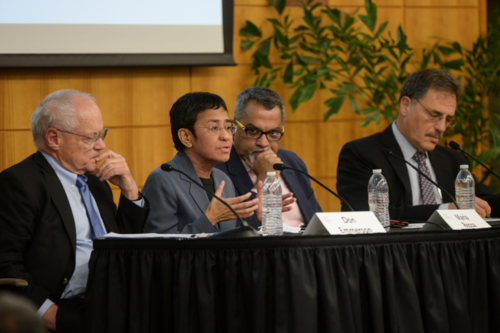
Chaired by Shorenstein APARC Southeast Asia Program Director Donald K. Emmerson, the discussion will include remarks by Larry Diamond, senior fellow at the Hoover Institution and at the Freeman Spogli Institute for International Studies at Stanford University, and Raju Narisetti, Director, Knight-Bagehot Fellowship in Economics and Business Journalism, Professor of Professional Practice, Columbia Journalism School.

The event will conclude with a short Q&A session. Follow us on Twitter and use the hashtag #SJA19 to join the conversation.

Panelists:

Image
Maria Ressa

Maria Ressa is the CEO and executive editor of Rappler, one of the leading online news organizations in the Philippines. Ressa has been a journalist in Asia for more than 30 years and has been honored around the world for her courageous and bold work in fighting disinformation, “fake news” and attempts to silence the free press. In 2018, she was named Time magazine's "Person of the Year" and won the prestigious Golden Pen of Freedom Award from the World Association of Newspapers and News Publishers, the Knight International Journalism Award of the International Center for Journalists, the Gwen Ifill Press Freedom Award of the Committee to Protect Journalists, the Journalist of Courage and Impact Award of East-West Center, and the IX International Press Freedom Award of University of Málaga and UNESCO, among others.
 

She was CNN’s bureau chief in Manila then Jakarta, and became CNN’s lead investigative reporter focusing on terrorism in Southeast Asia. In 2005, she managed ABS-CBN News and Current affairs, the largest multi-platform news operation in the Philippines. Her work aimed to redefine journalism by combining traditional broadcast, new media and mobile phone technology for social change.

Ressa is the author of two books — From Bin Laden to Facebook (2012), which traces the spread of terrorism from the training camps of Afghanistan to Southeast Asia and the Philippines, and Seeds of Terror: An Eyewitness Account of Al-Qaeda’s Newest Center of Operations in Southeast Asia (2003).

Larry Diamond is a senior fellow at the Hoover Institution and at the Freeman Spogli Institute for International Studies (FSI) at Stanford University, professor, by courtesy, of political science and sociology, and principal investigator at the Global Digital Policy Incubator within FSI’s Cyber Policy Center. He also codirects the Program on Arab Reform and Democracy at FSI’s Center on Democracy, Development and the Rule of Law.

Diamond is the founding coeditor of the Journal of Democracy and serves as senior consultant at the International Forum for Democratic Studies of the National Endowment for Democracy. His research focuses on democratic trends and conditions around the world and on policies and reforms to defend and advance democracy. His most recent book, Ill Winds: Saving Democracy from Russian Rage, Chinese Ambition, and American Complacency, analyzes the challenges confronting liberal democracy in the US and around the world at this potential “hinge in history,” and offers an agenda for strengthening and defending democracy at home and abroad. His other books include In Search of Democracy (2016), The Spirit of Democracy (2008), and Developing Democracy: Toward Consolidation (1999). He has also edited or coedited more than forty books on democratic development around the world.

Raju Narisetti is Director of the Knight-Bagehot Fellowship in Economics and Business Journalism and Professor of Professional Practice at Columbia Journalism School.

Raju Narisetti most recently served as chief executive of Gizmodo Media Group, which publishes well-known digital journalism sites such as Gizmodo, Jezebel, Deadspin, Lifehacker and The Root. As the chief executive, he oversaw a significant expansion in the audience and journalistic ambitions of the group, to a monthly readership of about 116 million.
 
Prior to Gizmodo, Narisetti was News Corp.’s senior vice president of strategy, helping the media giant diversify and establish itself as the world’s largest digital real-estate listings company, in addition to its news and information portfolio that includes The Wall Street Journal, The Times of London and Harper-Collins. He was actively involved in the company’s mergers and acquisition strategy, spearheading new revenue opportunities, particularly in Asia.
 
As a business journalist and editor, Narisetti spent 14 years at The Wall Street Journal, after first starting as a summer intern there in 1991. Among the roles he held at WSJ were Editor, The Wall Street Journal Europe; Deputy Managing Editor in charge of Europe, Middle East and Africa for the global WSJ; and Managing Editor, Digital.
 
Narisetti also served as the managing editor for digital and new products at The Washington Post, and was primarily responsible for integrating the Post’s then separate print and online newsroom and businesses.  His responsibilities at The Post also included managing web, mobile, engagement, social media, interactive, design, editing desk, video and photojournalists teams.
 
He is also the Founder, in 2007, of Mint, now India’s second-largest business newspaper and website, which is today known for its pioneering journalistic code of conduct and ethics in India. Narisetti began his business journalism career at The Economic Times in New Delhi, and his U.S. journalism career at The Dayton Daily News.
 
Narisetti is a Board Trustee of the Wikimedia Foundation, which operates Wikipedia, one of the Top 10 websites in the world, and is on the National Advisory Council of the Democracy Fund, a bipartisan foundation resource to strengthen the democratic process in the United States. He holds an M.A. from Indiana University and a B.A. (Economics) from Osmania University and an MBA from IRMA in India.
 
Panel Chair:
 

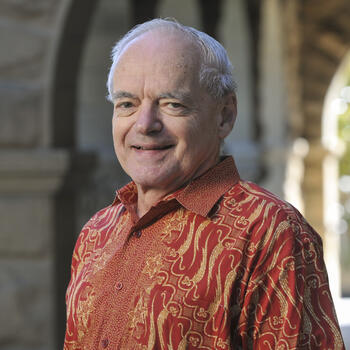
Donald K. Emmerson is senior fellow emeritus at Stanford University’s Freeman Spogli Institute for International Studies and director of the Southeast Asia Program at the Walter H. Shorenstein Asia-Pacific Research Center. An expert on Southeast Asian affairs, his research interests include issues such as sovereignty disputes in the South China Sea, China-Southeast Asia relations, U.S. Asia policy, and the future of the Association of Southeast Asian Nations (ASEAN). At Stanford, Emmerson is also affiliated with the Center for Democracy, Development and the Rule of Law and with Abbasi Program in Islamic Studies. He has taught courses on Southeast Asia in the International Relations and International Policy Studies Programs, in the Department of Political Science, and for the Bing Overseas Studies Program.
 

He has authored and edited numerous articles and books, and is also active as an analyst of current policy issues involving Southeast Asia. In his forthcoming edited volume, The Deer and the Dragon, leading experts explore key issues and aspects of Southeast Asia’s interactions with China, including regional security, maritime expansion, trade dependence, infrastructure diplomacy, and related foreign-policy options and actions. Emmerson has participated in many policy-related working groups focused on topics such as U.S. policy toward Southeast Asia, regionalism in East Asia, democratization in Asia, Indonesian political economy, and the future of Myanmar. In 2010 the National Bureau of Asian Research and the Woodrow Wilson International Center for Scholars awarded him a two-year research associateship given to “top scholars from across the United States” who “have successfully bridged the gap between the academy and policy.” He holds a PhD in political science from Yale and a BA in international affairs from Princeton.

About the Shorenstein Journalism Award:
The Shorenstein Journalism Award, which carries a cash prize of US $10,000, recognizes outstanding journalists who have spent their careers helping audiences around the world understand the complexities of the Asia-Pacific region, defined broadly to include Northeast, Southeast, South, and Central Asia and Australasia. Award recipients are veteran journalists with a distinguished body of work. News organizations are also eligible for the award.
 
The award is sponsored and presented by the Walter H. Shorenstein Asia-Pacific Research Center (Shorenstein APARC) at Stanford University. It honors the legacy of the Center’s benefactor, Mr. Walter H. Shorenstein, and his twin passions for promoting excellence in journalism and understanding of Asia. It also symbolizes the Center’s commitment to journalism that persistently and courageously seeks accuracy, deep reporting, and nuanced coverage in an age when attacks are regularly launched on the independent news media, on fact-based truth, and on those who tell it.
 
An annual tradition, the Shorenstein Journalism Award alternates between recipients whose work has mostly been conveyed through American news media and recipients whose work has mostly been conveyed through news media in one or more parts of the Asia-Pacific region. Included among the latter candidates are journalists who are from the region and work there, and who, in addition to their recognized excellence, may have helped defend and encourage free media in one or more countries in the region.
 
The award day is held at Stanford in the fall quarter. In addition to an acceptance speech at the award ceremony, the winner is expected to deliver a keynote address featured as part of a Shorenstein APARC-hosted public panel discussion on a topic relevant to his/her work. Learn more at https://aparc.fsi.stanford.edu/events/shorenstein-journalism-award.
 
Open to the public

Koret-Taube Conference Center
at the John A. and Cynthia Fry Gunn SIEPR Building
366 Galvez St.
Stanford, CA 94305

Maria Ressa <br>CEO and Executive Editor, <i>Rappler</i><br><br>
Larry Diamond <br>Senior Fellow, Hoover Institution and Freeman Spogli Institute for International Studies, Stanford<br><br>
Raju Narisetti <br>Director, Knight-Bagehot Fellowship in Economics and Business Journalism, Professor of Professional Practice, Columbia Journalism School<br><br>
Donald K. Emmerson (Panel Chair) <br>Shorenstein APARC Southeast Asia Program Director, Stanford<br><br>
Authors
Noa Ronkin
News Type
News
Date
Paragraphs

STANFORD, CA, May 21, 2019 — Stanford University’s Walter H. Shorenstein Asia-Pacific Research Center (APARC) announced today that the esteemed journalist Maria Ressa is the recipient of the 2019 Shorenstein Journalism Award. Ressa, the cofounder, CEO, and executive editor of the Philippine news platform Rappler, has been a highly-regarded journalist in Asia for more than thirty years and commended worldwide for her courageous work in fighting disinformation and attempts to silence the free press. Presented annually by APARC, the Shorenstein award is conferred upon a journalist who has contributed significantly to greater understanding of Asia through outstanding reporting on critical issues affecting the region. Ressa will receive the award at a ceremony at Stanford in fall quarter 2019.

Ressa spent nearly two decades at CNN, where she was lead investigative reporter focusing on terrorism in Southeast Asia and served as the network’s bureau chief in Manila, then Jakarta. She then became head of news and current affairs at ABS-CBN, the largest media network in the Philippines. Her work aimed to redefine journalism by combining traditional broadcast and new media for social change. In 2012, Ressa launched Rappler, turning it into one of the Philippines’ most influential news organizations and integrating data, content, and new technologies to promote public service journalism and civic engagement. With a commitment to editorial independence, Rappler has often produced critical coverage of Philippines President Rodrigo Duterte’s controversial policies and actions. In response to these reports, Duterte and his government have repeatedly targeted Rappler and Ressa with threats and lawsuits. Ressa has been arrested twice in recent months.

“Maria Ressa is a champion of digital journalism innovation, and a paragon of protecting democracy and speaking truth to power,” said Gi-Wook Shin, Shorenstein APARC director. “For decades, before she became internationally acclaimed for her brave fight to ‘hold the line,’ Maria’s work had provided deep insights into the complexities of Southeast Asia based on her nuanced knowledge, investigative skills, and the ability to draw upon them to connect with audiences around the world. We are honored to recognize her with the Shorenstein Journalism Award.”

Ressa has taught courses in politics and the press in Southeast Asia for her alma mater, Princeton University, and in broadcast journalism for the University of the Philippines. She is the author of two books: From Bin Laden to Facebook (2012), which traces the spread of terrorism from the training camps of Afghanistan to Southeast Asia and the Philippines, and Seeds of Terror: An Eyewitness Account of Al-Qaeda’s Newest Center of Operations in Southeast Asia (2003), which documented the changing tactics of Al-Qaeda and its next-generation roots in the Muslim strongholds in the Philippines and Indonesia.

The Shorenstein Journalism Award, which carries a $10,000 cash prize, honors the legacy of APARC’s benefactor, Mr. Walter H. Shorenstein, and his twin passions for promoting excellence in journalism and understanding of Asia. APARC recently introduced a new selection committee for the award that presides over the judging of nominees and honoree selection. “We are grateful to the Shorenstein family for its support of our Center and its mission, and to our selection committee members for their expertise and service,” noted Shin. “Our sincere thanks also to the members of the award’s previous jury for their contributions over the years.”

The independent selection committee for the Shorenstein Journalism Award, which unanimously chose Ressa as the 2019 honoree, includes Wendy Cutler, Vice President and Managing Director, Washington, D.C. Office, Asia Society Policy Institute; James Hamilton, Hearst Professor of Communication, Chair of the Department of Communication, and Director of the Stanford Journalism Program, Stanford University; Raju Narisetti, Director of the Knight-Bagehot Fellowship in Economics and Business Journalism and Professor of Professional Practice at Columbia Journalism School; Philip Pan, Asia Editor, The New York Times; and Prashanth Parameswaran, Senior Editor, The Diplomat.  

“Maria Ressa is recognized around the world as a stellar leader in accountability journalism,” said committee member James Hamilton. “As an investigative reporter at CNN, she shed light on terrorism’s threats in Southeast Asia. In cofounding and leading the online news outlet Rappler, she’s brought attention to contentious politics and policies in the Philippines even as she endured politically motivated arrests for her coverage.”

Ressa has earned multiple honors and awards by professional peers and international press freedom organizations, including the Golden Pen of Freedom Award from the World Association of Newspapers and News Publishers, the Knight International Journalism Award of the International Center for Journalists, the Gwen Ifill Press Freedom Award of the Committee to Protect Journalists, the Free Media Pioneer Award from the International Press Institute, the National Democratic Institute’s Democracy Award, and the 2018 Time magazine Person of the Year.

Seventeen journalists have previously received the Shorenstein award, including most recently Anna Fifield, the Washington Post’s Beijing Bureau Chief and long-time North Korea watcher; Siddharth Varadarajan, founding editor of the Wire and former editor of the Hindu; Ian Johnson, a veteran journalist with a focus on Chinese society, religion, and history; and Yoichi Funabashi, former editor-in-chief of the Asahi Shimbun.

Information about the 2019 Shorenstein Journalism Award ceremonies featuring Ressa will be forthcoming in the fall quarter.

Find out more at aparc.fsi.stanford.edu/events/shorenstein-journalism-award.


Media Contact:

Noa Ronkin
Associate Director for Communications and External Relations
Shorenstein APARC
noa.ronkin@stanford.edu


Hero Image
Portrait of Maria Ressa Rappler
All News button
1
News Type
Q&As
Date
Paragraphs

We sat down with our 2018-19 Shorenstein Postdoctoral Fellow in Contemporary Asia Ketian Zhang to discuss China's use of coercion in foreign policy; her research on  South China Sea disputes; her forthcoming articles; and the fellowship experience in general. To hear more from Ketian, RSVP for her April 16 seminar "Killing the Chicken to Scare the Monkey: Explaining Coercion by China in the South China Sea."

Hero Image
Ketian Zhang participating in Q&A Thom Holme, APARC
All News button
1
News Type
News
Date
Paragraphs

In October 2017, twenty-two scholars from eight countries attended a workshop titled “ASEAN @ 50, Southeast Asia @ Risk: What should be done?” The workshop was designed to facilitate a frank and creative discussion of policy recommendations, with the intention of providing the resulting proposals to ASEAN member states and other regional powers. Following two days of discussion and debate, the attendees produced a series of specific policy recommendations (SPRs).

Four sets of Southeast Asia-related topics were covered during the workshop: regional security, regional infrastructure, regional economy, and improving ASEAN. The attending scholars—which included Director of the U.S.-Asia Security Initiative Karl Eikenberry and Director of the Southeast Asia Program Donald Emmerson—submitted 24 SPRs for discussion.

Over two-and-a-half days, the group evaluated each SPR for its effectiveness, significance, specificity, and feasibility. The intention was to produce specific proposals addressing some of the main challenges facing Southeast Asia. So as to encourage openness in the dialogue, the workshop was held under the Chatham House Rule.

The Southeast Asia Program and the U.S.-Asia Security Initiative in the Walter H. Shorenstein Asia-Pacific Research Center prepared this program and final publication in cooperation with multiple partners. Their final recommendations have been included in the 20-page report which is now available online.

Hero Image
asean 50 group photo overlay custom resize crop
All News button
1
Paragraphs

In October 2017, twenty-two scholars from eight countries attended a workshop titled “ASEAN @ 50, Southeast Asia @ Risk: What should be done?” The workshop was designed to facilitate a frank and creative discussion of policy recommendations, with the intention of providing the resulting proposals to ASEAN member states and other regional powers. Following two days of discussion and debate, the attendees produced a series of specific policy recommendations (SPRs).


Four sets of Southeast Asia-related topics were covered during the workshop: regional security, regional infrastructure, regional economy, and improving ASEAN. The attending scholars—which included Director of the U.S.-Asia Security Initiative Karl Eikenberry and Director of the Southeast Asia Program Donald Emmerson—submitted 24 SPRs for discussion.


Over two-and-a-half days, the group evaluated each SPR for its effectiveness, significance, specificity, and feasibility. The intention was to produce specific proposals addressing some of the main challenges facing Southeast Asia. So as to encourage openness in the dialogue, the workshop was held under the Chatham House Rule.


The Southeast Asia Program and the U.S.-Asia Security Initiative in the Walter H. Shorenstein Asia-Pacific Research Center prepared this program and final publication in cooperation with multiple partners. Their final recommendations have been included in the 20-page report which is now available online.

All Publications button
1
Publication Type
Policy Briefs
Publication Date
Authors
Donald K. Emmerson
Authors
Lisa Griswold
News Type
News
Date
Paragraphs

The Association for Southeast Asian Nations (ASEAN), a coalition of 10 Southeast Asian countries formed to promote regional development and security, will mark its 50th anniversary this year. While ASEAN’s longevity is a cause for celebration, it also calls for creative introspection regarding what it can and should do, according to Southeast Asia Program Director Donald K. Emmerson.

“There is a lot that ASEAN cannot do in its present form, under its present leaders, and in presently China-challenged conditions. Yet no one could objectively scan ASEAN’s first fifty years and conclude that the organization has remained the same – once a cow, always a cow.

“Whatever ASEAN does become, its alternative futures should be considered now, carefully and creatively, while there is still time to prefer one scenario over the others and to follow up with steps that make it more likely,” he writes in a paper featured in the February edition of TRaNS: Trans-Regional and -National Studies of Southeast Asia.

ASEAN, he says, needs to reexamine its goals and consider new means to achieve them, to brainstorm better ways of protecting its region from external control, and to reevaluate the nature and efficacy of the “ASEAN Way,” including its self-paralyzing commitment to unanimity as a precondition for collective action.

That commitment has already been breached for economic policy arrangements that allow a “two-speed ASEAN” to exist, where for less developed members, deadlines for economic reform are postponed, while for all other members, the deadlines remain unchanged. So, why not adapt that idea to regional security initiatives as well?

According to Emmerson, the Southeast Asia region is being threatened by China’s efforts to control land features in the South China Sea for the purposes of projecting coercive power. China uses the ASEAN Way’s requirement of consensus by promising economic support to specific ASEAN members in hopes of coopting them into vetoing any move by ASEAN to counter China’s campaign in the South China Sea.

Abetting China’s expansion, he says, are the rival claims to maritime sovereignty by some of ASEAN’s own members. Their failure to settle their own disagreements precludes the bargaining power that a unified ASEAN might bring to the table in talks with China.

Emmerson, who addressed these matters at Stanford in March, argues that a more innovative ASEAN will lead to a more secure region.

Regarding the South China Sea, for example, ASEAN could encourage an effort by its four claimant members to settle their own differences first by drafting an ASEAN agreement, signing it and presenting it to China to sign as well. Even if China refuses, at least ASEAN would have established a common position among the ASEAN countries most directly concerned.

In the paper, he discusses several ways of restructuring ASEAN. They include:

  • ASEAN minus X: A subset of ASEAN members would move ahead on economic or security arrangements with the understanding that the remaining subset would join later.
  • ASEAN Pacific Alliance: ASEAN would work with Chile, Colombia, Mexico and Peru to create a coalition that would strengthen ASEAN’s trans-Pacific ties.
  • East Asia Summit (EAS): ASEAN would try to elevate this annual gathering of leaders, including China and the United States, into a capstone venue for cooperation on regional security.

Emmerson also urges outside observers to generate innovative policy proposals related to ASEAN and present them for discussion informally or in Track II dialogue formats.

“It’s time for ASEAN watchers to generate ideas for the grouping to consider, including initiatives that could be pursued by one, two or more member countries,” he said in a later interview. “The creative involvement of scholars, journalists, businesspeople and other analysts inside member states could socialize such proposals in local policy circles to make them better known and more feasible.”

In line with this vision, Emmerson is co-organizing a trilateral workshop on ASEAN reform, regional security, infrastructure building and economic regionalism. Hosted by the Shorenstein Asia-Pacific Research Center (APARC) and planned for this fall, it will evaluate proposals on these topics generated or compiled by Shorenstein APARC’s Southeast Asia Program and U.S.-Asia Security Initiative; the S. Rajaratnam School of International Studies in Singapore; and the Strategic and Defense Studies Centre in Canberra. Details about the conference will be posted in the coming months.

Hero Image
asean flags
Flags of member states of the Association of Southeast Asian Nations (ASEAN).
iStock/Getty Images
All News button
1
-

Brunei, China, Indonesia, Malaysia, the Philippines, Taiwan, and Vietnam have made ambiguous, intransigent, and overlapping claims of “sovereignty” and “rights” in the South

China Sea. China has enlarged and weaponized “its” land features and denounced and ignored the July 2016 decision by the International Tribunal for the Law of the Sea that denied China’s claims of “rights” within its vastly encompassing “nine-dash line.” The court also disallowed claims to sea space in excess of twelve nautical miles around land features in the Spratlys. China’s refusal to negotiate with ASEAN as a group and its use of yuan diplomacy have worsened the disunity of member states. Chinese procrastination and intra-Southeast Asian rivalry have stalled implementation of an existing but routinely violated Declaration on Conduct and prevented agreement on a meaningful and enforceable Code of Conduct. American policy toward China appears to have shifted from objection to provocation. The question is urgent:  What can and should be done?

Image
don emmerson 2

Donald K. Emmerson is the Director of the Southeast Asia Program, Shorenstein APARC; Senior Fellow at FSI, Emeritus; Affiliated Faculty of CDDRL; and Affiliated Scholar, Abbasi Program in Islamic Studies, all at Stanford University. In 2010 the National Bureau of Asian Research and the Woodrow Wilson International Center for Scholars awarded Dr. Emmerson a two-year Research Associateship given to “top scholars from across the United States” who “have successfully bridged the gap between the academy and policy.”

Dr. Emmerson’s policy concerns run from specific issues such as sovereignty disputes in the South China Sea to broad questions involving China-Southeast Asia relations, the American “rebalance” toward Asia, and the future of the Association of Southeast Asian Nations (ASEAN).

Dr. Emmerson’s recent publications include: “Facts, Minds, and Formats: Scholarship and Political Change in Indonesia” in Indonesian Studies: The State of the Field (2013); “Is Indonesia Rising? It Depends” in Indonesia Rising (2012); “Southeast Asia: Minding the Gap between Democracy and Governance,” Journal of Democracy (April 2012); “The Problem and Promise of Focality in World Affairs,” Strategic Review (August 2011); An American Place at an Asian Table? Regionalism and Its Reasons (2011); and Asian Regionalism and US Policy: The Case for Creative Adaptation (2010).

This event is co-sponsored by the Shorenstein APARC's China Program and The Forum for American/Chinese Exchange at Stanford (FACES).

This event is part of the winter colloquia series entitled "China: Going Global" sponsored by Shorenstein APARC's China Program.

Image

China: Going Global

Beijing’s new Silk Road initiative links old trade corridors from Asia to Africa and Europe. Many perceive that President Xi Jinping’s “One Belt, One Road” initiative as well as China’s many other trade, investment and finance projects transcend their economic calculus and reflect Beijing’s geopolitical ambitions to reposition China’s standing on the global stage. The China Program brings leading experts to explore the drivers and motivators of China’s international initiatives, their reach and scope as well as the implications of China’s increasing activism on the world stage.

http://aparc.fsi.stanford.edu/research/china-going-global

0
Senior Fellow Emeritus at the Freeman Spogli Institute for International Studies
Affiliated Faculty, CDDRL
Affiliated Scholar, Abbasi Program in Islamic Studies
aparc_dke.jpg PhD

At Stanford, in addition to his work for the Southeast Asia Program and his affiliations with CDDRL and the Abbasi Program in Islamic Studies, Donald Emmerson has taught courses on Southeast Asia in East Asian Studies, International Policy Studies, and Political Science. He is active as an analyst of current policy issues involving Asia. In 2010 the National Bureau of Asian Research and the Woodrow Wilson International Center for Scholars awarded him a two-year Research Associateship given to “top scholars from across the United States” who “have successfully bridged the gap between the academy and policy.”

Emmerson’s research interests include Southeast Asia-China-US relations, the South China Sea, and the future of ASEAN. His publications, authored or edited, span more than a dozen books and monographs and some 200 articles, chapters, and shorter pieces.  Recent writings include The Deer and the Dragon: Southeast Asia and China in the 21st Century (ed., 2020); “‘No Sole Control’ in the South China Sea,” in Asia Policy  (2019); ASEAN @ 50, Southeast Asia @ Risk: What Should Be Done? (ed., 2018); “Singapore and Goliath?,” in Journal of Democracy (2018); “Mapping ASEAN’s Futures,” in Contemporary Southeast Asia (2017); and “ASEAN Between China and America: Is It Time to Try Horsing the Cow?,” in Trans-Regional and –National Studies of Southeast Asia (2017).

Earlier work includes “Sunnylands or Rancho Mirage? ASEAN and the South China Sea,” in YaleGlobal (2016); “The Spectrum of Comparisons: A Discussion,” in Pacific Affairs (2014); “Facts, Minds, and Formats: Scholarship and Political Change in Indonesia” in Indonesian Studies: The State of the Field (2013); “Is Indonesia Rising? It Depends” in Indonesia Rising (2012); “Southeast Asia: Minding the Gap between Democracy and Governance,” in Journal of Democracy (April 2012); “The Problem and Promise of Focality in World Affairs,” in Strategic Review (August 2011); An American Place at an Asian Table? Regionalism and Its Reasons (2011); Asian Regionalism and US Policy: The Case for Creative Adaptation (2010); “The Useful Diversity of ‘Islamism’” and “Islamism: Pros, Cons, and Contexts” in Islamism: Conflicting Perspectives on Political Islam (2009); “Crisis and Consensus: America and ASEAN in a New Global Context” in Refreshing U.S.-Thai Relations (2009); and Hard Choices: Security, Democracy, and Regionalism in Southeast Asia (edited, 2008).

Prior to moving to Stanford in 1999, Emmerson was a professor of political science at the University of Wisconsin-Madison, where he won a campus-wide teaching award. That same year he helped monitor voting in Indonesia and East Timor for the National Democratic Institute and the Carter Center. In the course of his career, he has taken part in numerous policy-related working groups focused on topics related to Southeast Asia; has testified before House and Senate committees on Asian affairs; and been a regular at gatherings such as the Asia Pacific Roundtable (Kuala Lumpur), the Bali Democracy Forum (Nusa Dua), and the Shangri-La Dialogue (Singapore). Places where he has held various visiting fellowships, including the Institute for Advanced Study and the Woodrow Wilson International Center for Scholars. 


Emmerson has a Ph.D. in political science from Yale and a BA in international affairs from Princeton. He is fluent in Indonesian, was fluent in French, and has lectured and written in both languages. He has lesser competence in Dutch, Javanese, and Russian. A former slam poet in English, he enjoys the spoken word and reads occasionally under a nom de plume with the Not Yet Dead Poets Society in Redwood City, CA. He and his wife Carolyn met in high school in Lebanon. They have two children. He was born in Tokyo, the son of U.S. Foreign Service Officer John K. Emmerson, who wrote the Japanese Thread among other books.

Selected Multimedia

Date Label
<i>Director, Southeast Asia Program, Shorenstein APARC, Senior Fellow, Emeritus,</i> FSI, Stanford University
Seminars
616 Serra StreetEncina Hall E301Stanford, CA94305-6055
(650) 723-8429 (650) 723-6530
0
david_timberman.jpg

David Timberman is a political analyst and development practitioner with 30 years of experience analyzing and addressing political and governance challenges, principally in Southeast and South Asia. Recently he was a Visiting Professor of Political Science at De La Salle University in Manila, where he taught courses on Southeast Asian politics and policy reform in the Philippines. As a Technical Director at MSI he has conducted or managed multiple assessments, studies and evaluations intended to inform US government development strategies and programs. As a senior democracy and governance (DG) advisor in USAID’s Asia Near East Bureau he advised USAID Missions on the development of their DG and conflict strategies and programs. As a senior DG advisor to USAID Indonesia he was deeply involved in the design and implementation of elections, civil society, parliamentary strengthening and anti-corruption programs. Through his positions with the National Democratic Institute and the Asia Foundation he worked closely with political parties and NGOs across Asia. He has lived and worked in the Philippines, Indonesia and Singapore, including experiencing first-hand the democratic transitions in the Philippines (1986-1988) and Indonesia (1998-2001). He has written extensively on political and governance issues in the Philippines and has edited or co-edited multi-author volumes on the Philippines, Cambodia and economic policy reform in Southeast Asia. He holds a MA in International Affairs from Columbia University and a BA in political science (with honors) and history from Tufts University. 

p.p1 {margin: 0.0px 0.0px 0.0px 0.0px; font: 12.0px 'Times New Roman'; min-height: 15.0px} p.p2 {margin: 0.0px 0.0px 0.0px 0.0px; font: 11.0px 'Times New Roman'} span.s1 {font: 12.0px 'Times New Roman'}
Visiting Scholar
2016-2017 Lee Kong Chian NUS-Stanford Fellow on Contemporary Southeast Asia
Authors
Lisa Griswold
News Type
News
Date
Paragraphs

Australian Ambassador to the United States Joe Hockey delivered remarks at the Shorenstein Asia-Pacific Research Center (APARC) on Monday. Addressing a Stanford audience, he said shared values define the Australia-United States relationship, and upon that foundation, the two countries work together to confront challenges facing the Asia-Pacific region.

The public seminar, Australia-United States Relationship in the 21st Century, co-sponsored by the Southeast Asia Program and U.S.-Asia Security Initiative, began with remarks from Hockey which were followed by a question and answer session moderated by Donald K. Emmerson, an emeritus senior fellow in the Freeman Spogli Institute for International Studies.

“America has somehow managed to build a global empire that the rest of the world wants to join,” said Hockey, who before becoming ambassador, served as treasurer of Australia and for 17 years as a parliamentarian.

“It’s the first empire in the history of humanity that hasn't had to invade a host of different nations in order to spread its values and increase its influence. The United States has managed to do it simply on the basis of values they believe in,” he added.

The United States, Hockey said, has underpinned its values through a sustained network of allies and strategic partners—Australia among them—that, similar to America, pledge to uphold human rights and freedoms.

Dissatisfaction, however, and voices demanding reform continue to spread inside and outside of the United States. Hockey said he sees a pattern in the populist movements happening around the world, each of them overlaid with an “anti-establishment mood.”

Two clear examples, Hockey cited, were Brexit and the election of Donald Trump to the U.S. presidency, and most recently, the resignation of Italian Prime Minister Matteo Renzi resulting from a referendum on laws concerning the composition of the country’s legislature.

Parallels can be seen between anti-establishment views in democratic and non-democratic societies, he said. For example, terrorist groups like the Islamic State attract sympathizers who feel they lack the ability to influence change within current structures.

Hockey said, “It's a failure of the institutions to respond in part to the needs of the people. That has been the ‘oxygen’ that’s fed resistance.

“The question is how we respond and how we include people along the way—which is what they are demanding. And to that, there is no easy answer.”

Describing the Trans-Pacific Partnership (TPP) as more than a trade deal, Hockey called it a “strategic partnership” and also an “immense disappointment” that President-elect Trump has said repeatedly that the United States will no longer be involved in it once the next administration takes office.

Bilateral trade agreements between the 11 other signatories could offer an alternative to the TPP, but domestic pressures in each country would slow the negotiation process and make it difficult to ratify anything. Those kinds of political realities would, however, encourage substitutes, he said.

“When one leader steps back, another steps in,” said Hockey, also a former chair of the G20 Finance Ministers and Central Bank Governors.

Hockey suggested that the Regional Comprehensive Economic Partnership (RCEP), a proposed trade agreement linking 16 Asian countries, would be sought as a substitute in the absence of the TPP. The United States is not a part of RCEP, which by design is a “by Asia for Asia” trade agreement.

Following the seminar, Hockey participated in roundtable discussions with Stanford faculty, researchers and students. He held meetings with Karl Eikenberry, the Oksenberg-Rohlen Fellow at Shorenstein APARC and former U.S. ambassador to Afghanistan, and George Shultz, the Thomas W. and Susan B. Ford Distinguished Fellow at the Hoover Institution and former U.S. secretary of state, among others.

Shorenstein APARC will host the Australian American Leadership Dialogue at Stanford this January. The Dialogue is a gathering of scholars and practitioners from Australia and the United States that aims to promote exchange of views on foreign policy, innovation and health, and to deepen the bilateral relationship.

Hero Image
australia us flags Getty Images
All News button
1
Subscribe to Philippines