-

Image
img mk park
Myoung-kyu Park is a professor of sociology and director of the Institute for Peace and Unification Studies (IPUS) at Seoul National University. Professor Park is one of South Korea's leading scholars of the North Korea problem, Korean identity and nationalism, and popular attitudes toward Korean unification. He is an FSI-Humanities Center International Visitor at Stanford for the fall 2015.

In this talk, Professor Park will examine South Koreans' perception of North Korea-related issues: denuclearization, human rights, security, cooperation, and unification. Based on data from annual surveys conducted by IPUS during 2007-2015, Professor Park will discuss South Korean psychological attitudes, the generational gap, and general trends and policy orientation regarding North Korea.
Myoung-kyu Park Professor of Sociology, Seoul National University
Seminars
Paragraphs

Distrust between the United States and China continues to grow in Northeast Asia. Among many contributing factors, the North Korea issue is one of the most important, as illustrated by the controversy over the possible deployment of the United States’ THAAD missile defense system in South Korea. Thus, resolving or mitigating the Korea problem, a significant goal in its own right to both the United States and China, is also essential to reducing U.S.-PRC (People's Republic of China) strategic distrust. China and the United States share long-term interests vis-à-vis the Korean peninsula. The question is how its resolution might be achieved. U.S. efforts to induce North Korea to abandon its nuclear and missile programs by offering incentives and imposing sanctions have failed, and Chinese attempts to encourage Pyongyang to adopt PRC-style economic reforms have not fared much better. With Washington, Beijing, and Pyongyang unlikely to change their approaches, the hope for any new initiative must rest with Seoul. South Korea’s special relationships with the North, the United States, and the PRC, along with its status as a dynamic middle power, give it the potential to play a larger leadership role in dealing with North Korea. In doing so, South Korea should consult with the United States and China on a long-term strategy for inter-Korean reconciliation that would, for now, finesse the nuclear issue. Such a strategy would require U.S. and Chinese support of the South Korean leadership in addressing the Korea problem. The process of working together with Seoul to formulate and implement this strategy would allow both powers to ensure that their long-term interests on the peninsula are respected. Although there is no guarantee that such an effort will succeed, the worsening situation on and around the Korean peninsula and the U.S. and PRC’s lack of progress all argue for this new approach, as do the potential benefits to the U.S.-PRC relationship.

All Publications button
1
Publication Type
Journal Articles
Publication Date
Journal Publisher
China Quarterly of International Strategic Studies
Authors
Gi-Wook Shin
David Straub
News Type
Commentary
Date
Paragraphs

North Korea today threatened military action against South Korea if it did not end its propaganda broadcasts along the Demilitarized Zone (DMZ) within 48 hours. The broadcasts against the North are being systematically blared by loudspeakers over the border.   

South Korea resumed the broadcasts earlier this week after an 11-year hiatus, in retaliation for North Korea’s planting landmines just outside a South Korean DMZ guard post that crippled two South Korean soldiers on Aug. 4.

David Straub, associate director of the Korea Program at the Walter H. Shorenstein Asia-Pacific Research Center and a former Korean affairs director at the U.S. Department of State, offers insights on the situation. Straub also spoke on PRI's "The World" radioshow on Aug. 20, the audioclip and summary can be accessed by clicking here.

What’s behind the current tensions on the Korean Peninsula?

Fundamentally, the current situation is just another symptom of the underlying problem, which is the division of Korea into two competing states, with one of them—North Korea—having a Stalinist totalitarian system and a Maoist-style cult of personality. Since North Korea can’t compete with the South economically and diplomatically, it uses the threat of force or the actual use of it to try to intimidate South Korea. The North Koreans know that South Korea tends to “blink first” and step back because it is democratic and its leaders are concerned about civilian casualties.

The current situation is also related to the leadership transition in North Korea, with leader Kim Jong Un succeeding his father Kim Jong Il three years ago. Kim Jong Un still feels insecure, which is clearly evidenced by his execution of his powerful uncle Jang Seong-taek in 2013 and many other leaders there as well. To solidify support for his rule, he also manufactures a South Korean threat to rally his people behind him.

What does North Korea want?

North Korea’s immediate demand is that South Korea stop its propaganda broadcasts across the DMZ. The South Korean broadcasts criticize the North Korean system and its leaders, which is something that the North, with its cult of personality, can’t accept. But the South resumed the broadcasts only because the North Koreans recently snuck into the South Korean side of the DMZ and viciously planted landmines just outside a South Korean guard post. These were clearly intended to maim South Korean soldiers. They did just that, blowing the legs off two young men.

The North Korean regime’s long-term aim is not just to survive but also to get the upper hand on South Korea, and eventually try again to reunify the peninsula on its own terms. That explains why North Korea behaves as it does, rather than reform its system and reconcile with the South.

The North also demands an end to all U.S. and South Korean military exercises on the peninsula—even though the North has a much larger military than the South and U.S. forces there combined and is developing nuclear weapons and other weapons of mass destruction. Ultimately, the North wants to end the U.S.-South Korean alliance and see U.S. forces withdrawn from the peninsula, in the belief that it will open the way to eventual victory over the South.

Why did the South resume the broadcasts? Was it a good idea?

South Korea resumed the loudspeaker broadcasts in retaliation for the maiming of two of its soldiers on August 4th. Rather than retaliate by attacking militarily, the South resumed the loudspeaker broadcasts because the South Korean military knows that North Korean leaders hate them.

The South Korean military believes that North Korean leaders hate the broadcasts because they are effective in educating young North Korean soldiers and civilians in earshot about the nature of the regime and its leaders. The South Korean military seems to assume that the broadcasts are effective in that regard because they anger the North Korean leaders so much. But I think the reason the broadcasts anger the North Korean leaders is due to the cult of personality. The North Korean system can’t accept the idea of its leaders being criticized.

So I don’t think it was necessarily a wise step on the part of the South Korean military to resume the broadcasts. On the other hand, politically, by crippling two South Korean soldiers, the North Koreans had left South Korea with no option but to respond in some way. After the North Koreans killed fifty South Koreans in two separate sneak attacks five years ago, the South Korean government warned that it was not going to sit back the next time. The resumption of the broadcasts has further raised tensions but, frankly, given the danger of war on the peninsula, the South doesn’t have a lot of good ways to respond to North Korean provocations.

How serious is the situation?

North Korea has now threatened military action in 48 hours if South Korea doesn’t end the propaganda broadcasts. The North often makes threats. Usually, it doesn’t carry them out, but sometimes it does.

The United States and South Korea are conducting an annual military exercise together in the South until the end of August—something else that the North Koreans are demanding an end to. Most experts feel that the North is unlikely to launch a major provocation while the American presence is bolstered and the U.S. and South Korean militaries are paying full attention. The North Korean leaders know they are weaker than our side, so they usually avoid frontal assaults and instead engage in sneak attacks, at times and places and in ways of their own choosing.

There is more uncertainty in recent years because of the aggressive and threatening behavior thus far of Kim Jong Un, who is young and inexperienced. He seems anxious about his position in the North and prepared to take risks to bolster it, including rallying the people behind him by raising tensions with the South. We also don’t know if the North feels freer to engage in major provocations because it has developed at least a handful of nuclear devices since its first nuclear test in 2006.

So I myself wouldn’t be afraid to visit Seoul now but the situation bears even closer watching than usual.

Hero Image
dmz flickr stephan
North Korean soldiers stand guard at the Demilitarized Zone, 2008.
Flickr/(stephan)
All News button
1
News Type
Commentary
Date
Paragraphs

Two key challenges facing Northeast Asia are how to tame the power of nationalism and create shared memories of history, Stanford professor Gi-Wook Shin wrote in The Diplomat

Shin, director of the Shorenstein Asia-Pacific Research Center (APARC), urged action on the 70th anniversary of the end of World War II. Northeast Asians should use the commemoration as an “opportune occasion to reflect on their unfortunate past to learn lessons,” only then can the region become more peaceful and prosperous.

Shin and Daniel Sneider, Shorenstein APARC’s associate director for research, lead the Divided Memories and Reconciliation research project which examines memories of the wartime experience in Northeast Asia and what steps can be taken to reconcile disputes over history.

One of their latest outcomes is the book Confronting Memories of World War II: European and Asian Legacies (April 2015), edited with University of Washington professor Daniel Chirot, that studies how wartime narratives are interpreted, memorialized and used in Europe and Asia.

The full article in The Diplomat can be accessed by clicking here.

Hero Image
yasukuni reuters
Men dressed as Japanese imperial army soldiers march at the Yasukuni Shrine in August 2011, on the anniversary of the end of World War II.
Reuters/Issei Kato
All News button
1
Authors
Lisa Griswold
News Type
News
Date
Paragraphs

Thirty U.S. secondary school teachers, representing 11 states and multiple subject areas, came to Stanford for a three-day professional development conference that seeks to help teachers better incorporate Korean studies in the classroom.

Korea is arguably one of the most stable democracies in the world and its economic model often praised. Yet Korea-focused curriculum in the United States rarely covers much outside of the Korean War context, leaving a potential gap in students’ understanding of the Pacific nation. The Hana–Stanford Conference on Korea seeks to change that reality.

In its fourth year, the conference offers a venue for specialists on Korea to share knowledge with secondary school educators and creates an opportunity for educators to form a cross-cultural professional network toward the vision of enhancing their curriculum with Korean studies. 

For three days, scholars from Stanford and peer institutions taught the U.S. teachers about Korean history, economy, culture and the nation's regional and global relations. Speakers included economist Yong Lee and career diplomat David Straub, both scholars at the Walter H. Shorenstein Asia-Pacific Research Center (APARC), as well as Middlebury professor Rachael Miyung Joo, also a Stanford alum. Teachers and students from Hana Academy Seoul, a private high school in Korea, also shared perspectives with the American teachers. The full agenda is viewable here.

Supported by the Hana Financial Group, the conference is organized by Shorenstein APARC and the Stanford Program on International and Cross-Cultural Education (SPICE), a program that makes globally focused Stanford research accessible to K–12 grade levels.

SPICE’s Jonas Edman and Rylan Sekiguchi followed the lectures with curriculum demonstrations. Each teacher left the conference with a set of comprehensive lesson plans and strategies for putting the curriculum into practice.

Shorenstein APARC caught up with a few of the teachers (pictured below from right to left): Anne Schaefer from San Jose Middle School (Novato, CA), Orah Bilmes from Alvarez High School (Providence, RI), and Jeffrey Scharfen and Graham Rutherford from Cardinal Newman High School (Santa Rosa, CA). An abridged version of the conversation is below.

What has surprised you about Korea?

Anne: The process it took for Korea to have such strong economic growth—so quickly—and to understand all of the components that led to that growth really surprised me. Moving from an autocratic regime through many stages to where it is today, and the interesting role that education played in its development. Education really became a motivating factor for everybody. I found that a very unique, complex phenomenon.

Jeffrey: Hearing from scholars from both Korea and the United States about the Korean experience has given me a better sense of history. For instance, the Korean-American experience in Los Angeles during the 1992 Rodney King riots. I remember being there during those riots. For me, they were defining moments, but on the other hand, I never truly had a sense of the powerful impact it had on the Korean community.

What Korean cultural themes can U.S. students most relate to? Do your students consume Korean culture?

Orah: I teach many students from the Dominican Republic. One of the presentations gave me ideas for putting together activities for students to compare baseball in the Dominican Republic with baseball in Korea. When comparing cultures, starting with something that’s accessible allows students to develop the vocabulary needed to jump into higher-level discussions.

Jeffrey: My students are very connected to Korean pop themes. My own awareness actually comes from my own children and a student that I’ve taught who was adopted from Korea. For that student, Korean pop culture gave her a sense of identity and her interests emanated, so there was a multiplying factor and her friends became interested too.

Kimchi…you learned how to make the dish and sampled it, too. How’d it go?

Graham: I enjoyed watching and seeing how kimchi is made. It’s more than a name, it has this place in society. I’ve had kimchi before but it was neat to see and hear about its background. The variety of styles was surprising. And it was really good with rice.

Jeffrey: I love kimchi. I think I was first introduced to kimchi in 1973 and I’ve been eating it regularly since then. It’s one of those culinary pleasures that breaks down barriers and gives you an entrée into other relationships. In a way, it’s a kind of diplomacy.

Anne: The culture of kimchi as a family thing – having one’s own set of tastes and different ingredients depending on family history was fun to learn about. The conference made apparent that culinary history is important and creates an understanding of a culture.

What’s one lesson from the conference you’d share with other teachers?

Orah: I teach many immigrant and refugee students. For some, they left behind very poor countries. The information on Korea’s economic policies and history has my head spinning to have students try to “apply” the Korean economic approach to their home countries, analyze its strengths and weaknesses, and decide if one country’s approach can also work for another.

Anne: One of the tangential themes was that, despite all the talk of globalization, culture continues to exist in Korea and other countries. The Internet connects everyone, but I go to “this place” and it’s still “this place.” Culture—and the fact that we can still retain it even in today’s globalized world—is truly beautiful.

Graham: I try to get my students to not just look back at the problems they are studying but to also put themselves back into the time period—to realize that the decisions made then have to be understood in that moment in time. North Korea can be examined through that lens. And while it’s easy to look back and see the problems, it’s also worth encouraging students to look ahead and consider how the Korean divide could be solved.

Image
teaching resources korea 50pt
Hero Image
img 5009
Students from Hana Academy Seoul perform traditional Korean percussion at the Hana-Stanford Conference, July 28, 2015. Watch their performance here: https://youtu.be/iS_2owfT6iA.
Heather Ahn
All News button
1
News Type
News
Date
Paragraphs

The Washington Post's Anna Fifield reviewed Crossing Heaven's Border (Shorenstein APARC, 2015), a book by author and journalist Hark Joon Lee. The book details the challenges facing North Korean defectors -- their perilous escapes, the repressive regime that they seek to flee from, and for some, what life looks like on the other side.

"Lee’s book is compelling because it offers a fresh perspective on the puzzle that is North Korea. He writes about the challenges he faced in reporting on this story and the ethical questions he encountered, and the toll it took on him as a person," Fifield writes.

Sensationalist stories about North Korea often swirl in news headlines, but Lee chronicles their hardships as a firsthand witness who embedded with defectors from 2007 to 2011. 

Lee, reporting for the Korean newspaper Chosun Ilbo, initially published the stories as articles, and later as a documentary on the Public Broadcasting Service in 2009. Lee's account focuses on the lives of ordinary North Koreans.

"He writes about the tenderness he sees between a middle-aged couple from different social backgrounds who fled so they could be together; Soo-ryun, who had a difficult escape but found love and had a baby, only to be struck down by stomach cancer; pretty Young-mi, who dreamed of going to the United States but then found she couldn’t even understand the English that South Koreans use," Fifield writes.

The review and a Q&A with Lee is available on the Washington Post website.

Hero Image
ch19 kimyoungmi looking from china to dprk
Kim Young Mi looks from China over to North Korea.
Chosun Ilbo
All News button
1
Paragraphs
dynasty final front

Scholar and senior journalist Kim Hakjoon provides a timely analysis of the rise of the Kim Il Sung family dynasty and the politics of leadership succession in Pyongyang, including Kim Jong Il’s death and the advent of his son Kim Jong Un. Drawing on official North Korean statements and leaked confidential documents, journalistic accounts, and defector reports, the book synthesizes virtually all that is known about the secretive family and how it operates within a bizarre governing system. Particularly valuable for a Western audience is the author’s extensive use of South Korean studies of the Kim family, many of which have not been translated into English. Dynasty is insightful reading for officials, journalists, scholars, and students interested in the Korean Peninsula and its prospects.

‌Kim Hakjoon is president of the Northeast Asian History Foundation, a state-sponsored research institute on international relations and historical issues among the two Koreas, China, Japan, Mongolia, Russia, and the United States. Kim previously served as the president of the University of Incheon and president of the Korean Political Science Association. He has written extensively on North Korea and South Korean politics. He is currently on leave as the endowed chair professor of Korean studies at DanKook University, South Korea.

Desk, examination, or review copies can be requested through Stanford University Press.

All Publications button
1
Publication Type
Books
Publication Date
Subtitle

The Hereditary Succession Politics of North Korea

Authors
Hakjoon Kim
Book Publisher
Shorenstein Asia-Pacific Research Center, distributed by Stanford University Press
-
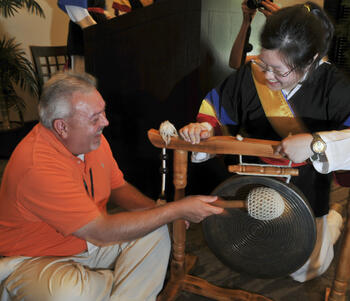
rsd14 054 0263acrop A Hana Academy student introduces an American high school teacher to "Jing."

The fourth annual Hana-Stanford Conference on Korea for U.S. Secondary School Teachers takes place this summer, from July 27 to 29, at Stanford. It will bring together secondary school educators from across the United States as well as a cadre of educators from Korea for intensive and lively sessions on a wide assortment of Korean studies-related topics ranging from U.S.-Korea relations to history, and religion to popular culture. In addition to scholarly lectures, the teachers will take part in curriculum workshops and receive numerous classroom resources developed by Stanford Program on International and Cross-Cultural Education (SPICE).

During the conference, the Sejong Korean Scholars Program(SKSP), a distance-learning program on Korea, will also honor high school students for their exceptional performance in the SKSP program. The finalists will be chosen based on their final research papers, and their overall participantion and preformance in the online course. The SKSP honorees will be presenting their research essays at the conference. The SKSP program is generously supported by the Korea Foundation

For more information about the conference, please visit the conference site at SPICE.


Paul Brest Hall West

555 Salvaterra Walk, Stanford University

Conferences
News Type
News
Date
Paragraphs


Sponsored by the Korea Program and the Center for East Asian Studies, the Korean Studies Program Prize for Writing in Korean Studies recognizes and rewards outstanding examples of writing by Stanford students in an essay, term paper or thesis produced during the current academic year in any discipline within the area of Korean studies, broadly defined. The competition is open to both undergraduate and graduate students. 

Benjamin Pham has won the 4th Annual Korean Studies Writing Prize for his paper titled "How and why did South Korea transition to an economic model of export-led industrialization?" Benjamin, a junior, will complete his undergraduate degree at Stanford in political science in spring 2016.

For more details about the prize, please visit the Center for East Asian Studies.

All News button
1
-

In this fourteenth session of the Strategic Forum, former senior American and South Korean government officials and other leading experts will discuss current developments in the Korean Peninsula and North Korea policy, the future of the U.S.-South Korean alliance, and a strategic vision for Northeast Asia. The session is hosted by the Korea Program at the Shorenstein Asia-Pacific Research Center, in association with Korea National Diplomatic Academy, a top South Korean think tank.

Bechtel Conference Center

Encina Hall, Stanford University

Conferences
Subscribe to North Korea