Shorenstein APARC's annual overview of the Center's 2017-18 activities is now available to download.
Feature sections look at the Center's seminars, conferences, and other activities in response to the North Korean crisis, research and events related to China's past, present, and future, and several Center research initiatives focused on technology and the changing workforce.
The overview highlights recent and ongoing Center research on Japan's economic policies, innovation in Asia, population aging and chronic disease in Asia, and talent flows in the knowledge economy, plus news about Shorenstein APARC's education and policy activities, publications, and more.
616 Serra StreetEncina Hall E301Stanford, CA 94305-6055
0
kvzhang@stanford.edu
ketian_zhang.jpg
Ph.D.
Ketian Vivian Zhang joined the Walter H. Shorenstein Asia-Pacific Research Center (APARC) as the 2018-2019 Shorenstein Postdoctoral Fellow in Contemporary Asia. Ketian studies coercion, economic sanctions, and maritime territorial disputes in international relations and social movements in comparative politics, with a regional focus on China and East Asia. She bridges the study of international relations and comparative politics and has a broader theoretical interest in linking international security and international political economy. Her book project examines when, why, and how China uses coercion when faced with issues of national security, such as territorial disputes in the South and East China Seas, foreign arms sales to Taiwan, and foreign leaders’ reception of the Dalai Lama. Ketian's research has been supported by organizations such as the Belfer Center for Science and International Affairs at the Harvard Kennedy School, Institute for Security and Conflict Studies at George Washington University, the Smith Richardson Foundation, and the Chiang Ching-kuo Foundation.
At Shorenstein APARC, Ketian worked on turning parts of her book project into academic journal papers while conducting fieldwork for her next major project: examining how target states of Chinese coercion respond to China's assertiveness, including the business community and ordinary citizens.
Ketian received her Ph.D. in Political Science at the Massachusetts Institute of Technology in 2018, where she is also an affiliate of the Security Studies Program. Before coming to Stanford, Ketian was a Predoctoral Research Fellow in the International Security Program at the Belfer Center for Science and International Affairs at the Harvard Kennedy School. Ketian holds a B.A. in Political Science and Sociology from the University of Wisconsin-Madison and was previously a research intern at the Institute for Policy Studies in Washington, D.C., where she was a contributor to its website Foreign Policy in Focus.
2018-2019 Shorenstein Postdoctoral Fellow in Contemporary Asia
A group of 8 Stanford graduate and undergraduate students entered the gates of Stanford Center at Peking University (SCPKU) on September 21st. They are participating in the inaugural fall quarter of China Studies in Beijing, an overseas, pilot program being offered by the Freeman Spogli institute for International Studies in partnership with Peking University. Jay Gonzalez, a Stanford junior, already described his experience as “life-changing” – “exactly what I dreamed of and more.”
Image
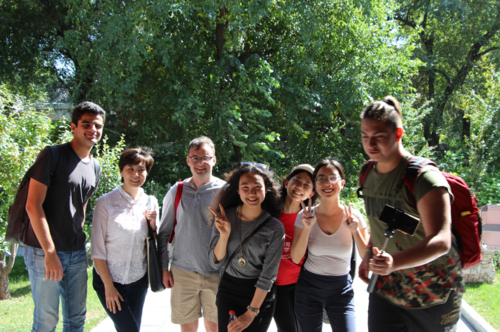
(From left to right): Lucas Hornsby (sophomore), Jenny Zhao (SCPKU’s Beijing program coordinator), Isaac Kipust (junior), Cathy Dao (sophomore), Minhchau Dinh (second year, Master’s in International Policy), Jenn Hu (sophomore), and Jay Gonzalez (junior) walking towards SCPKU for China Studies in Beijing orientation.
China Program faculty from different Stanford departments and two Peking University faculty are offering intensive courses on contemporary Chinese society, politics, international relations and economic development. And each of the students brought their energy, curiosity and long-standing interest in China to the fall program. With an array of exposure to China – from one whose Chinese begins and ends with “ni hao (hello)” to another who calls China his adoptive home -- their interests vary from a passionate interest in the Belt Road Initiative; China-Africa relations; geopolitics; technology and Chinese entrepreneurs; Chinese domestic politics; and, literally, “anything China.” Many recognize China’s central role in the world and the critical importance of acquiring a nuanced understanding of this global power.
Image
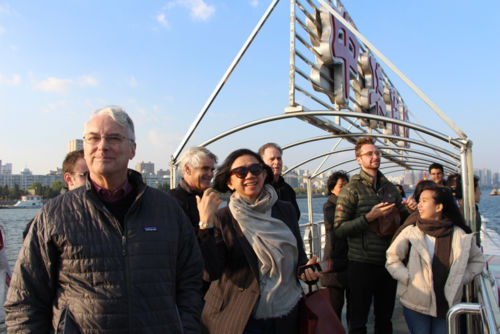
(Clockwise, from left to right): Isaac Kipust, Jay Gonzalez, Prof. Andrew Walder, Lucas Hornsby, Prof. Thomas Fingar, Josh Cheng (Executive Director, SCPKU), Jenny Zhao, Prof. Jean Oi, Jenn Hu, Cathy Dao, and Minchau Dinh
Each of the Stanford China Program faculty teaching in the overseas program has dedicated his or her professional life to engaging with and understanding China. These students have unparalleled access to foremost China experts like Prof. Thomas Fingar, Shorenstein APARC Fellow and former chairman of the National Intelligence Council who has devoted himself to U.S.-China relations since the “ping-pong diplomacy” days in the early 1970’s. Prof. Jean Oi, Director of the China Program and the William Haas Professor in Chinese Politics in the department of political science; and Prof. Andrew Walder, Denise O’Leary & Kent Thiry Professor in the Department of Sociology, were among the first group of U.S. scholars to conduct fieldwork in China after Deng Xiaoping’s Open Door policy was announced in 1978. Prof. Scott Rozell, Senior Fellow at FSI and Co-director of the Rural Education Action Program is the recipient of numerous awards and recognitions, including in 2008 of the Friendship Award, the highest award given to a non-Chinese by China’s Premier.
Image
(Clockwise, from left to right): Prof. Thomas Fingar, Isaac Kipust, Prof. Scott Rozelle, Prof. Andrew Walder, Jennifer Choo (Associate Director, Stanford China Program), Lucas Hornsby, Drew Hasson (second year, Master’s in International Policy), Jenn Hu, and Prof. Jean Oi on the Yalu River looking over at North Korea.
The program is simultaneously exposing students to China’s contemporary politics, society and economy in the classrooms and pairing them with lived experiences -- through real-life conversations with PKU professors and PKU classmates; ordinary citizens of Beijing; and through visits to diverse parts of China. To date, the group has traveled to historic Chengde (承德); a mining equipment factory in Jinzhou city (锦州); the China-North Korean border in Dandong (丹东); and the strategic port city of Dalian (大连). Each of these areas embed layers of history and reveal artifacts from different eras: the Manchus who ruled the Han Chinese during the Qing Dynasty (Chengde); the SOE restructuring in the 1990’s that devastated China’s Northeastern “rust belt” (Jinzhou); massive human casualty suffered by the Chinese during the Korean War (Dandong); and the Sino-Russo-Japanese tug-of-war that marked Dalian’s fate throughout the 19th and 20th century. Through these experiences, students are gaining insights into how the world might look to their counterparts in China and elsewhere.
Below are pictures and reflections from students’ own experiences at Jinshanling (金山岭) Great Wall, Chengde as well as in China’s Northeast (东北) region.
Jinshangling (金山岭) Great Wall
Image
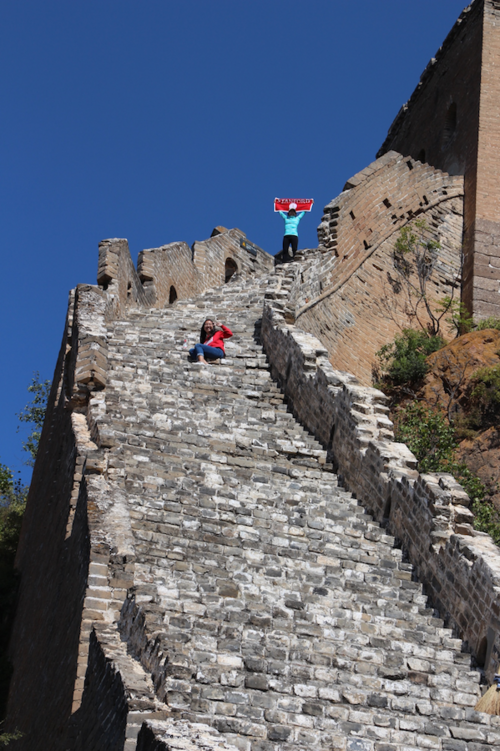
Jenn Hu and Minchau Dinh (holding up the Stanford banner) at the Great Wall
Chengde City (承德市)
The city of Chengde in Hebei Province, located 155 miles northeast of Beijing, was an imperial summer resort during the Qing Dynasty. Emperor Kang Xi (1662-1723) discovered this rare scenic spot during a hunting trip and turned it into a “Mountain Resort.”
As one student noted, these field trips “supplement academic discussions with . . . diverse representations of China – from historical kingdom to innovation contender (Cathy Dao, Stanford sophomore).”
Image
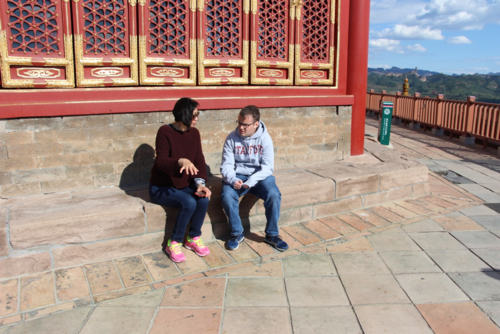
Prof. Jean Oi and Isaac Kipust engaged in discussion at the imperial summer resort of Chengde
China’s Northeast region (东北)
Jinzhou City (锦州市), Liaoning Province Jinzhou Mining Machinery (Group) Co., Ltd
Image
Faculty and students enter the factory at Jinzhou Mining Machinery (Group) Co., Ltd. with the company’s senior managers
Stanford students and faculty toured a mining equipment factory in Jinzhou city in Northeast China. Massive worker lay-offs and closures of state-owned enterprises devastated this “rust belt” region throughout the 1990’s and early 2000’s. The company’s senior management sat with students and faculty and described its current reincarnation as a private shareholding company. They also opened up about their difficulties in attracting talent; local tax rates and land use fees; and their inability to enforce contracts and redress payment defaults.
As Jenn Hu (Stanford sophomore) remarked, “One thing I found particularly fascinating [was that]. . . it was not unusual for [the company’s] clients to bail on contractual obligations . . . . [T]he company allowed their client to pay them back in the form of raw materials, essentially engaging in barter trade . . . The fact that an increasing number of clients are unable to pay back, a trend party leaders have dubbed the ‘new normal,’ is also indicative of China’s slowing growth.”
Image
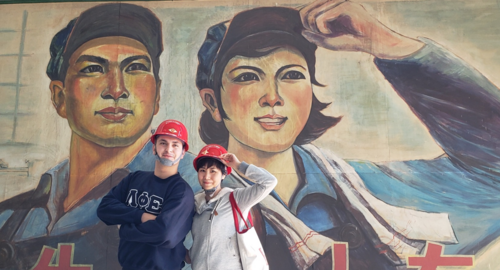
Jay Gonzalez and Jenny Zhao pose in front of a giant painting of “model workers” at Jinzhou Mining Machinery (Group) Co., Ltd.
Dandong City (丹东市) War to Resist U.S. Aggression and Aid Korea Railroad Museum (铁路抗美援朝博物馆)
Image
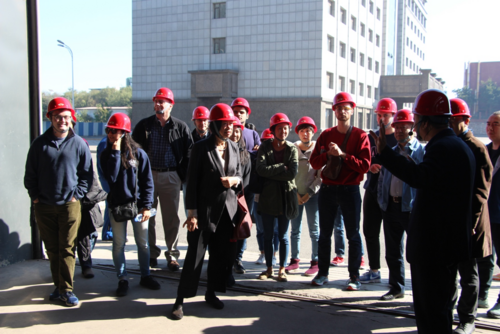
Group photo in front of the old railroad tracks in Dandong, Liaoning province, that helped transport Chinese troops into North Korea during the Korean War
Image
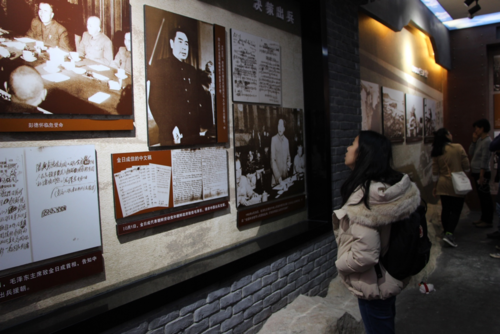
Jenn Hu reading the captions at the “War to Resist U.S. Aggression and Aid Korea” Railroad Museum
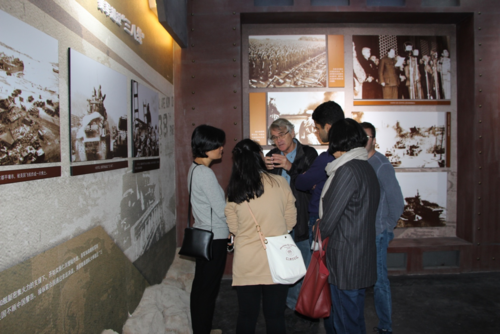
Dandong’s small “railroad museum” displayed images, quotes and photos from the Korean War – better known as “War to Resist U.S. Aggression and Aid Korea” in China. Nearly 3 million People’s Liberation Army troops overwhelmed the U.S. troops and allies in 1950; and China tragically lost anywhere from 149,000 to 400,000 soldiers in the war.
Students heard the Chinese perspective on the war, which focused on U.S. aggression and China’s rightful defense. The museum’s guided tour, in fact, ended with an anti-American sing-along that praised China’s bravery and denounced U.S. imperialism. As one student commented on her blog, “[f]rom the ends of the room, [the museum’s visitors’] voices rose in unison, and swelled into a chorus of song -- 抗美援朝鲜,打败美帝野心狼! (‘Resist America, help Korea, defeat the American imperialists with their wolf-like ambitions!’) (Cathy Dao, Stanford sophomore),” giving substance to the reality that history is, indeed, political.
Image
Prof. Scott Rozelle, Senior Fellow at FSI and faculty member for China Studies in Beijing, engaged in a heated debate with the local guide from Dandong who argued that North Korea’s decision to start the Korean War was to defend its motherland against U.S. military aggression.
Image
Sino-North Korean Friendship Bridge that links Shinuiju, North Korea, to Dandong, China.
Dalian (大连)
Lastly, students traveled to Dalian, the “pearl of the East” founded by the Russians in 1898 and built in the style of European cities at the turn-of-the-century. The site of intense battles during the Russo-Japanese War of 1904, the city now boasts a Sino-Soviet Friendship Monument built in 1996.
Image
Group photo in front of the Sino-Soviet Friendship Monument in Dalian city
Whether it be “[t]he sheer size of a small city like Jinzhou”(pop: 3.1 million) or the “‘little’ city” of Dalian (pop: 6.2 million), these cities drove home for students the sheer scale of a country like China – its significance, complexity, and import.
Students have written blog pieces posted on FSI’s Medium site in which one student also described a fascinating solo backpacking trip to Tibetan communities in western Sichuan and, another, the quotidian challenges of everyday life in Beijing. Regardless of their subject matter, however, their words echo the program’s success in enabling students to perceive the world through vastly differing lenses – lenses that often show a place and people that are deeply warm and welcoming and, at other times, reflect a world that proves decentering and unclear. Yet, the complementary experiences in the classroom and outside the curriculum are enabling students to develop an imagination that can encompass the “other” and nurture a humility that can feed a lifetime of questions. As Cathy Dao commented upon visiting the “War to Resist U.S. Aggression and Aid Korea” Railroad Museum, “I realized that such hostility is a function of history. How each country portrays conflicts [such as the Korean War] strongly influences the perceptions that its people have. [But] [s]hould we learn how one another views history, we can see the humanity in what would otherwise be an abstract and incompatible ‘other.’”
Image
(Counter clockwise): Julie Gu (second year, Masters in International Policy), Pan Xue (Beijing program assistant), Jenny Zhao, and Lucas Hornsby taking a group selfie in Dalian city
For information regarding similar opportunities, please visit FSI Student Programs or email Patrick Laboon, FSI’s Academic Program Manager, at plaboon@stanford.edu for all updates regarding the many international student opportunities offered through FSI.
In this recent lecture at Cornell University’s Contemporary China Initiative, Karen Eggleston, Shorenstein APARC deputy director and the Asia Health Policy Program director, talks about China’s health system reforms, including progress to date in achieving effective universal coverage, priorities set in the national health meetings, Healthy China 2030 goals, and local experiments in strengthening patient-centered integrated care.
The Freeman Spogli Institute for International Studies (FSI) at Stanford University is pleased to announce that renowned China scholar David Michael (“Mike”) Lampton, Hyman Professor of China Studies and Director of the China Studies Program at the Johns Hopkins School of Advanced International Studies Emeritus, has been appointed the Oksenberg-Rohlen Fellow at FSI. Lampton will be affiliated with FSI’s Walter H. Shorenstein Asia-Pacific Research Center (Shorenstein APARC), where he will conduct research on contemporary China and U.S.-China relations. Currently he is working on a book with two colleagues on the development of high-speed railways from southern China to Singapore.
“We are thrilled to welcome Mike Lampton back to Stanford,” says Gi-Wook Shin, director of Shorenstein APARC. “Mike’s expertise in Chinese politics and his long-time experience on the front lines of efforts to foster constructive U.S.-China engagement will be a tremendous asset to APARC and Stanford, especially at this time when relations between Washington and Beijing are at a state fraught with uncertainties and growing mistrust.”
Lampton, BA ’68, MA ’71, PhD ’74, is the author of a dozen books and monographs, including, most recently, Following the Leader: Ruling China, from Deng Xiaoping to Xi Jinping (University of California Press, 2014). He has testified at multiple congressional and commission sessions and published numerous articles, essays, book reviews, and opinion pieces in many venues popular and academic in both the western world and in Chinese-speaking societies, including Foreign Affairs, Foreign Policy, The American Political Science Review, The China Quarterly, The New York Times, The Washington Post, and many others.
Over the course of his career, Lampton accompanied American public and private sector leaders to China, and Chinese leaders to the United States. Formerly President of the National Committee on United States-China Relations, Lampton consults with government, business, and social sector organizations, and has served on the boards of several non-governmental and educational organizations, including the Asia Foundation for which he serves as chairman. The recipient of many academic awards, he is an Honorary Senior Fellow of the American Studies Institute of the Chinese Academy of Social Sciences and the inaugural winner of the Scalapino Prize in 2010, awarded by the National Bureau of Asian Research and the Woodrow Wilson International Center for Scholars in recognition of his exceptional contributions to America’s understanding of the vast changes underway in Asia.
Michael McFaul, director of FSI, said, “I am delighted to have Mike back at Stanford joining our team. We are looking forward to his contributions to scholarly and policy work on China’s international behavior and to efforts to promote productive relations between the United States and China.”
Lampton expressed his excitement, saying, “I am honored to join Shorenstein APARC and FSI to support Stanford’s research, education, and policy outreach focused on challenges and choices facing China and the international community.”
Media Contact Noa Ronkin Associate Director for Communications and External Relations Shorenstein APARC
Stanford anthropologist and APARC-affiliated faculty Matthew Kohrman talks about his latest book that sheds light on the world’s greatest cause of preventable death in the context of the world’s most populous country.
A common mythology is that cigarette smoking is yesterday’s problem. But as Stanford Associate Professor of Anthropology Matthew Kohrman shows, the cigarette epidemic is today’s greatest health calamity. In a recent book he edited and co-authored, Poisonous Pandas: Chinese Cigarette Manufacturing in Critical Historical Perspectives, Kohrman assembles leading scholars from a variety of disciplines who examine sources of the world’s greatest cause of preventable death and who open up a new area of research: critical historical studies of China’s cigarette industry.
China today is the world’s largest manufacturer and consumer of cigarettes and is, therefore, the most important setting in which to investigate the proliferation of cigarette production amidst the public health condemnation of smoking. Poisonous Pandas, part of Shorenstein APARC’s series with Stanford University Press, focuses on that thinly-studied phenomenon. The book's co-editors include Robert Proctor, professor of the history of science at Stanford; Gan Quan, director of tobacco control at the International Union Against Tuberculosis and Lung Disease; and Liu Wennan, editor for the Institute of Modern History at the Chinese Academy of Social Sciences. I recently sat down with Kohrman to discuss the book and its findings.
How did you get involved in studying China’s cigarette industry?
Before I arrived at Stanford I had studied disability-rights organizations in China. I was interested in biopolitics, and particularly in the intersection between state and gender. My first book explored what happens in a patriarchal environment when the patriarch's body breaks down and it focused on the rise of disability discourse in China. When it was time to consider my next project I started thinking about the people I was interacting with during my years of community research—men mostly. These men were smokers, many of them very joyous smokers, who found cigarettes to be indispensable for building relationships and getting through the complexities of their adult lives. And in addition to sharing with me their joys of smoking, they also shared with me personal stories of heartbreak, of how they and their family members who were smokers had fallen ill and were dying from tobacco-related diseases.
As a medical anthropologist, thinking about cigarettes in China allowed me to extend the study of what social scientists call biopolitics. Cigarettes allowed me to move the study of biopolitics from something focused on life making to something also centered on death making. After all, cigarettes have long been heavily marketed as life promoting and they have long generated huge amounts of taxes, which countries use for providing government services. At the same time cigarettes have become the single greatest cause of preventable death in the world today. No less interesting is that this is a story long grounded in a close synergy between governments and corporations, in China and pretty much everywhere else in the world.
When I began my ethnographic fieldwork on tobacco in China I initially studied mostly consumer behavior—which is what the rhetoric of global health emphasizes and what researchers are often disciplined to investigate. But I quickly realized that focusing solely on cigarette consumption, without considering the relationship between supply and demand, was like studying obesity while ignoring food; it was like studying nuclear proliferation while ignoring the mining, refinement, and sale of uranium. So, I shifted focus and began looking more and more at the cigarette industry, especially as managed in China, and started asking questions about why public health had been designed in ways that conceal the role of the industry.
Your book dispels the prevalent notion that public health interventions have succeeded in making the cigarette epidemic a thing of the past. What, in fact, has been happening worldwide, and particularly in China?
It’s true that there have been declines in smoking usage in a number of countries, particularly among the well educated. Yet, three times more cigarettes are produced and consumed today worldwide than in the 1960s, when the scientific community reached a consensus about the health risks of cigarette smoking. Cigarettes are the cause of an estimated six million deaths worldwide. In the United States today half a million deaths a year are attributed to cigarettes.
Other important global trends we see are the outsourcing of cigarette consumption and the consolidation of the tobacco industry worldwide around a set of big players (outside of China those are most notably Philip Morris/Altria, BAT, Imperial Tobacco, and Japan Tobacco). Following a carefully choreographed playbook, the industry has ramped up marketing and sales of cigarettes in lower- and middle-income countries. Driving that trend have been several companies carrying out a massive mergers-and-an-acquisition game, buying up smaller companies around the world at a frenzied pace, closing cigarette factories in high-income countries, and building more efficient new ones elsewhere, especially in places like Eastern Europe, Russia, Africa, and across Asia. So, instead of declining as we would expect based on our impressions living here in California, the number of daily cigarette smokers around the world is projected to continue climbing, with new smokers coming on board in low- and middle-income countries that often have relatively high birth rates, while in high-income countries, which often have declining birth rates, the number of smokers continues to fall. The net result is an escalating global health catastrophe, much of it unfolding outside the purview of the academy.
In China at present, over 300 million people are daily cigarette smokers, over half of the population is regularly exposed to cigarette smoke, and more than a million deaths per year can be attributed to cigarette smoke exposure. Predictions are that, by 2030, morbidity will triple to 3.5 million annual deaths and that, by 2050, one out of three male deaths will be tobacco-related. Chinese hospitals are already filled with patients suffering from tobacco-induced illnesses. Death due to lung cancer alone has soared in China during the past three decades. It’s mostly men who are dying from these ailments, families are struggling to care for them, and are spending their savings on invasive treatments which, even in the richest of countries, often have poor outcomes.
And the industrial source of all this devastation? China’s State Tobacco Monopoly Administration (STMA, also known as the China National Tobacco Corporation, or China Tobacco) is responsible for two out of every five cigarettes rolled, packed, and shipped worldwide today. Catering mostly to a domestic market, China Tobacco produces more cigarettes now than the world’s next four largest tobacco companies combined.
In that regard, it is important to re-emphasize that this story isn't unique to China and must not be interpreted as only a matter of one country poisoning its people with cigarettes. Rather what happens in China is a piece of a global story about the worldwide tripling of tobacco production and consumption.
those who die from using cigarettes don't make good victims in the sense of mobilizing politics. - Matthew Kohrman
Why isn’t more attention being paid to this global cigarette epidemic? Why doesn’t it make headlines?
One answer is that those who die from using cigarettes don't make good victims in the sense of mobilizing politics. There are several reasons for that. First, typically there is a long delay from the start of cigarette use to death, meaning there is no sudden “crash” or “outbreak” event associated with tobacco, as opposed to, say, Ebola or other types of infectious diseases that, as we know, can trigger media and security attention. At the same time, survival rates among the paradigmatic cigarette victim, the lung cancer patient, are very low, so there is no strong survivor community like with other types of cancer. In the United States today far more women die of lung cancer than of breast cancer, but there is no critical lung cancer victimology as there is around breast cancer.
Second, prodded by industry rhetoric, cigarette smoking in much of the world is strongly tied up with the notions of consumer choice and freedom, and therefore cigarettes create victims who are largely blamed for their own behavior. This rhetoric is supported by weak warning labels: consumers are alerted that smoking is “harmful” to their health and told that they are taking on that risk at their own discretion. This has much to do with the prevalent tobacco-control approach: we push out knowledge that says that you're smarter if you don't smoke and that people who do smoke cannot control themselves. This is why the tobacco industry actually loves warning labels (to a certain degree): warning labels protect the industry by creating a short-circuiting of the victimology that is needed to develop a critical political and social action. More to the point, whenever someone gets sick from a “tobacco-related disease,” there is a lot of intimate blaming that crops up (of self as well as one’s smoking compatriots), such that few people are inclined to talk about their or their family member’s tobacco-induced disease. Cigarettes, therefore, remain a well-known killer on the scale of demographics and epidemiology, but very much a silent killer at the level of social action.
Third, the global cigarette epidemic is a gendered story: far more men worldwide smoke than women. In China today only two to three percent of women are daily cigarette smokers, compared with well over half of men ages 25 to 64. Now for various reasons, men—particularly older men—don't make as sympathetic a victim as women or children do.
Finally, the epidemiology of tobacco is increasingly understood as class-based: with more and more of the people killed by tobacco-induced illnesses being people in less-educated and in lower- and middle-income contexts. Whether that is actually true is an open question. But because cigarette smoking has become increasingly associated with the poor, its resultant morbidity is increasingly associated in people’s minds with the poor. And as we well know, rarely is caring for the poor a political priority around the world.
All this means that, overall, the cigarette epidemic isn’t an attractive or generative story for political mobilization.
Your book prioritizes several themes, the first of which is cigarette normalization, that is, not just how the behavior of cigarette smoking has become perceived as normal, but also how the cigarette’s widespread availability as a consumer product has come to be viewed as unremarkable, expected, and commonplace. What has shaped this process of normalization, particularly in China?
The globalization of tobacco started in a colonial context, in the late 1400s, but the ability to inhale tobacco smoke is a relatively new phenomenon that began in the late 1800s, with the discovery of flue-cured tobacco, something which made tobacco smoke far more addictive. With the discovery of flue-curing and the advent of the cigarette rolling machine in the late 1800s, cigarettes become commodities: consumer goods increasingly visible and understood to be as normal to the retail experience as gum, wrapped candy, or razor blades—part of the average store of daily use items. Not long after the first cigarette rolling machine was patented, there were more cigarettes available than existing cigarette consumers desired. That is, companies found that it was much easier to produce cigarettes than to sell them. The remedy for the industry quickly became advertising. The birth of the U.S. advertising business is closely tied to the cigarette industry.
The same also applies to China. Tobacco had been part of governance and part of everyday life there since the end of the Ming dynasty when Beijing first began taxing tobacco, but cigarettes only became normalized in China during the early twentieth century, helped along by the tobacco industry building the country’s early advertising apparatuses.
Communism nurtured this normalization. Mao and other Communist forbearers viewed tobacco and cigarette taxes in particular as vital to state-building. As a consequence, in the Communist pre-1949 Base Areas, the Red Army blocked people’s access to exogenous cigarettes and set up cigarette factories of their own. In that context, locally produced cigarettes came to be viewed as integral to life for an emergent party-state. This view was intensified in the 1950s with the nationalization of the industries and the state’s promotion of cigarette manufacturing not just in traditional venues like Shanghai but in most provinces. In the 1960s cigarette ration coupons were issued, thereby furthering the normalization of cigarettes as items to which a citizen should have some guaranteed access, on par with grain and meat.
Regulatory localization has also been crucial to cigarette normalization in China. In the early 1950s the Chinese Communist leadership granted significant autonomy over the tobacco industry at the province level, such that a state-run monopoly turned into a set of regionalized public cartels that allowed manufacturers controlled by local party bosses to sell their cigarettes only within their boundaries. With the rise of regional state-owned factories pumping out cigarettes, regional governments issuing cigarette ration coupons for those cigarettes and blocking access to product from other parts of the country, it was not just that cigarette brands became highly localized. Cigarettes themselves became an index of residency and locality—part of one’s identity as a resident of Hunan, Yunnan, Shandong, etc.
Another aspect of cigarette normalization in Communist China has been party careerism: success at helping sell local cigarette brands has been a way for local cadres to prove their political worth to the party. This became especially the case after Mao's death. In the Deng Xiaoping era, promotion within the party came to be closely tied to raising local GDP. This sparked an immense increase in regional cigarette production and marketing because cigarette sales are an easy way to spike GDP.
Eventually, after the State Tobacco Monopoly Administration took over many of the reins of China’s cigarette businesses from local party authorities in the 1980s, that Beijing-based bureaucracy began consolidating and closing smaller cigarette factories in order to engineer economies of scale. STMA’s organizational mandate has been to increase efficiencies and make cigarettes the centerpiece of a new consumerist era.
China has accelerated its tobacco-control efforts over the past few years. What is your view of these efforts?
In 2003, the Chinese government signed the World Health Organization’s Framework Convention on Tobacco Control, which enacts a set of universal standards aimed at limiting tobacco use worldwide, and we’ve seen Hu Jintao’s and Xi Jinping’s administrations taking various measures towards tobacco control. These include directives to government officials, restricting tobacco advertising and smoking in public places, as well as at least one experiment in raising the rates of cigarette taxes. But the road towards comprehensive tobacco prevention in China is going to be a long one, especially given the power and influence of the industry and its State Tobacco Monopoly Administration. Public opinion in China regarding the cigarette epidemic is yet to be mobilized in any notable way.
That does not mean we should despair, my Chinese colleagues working on this topic tell me. It just means that there is that much more work to do. And that brings us back to the Poisonous Pandas volume. A central aim of this book is to help nurture a new area of historical research in China, critical industry studies of tobacco. But the purpose of the book does not stop there. The authors contributing to Poisonous Pandas hope that, in time, this area of study will serve as a fertile ground for a vibrant critical consciousness regarding the tobacco industry to emerge, one that extends well beyond the academy. Qiānlǐ zhī xíng, shǐyú zú xià. A journey of a thousand miles begins with a single step.
616 Serra StreetEncina Hall E301Stanford, CA 94305-6055
0
spanlai@stanford.edu
shipan_lai.jpg
Ph.D.
Shipan LAI joined the Walter H. Shorenstein Asia-Pacific Research Center (Shorenstein APARC) during the 2018-2019 academic year from the School of Political Science and Public Administration at Huaqiao University (Quanzhou, China), where he serves as an associate professor and vice director of MAP (Master of Public Administration) program.
His research interests focus on organizational theory, Chinese state governance and Chinese local government behavior. He has published several papers and led two research projects in his field. During his time at Shorenstein APARC, Lai will conduct a study of the relationship between the Chinese local government’s task of economic development and its task of environmental protection.
Lai holds a PhD in public management from Sun Yat-sen University (Guangzhou,China). He received his MA and BA in public management, both from Zhongnan University of Economics and Law (Wuhan, China).
616 Serra StreetEncina Hall E301Stanford, CA94305-6055
0
eypark18@stanford.edu
eun_young_park.jpg
J.S.D., L.L.M.
Eun Young Park joins the Walter H. Shorenstein Asia-Pacific Research Center (Shorenstein APARC) during the 2018-2019 academic year from the law firm of Kim & Chang where he serves as a partner and co-chair of international arbitration and litigation practice group. Dr. Park has served as Judge in the Seoul District Court during the Kim Young Sam government. After joining Kim & Chang he has focused on international dispute resolution including trade sanctions, transnational litigation, and international arbitration. He was appointed to Vice-President of the London Court of International Arbitration and a Member of the Court of Arbitration of the Singapore International Arbitration Centre. He has taught in many universities including SKK University School of Law as an adjunct professor. His research focuses on the possibility of establishing dispute resolution mechanism in the transition of East Asian countries. The research interests encompass decisions from international tribunal arising out of international and transnational disputes of various areas including boundaries, economic disputes, and reparation arising out of transitional justice; trends and efforts to establish an independent judicial body to cope with conflicts and disputes in the region. Dr. Park is an editor of Korean Arbitration Review and has published articles including "Appellate Review in Investor State Arbitration," Reshaping the Investor-State Dispute Settlement System: Journeys for the 21st Century and "Rule of Law in Korea," Taiwan University Journal of Law. He is an author of a book entitled "The Analysis of the Iran Sanctions Act of the United States and the Strategy of the Overseas Construction Project” (in Korean).
He holds a J.S.D. and LL.M. from NYU School of Law and M. Jur. and B. Jur. from Seoul National University.
616 Serra StreetEncina Hall E301Stanford, CA94305-6055
0
yufanwh@stanford.edu
fan_yu.jpg
Ph.D.
Fan Yu joins the Walter H. Shorenstein Asia-Pacific Research Center as visiting scholar from the Institute of Quality Development Strategy at Wuhan University, where he serves as assistant professor. His research field is in economic growth quality and human capital quality. At APARC, Dr. Yu will be working with Professor Jean Oi researching quality innovation and total factor productivity in China.