News Type
News
Date
Paragraphs

The Shorenstein Asia-Pacific Research Center (APARC), in pursuit of training the next generation of scholars on contemporary Asia, has selected two postdoctoral fellows for the 2017-18 academic year. The fellows will begin their year of academic study and research at Stanford this fall.

Shorenstein APARC has for more than a decade sponsored numerous junior scholars who come to the university to work closely with Stanford faculty, develop their dissertations for publication, participate in workshops and seminars, and present their research to the broader community.

The 2017-18 cohort includes two Shorenstein Postdoctoral Fellows; they carry a broad range of interests from labor migration policy in China to regional institutions in East Asia. Their bios and research plans are listed below:


Image
hyun seung cho
H. Seung Cho is completing his doctorate at Columbia University’s Department of Political Science. He researches U.S. and Chinese foreign policy toward East Asia’s regional institutions with a broader interest in U.S.-China relations, the political economy of East Asia and qualitative research methods. His dissertation probes the popular narrative that United States and China are competing over East Asia’s regional architecture, arguing that mutual misperception and security dilemma dynamics also play out in the politics of regional institution building. To explore this phenomenon, Seung has conducted extensive fieldwork in Beijing, Jakarta, Seoul and Washington, D.C. At Shorenstein APARC, Seung will be developing his dissertation into a book manuscript while looking to further examine the relationship between the politics of East Asia’s multilateral security institutions and their perceived lack of effectiveness. Previously, Seung was a predoctoral fellow at Peking University’s School of International Studies from 2014-16. Prior to starting his doctoral studies, he also served in South Korean military intelligence as part of the two-year national service. Seung holds a Bachelor of Science in government and economics and Master of Science in international relations from the London School of Economics and Political Science (LSE).


Image
samantha vortherms
Samantha Vortherms is a doctoral candidate in the University of Wisconsin – Madison Department of Political Science. Her research focuses on comparative political economy, development, social welfare and research methodology. Her dissertation examines subnational variation in access to citizenship rights in China through the household registration system. Her research has been supported by the National Science Foundation, the U.S. Department of Education through the Fulbright-Hays Doctoral Dissertation Research Abroad and the Social Science Research Council's Dissertation Proposal Development Fellowship, among others. At Shorenstein APARC, Sam will work on converting her dissertation to a book manuscript and advance her post-dissertation project on the role of the firm in labor migration policies. Before going to Wisconsin, Sam received her Master of Arts in international relations at the University of Chicago, Artium Magister in public policy from University of Chicago's Harris School of Public Policy, and a Bachelor of Arts from the University of Richmond. From 2014-16, she was a visiting research fellow at the National School of Development's China Center for Health Economics Research at Peking University.

Hero Image
encina hall
All News button
1
-

Brunei, China, Indonesia, Malaysia, the Philippines, Taiwan, and Vietnam have made ambiguous, intransigent, and overlapping claims of “sovereignty” and “rights” in the South

China Sea. China has enlarged and weaponized “its” land features and denounced and ignored the July 2016 decision by the International Tribunal for the Law of the Sea that denied China’s claims of “rights” within its vastly encompassing “nine-dash line.” The court also disallowed claims to sea space in excess of twelve nautical miles around land features in the Spratlys. China’s refusal to negotiate with ASEAN as a group and its use of yuan diplomacy have worsened the disunity of member states. Chinese procrastination and intra-Southeast Asian rivalry have stalled implementation of an existing but routinely violated Declaration on Conduct and prevented agreement on a meaningful and enforceable Code of Conduct. American policy toward China appears to have shifted from objection to provocation. The question is urgent:  What can and should be done?

Image
don emmerson 2

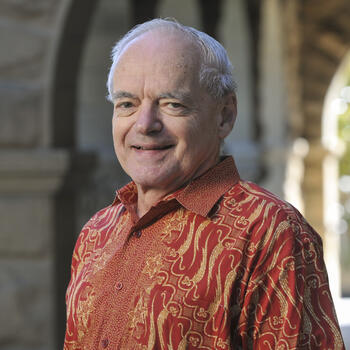
Donald K. Emmerson is the Director of the Southeast Asia Program, Shorenstein APARC; Senior Fellow at FSI, Emeritus; Affiliated Faculty of CDDRL; and Affiliated Scholar, Abbasi Program in Islamic Studies, all at Stanford University. In 2010 the National Bureau of Asian Research and the Woodrow Wilson International Center for Scholars awarded Dr. Emmerson a two-year Research Associateship given to “top scholars from across the United States” who “have successfully bridged the gap between the academy and policy.”

Dr. Emmerson’s policy concerns run from specific issues such as sovereignty disputes in the South China Sea to broad questions involving China-Southeast Asia relations, the American “rebalance” toward Asia, and the future of the Association of Southeast Asian Nations (ASEAN).

Dr. Emmerson’s recent publications include: “Facts, Minds, and Formats: Scholarship and Political Change in Indonesia” in Indonesian Studies: The State of the Field (2013); “Is Indonesia Rising? It Depends” in Indonesia Rising (2012); “Southeast Asia: Minding the Gap between Democracy and Governance,” Journal of Democracy (April 2012); “The Problem and Promise of Focality in World Affairs,” Strategic Review (August 2011); An American Place at an Asian Table? Regionalism and Its Reasons (2011); and Asian Regionalism and US Policy: The Case for Creative Adaptation (2010).

This event is co-sponsored by the Shorenstein APARC's China Program and The Forum for American/Chinese Exchange at Stanford (FACES).

This event is part of the winter colloquia series entitled "China: Going Global" sponsored by Shorenstein APARC's China Program.

Image

China: Going Global

Beijing’s new Silk Road initiative links old trade corridors from Asia to Africa and Europe. Many perceive that President Xi Jinping’s “One Belt, One Road” initiative as well as China’s many other trade, investment and finance projects transcend their economic calculus and reflect Beijing’s geopolitical ambitions to reposition China’s standing on the global stage. The China Program brings leading experts to explore the drivers and motivators of China’s international initiatives, their reach and scope as well as the implications of China’s increasing activism on the world stage.

http://aparc.fsi.stanford.edu/research/china-going-global

0
Senior Fellow Emeritus at the Freeman Spogli Institute for International Studies
Affiliated Faculty, CDDRL
Affiliated Scholar, Abbasi Program in Islamic Studies
aparc_dke.jpg PhD

At Stanford, in addition to his work for the Southeast Asia Program and his affiliations with CDDRL and the Abbasi Program in Islamic Studies, Donald Emmerson has taught courses on Southeast Asia in East Asian Studies, International Policy Studies, and Political Science. He is active as an analyst of current policy issues involving Asia. In 2010 the National Bureau of Asian Research and the Woodrow Wilson International Center for Scholars awarded him a two-year Research Associateship given to “top scholars from across the United States” who “have successfully bridged the gap between the academy and policy.”

Emmerson’s research interests include Southeast Asia-China-US relations, the South China Sea, and the future of ASEAN. His publications, authored or edited, span more than a dozen books and monographs and some 200 articles, chapters, and shorter pieces.  Recent writings include The Deer and the Dragon: Southeast Asia and China in the 21st Century (ed., 2020); “‘No Sole Control’ in the South China Sea,” in Asia Policy  (2019); ASEAN @ 50, Southeast Asia @ Risk: What Should Be Done? (ed., 2018); “Singapore and Goliath?,” in Journal of Democracy (2018); “Mapping ASEAN’s Futures,” in Contemporary Southeast Asia (2017); and “ASEAN Between China and America: Is It Time to Try Horsing the Cow?,” in Trans-Regional and –National Studies of Southeast Asia (2017).

Earlier work includes “Sunnylands or Rancho Mirage? ASEAN and the South China Sea,” in YaleGlobal (2016); “The Spectrum of Comparisons: A Discussion,” in Pacific Affairs (2014); “Facts, Minds, and Formats: Scholarship and Political Change in Indonesia” in Indonesian Studies: The State of the Field (2013); “Is Indonesia Rising? It Depends” in Indonesia Rising (2012); “Southeast Asia: Minding the Gap between Democracy and Governance,” in Journal of Democracy (April 2012); “The Problem and Promise of Focality in World Affairs,” in Strategic Review (August 2011); An American Place at an Asian Table? Regionalism and Its Reasons (2011); Asian Regionalism and US Policy: The Case for Creative Adaptation (2010); “The Useful Diversity of ‘Islamism’” and “Islamism: Pros, Cons, and Contexts” in Islamism: Conflicting Perspectives on Political Islam (2009); “Crisis and Consensus: America and ASEAN in a New Global Context” in Refreshing U.S.-Thai Relations (2009); and Hard Choices: Security, Democracy, and Regionalism in Southeast Asia (edited, 2008).

Prior to moving to Stanford in 1999, Emmerson was a professor of political science at the University of Wisconsin-Madison, where he won a campus-wide teaching award. That same year he helped monitor voting in Indonesia and East Timor for the National Democratic Institute and the Carter Center. In the course of his career, he has taken part in numerous policy-related working groups focused on topics related to Southeast Asia; has testified before House and Senate committees on Asian affairs; and been a regular at gatherings such as the Asia Pacific Roundtable (Kuala Lumpur), the Bali Democracy Forum (Nusa Dua), and the Shangri-La Dialogue (Singapore). Places where he has held various visiting fellowships, including the Institute for Advanced Study and the Woodrow Wilson International Center for Scholars. 


Emmerson has a Ph.D. in political science from Yale and a BA in international affairs from Princeton. He is fluent in Indonesian, was fluent in French, and has lectured and written in both languages. He has lesser competence in Dutch, Javanese, and Russian. A former slam poet in English, he enjoys the spoken word and reads occasionally under a nom de plume with the Not Yet Dead Poets Society in Redwood City, CA. He and his wife Carolyn met in high school in Lebanon. They have two children. He was born in Tokyo, the son of U.S. Foreign Service Officer John K. Emmerson, who wrote the Japanese Thread among other books.

Selected Multimedia

Date Label
<i>Director, Southeast Asia Program, Shorenstein APARC, Senior Fellow, Emeritus,</i> FSI, Stanford University
Seminars
-

In Japan's increasingly complex security environment, the Japan-U.S. Alliance is indispensable not only to the security of Japan, but also to the peace and stability of the Asia-Pacific region.  The Honorable Satoshi Morimoto, former Defense Minister of Japan, will talk about Japan’s security policy and the importance of the Japan-U.S. Alliance under the Trump Administration.

This seminar will be moderated by Ambassador Karl Eikenberry, Director, U.S.-Asia Security Initiative


Image
The Honorable Satoshi Morimoto served with the Japan Air Self-Defense Force and is a graduate of the National Defense Academy of Japan. In 1977, he was assigned to the Security Division, American Affairs Bureau of the Ministry of Foreign Affairs of Japan. In 2009 he served as the 1st Senior Adviser to the Minister of Defense. Since October 2015, he has served as the Special Adviser to the Minister of Defense of Japan. In March 2016, he was appointed President of Takushoku University.


This event is co-sponsored by the Japan Program, U.S.-Asia Security Initiative and the Consulate-General of Japan, San Francisco


The Honorable Satoshi Morimoto <i>Former Minister of Defense,</i> Japan
Seminars
-

In the two decades since the countries of Central Asia declared independence, China has become one of their main partners, eclipsing many other actors. This has impacted the international relations of the new states, and structured their economic development. China's influence in the region has, however, raised many questions, ranging from issues of national integrity to economic stability and geopolitical policies.

In terms of economics, hydrocarbons and trade are at the forefront of Chinese activity in the region. Beijing has become a key positive element in the development of a service economy and new technologies, while China's geographical proximity has supported regional development and the insertion of Central Asian countries into world markets. However, Beijing also has played a negative role by using the local economies as mere sources for raw materials and by destroying, through dominating competition, the already very fragile post-Soviet industrial fabric.

On the geopolitical level, how does Central Asia handle its relations with a diverse array of international actors and thus competing interests in order to achieve a positive balance? Central Asian governments have been playing a careful balancing game between the two main actors, Beijing and Moscow. However, many Central Asians argue for countering what they see as an impasse in their countries' partnerships with Russia and China by developing relations with other actors, particularly Muslim countries (such as Turkey, Iran or the UAE) and Western countries. This presentation will address questions at both the economic and geopolitical levels, where Beijing has made it possible to act as a catalyst for political debates about the choices made by Central Asia governments. 


Image
Peyrouse

Sebastien Peyrouse is the Research Professor of International Affairs at the Elliott School of International Affairs of The George Washington University. He was a doctoral and postdoctoral Fellow at the French Institute for Central Asia Studies in Tashkent (1998-2000 and 2002-2005), a Research Fellow at the Slavic Research Center, Hokkaido University in Sapporo (2006), and a Research Fellow at the Woodrow Wilson International Center for Scholars in Washington (2006-2007). In 2008-2012, he was a Senior Research Fellow with the Central Asia-Caucasus Institute & Silk Road Studies Program (SAIS, Johns Hopkins University, Washington D.C.) and with the Institute for Security and Development Policy (Stockholm). He is an Associated Scholar with the Institute for International and Strategic Relations (IRIS, Paris), and with the Fundación para las Relaciones Internacionales y el Diálogo Exterior (FRIDE, Madrid) and a member of the Brussels-based EUCAM (Europe-Central Asia Monitoring). 

p.p1 {margin: 0.0px 0.0px 0.0px 0.0px; font: 16.0px Garamond; -webkit-text-stroke: #000000} span.s1 {font-kerning: none}

Dr. Peyrouse is the author of Turkmenistan. Strategies of Power, Dilemmas of Development (M. E. Sharpe, 2011), and the co-author of The 'Chinese Question' in Central Asia. Domestic Order, Social Changes, and the Chinese Factor (Hurst, Columbia University Press, 2012) and of Globalizing Central Asia. Geopolitics and the Challenges of Economic Development (M.E. Sharpe, 2012). He has also co-edited China and India in Central Asia. A new "Great Game"? (Palgrave Macmillan, 2010), and Mapping Central Asia: Indian Perceptions and Strategies (Ashgate, 2011). His articles have appeared in Europe Asia Studies, Problems of Post-Communism, Nationalities Papers, China Perspectives, Religion, State & Society, Journal of Church and State. He has authored or co-authored seven books on Central Asia in French.


This event is co-sponsored by the Shorenstein APARC's China Program and The Forum for American/Chinese Exchange at Stanford (FACES).

This event is part of the winter colloquia series entitled "China: Going Global" sponsored by Shorenstein APARC's China Program.

Image

China: Going Global

Beijing’s new Silk Road initiative links old trade corridors from Asia to Africa and Europe. Many perceive that President Xi Jinping’s “One Belt, One Road” initiative as well as China’s many other trade, investment and finance projects transcend their economic calculus and reflect Beijing’s geopolitical ambitions to reposition China’s standing on the global stage. The China Program brings leading experts to explore the drivers and motivators of China’s international initiatives, their reach and scope as well as the implications of China’s increasing activism on the world stage.

http://aparc.fsi.stanford.edu/research/china-going-global

Sebastien Peyrouse <i>Research Professor of International Affairs, Elliott School of International Affairs, The George Washington University</i>
Seminars
-

Trade has been a key instrument behind China’s rapid economic growth. Taking advantage of rapidly increasing global and regional production networks, China has become the major trading partner of virtually every other country within East Asia. Equally important, China’s trade strategy has married China’s combination of high savings levels plus low cost exports with America’s low savings rates and high consumption levels. As well, China has been a major funder of U.S. debt levels. To date the result has been a win-win for both countries. The election of Donald Trump threatens to upend China’s trade strategy, most fundamentally by branding China a currency manipulator and by threatening to impose massive tariffs on U.S. imports from China. Trump has also pulled out of the Trans-Pacific Partnership (TPP) despite six years of complex negotiations and in defiance of the wishes of its other eleven member states. All are convinced of the importance of TPP as a bridge linking the Asia-Pacific and as a counterbalance to Chinese economic influence in East Asia.  Professor Pempel will examine these complex interrelations with particular attention to the broad role hitherto played by economic cooperation in reducing security tensions within East Asia and across the Asia-Pacific.


Image
pempel

T.J. Pempel (Ph.D., Columbia) is Jack M. Forcey Professor of Political Science in U.C. Berkeley's Department of Political Science which he joined in July 2001. Just prior to coming to Berkeley, he was at the University of Washington in Seattle where he was the Boeing Professor of International Studies in the Jackson School of International Studies and an adjunct professor in Political Science. Professor Pempel's research and teaching focus on comparative politics, political economy, contemporary Japan, and Asian regional ties. His recent books include Remapping East Asia: The Construction of a Region; Regime Shift: Comparative Dynamics of the Japanese Political Economy (both by Cornell University Press); Security Cooperation in Northeast Asia and The Economic-Security Nexus in Northeast Asia (both by Routledge). In 2015, he co-edited a book entitled Two Crises; Different Outcomes (Cornell University Press) which analyzes the negative Asian experience in the 1997-98 crisis and the positive outcome in 2008-09. In addition, he has published over one hundred twenty scholarly articles and chapters in books. Professor Pempel is on the editorial boards of a dozen professional journals, and serves on various committees of the American Political Science Association, the Association for Asian Studies, and the International Studies Association Council. He is a presidentially-appointed Commissioner on the Japan-U.S. Friendship Commission and is active in the Northeast Asian Cooperation Dialogue. His current research involves Asian adjustments to the rise in global finance and the decline in security bipolarity.

This event is co-sponsored by the Shorenstein APARC's China Program and The Forum for American/Chinese Exchange at Stanford (FACES).

Multimedia for this event.

This event is part of the winter colloquia series entitled "China: Going Global" sponsored by Shorenstein APARC's China Program.

[[{"fid":"224946","view_mode":"crop_870xauto","fields":{"format":"crop_870xauto","field_file_image_description[und][0][value]":"","field_file_image_alt_text[und][0][value]":false,"field_file_image_title_text[und][0][value]":false,"field_credit[und][0][value]":"Economist.com","field_caption[und][0][value]":"","field_related_image_aspect[und][0][value]":"","thumbnails":"crop_870xauto"},"type":"media","field_deltas":{"1":{"format":"crop_870xauto","field_file_image_description[und][0][value]":"","field_file_image_alt_text[und][0][value]":false,"field_file_image_title_text[und][0][value]":false,"field_credit[und][0][value]":"Economist.com","field_caption[und][0][value]":"","field_related_image_aspect[und][0][value]":"","thumbnails":"crop_870xauto"}},"link_text":null,"attributes":{"width":"870","style":"margin-left: 0px; margin-right: 15px; padding: 5px; float: left; width: 350px; height: 194px;","class":"media-element file-crop-870xauto","data-delta":"1"}}]]China: Going Global

Beijing’s new Silk Road initiative links old trade corridors from Asia to Africa and Europe. Many perceive that President Xi Jinping’s “One Belt, One Road” initiative as well as China’s many other trade, investment and finance projects transcend their economic calculus and reflect Beijing’s geopolitical ambitions to reposition China’s standing on the global stage. The China Program brings leading experts to explore the drivers and motivators of China’s international initiatives, their reach and scope as well as the implications of China’s increasing activism on the world stage.

http://aparc.fsi.stanford.edu/research/china-going-global

T.J. Pempel <i>Jack M. Forcey Professor of Political Science</i>, U.C. Berkeley
Seminars
News Type
Commentary
Date
Paragraphs

A hot springs summit between Japanese Prime Minister Shinzo Abe and Russian President Vladimir Putin next week hopes to solve the 70-year-old dispute over an isolated string of islands that Russian and Japanese nationalists both claim as their own, according to Daniel Sneider, associate director for research at the Shorenstein Asia-Pacific Research Center.

Read the commentary piece in Foreign Policy here.

Hero Image
Japanese Prime Minister Shinzo Abe shakes hands with Russian President Vladimir Putin at the G20 Summit on Sept. 4, 2016, Hangzhou, China. | Photo credit: Lintao Zhang/Getty Images
Japanese Prime Minister Shinzo Abe shakes hands with Russian President Vladimir Putin at the G20 Summit on Sept. 4, 2016, Hangzhou, China.
Lintao Zhang/Getty Images
All News button
1
News Type
News
Date
Paragraphs

As 2017 approaches, the Shorenstein Asia-Pacific Research Center documents highlights from the 2015-16 academic year. The latest edition of the Center Overview, entitled "Challenges to Globalization," includes research, people, events and outreach features, and is now available for download online.

Hero Image
containers port singapore
A container is loaded onto a ship docked at the terminal port in Singapore, June 2016.
ROSLAN RAHMAN/AFP/Getty Images
All News button
1
Subscribe to Northeast Asia