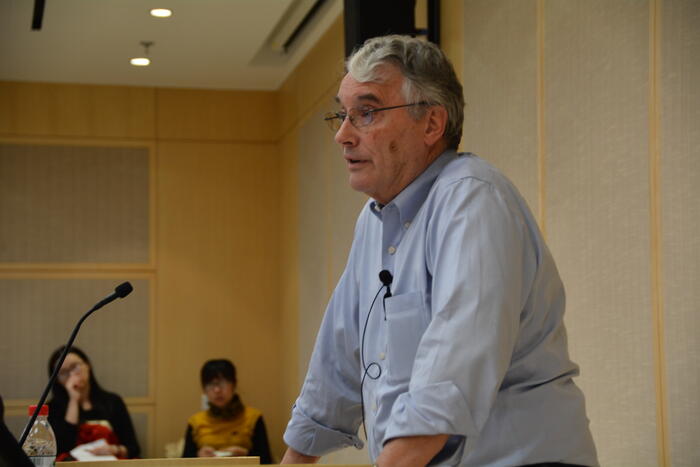
-

Co-sponsored by the Center for East Asian Studies

Why have Indonesia, South Korea, the Philippines, and Thailand proven so recurrently vulnerable to political crises? In their new volume, Incomplete Democracy in the Asia-Pacific, Giovanna Dore, Jae Ku, and Karl Jackson cite the relative absence of participation between elections, the continued influence of traditional social structures, the incomplete emergence of civil society organizations, public opinions of democracy and authoritarian rule, and the persisting weaknesses of political parties. Their book shows how mass attitudes and behaviors enable continued elite control of these electoral democracies, and conclude that although there are substantial differences between them, the chronic problem of democracy in Asia has been the lack of mobilized public demand for good governance.

Karl D. Jackson directs Asian Studies at SAIS and heads its Southeast Asia Studies Program. He has served as the national security advisor to the US vice president, special assistant to the US president, senior director for Asia on the National Security Council, deputy assistant secretary of defense for East Asia and the Pacific, and senior advisor to the president of the World Bank. He was a professor of political science at the University of California, Berkeley (1972–1991). His degrees are from the Massachusetts Institute of Technology (PhD) and Princeton University (BA).

Giovanna Maria Dora Dore is a fellow in the Asian Studies Program at SAIS. For over a decade, as a political economist in the World Bank Group, she has focused on economic change and institutional development in Asia. She has a PhD in Political Economy and Southeast Asia Studies and an MA from SAIS and a Laurea Magistralis in Philosophy and Contemporary History from the Catholic University of Milan.

Jae H. Ku directs the U.S.-Korea Institute at SAIS. He has taught courses at SAIS, Brown University, and Yonsei University, and Sookmyung Women’s University in Seoul. He has a PhD from SAIS, an MSc from the London School of Economics and Political Science, and a BA from Harvard University.

Book Presentation
Download pdf

Philippines Conference Room

Encina Hall 3rd Floor Central

Stanford, CA 94305

Giovanna Maria Dora Dore Fellow, Asian Studies Program, Paul H. Nitze School of Advanced International Studies (SAIS), Johns Hopkins University (JHU)
Jae H. Ku Director, US-Korea Institute, SAIS, JHU
Karl D. Jackson CV Starr Distinguished Professor, SAIS, JHU
Seminars
-

In Indonesia on the day of this talk, for the first time ever in that country, a directly elected president will be inaugurated to replace his also directly elected predecessor.  In the Philippines, in contrast, voters will go to the polls to elect their president on 9 May 2016 for the sixteenth time since 1935.  But this comparison is far too narrow to sustain a comparison of democracy’s present quality and future durability in these two countries.  Age could be a mere chronological achievement; a mature democracy could be moribund; and some argue that in both nations, overriding their different histories, crony capitalism continues to debilitate ostensibly accountable rule.  In his own assessment of democracy’s roots, results, and prospects in Indonesia and the Philippines, Prof. Mendoza will address, inter alia, these questions:  Which country is more democratic procedurally?  Which country is more democratic substantively, in terms of governance and performance?  And which country is more likely to remain democratic in times to come?  His answer to each of these questions will also call for explanation:  Why?  

Amado M. Mendoza, Jr. is a prominent political economy and policy scholar in the Philippines.  He was the lead investigator on the Philippines for the Global Integrity Report 2010.  More recent activities have included directing a course on the political dimensions of national security at the National Defense College of the Philippines and writing an on-line column at Interaksyon.com analyzing Southeast Asian issues and developments.  A piece in Iteraksyon on 6 October 2014, for example, highlighted tax compliance as a key requisite for improved governance in the Philippines.  As an unwilling alumnus of the detention centers of the Philippine dictator Ferdinand Marcos in the 1970s, Prof. Mendoza has a personal interest in democracy as well.

Philippines Conference Room

Encina Hall Central, 3rd Floor.

Stanford, CA 94301

Amado M. Mendoza, Jr. Professor of Political Science and International Studies University of the Philippines, Diliman, Quezon City
Seminars
-

Following the end of World War II, Japan achieved remarkable economic growth, rising to be on par with the levels of the United States and Europe. With particular strength in manufacturing, Japan attracted much attention from around the world for its technological capabilities and ability to produce high quality products. Can Japan restore its glories such as those that garnered global attention in the 1980s? In 2006, Bill Emmott, a former editor of The Economist, published "Hi wa Mata Noboru (The Sun Also Rises)", which predicts that someday Japan will restore its competitiveness by increasing productivity through economic structural reforms.

However, so far, we do not see the clear picture of The Sun’s rising again. This talk is based on Motohashi’s new book, “Hi ha Mata Takaku (The Sun Rises Again)” from Nikkei, for explaining the way Japan should proceed to regain its industrial competitiveness. He has analyzed the shift of sources of industrial competitiveness, taking into account science revolutions (IT, life science etc.) and growing presence of emerging economies such as China and India, and explained new model of innovation lead growth by the concept of “science based economy”. His talk also touches on the subject of differences of economic institutions among nations, and proposes new model of Japanese innovation system in 21st century with the importance of labor market liberalization to proceed structural reforms to adjust new environment. Please refer to the following link for more detail description of the book. http://www.rieti.go.jp/en/columns/a01_0391.html

Image
motohashi
Kazuyuki Motohashi joins the Walter H. Shorenstein Asia-Pacific Research Center (Shorenstein APARC) during the period of September 2014 to March 2015 as Sasakawa Peace Fellow, from the University of Tokyo where he serves as a professor at the Department of Technology Management for Innovation, Graduate School of Engineering. Until this year, he had taken various positions at the Ministry of Economy, Trade and Industry of the Japanese Government, economist at OECD and associate professor at Hitotsubashi University.

His research interest covers a broad range of issues in economic and statistical analysis of innovation, including economic impacts of information technology, international comparison of productivity, national innovation system focusing on science and industry linkages and SME innovation and entrepreneurship policy. He has published several papers and books on above issues, including Productivity in Asia: Economic Growth and Competitiveness (2007). At Shorenstein APARC, he conducts research project, “New Channles: Reinventing US-Japan Relationship”, particularly focusing on innovation in silicon valley and its linkage with Japanese innovation system.

Mr. Motohashi was awarded Master of Engineering from University of Tokyo, MBA from Cornell University and Ph.D. in business and commerce from Keio University.

Slides_The Sun Rises Again? Regaining INdustrial Competitiveness of Japan in Science Based Economy Era
Download pdf

Philippines Conference Room

Encina Hall
616 Serra St., 3rd floor
Stanford University
Stanford, CA 94305


Shorenstein Asia-Pacific Research CenterEncina Hall E301616 Serra StreetStanford, CA 94305-6055
(650) 723-1434 (650) 723-6530
0
kazuyuki_motohashi.jpg Ph.D.

Kazuyuki Motohashi joins the Walter H. Shorenstein Asia-Pacific Research Center (Shorenstein APARC) during the period of September 2014 to March 2015 as this year's Sasakawa Peace Fellow, from the the University of Tokyo, where he serves as a professor at the Department of Technology Management for Innovation, Graduate School of Engineering. Until this year, he had taken various positions at the Ministry of Economy, Trade and Industry of the Japanese Government, economist at OECD, and associate professor at Hitotsubashi University.

His research interest covers a broad range of issues in economic and statistical analysis of innovation, including economic impacts of information technology, international comparison of productivity, national innovation systems focusing on science and industry linkages, and SME innovation and entrepreneurship policy. He has published several papers and books on the above issues, including Productivity in Asia: Economic Growth and Competitiveness (2007). At Shorenstein APARC, he is conducting the research project, “New Channles: Reinventing US-Japan Relationship”, particularly focusing on innovation in Silicon Valley and its linkage with the Japanese innovation system.

Mr. Motohashi was awarded his Master of Engineering degree from the University of Tokyo, MBA from Cornell University, and Ph.D. in business and commerce from Keio University.

Sasakawa Peace Fellow, 2014-2015
Seminars
Authors
News Type
News
Date
Paragraphs


Ronald I. McKinnon, a renowned scholar of international economics, has died. A primary focus of McKinnon’s work was on East Asia, including the currency crisis of 1997-98 and Japan’s liquidity trap. The Walter H. Shorenstein Asia-Pacific Research Center remembers him with gratitude for his collaboration on research activities and participation in many public seminars. An article written by the Stanford News Service recognizes his contributions to the Stanford community and beyond.


Image
r mckinnon headshot
Ronald I. McKinnon, the William D. Eberle Professor in Economics, Emeritus, died Oct. 1 at the Mills-Peninsula Hospital in Burlingame, California, from complications resulting from a fall on an escalator at San Francisco International Airport on Sept. 18. He was 79. 

McKinnon was born in Edmonton, Canada, on July 10, 1935. He joined the Stanford economics faculty in 1961 as an assistant professor. He received tenure in 1966, was promoted to full professor in 1969 and eventually became a chaired professor. He earned his bachelor's degree in economics from the University of Alberta in 1956 and his doctorate in economics from the University of Minnesota in 1961.

McKinnon was an applied economist whose primary interests were international economics and economic development. Understanding financial institutions and monetary institutions was central to his teaching and research. A prolific writer, he wrote or co-authored nine books and penned numerous articles and commentary pieces for economic journals and publications such as The Economist, the Financial Times and the Wall Street Journal.

'Intellectual giant'

"SIEPR and the entire Stanford economics community lost a dear friend and an intellectual giant. We were lucky to have shared him for 53 years," said John Shoven, the director of the Stanford Institute for Economic Policy Research.

Shoven said McKinnon combined wit and wisdom. "He was both an intellectual powerhouse and a fun-loving colleague with a twinkle in his eye while he told a joke or two, or argued for his favorite unconventional theory."

McKinnon's wife, Margaret, said that her husband had a "second wind" of academic inquisitiveness that made his retirement years very active. "He did a lot of work on Asia and China, and was engaged with a whole new generation of economists and organizations."

She added that McKinnon loved economics. "He was a family man, but if something came up in economics, we knew where he would turn. His granddaughters remember him for his devotion to them and for his infectious passion for his work."

Financial repression

Along with his Stanford colleague the late Edward S. Shaw, McKinnon was among the first scholars to investigate "financial repression" as a substantial barrier to successful economic development. Financial repression refers to policies that force savers to accept returns below the rate of inflation and that enable banks to provide cheap loans to companies and governments to reduce the burden of their debt repayments.

His first book, published in 1973, Money and Capital in Economic Development, analyzed why the prevailing economic doctrines of the time had become too tolerant of inflation and of state interventions in the credit mechanism. McKinnon noted that without proper constraints, politicians were only too tempted to direct the flow of credit to suit their own ends.

He suggested strategies to escape financial repression in his 1993 book, The Order of Economic Liberalization: Financial Control in the Transition to a Market Economy. In it, he outlined how to liberalize government policies in domestic finance and foreign trade as a way to create more open markets.

McKinnon's other major area of interest was the study of international money and finance. He probed how the use of national currencies allows international trade to be effectively monetized and multilateral rather than bartered and bilateral.

Those rules of the game, McKinnon noted, can only be understood by considering the historical perspective – from the late 19th-century gold standard, the Bretton Woods Agreement of 1945 and the postwar dollar standard.

In Money in International Exchange: The Convertible Currency System (1979), McKinnon analyzed why and how the dollar came to be used as an international vehicle and reserve currency among banks and the primary currency of invoice in international commodity trade.

In his 1996 book, The Rules of the Game: International Money and Exchange Rates, McKinnon discoursed on macroeconomics and how the dollar standard could have been modified to make the world economy more stable in the postwar era.

East Asia, China and students

In his later years, McKinnon focused on East Asia and the great currency crisis of 1997-98 in that region, as well as Japan's liquidity trap. With Kenichi Ohno, McKinnon wrote Dollar and Yen: Resolving Economic Conflict between the United States and Japan (1997).

"His work had a following all over the world," said Shoven. "This was brought home to me in 1979 when I was visiting the London School of Economics and Ron McKinnon came to give a seminar. The faculty and students were so anxious to hear Ron that the seminar room was standing room only."

McKinnon was deeply engaged with his students – both graduate and undergraduate – many of who went on to write doctoral dissertations or senior undergraduate honors theses under his mentorship.

Throughout his career, McKinnon traveled internationally to conferences and for consulting with central banks and monetary authorities in Asia, Latin America, North America and Europe. He worked with international agencies such as the International Monetary Fund, the World Bank and the Asian Development Bank, among others.

He is survived by his wife, Margaret Learmonth McKinnon, and three children – Neil Charles McKinnon of San Francisco; Mary Elizabeth McKinnon Villeneuve of Redlands, California; and David Bruce McKinnon, of Ottawa, Canada; and seven grandchildren. Plans for a memorial service have not yet been announced.

Clifton Parker is a writer for the Stanford News Service.

Hero Image
r mckinnon headshot
All News button
1
News Type
News
Date
Paragraphs


The Walter H. Shorenstein Asia-Pacific Research Center at Stanford University is pleased to announce its search for two 2015–16 Shorenstein Postdoctoral Fellows in Contemporary Asia. The award will be given to two junior scholars, who have completed their Ph.D. (with degree conferral and approval by August 31, 2015).

The primary focus of the fellowship is to conduct research and writing on contemporary political, economic or social change in the Asia-Pacific region (including Northeast, Southeast and South Asia), or topics related to international relations and international political economy.

The fellowship provides the postdoctoral fellows an opportunity to expand their dissertation, explore new topics and work alongside the Center’s distinguished scholars.

Postdoctoral fellows are required to be in residence at Stanford University for the duration of the appointment, and take part in Center activities throughout the academic year. Fellows are also required to present their research findings in seminars, and participate in the Center’s publication program.

The fellowship is a 10-month appointment with a salary rate of $50,000, plus $3,000 for research expenses. Appointments will begin in the fall quarter of the 2015–16 academic year.

The fellowship is made possible through the generosity of Walter H. Shorenstein, the benefactor for whom the Center is named.

Please access the fellowship posting for complete details and how to apply. The application deadline is December 19, 2014.

Hero Image
Encina Hall arches
All News button
1
News Type
News
Date
Paragraphs

As the new academic year gets underway, the Walter H. Shorenstein Asia-Pacific Research Center’s Corporate Affiliates Program is excited to welcome its new class of fellows to Stanford University.

The 2014-15 fellows and their affiliations are listed below:

  • Liang Fang, China Sunrain Solar Energy Co., Ltd.
  • Wataru Fukuda, Shizuoka Prefectural Government
  • Zhao Han, PetroChina
  • Yoshihiro Kaga, Ministry of Economy, Trade & Industry, Japan
  • Tsuyoshi Koshikawa, Ministry of Finance, Japan
  • Jaigeun Lim, Seoul Metropolitan Government
  • Yun Bae Lim, Samsung LIfe Insurance
  • Feng Lin, ACON Biotechnology
  • Yasunori Matsui, Mitsubishi Electric
  • Tatsuru Nakajima, Sumitomo Corporation
  • Shingo Nakano, Ministry of Economy, Trade & Industry, Japan
  • Ryuichi Ohta, Japan Patent Office
  • Jong Soo Paek, Samsung Electronics
  • Rajeev Prasad, Reliance Life Sciences
  • Ryuichiro Takeshita, Asahi Shimbun
  • Ryo Wakabayashi, Sumitomo Corporation
  • Changbao Zhang, PetroChina

At Stanford, the fellows will audit classes, work on English language skills, and conduct individual research projects. At the end of the year, they will give formal presentations on their research findings. At the Center, they will have the opportunity to consult with Shorenstein APARC's scholars and attend events featuring visiting experts from around the world. The fellows will also participate in special events and site visits to gain a firsthand understanding of business, society and culture in the United States.

Hero Image
corporate affiliates 2014 15
The 2014-15 Corporate Affiliate Visiting Fellows stand on the front steps of Encina Hall.
Rod Searcey
All News button
1
-

[[{"fid":"215851","view_mode":"crop_870xauto","fields":{"format":"crop_870xauto","field_file_image_description[und][0][value]":"","field_file_image_alt_text[und][0][value]":"","field_file_image_title_text[und][0][value]":"","field_credit[und][0][value]":"","field_caption[und][0][value]":"","field_related_image_aspect[und][0][value]":"","thumbnails":"crop_870xauto","pp_lightbox":false,"pp_description":true},"type":"media","attributes":{"height":1126,"width":870,"style":"width: 500px; height: 647px;","class":"media-element file-crop-870xauto"}}]]

Philippines Conference Room

Encina Hall, 3rd Floor, Central

Stanford University

Paragraphs

This paper argues that game-theoretic approach is incomplete for institutional studies, because comparative institutions as well as institutional changes involve a possibility of multiple equilibria.  In order to solve the common knowledge problem, this paper proposes to unify game theoretic thought with an analysis of public representations/propositions to summarize salient features of the recursive/emergent states of play.  From this perspective the paper tries to reconcile differences in three accounts of institutions, endogenous outcome, exogenous rules and constitutive rules accounts.  Then, the unified approach is applied to comparative and historical cases of the Tokugawa Japan and the Qing China.  Specifically it sheds new light into the coalitional nature of Tokugawa Baku-Han regime nesting the fundamental Samurai-village pact as well as the tendency toward decentralization of political violence and fiscal competence to the provincial level toward the end of the Qing China.  From these new historical interpretations, endogenous strategic forces and associated public propositions leading to institutional changes through the Meiji Restoration and the Xinhai Revolution are identified and compared.

All Publications button
1
Publication Type
Working Papers
Publication Date
Authors
Masahiko Aoki
-

Co-sponsored by the Center on Democracy, Development, and the Rule of Law and the Southeast Asia Program

The recent reversal of democracy in Thailand has been rapid, dramatic, and increasingly thorough. Generals in civilian guise now manage the country. Their coup in May restored, in effect, a Cold War-era nexus of the military, the monarchy, and the bureaucracy. That trinity thwarted communism and enabled development but fell victim to its own success, as formerly marginalized Thais became vocal stakeholders seeking better lives. Democracy and growth spawned new wealth and new players, triggering sharp conflicts among elites competing for the first time for mass support. In the fading twilight of a gloried monarch, Thai politics before and since the 2014 coup amount to a long and no-longer latent endgame over the weighting and balancing of royalty, bureaucracy, and military, and the implications for democracy. Prof. Pongsudhirak will construe the contest and assess the stakes for Thailand, Southeast Asia, and the larger world.

Thitinan Pongsudhirak is an associate professor in Chulalongkorn University’s Faculty of Political Science. A prolific and prize-winning author, his latest writings include articles on Thai politics in the Journal of Democracy and on the Mekong region in Foreign Affairs. He taught at the University of Yangon earlier this year and has been a visiting scholar at, among other places, SAIS (2011) and Stanford (2010). His alma maters include the London School of Economics (PhD) and UC-Santa Barbara (BA).

Philippines Conference Room

Encina Hall Central, 3rd Floor.

Stanford, CA 94305

Stanford Humanities Center
424 Santa Teresa St.
Stanford, CA 94305

(650) 723-3052
0
FSI-Stanford Humanities Center International Visiting Scholar

Thitinan Pongsudhirak is a high-profile expert on contemporary political, economic, and foreign-policy issues in Thailand today  He is also a prolific author; witness his op ed, "Moving beyond Thaksin," in the 25 February 2010 Wall Street Journal.

Pongsudhirak is not senior in years, but he is in stature.  His career path has been meteoric since he earned his BA in political science with distinction at UC-Santa Barbara not long ago. In 2001 he received the United Kingdom's Best Dissertation Prize for his doctoral thesis at the London School of Economics on the political economy of Thailand's 1997 economic crisis.

Since 2006 he has held an associate professorship in international relations at Thailand's premier institution of higher education, Chulalongkorn University, while simultaneously heading the Institute of Security and International Studies, the country's leading think tank on foreign affairs.

His many publications include: "After the Red Uprising," Far East Economic Review, May 2009; "Why Thais Are Angry," The New York Times, 18 April 2009; "Thailand Since the Coup," Journal of Democracy, October-December 2008; and "Thaksin: Competitive Authoritarian and Flawed Dissident," in Dissident Democrats: The Challenge of Democratic Leadership in Asia, ed. John Kane et al. (2008).  He has written on bilateral free-trade areas in Asia, co-authored a book on Thailand's trade policy, and is admired by Southeast Asianist historians for having insightfully revisited, in a 2007 essay, the sensitive matter of Thailand's role during World War II.

He was a Salzburg Global Seminar Faculty Member in June 2009, Japan Foundation's Cultural Leader in 2008, and a Visiting Research Fellow at the Institute of Southeast Asian Studies (Singapore) in 2005.  For ten years, in tandem with his academic career, he worked as an analyst for The Economist's Intelligence Unit.

Director, Institute of Security and International Studies Chulalongkorn University, Bangkok
Seminars
Authors
Gi-Wook Shin
News Type
News
Date
Paragraphs


With tensions between Japan and South Korea continuing over historical and territorial issues, Beijing is more than willing to use the history card to woo Seoul. In a recent visit to South Korea, Chinese President Xi Jinping said that "in the first half of the 20th century, Japanese militarists carried out barbarous wars of aggression against China and South Korea, swallowing up Korea and occupying half of China." Earlier this year, China opened an elaborate memorial hall in Harbin to honor Ahn Jung-geun, who killed Hirobumi Ito, the first Japanese resident-general of Korea. To Koreans, Ahn is a national hero; to Japanese, a terrorist. Xi's visit to Seoul was to repay South Korean President Park Geun-hye's own visit to Beijing last year. Neither Park nor Xi has visited Tokyo yet.

China is apparently seeking to pull South Korea over to its side in its widening strategic competition with the United States and Japan. Xi's "charm offensive" toward Seoul is based on the calculation that South Korea's strategic value will only increase in coming years.

For South Korea, there are compelling reasons to improve relations with China. Ties had been strained by Park's predecessor, Lee Myung-bak, emphasizing South Korea's alliance with the U.S. She must take into account that China is becoming ever more important to South Korea's economy. (Apart from Taiwan, South Korea enjoys the world's largest merchandise trade surplus with China, approaching $100 billion). Park also wants China to support her North Korea policy focused on ending Pyongyang's nuclear weapons program and preparing for unification. 

While China actively asserts its claim to leadership in Northeast Asia in courting South Korea, Japanese Prime Minister Shinzo Abe seems to deliberately ignore, if not dismiss, the importance of South Korea. Japanese policymakers argue, wrongly, that the Park government is "pro-China" and that Japan needs only to worry about China itself. Conservative Japanese media regularly bash the South Korean government and South Korea more broadly, and anti-Korean sentiments in Japan are on the rise.

Japanese focus is understandably on its alliance with the United States. But American policymakers openly worry that continuing tensions between its main allies in the region will undermine its strategic position regarding China and North Korea. President Barack Obama brought Abe and Park together in March on the sidelines of the Nuclear Security Summit, but with little to show for it. The United States is also concerned that the Abe government's nontransparent dealings with North Korea on the abductee issue could further damage Japanese-South Korean relations and vitiate U.S. efforts to press Pyongyang on the nuclear issue.

Northeast Asia is in flux. With its economic and military power growing, China is seeking to regain the dominant position in the region that it ceded to Japan over a century ago. In the process of reshaping a regional order, the Korean Peninsula will again be very important. Already, two major wars occurred over Korea when old and new powers competed for hegemony -- the Sino-Japanese War of 1894-95 and the Russo-Japanese War of 1904-05.  It is crucial for both Japan and South Korea to maintain friendly relations with a rising China, but it is just as important that they improve their own bilateral relationship. Both have much to lose if the current trajectory in the region is not corrected. Moreover, Japan and South Korea have much in common, from their social and economic systems to democratic values, much more in fact than either has with China.

So, what should be done?  Above all, both Japan and South Korea must work much harder to resolve the issues that continue to arise out of their shared history of colonial rule and war. South Korea needs to move beyond victim consciousness, and Japan needs to show more farsighted political leadership. Specifically, Japan should unequivocally reaffirm the Kono Statement regarding the "comfort women" issue, and Abe should make it clear that he won't visit Yasukuni Shrine again during his tenure as prime minister.

The 1993 statement was a key marker on the history question for South Koreans; the recent review of it sent the wrong message to Koreans. Japanese leaders are certainly entitled to honor those who sacrificed their lives for their country, but paying tribute also to convicted war criminals is an entirely different matter -- not only in the eyes of South Koreans but also of the international community as a whole. For its part, Seoul should make clear how much it values good relations with Japan and state that it is ready to work with Tokyo in a constructive fashion to fully and finally resolve the remaining historical issues.

Next year will be the 50th anniversary of the normalization of relations between Japan and South Korea. It should be an occasion to celebrate what that has meant for both countries -- regional peace and stability and economic prosperity. But even more importantly, both Tokyo and Seoul should also use the anniversary as a golden opportunity to develop a new vision for their relationship. The future of Northeast Asia will be brighter for all the countries in the region if its two major democracies show greater wisdom.

Gi-Wook Shin is a professor of sociology and director of the Walter H. Shorenstein Asia-Pacific Research Center (APARC) at Stanford University. Shin's article (with Daniel Sneider, the associate for resarch at Shorenstein APARC), "History Wars in Northeast Asia," appeared in Foreign Affairs (April 2014).

This article was originally carried by Nikkei Asian Review on 17 Sept. and reposted with permission.

Hero Image
9156445989 4898f6fb09 b
Chinese President Xi Jinping and other political leaders greet South Korean President Park Geun-hye during a welcome ceremony for President Park's state visit to China in June 2013.
Flickr/Korea.net (image crop applied)
All News button
1
Subscribe to Asia-Pacific