Paragraphs

The digital information technology (IT) revolution currently underway is profoundly reshap- ing economic activity, influencing politics, and transforming societies around the world. It is also forcing a reconceptualization of the global and local: many of the technologies, platforms, and fundamental disruptions are global in nature, but national or local contexts critically influence the uses and effects of IT.

The Asia-Pacific region provides a fascinating array of countries for examination of the political, economic, and sociocultural effects of digital media on the modern world. Economies range from developing to advanced. Governments include varied democracies as well as one-party regimes. The press enjoys relative freedom in some countries, undergoes limited constraints in others, and is tightly controlled in a few. Populations range from dense to sparse, and from diverse to relatively homogenous.

Held September 12–13, 2013, in Kyoto, Japan, the fifth Stanford Kyoto Trans-Asian Dialogue focused on the catalyzing effects of digital media for change in the Asia-Pacific. Four major themes were addressed:

  1. Digital Media versus Traditional Media
  2. Digital Media and Political Change in Asia
  3. Social Change and Economic Transformation
  4. Digital Media and International Relations
All Publications button
1
Publication Type
Policy Briefs
Publication Date
Journal Publisher
Shorenstein Asia-Pacific Research Center
Paragraphs
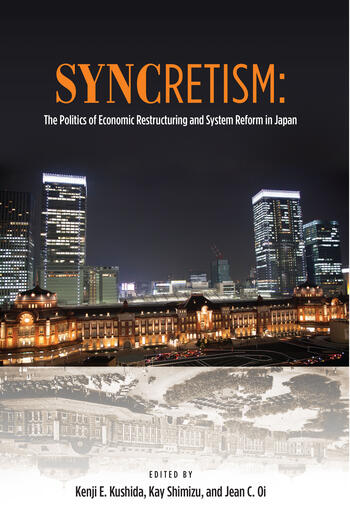
Syncretism front final SYNCRETISM front cover

Japan’s first decade of the twenty-first century was both disappointing and bewildering, producing wildly contrasting evaluations. Many have come to call this period the “second lost decade,” characterized by policy paralysis and overall lackluster economic growth.

For those studying Japan more closely, however, the same decades reveal nothing short of a broad transformation in numerous core tenets of Japan’s postwar political economy. How can we best capture this transformation?

Each chapter in this volume examines a different aspect of Japan’s political economy within a longer historical trajectory, from multiple angles, to depict a flexible but resilient system. We characterize Japan’s process of change as syncretism—practices foreign, domestic, old and new were selectively adopted, mixed and matched, along the way creating a new and unique hybrid system.

Examination copies: Desk, examination, or review copies can be requested through Stanford University Press

All Publications button
1
Publication Type
Books
Publication Date
Subtitle

The Politics of Economic Restructuring and System Reform in Japan

Authors
Kenji E. Kushida
Jean C. Oi
Book Publisher
Shorenstein APARC
Paragraphs

This paper presents a simulation model based on the growth rate, the inflation rate, and the consumption tax rate in the future. Future tax revenues and fiscal expenditures are projected using regression models estimated from past data. The fiscal situation is called unsustainable if the outstanding amount of Japanese government bonds (JGBs) becomes higher than the level of private sector financial assets. We focus on the general account of the central government, which is the source of JGB issues. We find that the higher the economic growth, the more likely it is that the fiscal situation is sustainable. When a larger portion of interest income is reinvested in JGBs, the chance is higher that the fiscal situation is sustainable. Most importantly, raising the consumption tax to 20% guarantees fiscal sustainability in most cases. Our analysis shows that without a consumption tax hike beyond the 10% rate, a fiscal crisis will be almost a certainty, even with a real economic growth rate of 2% despite a shrinking labor force. A reasonably quick hike of the consumption tax, namely a hike by 1% a year, up to 20%, combined with high or moderate economic growth rates, seems to keep the economy out of a fiscal crisis, where a moderate growth rate is defined to be generated by a productivity increase per working-age population of 1.9%, which was the average during the Koizumi years.

All Publications button
1
Publication Type
Journal Articles
Publication Date
Journal Publisher
Asian Economic Policy Review
Authors
Takeo Hoshi
-

Historically, in Japan, out-of-court corporate restructurings have played a significant role in disciplining managers in the near-absence of hostile takeover activity and shareholder activism. This paper analyzes management turnover in a large sample of Japanese firms that underwent restructurings between 1981 and 2010. I find that restructurings that happen in later stages of financial distress, and those that are not initiated by the firm itself, are more likely to involve management turnover, as are restructurings in which the firm's main business operations are left intact. Furthermore, in restructurings after the reforms around the year 2000, management turnover is more likely to occur if the local potential managerial labor market is substantial. After controlling for firm characteristics and the firm's initial financial condition, it does not appear that management turnover is associated with an improvement in post-restructuring operating performance--in fact, the effect is significantly negative by estimates that address the non-random nature of management turnover. However, for restructurings led by equity funds, management turnover is associated with a more successful turnaround of the firm's performance. These results suggest that equity funds possess the ability to locate and recruit talented outside managers in a thin market for experienced managers.


Michael Furchtgott is an economist interested in corporate finance and governance. His current research investigates Japanese corporate restructurings and the behavior of firms and lenders when financial distress arises.

Furchtgott has completed his PhD in economics at the University of California, San Diego, where his research on corporate financial restatements has demonstrated that firms frequently circumvent laws designed to protect investors.

He holds a BA in economics and mathematics from Columbia University.

Daniel and Nancy Okimoto Conference Room

Shorenstein APARC
Encina Hall C331
616 Serra Street
Stanford, CA 94304-6055

(650) 724-9747 (650) 723-6530
0
Shorenstein Postdoctoral Fellow in Contemporary Asia
FURGHOTT,_Michael_3x4.jpg PhD

Michael Furchtgott is an economist interested in corporate finance and governance. His current research investigates Japanese corporate restructurings and the behavior of firms and lenders when financial distress arises.

Furchtgott has completed his PhD in economics at the University of California, San Diego, where his research on corporate financial restatements has demonstrated that firms frequently circumvent laws designed to protect investors.

He holds a BA in economics and mathematics from Columbia University.

Michael Furchtgott Postdoctoral Fellow in Contemporary Asia Speaker Shorenstein APARC
Seminars
-

Co-sponsored by the Stanford Center for International Development

Under what conditions is decentralization most likely to foster development and reduce poverty?  Plausible answers include:  a sufficiently committed central government; local checks against corruption; and sufficiently resourced actors able to deliver public services effectively. Indonesia is a good place to explore the explanatory power of these and other propositions, thanks to the country’s diverse local conditions and the rapid and sweeping (“Big Bang”) decentralization that it underwent in the late 1990s.  In his disaggregation of the Indonesian case since then, Dr. Sumarto will examine whether, how, and why poverty alleviation has been helped or hurt by particular economic, social, and political variations in the context and character of local governments across the archipelago.

Sudarno Sumarto was an Asia Foundation Visiting Fellow at APARC in 2009-2010.  In 2001-2009 he was the director of SMERU, a highly regarded independent institute for research and public policy studies in Jakarta.  He has served as a consulting economist for the World Bank, the Asian Development Bank, among other organizations, and has taught in Indonesia’s leading universities. His latest publication is Explaining Regional Heterogeneity of Poverty:  Evidence from Decentralized Indonesia (co-authored, 2013).  Earlier titles include more than sixty co-authored books, working papers, articles, chapters, and reports on topics such as poverty, decentralization, employment, vulnerability, and economic growth.  His degrees in economics include a PhD and an MA from Vanderbilt University and a BSc from Satya Wacana Christian University (Salatiga).

Lunch will be served.

Philippines Conference Room

0
Shorenstein APARC/Asia Foundation Visiting Fellow
652666552_jnP6G-L-1.jpg MA, PhD

Sudarno Sumarto is the Shorenstein APARC / Asia Foundation fellow for 2009-10.  He has a PhD and an MA from Vanderbilt University and a BS from Satya Wacana Christian University (Salatiga), all in economics.  Prior to joining Shorenstein APARC he was the director of SMERU for nearly 10 years. SMERU is an independent institution for research and public policy studies which professionally and proactively provides accurate and timely information, as well as objective analysis on various socioeconomic and poverty issues considered most urgent and relevant for the people of Indonesia. The institute has been at the forefront of the research effort to highlight the impact of government programs and policies, and has actively published and reported its research findings. The work expanded to include other areas of applied and economic research that are of fundamental importance to contemporary development issues. He was also a lecturer at Bogor Institute of Agriculture (IPB), Bogor, Indonesia.

Sumarto has contributed to more than sixty co-authored articles, chapters, reports, and working papers, including "Agricultural Growth and Poverty Reduction in Indonesia," in Beyond Food Production (2007); "Reducing Unemployment in Indonesia," SMERU Working Paper, 2007; "Improving Student Performance in Public Primary Schools in Developing Countries:  Evidence from Indonesia," Education Economics, December 2006; and “The Effects of Location and Sectoral Components of Economic Growth on Poverty: Evidence from Indonesia.” Journal of Development Economics, 89(1), pp. 109-117, May 2009.  As well as conducting research and writing papers, Sumarto has worked closely with the Indonesian government, giving advice on poverty issues and government poverty alleviation programs.

Sumarto has spoken on poverty and development issues in Australia, Chile, Peru, China, Egypt, Ethiopia, France, Japan, Morocco, Thailand, and the United Kingdom, among other countries.

Date Label
Sudarno Sumarto Senior fellow Speaker SMERU Research Institute
Seminars

In this eleventh session of the Strategic Forum, former senior American and South Korean government officials and other leading experts will discuss current developments in the Korean Peninsula and North Korea policy, the future of the U.S.-South Korean alliance, and a strategic vision for Northeast Asia. The session is hosted by the Korean Studies Program at the Shorenstein Asia-Pacific Research Center, in association with Korea National Diplomatic Academy, a top South Korean think tank.

PARTICIPANTS

United States:

Michael Armacost, Distinguished Fellow, Shorenstein APARC, Stanford University

Karl Eikenberry, Distinguished Fellow, Shorenstein APARC

Siegfried Hecker, Professor, Management Science and Engineering; former co-director, CISAC, Stanford University

Thomas Fingar, Distinghished Fellow, Shorenstein APARC

T.J. Pempel, Professor, Political Science, University of California, Berkeley

Gi-Wook Shin, Professor, Sociology; Director, Shorenstein APARC, Stanford University

Daniel Sneinder, Associate Director for Research, Shorenstein APARC

David Straub, Associate Director, Korean Studies Program, Shorentein APARC

Kathleen Stephens, 2013–14 Koret Fellow, Korean Studies Program, Shorenstein APARC

Seoul, Korea

Workshops
Authors
News Type
News
Date
Paragraphs

Reports of the detention and eventual release by North Korean authorities of an 85-year-old Palo Alto retiree, Merrill Newman, spurred a wave of media interest. Newman, a Korean War veteran, had decided to go on a tour of North Korea, apparently in part to revisit the place where he had served more than 60 years ago.

He was accompanied by a fellow retiree, Bob Hamrdla, also a Palo Alto resident. According to accounts provided by Hamrdla, Newman was taken off the plane as he was leaving the country after a nine-day tour. During his detention, Newman was videotaped reading an apology, in which he accepted responsibility for “hostile acts” and requested forgiveness.

After 42 days in custody, Newman was released and arrived back in the United States on Dec. 7. Newman was greeted by his family and spoke briefly to reporters, recognizing the U.S. Embassy in Beijing and the Swedish Embassy in Pyongyang for securing his release, before heading home. The full details that led to Newman’s detention still remain unclear.

Both local and national media rushed to understand these events, first reported in detail by the San Jose Mercury News (Nov. 20). Reporters sought out expertise at Shorenstein Asia-Pacific Research Center, speaking to Associate Director for Research Daniel Sneider and to Korean Studies Program Associate Director David Straub, who both have long experience with Korea and have been frequently cited as experts.

Sneider was cited in newspaper reports in the San Jose Mercury News (Nov. 20) and the Los Angeles Times; was interviewed on local radio, and also interviewed for broadcast on the evening news programs of the CBS, ABC and NBC networks local affiliates. Straub was quoted by NK News, a leading agency specializing in coverage of North Korea, also cited by the Washington Post. Most recently, Sneider was cited in the San Jose Mercury News (Dec. 7) upon the confirmation of Newman’s release.

Hero Image
detention photo
All News button
1
-

China and Japan have entered a dangerous standoff in the East China Sea. As China launched a series of unprecedented maritime patrols, anti-Japan protests erupted in more than 200 Chinese cities to condemn Japan's nationalization of the Senkaku/Diaoyu islands. What missed signals and domestic political pressures led to this crisis? Why did Chinese authorities tolerate widespread anti-Japanese protests in 2012 after restraining protests in earlier crises, including the 2010 dispute over a Chinese fishing captain's arrest? Drawing on material from her forthcoming book, Powerful Patriots: Nationalist Protest in China's Foreign Relations (Oxford University Press, Summer 2014), Professor Jessica Chen Weiss will trace China's management of anti-Japan protest from 1985 to 2012, discussing the role of nationalism and public opinion in Chinese foreign policy.

Jessica Chen Weiss is Assistant Professor of Political Science at Yale University and Research Fellow at the MacMillan Center for International and Area Studies. Her research interests include Chinese politics and international relations, nationalism, and social protest. Her book, Powerful Patriots: Nationalist Protest in China's Foreign Relations, is forthcoming with Oxford University Press (Summer 2014). The dissertation on which it is based won the 2009 American Political Science Association Helen Dwight Reid Award for best dissertation in
international relations, law and politics. Her research has appeared in International Organization and has been supported by the National Science Foundation, Princeton-Harvard China  & The World Program, Bradley Foundation, Fulbright-Hays program, and the University of California Institute on Global Conflict and Cooperation. Before joining the Yale faculty, she founded FACES, the Forum for American/Chinese Exchange at Stanford, while an undergraduate at Stanford (B.A., 2003). She teaches courses on Chinese foreign relations, state-society relations in post-Mao China, and anti-Americanism in world politics.

Philippines Conference Room

Jessica Chen Weiss Assistant Professor of Political Science at Yale University and Research Fellow at the MacMillan Center for International and Area Studies Speaker
Seminars
Date Label
News Type
News
Date
Paragraphs

On November 7, Stanford economist Takeo Hoshi presented a coauthored paper "Will the U.S and Europe Avoid a Lost Decade?  Lessons from Japan's Post Crisis Experience" at the Fourteenth Jacques Polak Annual Research Conference at the International Monetary Fund headquarters in Washington DC. 

Hero Image
logo
Sakura, the bank of Japan, April 2009 | Flickr user saitomo
All News button
1
News Type
News
Date
Paragraphs

Japan Program at Shorenstein Asia-Pacific Research Center received a grant from Sasakawa Peace Foundation in Japan for the New Channels project.  Hideichi Okada, Senior Advisor at NTT Data Institute of Management and Consulting has joined the Japan Studies Program at APARC as the 2013-14 Sasakawa Peace Fellow to play a leading role in organizing the annual New Channels Dialogue.

On October 8th, Hideichi Okada spoke on “Japan’s Energy Challenge” at a Shorenstein APARC seminar in the Philippines Conference Room at Encina Hall.  As the world watches with great interest on how Japan will overcome its energy challenges, Okada highlighted the importance of formulating a new energy policy and reducing the cost of renewable and imported hydrocarbon.  He also pointed out the challenges of decommissioning damaged nuclear power plants and cleaning contaminated soil and water, which would require a new technology as well as an international cooperation.  The talk was followed by active discussion with the participants.

Hero Image
logo
Hideichi Okada, 2013-14 Sasakawa Peace Fellow, gave a talk on "Japan's Energy Challenge" on October 8, 2013. | Meiko Kotani
All News button
1
Subscribe to Asia-Pacific