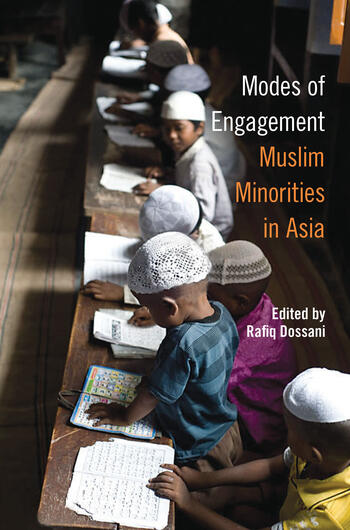
Of Asia’s 800 million Muslims, 215 million are minorities within their countries. These Muslim minorities have experienced a persistent decline in their socioeconomic and political status. Along with this decline, they are increasingly identified by their faith and largely accorded no other identity for civic relations. Why have these Muslim minorities been particularly affected during a time of unprecedented opportunities for the mainstream in Asia’s unprecedented era of growth and rising freedoms?
Using detailed analyses of China, India, and the Philippines, Modes of Engagement argues that key factors in this phenomenon include the linkage between socioeconomic decline, loss of political power, and narrowing of identity; nationalism and its associated connotations of the assimilation of minorities; the weakness of civil society generally in Asia; and the rise in regional and global alliances for security and trade.
Contributors include Wajahat Habibullah (National Commission for Minorities and National Institute of Technology, India), Rakesh Basant (Indian Institute of Management), Dru C. Gladney (Pomona College), and Joseph Chinyong Liow (Nanyang Technological University’s S. Rajaratnam School of International Studies, Singapore).
Rafiq Dossani is a senior economist at the RAND Corporation. His research interests include regional integration, security, and education. Previously, Dossani was a senior research scholar at the Shorenstein Asia-Pacific Research Center and director of the Stanford Center for South Asia.
U.S.-Japan Economic Collaboration at the State-Prefecture Level
July 28, 2014
MacCaw Hall at Arrillaga Alumni Center, Stanford University
This July, as part of the U.S.-Japan Council’s (USJC) Governors’ Circle Initiative, USJC and The Walter H. Shorenstein Asia-Pacific Research Center (APARC) will convene a Japan Governors’ Meeting in Silicon Valley. Governors from six prefectures, namely Fukuoka, Hiroshima, Oita, Okayama, Saga and Shizuoka, have confirmed their attendance, and each plans to bring a delegation of business leaders and government officials involved in bilateral economic collaboration. These governors are interested in the state of California, particularly Silicon Valley, as a leader in the fields of IT, biomedical/healthcare, automobile technology, clean energy and consumer goods. This event will serve as a catalyst for select Japanese prefectures to connect with the Silicon Valley’s innovative companies, pilot projects, and state-of-the-art technologies across a number of sectors, including technology licensing, market development, manufacturing agreements, investments, joint ventures, and strategic partnerships.
Fourteen Stanford researchers addressing global poverty through a range of academic disciplines are receiving a total of $4.6 million in awards from the university-wide Global Development and Poverty (GDP) initiative.
Their projects, which are the first to be funded by the GDP, deal with challenges of health, violence, economics, governance and education in the developing world.
“GDP seeks to transform scholarly activity and dialogue at Stanford around the topic of global poverty, so that the university may have a greater impact on poverty alleviation in developing economies,” said GDP faculty co-chair Jesper B. Sørensen. “By focusing on placing a small number of big bets, GDP encourages researchers to think big, and to move beyond the conventional way of doing things. We are thrilled by the inaugural set of awardees, as they demonstrate the creative, inter-disciplinary approaches that will make Stanford a leader in this area.”
The GDP initiative is part of the Stanford Institute for Innovation in Developing Economies (SEED) and is administered in partnership with Stanford's Freeman Spogli Institute for International Studies (FSI). The GDP is co-chaired by Sørensen, the faculty director for SEED and the Robert A. and Elizabeth R. Jeffe Professor of Organizational Behavior at the Graduate School of Business; and Mariano-Florentino Cuéllar, senior fellow and director of FSI and the Stanley Morrison Professor at Stanford Law School.
SEED, which seeks to alleviate poverty by stimulating the creation of economic opportunities through innovation, entrepreneurship and the growth of businesses, was established in 2011 through a generous gift from Robert King, MBA '60, and his wife, Dorothy.
Through complementary areas of focus, GDP funding and other SEED research initiatives will stimulate research, novel interdisciplinary collaborations and solutions to problems of global poverty and development. GDP research aims to pursue answers to crucial questions that are essential to an understanding of how to reduce global poverty and promote economic development. That includes governance and the rule of law, education, health, and food security – all of which are essential for entrepreneurship to thrive. By contrast, other SEED research focuses on innovation, entrepreneurship, and the growth of businesses in developing economies.
Since 2012, SEED’s Entrepreneurship and Innovation in Developing Economies Award program also has doled out 22 awards and seven PhD fellowships to help support and scale businesses in developing economies. Among the $1 million in funded projects were studies of how to improve the livelihoods of small-holder cacao farmers throughout the tropics; how to identify startups with high job- and wealth-creating potential in Chile; how political accountability affects the ability to attract investment in Sierra Leone; and how managerial practices affect trade entrepreneurship in China.
First GDP Awards
The first 14 GDP award recipients are professors of economics, political science, law, medicine, pediatrics, education and biology, and senior fellows from FSI, the Woods Institute, and the Stanford Institute for Economic Policy Research (SIEPR).
“Each of these projects cuts across disciplines, reflects innovative thinking, and has the potential to generate crucial knowledge about how to improve the lives of the poor around the world,” Cuéllar said. “These projects, along with a variety of workshops engaging the university and external stakeholders, will help us strengthen Stanford’s long-term capacity to address issues of global poverty through research, education and outreach.”
Among the award recipients is Pascaline Dupas, an associate professor of economics and senior fellow at SIEPR. Dupas, along with faculty from the Center for Health Policy and Center on Democracy, Development and the Rule of Law, will launch the Stanford Economic Development Research Initiative using GDP funds. This initiative will focus on collecting high-quality institutional and individual-level data on economic activity in a number of developing countries over the long term, and making these data available to scholars around the world.
Beatriz Magaloni, an associate professor of political science and senior fellow at FSI, is receiving an award to lead a team focused on criminal violence and its effects on the poor in developing economies, and the practical solutions for increasing security in those regions.
Douglas K. Owens, a professor of medicine and FSI senior fellow, was awarded an award to help him lead a team that will develop models to estimate how alternative resource allocations for health interventions among the poor will influence health and economic outcomes.
Stephen Haber, a professor of political science and history and a senior fellow at the Hoover Institution, received an award to bring together Stanford researchers interested in examining the long-term institutional constraints on economic development. Their goal will be to provide policymakers with a framework for determining the conditions under which particular innovations are likely to have positive payoffs, and the conditions under which resources will likely be wasted.
Other projects will address the educational impacts of solar lighting systems in poor communities; identifying interventions to improve the profits and safety among poor, smallholder pig farmers in Bangladesh and China; the role of law and institutions in economic development and poverty reduction; and how to rethink worldwide refugee problems. Awards are also being provided to researchers focused on microfinance, online education and teacher training.
The project proposals were reviewed by an interdisciplinary faculty advisory council chaired by Cuéllar and Sørensen.
“We were very encouraged by the impressive number of project proposals from a wide range of areas and are looking forward to introducing several new capacity and community-building activities in the fall,” Sørensen said.. “This wide range of research initiatives will form a vibrant nucleus for Stanford’s growing community of scholars of global development and poverty.”
In early 2014, Stanford Graduate School of Business (GSB) launched a new organization structured to further increase the research support of our faculty and their teaching objectives. That group, called Centers and Initiatives for Research, Curriculum and Learning Experiences (CIRCLE), supports areas of academic focus including social innovation, entrepreneurship, value chain, data and analytics, and corporate governance, in addition to China-related work.
With staffing and a facility now grounded in Beijing, the GSB is transitioning management of our China initiatives to CIRCLE led by Wendy York-Fess, Assistant Dean and Executive Director. Within CIRCLE, Frank Hawke, located in Beijing, is the director of GSB China-related activities designed to continue the focus on building a bridge between China and Silicon Valley.
Going forward, updates on China programs will be communicated through other GSB online channels. Content hosted on this site will remain available, and we encourage you to engage with our rich library of videos, podcasts, and stories.
China 2.0 originated from within the Stanford Program on Regions of Innovation and Entrepreneurship (SPRIE), which was active from 1998 through fall 2013. Led by faculty co-directors William F. Miller and Henry S. Rowen, with Associate Director Marguerite Gong Hancock, SPRIE was dedicated to the understanding and practice of innovation and entrepreneurship in leading regions around the world. SPRIE fulfilled its mission through interdisciplinary and international collaborative research, seminars and conferences, publications, and briefings for industry and government leaders.
“We are grateful to have made our home at two remarkable parts of Stanford, the Shorenstein Asia Pacific Research Center until 2011 and then the Graduate School of Business,” said Henry Rowen. William Miller added, “The impact of SPRIE’s work among leaders around the world has been made possible through wonderful relationships with faculty colleagues across the university and beyond, active Advisory Board members, generous donors, engaging alumni and students, strong corporate and government partners, and extraordinary staff.”
Under the direction SPRIE faculty co-directors William F. Miller and Henry S. Rowen, Marguerite Gong Hancock launched and led China 2.0 from 2010 to June 2014. Important contributors to the development of the program included faculty from across campus, a distinguished and active Advisory Board, generous donors and sponsors, as well as GSB staff, including China 2.0 team members Yan Mei and Rustin Crandall. During this time, it has grown into a platform for convening thought leaders in China and Silicon Valley, supporting cutting-edge research and curriculum development by faculty, and organizing programs to educate students as next-generation leaders.
Through conferences at Stanford University and in Beijing, to date China 2.0 has engaged with more than 100 speakers, dozens of media, and more than 2,500 Stanford faculty, students, and alumni. China 2.0 seminars have enhanced student educational experiences and facilitated cross-campus faculty and student interaction. China 2.0 content has become part of our classrooms, online resources, and also reached hundreds of thousands of viewers in English and Chinese.
As part of the GSB reorganization, we are pleased to announce that Marguerite Gong Hancock is now the director for a new CIRCLE research effort called Stanford Project on Emerging Companies 2.0 (SPEC 2.0), where she will focus on supporting faculty research on entrepreneurship, as part of the Center for Entrepreneurial Studies.
While our organization has changed, Stanford Graduate School of Business remains committed to bringing together executives, entrepreneurs, investors, policy makers, academics and students through a number of existing and emerging programs related to innovation and entrepreneurship around the world.
Gi-Wook Shin, director of the Shorenstein Asia-Pacific Research Center, urged Korea to embrace diversity in order to achieve broader social integration in a keynote speech delivered at the Korea Forum 2014 in Seoul. Korea needs to shift its orientation to “respecting differences while maintaining shared goals," he said.
Hero Image
A reminder to vote in South Korea's regional elections on June 4, one that was said to act as a referendum and encourage reform. | Flickr/Travel Oriented
Mari Tanaka1, a Ph.D. candidate in economics at Stanford, has been named the Shorenstein APARC Predoctoral Fellow in Contemporary Asia for 2014–15. She will join the Shorenstein Asia-Pacific Research Center this fall, examining the effects of enterprise development and international trade in low-income countries.
The fellowship supports a Stanford predoctoral student researching topics related to contemporary political, economic and social change in the Asia-Pacific region.
Tanaka’s dissertation focuses on the impact of Myanmar’s recent trade opening on local manufacturing firms. She is interested in how trade with the United States, European Union and Japanese buyers affects firms’ management practices and working conditions, particularly safety and health standards.
By analyzing data collected in about 400 firms in 2013–14, Tanaka plans to compare the evolutions of those measures in garment plants, an industry heavily affected by trade opening, to processed food plants, an industry little affected because of strict food regulations imposed by developed countries.
Tanaka is a fourth-year Ph.D. student in economics at Stanford. She holds a master’s degree in economics from the University of Tokyo and a bachelor’s degree from the International Christian University, Japan.
Hero Image
The skyline of Yangon, Myanmar's largest city. | Flickr/World Bank
South Korea held their regional elections on June 4th, not long after the Sewol ferry capsized and claimed the lives of many school-aged children. The ballot was largely viewed as a referendum on President Park Geun-hye’s response to the ferry tragedy. In the Economist, Shorentein APARC Director Gi-Wook Shin says Ms. Park will likely take the poll results as an opportunity to reform.
The Obama administration’s policy of “re-balance” toward Asia, that began as early as 2009, is now increasingly under stress, as those in the region question American staying power and China emerges as a challenger to U.S. dominance. As the territorial disputes in the East and South China Seas in recent months have demonstrated, China’s relations with the region and the United States have become visibly strained, bringing the U.S. re-balance policy into question and raising concerns about security tensions and the danger of conflict.
U.S.-China relations are heading, for the foreseeable future, into “a very scratchy time,” predicted Kenneth Lieberthal, a respected senior China scholar at The Brookings Institution, in his keynote speech delivered at the annual Oksenberg Lecture on June 3 at the Shorenstein Asia-Pacific Research Center.
Lieberthal told a standing room audience in Encina Hall that while the U.S. attempt to temper its relations with China and others has “worked quite well over time,” now, “at a geostrategic level, we seem to be sliding with increasing speed toward an inflection point in U.S.-China relations.”
The discussion was part of the Oksenberg Lecture, an annual dialogue that functions as a policy workshop on U.S.-Asia relations, named in honor of late professor and senior fellow Michel Oksenberg (1938–2001). Oksenberg was a noted China specialist, who served as a senior member of the National Security Council and is credited as the architect of the normalization of relations with China under the Carter administration in the late 1970s.
Points of tension in the U.S.-China relationship have been increasingly visible. Senior American officials have assailed China for its aggressive actions toward its neighbors over the Diaoyu/Senkaku Islands and in South China Sea, including its latest altercations with Vietnam and the Philippines. The United States recently indicted five members of China’s People’s Liberation Army for carrying out cyber espionage against U.S. technology companies.
Incidents like these have prompted both countries to throw harsh words at each other, leading to a situation of brinkmanship. However, Lieberthal pointed out that tense relations between the United States and China are certainly not new. Most notably, relations took a nosedive in 1989 when China cracked down on democratization protests at Tiananmen Square, in 1999 after the accidental bombing of the Chinese Embassy in Serbia, and in 2008, in response to the global financial crisis.
The U.S.-China relationship has been riddled with periods of distrust in the past. But now, “the speed and scale of China’s economic growth, especially over the last two decades, has also increased concerns, on all sides, that the evolving distribution of power may create new frictions and suspicions,” Lieberthal said.
Yet, refusing to work with each other is not an option, the senior scholar, who also served in the Clinton administration, told the audience. Without the United States and China in conversation, progress in multilateral areas such as climate change and trade would falter, he argued. Given the two countries’ position as the world’s largest economies, the international system would effectively be constrained if the two were entrenched in long-term bitterness.
Lieberthal recognized the common admonition, “if we treat China as an enemy, it will surely become one,” saying this warning could be applied to both sides. China and the United States must make greater efforts to manage and mitigate tensions.
“The question is whether we can prevent bad things, not only specific conflicts, but the political tensions and politics that make cooperation on major issues very, very difficult at best.”
He then outlined a few steps that could help China and the United States sort out their disputes. His recommendations began with the need for strong determination on the part of top political leaders to move things forward and the importance of clear, consistent use of vocabulary when discussing issues.
As a final point, but one that was offered as a contingent factor to success, Lieberthal said U.S.-China relations and both countries’ roles in greater Asia will depend on “how effective each of us is in dealing with domestic reforms,” because, “that will determine how dynamic, how vibrant, how innovative, and how secure we feel.”
During the lecture, Ret. Lt. Gen. Karl Eikenberry shared his observations from the Shangri-La Dialogue, an inter-governmental security forum held from May 30 – June 1 in Singapore. The Dialogue has in recent years become a gathering of premiere defense ministers to discuss security issues in Track I and “quasi-track” meetings.
Afterward, Eikenberry talked with Shorenstein APARC about key highlights and implications that emerged from the Dialogue:
Shangri-La Dialogue
Photo credit: Flickr/The International Institute for Strategic Studies
Media reported a tense environment overlaid the Dialogue. What was the general atmosphere there?
The remarks at the Shangri-La Dialogue by Japanese Prime Minister Abe and U.S. Defense Secretary Hagel on the one hand, and Chinese General Wang Guanzhong, made clear very different views on the causes for tension surrounding various maritime sovereignty claims in the East and South China Seas. Still, if you read the full text of all three speeches and the Q&As that followed, there is still great emphasis placed on dialogue and common interests. And in the many meetings that took place between national delegations on the margins of the conference events, the emphasis was on cooperation.
What revelations at the Dialogue were surprising?
I think the degree to which dissatisfaction with China’s assertive behavior in pursuing its maritime claims was expressed by many of the participants – not just the United States and Japan. Vietnam, the Philippines and India were explicit. Analysts have said the only China (through threatening behavior) could contain China by catalyzing a counterbalancing response. From the results of the Dialogue, I think this is correct.
Japanese Prime Minister Shinzo Abe emphasized values and international law throughout his keynote speech. What is your take on this?
The Prime Minister did emphasize both democracy and rule of law during his prepared remarks and answers to questions from conference participants. He was drawing an obvious distinction between Japan’s and China’s political systems and commitment to approaches to resolving territorial disputes. I think the Prime Minister is trying to establish Japan as a leader in East and Southeast Asia, and wanted to make clear what he views as important differences between the Japanese and Chinese “models.”
U.S. Defense Secretary Chuck Hagel referenced China’s suspension of the U.S.-China Cyber Working Group. What direction do you think the cybersecurity dialogue will go now?
It was unfortunate that China suspended its participation in the U.S.-China Cyber Working Group after the U.S. Government’s indictment of five People’s Liberation Army officers for alleged cyber theft. The U.S. Government has been providing the PRC Government with evidence of cyber theft being conducted by entities in China and has failed to receive any meaningful response so the indictments seem warranted. It would seem that the Cyber Working Group is precisely the forum to discuss this matter and the many related to managing the cyber domain with agreed rules and procedures. Working Groups provide a forum to address disagreement and disputes. I think China’s response was counterproductive and hope the government will indicate a willingness to resume the dialogues in the near future.
Where do you see the regional security conversation heading next?
The risk is that security dialogues will be divided into two camps – one led by the United States and its close allies and partners, and the other by China – somewhat isolated at this time but seeking to entice Asian nations to bandwagon to its side. Perhaps further regional economic integration can facilitate a more common approach to security, but this year’s Shangri-La Dialogue is perhaps a warning that trends, for now, are not heading in a positive direction.
Hero Image
Kenneth Lieberthal of The Brookings Institution delivered the keynote speech at the annual Oksenberg Lecture on June 3. | Irene Bryant/Debbie Warren
Nearly forty-four percent of Indonesia’s population is living on less than $2 a day, making it near impossible for some to seek proper health treatment. One way to improve this situation is through Indonesia’s conditional cash transfer (CCT) programs, Margaret Triyana says.
The CCT program, first piloted by the World Bank in 2007 and expanded from 2009–10, encourages Indonesia’s most destitute to pursue health-seeking behaviors by reducing barriers to health care through cash incentives. Payment is given for receiving treatments at a local clinic. Essentially, the poor are reimbursed simply for “showing up” for health services.
Image
Triyana, a Jakarta native and postdoctoral fellow in the Asia Health Policy Program, has been in residence at the Shorenstein Asia-Pacific Research Center in the Freeman Spogli Institute for International Studies studying the effects of the CCT program on Indonesia’s poor. She has been evaluating the household CCT program’s two-year implementation, focusing on the maternal and child health initiatives.
She plans to produce multiple papers that focus on issues related to CCT interventions and its impact on mothers and children. Triyana will continue this research after leaving Shorenstein APARC this July, accepting an academic teaching position at Nanyang Technological University in Singapore.
Recently, Triyana discussed her research with Shorenstein APARC.
What types of health initiatives does the CCT program sponsor, and for whom?
The CCT program targets Indonesia’s most poverty-stricken by selecting approximately the bottom 30 percent of the poorest households, with preference toward households with pregnant women or school-aged children. Eligibility depends on socioeconomic factors per district such as expenditure, education and asset ownership. The program stretches the rural-urban divide, covering people in and off Java (this is the main island where 60 percent of the population resides). Many initiatives in the household CCT program are focused on child and maternal health. For mothers, they include a series of prenatal care visits, an iron tablet prescription, childbirth assistance and postnatal care. For children, they cover vaccinations, monthly height and weight measurements at the clinic and vitamin A pills. Overall the CCT program is a combination of poverty reduction and human capital investments, attempting to induce good behavior that instills long-term health in low resource settings.
Who is the typical primary care provider in Indonesia?
The primary care provider is often a midwife. This is because Indonesia doesn’t have enough trained doctors to support the growing demand. Clinics operate at the sub-district level, which comprise of 10-15 villages each. Every village is assigned one midwife. Midwives can perform most procedures just short of surgery. For example, midwives offer typical delivery services but refer patients to a district-level hospital for a Caesarean section. This system, for the most part, functions well, but midwives do have an expanded scope of care that can be unsettling. Children have their cuts taken care of by midwives; adults can get antibiotics through them. This diffused system is perhaps more efficient, but it can call into question the legitimacy of their authority. Midwives receive only three years of training for their certification. This is something the Indonesian government intends to inspect and will likely restructure.
What behavior changes do you see as a result of the CCT program?
My initial findings show there is increased utilization of health care programs. The CCT program incentivizes certain behaviors – attending the clinic for a test or retrieving medication – which then, in theory, leads to better health. “Showing up” doesn’t automatically correlate with improved health, but if we think about the population at hand, it would in most cases. People who weren’t using health services before now are. Everyone that was offered the program signed up. Monthly attendance to CCT-linked programs is reported at a rate of 85 percent. In particular to maternal health, I noted a 10 percent increase in delivery fees. This trend follows what we would expect to see – because of increased utilization, there is a natural rise in price for the service. On the demand-side, I found a 40 percent increase in the use of midwives, and a rise in fees paid to providers for maternal and child services. These factors indicate with a high level of certainty that the CCT program lowers barriers to health care.
Since health is effectively its own market, will increased demand for services cause a rise in price?
Yes, health care is its own market so the supply-demand relationship is relevant. My research looks at the local market because it depends upon the price being offered at the local clinic. Indonesia’s health care system is a public-private mixture, therefore public fees are regulated while private fees are less so. Indonesia now offers universal care, but people can pay a few for services beyond basic coverage. I saw a change in the private domain in terms of demand for services. The “demand shock” caused a bit of a higher price for services. It costs about $80 to meet all of the program requirements. Payment to midwives increased, while a slight decrease occurred for traditional birth attendants. I find no significant change in birth outcomes, and the quality provided by midwives does not appear to be affected by the program. These outcomes are exactly what we’d expect to see; it is consistent with the puzzle in the literature and economics, showing more women and children in the CCT program are seeking care from health care providers, but no change in health outcomes.
Can we expect increased utilization of health services in the long-run?
I anticipate there will be long-term increased utilization. The CCT program seeks to create habit formation by focusing on youth and pregnant mothers. For example, we can see this when expectant mothers attended the clinic for prenatal care, delivery assistance and postnatal care. With cost and travel barriers eliminated or reduced, participants should find it easier to initially come and then return. I did see repeat visits in my research as a positive outcome of the CCT program. A technique used to encourage commitment is a public education program as part of the program. Participants get a group briefing on how the program works, so that they are fully introduced to the incentives and guarantees of the program.
Does Indonesia plan to extend this into a national program?
Yes, the CCT program is planned to go national later this year. The research shows that the benchmark of high attendance was met, program participants did “show up.” Next steps are to analyze health outcomes in maternal and child health, and then look at policy implications. Indeed, the Indonesian government is seeking ways to better target and deliver health services; it will be interesting to see the long-term effects of this program.
Hero Image
Nursing students are trained in Yogyakarta, Indonesia, part of the World Bank's Health Professional Education Quality Project. | Flickr/WorldBank



 Shangri-La Dialogue