-

Koret Distinguished Lecture Series: Lecture IV

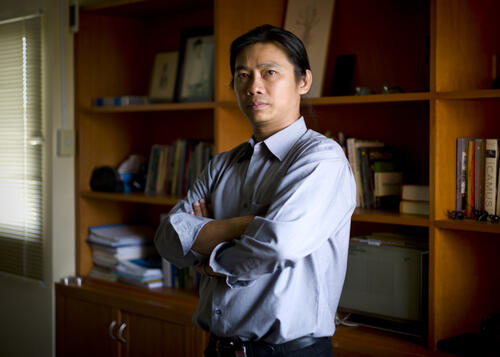
From early 2012, South Korea-Japan relations worsened due to what many Koreans regard as a series of Japanese provocations involving historical and territorial disputes. Unfortunately, the neighbors failed to utilize the opportunity to improve the situation following leadership changes in both countries at the beginning of 2013. Today their bilateral relationship, long considered a cornerstone of peace and stability in Northeast Asia, appears to the worst since the normalization of diplomatic ties in 1965. Former Korean ambassador to Japan Shin Kak-soo will analyze the complicated structural reasons behind this downward spiral and explore whether differences over history can be addressed and an early diplomatic "reset" achieved.

Ambassador Shin has served various diplomatic positions during his thirty-five year career in foreign affairs, including service as ambassador to the State of Israel from 2006 to 2008 and to Japan from 2011 to 2013. He is currently a professor at the Korean National Diplomatic Academy and also a special research fellow at the Institute of Japanese Studies, Seoul National University.

The Koret Distinguished Lecture Series was established in 2013 with the generous support of the Koret Foundation

Philippines Conference Room

Shin Kak-soo former Korean Ambassador to Japan Speaker
Lectures
-

With rising tensions over history and territory among Asian nations, China's rise as a regional power, and a so called rebalancing of the American role and presence our two most important alliances in the region will demand careful management in future years. What should we, and our partners in Japan and South Korea, be doing to assure that our alliances remain vibrant and relevant in this evolving regional context?

Ambassador Bosworth is a former career diplomat, he served as U.S. Ambassador to the Republic of Korea, the Philippines, and Tunisia. Most recently, he served as U.S. Special Representative for North Korea Policy for the Obama administration.

Philippines Conference Room

0
Payne Distinguished Lecturer, Shorenstein Asia-Pacific Research Center, Freeman Spogli Institute for International Studies
BosworthLOGO1.jpg

Stephen W. Bosworth was a Payne Distinguished Lecturer at the Walter H. Shorenstein Asia-Pacific Research Center in Freeman Spogli Institute for International Studies. He was a Senior Fellow at The Belfer Center for Science and International Affairs at the John F. Kennedy School of Government, Harvard University. He was also the Chairman of the U.S.-Korea Institute at the Johns Hopkins University Paul H. Nitze School of Advanced International Studies (SAIS). From 2001-2013, he served as Dean of The Fletcher School of Law and Diplomacy at Tufts University, where he then served as Dean Emeritus. He also served as the United States Ambassador to the Republic of Korea from 1997-2001.

From 1995-1997, Bosworth was the Executive Director of the Korean Peninsula Energy Development Organization [KEDO], an inter-governmental organization established by the United States, the Republic of Korea, and Japan to deal with North Korea. Before joining KEDO, he served seven years as President of the United States Japan Foundation, a private American grant-making institution. He also taught International Relations at Columbia University’s School of International and Public Affairs from 1990 to 1994. In 1993, he was the Sol Linowitz Visiting Professor at Hamilton College. He co-authored several studies on public policy issues for the Carnegie Endowment and the Century Fund, and, in 2006, he co-authored a book entitled Chasing the Sun, Rethinking East Asian Policy

Ambassador Bosworth had an extensive career in the United States Foreign Service, including service as Ambassador to Tunisia from 1979-1981 and Ambassador to the Philippines from 1984-1987. He served in a number of senior positions in the Department of State, including Director of Policy Planning, Principal Deputy Assistant Secretary of State for Inter-American Affairs, and Deputy Assistant Secretary for Economic Affairs. Most recently, from March 2009 through October 2011, he served as U.S. Special Representative for North Korea Policy for the Obama Administration. 

He was the recipient of many awards, including the American Academy of Diplomacy’s Diplomat of the Year Award in 1987, the Department of State’s Distinguished Service Award in 1976 and again in 1986, and the Department of Energy’s Distinguished Service Award in 1979. In 2005, the Government of Japan presented him with the Order of the Rising Sun, Gold and Silver Star. 

Bosworth was a graduate of Dartmouth College where he was a member of the Board of Trustees from 1992 to 2002 and served as Board Chair from 1996 to 2000. He was married to the former Christine Holmes; they have two daughters and two sons.

Stephen W. Bosworth Payne Distinguished Lecturer, Shorenstein Asia-Pacific Research Center, Freeman Spogli Institute for International Studies Speaker Stanford University
Seminars
News Type
News
Date
Paragraphs

Warning against the “dangers of excessive hubris,” former U.S. Ambassador Stephen W. Bosworth emphasized the intricacies and complexity of creating American foreign policy and called for the government to exercise greater restraint and better understand the countries it engages with.

The veteran diplomat and visiting lecturer at Stanford’s Freeman Spogli Institute for International Studies called for the United States to exercise greater self-restraint and better understand the history and current circumstances of countries it engages with. 

“The making of U.S. policy is inherently a very, very difficult enterprise,” said Bosworth, positioned at Stanford for winter quarter.

“The issues tend to be complex, and they frequently pose moral as well as political choices,” he said. “I found that perfection is usually the enemy of the good in the making of foreign policy and is, for the most part, unattainable.”

Foreign policy can be ambiguous and difficult at times; it is a process that can be compared to gardening because “you have to keep tending to it regularly,” Bosworth said, referencing former Secretary of State George Shultz’s well-known analogy.

Bosworth, who served for five decades in the U.S. government and for 12 years as dean of Tuft’s Fletcher School of Law and Diplomacy, delivered these thoughts in the first of three public seminars this quarter. He is the Frank E. and Arthur W. Payne Distinguished Lecturer in residence at FSI’s Walter H. Shorenstein Asia-Pacific Research Center (Shorenstein APARC).

He cautioned against America’s tendency to revert to military power when crisis occurs. “I believe that when at all possible, we need to choose diplomacy over force,” Bosworth asserted, “although it is sometimes true that diplomacy backed by potential force can be more effective.” 

Citing Afghanistan, Iraq and Southwest Asia, Bosworth noted these among other examples as situations of excessive power projected by the American foreign policy arm. In some cases, pride may have gotten the better of policymakers who sometimes “want to be seen as doers and solvers.”

Bosworth pointed out that the nature of our actions speaks loudly – both at home and abroad – thus sensitivity and sincerity are important in any international exchange.

Since the Vietnam War, American values and the push for democracy are not always well received by other countries. And there’s often good reason for that, he said.

“It is awkward for the U.S. to campaign for more democracy elsewhere when our own model seems to have increasing difficulty in producing reasonable solutions for our own problems,” he said.

Democracy is “not a cure-all” for every nation and this is reflected in the amended model adopted by countries such as Singapore, Indonesia and Burma. However, Bosworth said he remains confident that the American democratic system “will prevail and eventually work better than it seems to be working now.”

Bosworth will explore the challenges of maturing democracies in Japan and South Korea and negotiations and management of relations with North Korea in his two other Payne lectures. The Payne Lectureship brings prominent speakers to campus for their global reputation as visionary leaders, a practical grasp of a given field, and the capacity to articulate important perspectives on today’s global challenges.

Bosworth entered the Foreign Service in 1961, a difficult yet “exciting time to join the government,” he said.

“At the age of 21, I was the youngest person entering my class,” he said, “and of the 38 people, there were only two women…and were zero persons of color and only a handful who were not products of an Ivy League education.” The State Department of then is very different compared to the one that exists today; this signals positive, necessary change in the diplomatic corps.

Bosworth, having served three tours as a U.S. ambassador in South Korea (from 1997 to 2001); the Philippines (from 1984 to 1987); and Tunisia (from 1979 to 1981) and twice received the State Department’s Distinguished Service Award (in 1976 and 1986), has a long established career.

He brings great wisdom on foreign affairs given his extensive engagement as a practitioner and a writer, said former colleague and Shorenstein APARC distinguished fellow Michael H. Armacost.

“To say that Steve has had an extraordinarily distinguished career in the Foreign Service doesn't quite capture the range of his accomplishments, I can’t think of very many Foreign Service officers in this or any other generation that have left a footprint on big issues in three consecutive decades,” Armacost acknowledged. 

During his time at Stanford, Bosworth will hold seminars and mentor students who may be interested in pursuing a career in the Foreign Service, in addition to the two upcoming public talks.

A student seeking this very advice posed a question in the discussion portion following Bosworth’s talk.

Speaking to anyone considering a Foreign Service career, Bosworth said one must “think about it hard, and think again.” He said public service is a privilege, not so much a sacrifice as the typical notion holds. “It can be a great career as long as you have the right perspective on it,” he ended.

Hero Image
Bosworth speaking LOGO
All News button
1
-

This is a keynote speech open to the public during the Sixth Annual Koret Conference on "Engaging North Korea: Projects, Challenges, and Prospects."

The North Korean nuclear threat has now been with us for more than a quarter century.  Our policy of "strategic patience" seems more patient than strategic as the US waits for Pyongyang to meet certain preconditions before we return to the bargaining table.  But North Korea continues to develop both its nuclear weapons and missile systems, and there are no negotiations in sight.  What alternatives are there to our current approach?  If so, what might those look like?

Ambassador Bosworth is a former career diplomat, he served as U.S. Ambassador to the Republic of Korea, the Philippines, and Tunisia. Most recently, he served as U.S. Special Representative for North Korea Policy for the Obama administration. 


Oksenberg Conference Room

0
Payne Distinguished Lecturer, Shorenstein Asia-Pacific Research Center, Freeman Spogli Institute for International Studies
BosworthLOGO1.jpg

Stephen W. Bosworth was a Payne Distinguished Lecturer at the Walter H. Shorenstein Asia-Pacific Research Center in Freeman Spogli Institute for International Studies. He was a Senior Fellow at The Belfer Center for Science and International Affairs at the John F. Kennedy School of Government, Harvard University. He was also the Chairman of the U.S.-Korea Institute at the Johns Hopkins University Paul H. Nitze School of Advanced International Studies (SAIS). From 2001-2013, he served as Dean of The Fletcher School of Law and Diplomacy at Tufts University, where he then served as Dean Emeritus. He also served as the United States Ambassador to the Republic of Korea from 1997-2001.

From 1995-1997, Bosworth was the Executive Director of the Korean Peninsula Energy Development Organization [KEDO], an inter-governmental organization established by the United States, the Republic of Korea, and Japan to deal with North Korea. Before joining KEDO, he served seven years as President of the United States Japan Foundation, a private American grant-making institution. He also taught International Relations at Columbia University’s School of International and Public Affairs from 1990 to 1994. In 1993, he was the Sol Linowitz Visiting Professor at Hamilton College. He co-authored several studies on public policy issues for the Carnegie Endowment and the Century Fund, and, in 2006, he co-authored a book entitled Chasing the Sun, Rethinking East Asian Policy

Ambassador Bosworth had an extensive career in the United States Foreign Service, including service as Ambassador to Tunisia from 1979-1981 and Ambassador to the Philippines from 1984-1987. He served in a number of senior positions in the Department of State, including Director of Policy Planning, Principal Deputy Assistant Secretary of State for Inter-American Affairs, and Deputy Assistant Secretary for Economic Affairs. Most recently, from March 2009 through October 2011, he served as U.S. Special Representative for North Korea Policy for the Obama Administration. 

He was the recipient of many awards, including the American Academy of Diplomacy’s Diplomat of the Year Award in 1987, the Department of State’s Distinguished Service Award in 1976 and again in 1986, and the Department of Energy’s Distinguished Service Award in 1979. In 2005, the Government of Japan presented him with the Order of the Rising Sun, Gold and Silver Star. 

Bosworth was a graduate of Dartmouth College where he was a member of the Board of Trustees from 1992 to 2002 and served as Board Chair from 1996 to 2000. He was married to the former Christine Holmes; they have two daughters and two sons.

Stephen W. Bosworth former U.S. Special Representative for North Korea Policy Speaker
Lectures
-

The opening up of Myanmar (Burma) and the steps undertaken taken toward political reform in that formerly isolated dictatorship have been among Asia's most dramatic and least expected events.  But the establishment of full democracy is still on the agenda and faces many challenges.  How willing is the current government in Burma to allow a full and free exercise of political rights, including media freedom?  A panel of experts, including Aung Zaw, the editor and founder of The Irrawaddy and this year's recipient of the Shorenstein Award for Journalism in Asia, will address that question in discussing "Burma's Democracy:  How Real?"

Stanford University’s Walter H. Shorenstein Asia-Pacific Research Center (Shorenstein APARC) is pleased to announce Aung Zaw as the 2013 recipient of the Shorenstein Journalism Award. Zaw has been selected for his leadership in establishing independent media in Myanmar (Burma) and his dedication to integrity in reporting on Southeast Asia.

Image
 Aung Zaw

Aung Zaw is the founding editor-in-chief and executive director of The Irrawaddy, an independent Burmese media organization operating in Myanmar and northern Thailand. Zaw has been an active campaigner for democratic reform in Burma/Myanmar over the last two decades. He was awarded the 2010 Prince Claus Fund Award for journalism along with two journalists from Iran and Cuba – and is recognized for his active dedication to achieving democratic governance in Burma and his work to uphold press freedom.

Zaw studied Botany at Rangoon University. As a student activist in Burma, he was part of the 1988 protests in Rangoon against the Burmese military regime of General Ne Win. He was arrested and detained for a week in Rangoon’s notorious Insein prison where he was severely tortured during interrogation about his pro-democracy activities. Upon release Aung Zaw continued to work with the resistance movement until the military staged a coup in September that year and he was forced to leave the country for neighboring Thailand.

Two years later, Aung Zaw founded the Burma Information Group (BIG) in Bangkok, to document human rights violations in Burma. He began to write political commentaries for national newspapers in Thailand and internationally, and in late 1993 launched The Irrawaddy News Magazine in Bangkok, covering Burma affairs. He worked in Bangkok for two years producing The Irrawaddy Magazine until relocating to the more secure position in Chiang Mai in the north of Thailand.

In February 2012, Aung Zaw was able to return to his homeland for the first time in more than 20 years for a temporary visit as an independent journalist. By the end of 2012, The Irrawaddy was able to establish a media and news office in central Yangon, returning to Burma/Myanmar to practice independent journalism, whilst retaining a regional office in Thailand.

In 2013, the government lifted ban on The Irrawaddy and other exiled websites, the Irrawaddy English magazine and the Irrawaddy Dateline Current Affairs TV program is available for audiences in Myanmar. Aung Zaw writes for New York Times, International Herald Tribune, Time, The Guardian, Bangkok Post, The Nation and several publications in the Europe. His interviews have also appeared on CN, BBC and Al Jazeera. He is the author of the Face of Resistance and is a recent Visiting Scholar at UC Berkeley, School of Journalism.

Bechtel Conference Center

Aung Zaw 2013 Journalism Prize Winner and Founder and Editor, The Irrawaddy News Magazine Panelist
Nayan Chanda Director of Publications and the Editor of YaleGlobal Online Magazine Panelist Yale Center for the Study of Globalization
0
Senior Fellow Emeritus at the Freeman Spogli Institute for International Studies
Affiliated Faculty, CDDRL
Affiliated Scholar, Abbasi Program in Islamic Studies
aparc_dke.jpg PhD

At Stanford, in addition to his work for the Southeast Asia Program and his affiliations with CDDRL and the Abbasi Program in Islamic Studies, Donald Emmerson has taught courses on Southeast Asia in East Asian Studies, International Policy Studies, and Political Science. He is active as an analyst of current policy issues involving Asia. In 2010 the National Bureau of Asian Research and the Woodrow Wilson International Center for Scholars awarded him a two-year Research Associateship given to “top scholars from across the United States” who “have successfully bridged the gap between the academy and policy.”

Emmerson’s research interests include Southeast Asia-China-US relations, the South China Sea, and the future of ASEAN. His publications, authored or edited, span more than a dozen books and monographs and some 200 articles, chapters, and shorter pieces.  Recent writings include The Deer and the Dragon: Southeast Asia and China in the 21st Century (ed., 2020); “‘No Sole Control’ in the South China Sea,” in Asia Policy  (2019); ASEAN @ 50, Southeast Asia @ Risk: What Should Be Done? (ed., 2018); “Singapore and Goliath?,” in Journal of Democracy (2018); “Mapping ASEAN’s Futures,” in Contemporary Southeast Asia (2017); and “ASEAN Between China and America: Is It Time to Try Horsing the Cow?,” in Trans-Regional and –National Studies of Southeast Asia (2017).

Earlier work includes “Sunnylands or Rancho Mirage? ASEAN and the South China Sea,” in YaleGlobal (2016); “The Spectrum of Comparisons: A Discussion,” in Pacific Affairs (2014); “Facts, Minds, and Formats: Scholarship and Political Change in Indonesia” in Indonesian Studies: The State of the Field (2013); “Is Indonesia Rising? It Depends” in Indonesia Rising (2012); “Southeast Asia: Minding the Gap between Democracy and Governance,” in Journal of Democracy (April 2012); “The Problem and Promise of Focality in World Affairs,” in Strategic Review (August 2011); An American Place at an Asian Table? Regionalism and Its Reasons (2011); Asian Regionalism and US Policy: The Case for Creative Adaptation (2010); “The Useful Diversity of ‘Islamism’” and “Islamism: Pros, Cons, and Contexts” in Islamism: Conflicting Perspectives on Political Islam (2009); “Crisis and Consensus: America and ASEAN in a New Global Context” in Refreshing U.S.-Thai Relations (2009); and Hard Choices: Security, Democracy, and Regionalism in Southeast Asia (edited, 2008).

Prior to moving to Stanford in 1999, Emmerson was a professor of political science at the University of Wisconsin-Madison, where he won a campus-wide teaching award. That same year he helped monitor voting in Indonesia and East Timor for the National Democratic Institute and the Carter Center. In the course of his career, he has taken part in numerous policy-related working groups focused on topics related to Southeast Asia; has testified before House and Senate committees on Asian affairs; and been a regular at gatherings such as the Asia Pacific Roundtable (Kuala Lumpur), the Bali Democracy Forum (Nusa Dua), and the Shangri-La Dialogue (Singapore). Places where he has held various visiting fellowships, including the Institute for Advanced Study and the Woodrow Wilson International Center for Scholars. 


Emmerson has a Ph.D. in political science from Yale and a BA in international affairs from Princeton. He is fluent in Indonesian, was fluent in French, and has lectured and written in both languages. He has lesser competence in Dutch, Javanese, and Russian. A former slam poet in English, he enjoys the spoken word and reads occasionally under a nom de plume with the Not Yet Dead Poets Society in Redwood City, CA. He and his wife Carolyn met in high school in Lebanon. They have two children. He was born in Tokyo, the son of U.S. Foreign Service Officer John K. Emmerson, who wrote the Japanese Thread among other books.

Selected Multimedia

Date Label
Donald K. Emmerson Senior Fellow at FSI, Emeritus; Affiliated Faculty, CDDRL; Affiliated Scholar, Abbasi Program in Islamic Studies and Director, Southeast Asia Forum Panelist Stanford University
Daniel C. Sneider Associate Director for Research, Shorenstein Asia-Pacific Research Center Moderator Stanford University
Panel Discussions
News Type
News
Date
Paragraphs

Stephen W. Bosworth, a former diplomat and expert on Korea, will spend the winter quarter at Stanford as a visiting lecturer.

Bosworth was a United States ambassador to three countries: South Korea (from 1997 to 2001); the Philippines (from 1984 to 1987); and Tunisia (from 1979 to 1981).

He was the President Barack Obama’s Special Representative for North Korea Policy between 2009 and 2011 and held several other senior positions at the State Department. He was a dean of the Fletcher School of Law and Diplomacy at Tufts University and is currently a senior fellow at Harvard’s Belfer Center for Science and International Affairs.

At Stanford, he will be a Payne Distinguished Lecturer at the Freeman Spogli Institute for International Studies, in residence at FSI’s Walter H. Shorenstein Asia-Pacific Research Center.

Prior to his arrival at Stanford University, Bosworth also served as the Director of Policy Planning, Principal Deputy Assistant Secretary of State for Inter-American Affairs, and Deputy Assistant Secretary for Economic Affairs, among other senior level positions at the State Department. Bosworth co-authored Chasing the Sun, Rethinking East Asian Policy in 2006, and focuses on U.S.-Asia foreign policy, energy security and inter-governmental relations.

The Payne lectureship, named after Frank and Arthur Payne, presents prominent speakers chosen for their international reputation as leaders who emphasize visionary thinking, a broad grasp of a given field, and the capacity to engage the larger community in important issues. Former FBI Director Robert Mueller is also spending this academic year as a Payne lecturer.

Bosworth will deliver three public lectures at Stanford. His first talk will focus on his extensive experience in the diplomatic service. The public lecture and reception will take place in the Bechtel Conference Center in Encina Hall on Feb. 3. The two other lectures will address negotiations and relations between North Korea and the U.S. management of its alliance with Japan and South Korea.

Hero Image
DoS Bosworth LOGO2
All News button
1
0
Payne Distinguished Lecturer, Shorenstein Asia-Pacific Research Center, Freeman Spogli Institute for International Studies
BosworthLOGO1.jpg

Stephen W. Bosworth was a Payne Distinguished Lecturer at the Walter H. Shorenstein Asia-Pacific Research Center in Freeman Spogli Institute for International Studies. He was a Senior Fellow at The Belfer Center for Science and International Affairs at the John F. Kennedy School of Government, Harvard University. He was also the Chairman of the U.S.-Korea Institute at the Johns Hopkins University Paul H. Nitze School of Advanced International Studies (SAIS). From 2001-2013, he served as Dean of The Fletcher School of Law and Diplomacy at Tufts University, where he then served as Dean Emeritus. He also served as the United States Ambassador to the Republic of Korea from 1997-2001.

From 1995-1997, Bosworth was the Executive Director of the Korean Peninsula Energy Development Organization [KEDO], an inter-governmental organization established by the United States, the Republic of Korea, and Japan to deal with North Korea. Before joining KEDO, he served seven years as President of the United States Japan Foundation, a private American grant-making institution. He also taught International Relations at Columbia University’s School of International and Public Affairs from 1990 to 1994. In 1993, he was the Sol Linowitz Visiting Professor at Hamilton College. He co-authored several studies on public policy issues for the Carnegie Endowment and the Century Fund, and, in 2006, he co-authored a book entitled Chasing the Sun, Rethinking East Asian Policy

Ambassador Bosworth had an extensive career in the United States Foreign Service, including service as Ambassador to Tunisia from 1979-1981 and Ambassador to the Philippines from 1984-1987. He served in a number of senior positions in the Department of State, including Director of Policy Planning, Principal Deputy Assistant Secretary of State for Inter-American Affairs, and Deputy Assistant Secretary for Economic Affairs. Most recently, from March 2009 through October 2011, he served as U.S. Special Representative for North Korea Policy for the Obama Administration. 

He was the recipient of many awards, including the American Academy of Diplomacy’s Diplomat of the Year Award in 1987, the Department of State’s Distinguished Service Award in 1976 and again in 1986, and the Department of Energy’s Distinguished Service Award in 1979. In 2005, the Government of Japan presented him with the Order of the Rising Sun, Gold and Silver Star. 

Bosworth was a graduate of Dartmouth College where he was a member of the Board of Trustees from 1992 to 2002 and served as Board Chair from 1996 to 2000. He was married to the former Christine Holmes; they have two daughters and two sons.

0
kharis_templeman_2018.jpg

Kharis Templeman is the former project manager of the Taiwan Democracy and Security Project in the U.S.-Asia Security Initiative at the Shorenstein Asia-Pacific Research Center (APARC). He currently serves as advisor to the Taiwan Democracy and Security Project. A fluent Mandarin speaker, he has lived, worked and traveled extensively in both Taiwan and the People’s Republic of China.

His research includes projects on party system institutionalization and partisan realignments, electoral integrity and manipulation in East Asia, the politics of defense spending in Taiwan, and the representation of Taiwan’s indigenous minorities. His most recent publication is “The China Model: How Successful Is the Chinese Regime?” a review essay in the Taiwan Journal of Democracy. He is also the editor (with Larry Diamond and Yun-han Chu) of Taiwan’s Democracy Challenged: The Chen Shui-bian Years (2016, Lynne Rienner Publishing). Other work has appeared in Comparative Political Studies and the APSA Comparative Democratization Newsletter.

Dr. Templeman currently serves as coordinator of the American Political Science Association Conference Group on Taiwan Studies (CGOTS) and as a regional manager for the Varieties of Democracy (V-Dem) Project. He holds a BA (2003) from the University of Rochester and a PhD (2012) in political science from the University of Michigan.

Former Project Manager, Taiwan Democracy and Security Project
Date Label
-

WE ARE AT FULL CAPACITY - PLEASE ARRIVE EARLY FOR A SEAT

In China Goes Global, eminent China scholar David Shambaugh delivers the book many have been waiting for—a sweeping account of China's growing prominence on the international stage. Thirty years ago, China's role in global affairs beyond its immediate
East Asian periphery was decidedly minor and it had little geostrategic power. As Shambaugh charts, though, China's expanding economic power has allowed it to extend its reach virtually everywhere—from mineral mines in Africa, to currency markets in the West, to oilfields in the Middle East, to agribusiness in Latin America, to the factories of East Asia. Shambaugh offers an enlightening look into the manifestations of China's global presence: its extensive commercial footprint, its growing military power, its increasing cultural influence or "soft power," its diplomatic activity, and its new prominence in global governance institutions. But Shambaugh is no alarmist. In this balanced and well-researched volume, he argues that China's global presence is more broad than deep and that China still lacks the influence befitting a major world power—what he terms a "partial power."

---

David Shambaugh is professor of political science and international affairs and director of the China Policy Program at George Washington University, as well as a nonresident senior fellow in the Foreign Policy Studies Program at the Brookings Institution in Washington, D.C. His most recent books include Tangled Titans: The United States and China; Charting China's Future: Domestic & International Challenges; and China's Communist Party: Atrophy & Adaptation.


**Books will be available for purchase at the talk.**

Philippines Conference Room

David Shambaugh Director, China Policy Program Speaker George Washington University
Seminars
Authors
News Type
News
Date
Paragraphs

U.N. Secretary-General Ban Ki-moon on Thursday urged Stanford students to become global citizens, working together beyond borders for peace, security and a common prosperity.

"You may come from the United States or Korea, Japan or elsewhere, Arab countries, but you're now part of a global family," Ban said to a crowded auditorium during his campus visit. "Therefore, it's very important to raise your capacity as global citizens. Only then, I think we can say, we're living in a very harmoniously prosperous world."

Despite a troubling tally of crises around the world, Ban was hopeful about the future, and said he gains inspiration from the younger generation.

"Everything my life has taught me points to the power of international solidarity to overcome any obstacle," he said.

Ban's speech, sponsored by Stanford's Freeman Spogli Institute for International Studies and the Walter H. Shorenstein Asia-Pacific Research Center, kicked off a series of events celebrating the 30th anniversary of the center.

Ban was introduced by former Secretary of Defense William Perry, an FSI senior fellow, who lauded Ban for his work on women's rights, climate change, nuclear disarmament and gay rights.

Ban told the audience that the world was undergoing massive changes and outlined three ways to navigate the transition: sustainable development, empowering young people and women, and pursuing dignity and democracy.

"The level and degree of global change that we face today is far more profound than at any other period in my adult lifetime," he said.

"We have no time to lose," he added later.

California, he said, has led on clean air legislation, creating a cap-and-trade law to reduce greenhouse gas emissions.

"I am convinced national and state action can spur progress in global negotiations, creating a virtuous cycle," he said.

Sustainable development, Ban said, goes hand in hand with creating peace. Noting the problems in North Africa and the Middle East, particularly Syria, he said a country cannot be developed if there is no peace and security.

"Syria is in a death spiral," he said. He cited the toll the conflict has taken on Syria's citizens and surrounding countries since the uprising against President Bashar al-Assad began in March 2011. More than 60,000 people, mostly civilians, have been killed. Hundreds of thousands more have been displaced.

Ban spoke at Stanford as a hostage crisis also unfolded in the region.

In retaliation for military action by France in the West African nation of Mali, Islamist extremists in Algeria took several hostages at an international gas field Thursday. News organizations reported that the kidnappers and some hostages were killed in a raid by the Algerian government.

Ban spoke of the efforts by the United Nations to counter terrorism in Mali, where Islamist rebels last year took control in the north in the chaos following a military coup that ousted the elected government of President Amadou Toumani Touré.

"We must continue to work for peace," Ban said. "Our hard work cannot be reversed, especially for women and young people."

With half the world's population under the age of 25, Ban said the international community must support and empower that group.

Ban also said that fighting for equality for lesbian, gay, bisexual and transgender communities was important in advancing peace and prosperity around the world.

"I have learned to speak out for one essential reason," he said. "Lives and fundamental values are at stake."

Ban told the students to harness a spirit of hope as they confront the challenges of the world.

For him, he said, that spirit was sparked by a visit to California decades ago. He reflected on an eight-day visit to the state in 1962, when he stayed with a family, the Pattersons, in Novato on a trip sponsored by the Red Cross.

"In many ways, I still carry the same energy and enthusiasm and sense of wonder that I did when I first landed on Miss Patterson's doorstep half a century ago," he said.

"I came back knowing what I wanted to do with my life and for my country," he said.

Ban said he still keeps in touch with his host, his "American mom," 95-year-old Libba Patterson, who was in the audience and stood to applause.

"It was here in California," he reflected to the students, "that I first felt I could grab the stars from the sky."

 Brooke Donald writes for the Stanford News Service.
Hero Image
Ban Edit
U.N. Secretary-General Ban Ki-moon speaking at Stanford's Dinkelspiel Auditorium on Thursday.
L.A. Cicero
All News button
1
Subscribe to Middle East and North Africa