


US trade chief discusses TPP, unveils report on digital economy
News Type
News
Date
Paragraphs
Globalization has lifted more than one billion people out of extreme poverty, but as inequality and barriers to trade remain worldwide, improved trade standards are needed and the Trans-Pacific Partnership promises to be a primary conduit of those standards, America’s top trade official told a Stanford audience on Tuesday.
Ambassador Michael Froman, the U.S. Trade Representative, spoke of the merits of the multilateral trade agreement, known as the ‘TPP,’ in a speech given at the Freeman Spogli Institute for International Studies (FSI).
The TPP seeks to liberalize trade and investment between 12 Pacific Rim countries. Signed earlier this month, the document now faces the path to ratification through its members.
“In today’s rapidly globalizing world, the alternative to the TPP is not the status quo,” Froman told nearly one hundred affiliates and guests at the Bechtel Conference Center.
Froman cited efforts by various countries to build up alternative frameworks that promote free trade, but said they miss some components of stability and longevity that the TPP offers. For example, China’s 'one belt, one road' initiative and the Regional Comprehensive Economic Partnership, a negotiation between 16 Asian countries.
The TPP would serve as an important benchmark for countries seeking to expand economic gains from trade and to level up on common “rules of the road.” He said increase in exports to the United States alone is estimated at $350 billion a year.
“Smart trade agreements like the TPP are how we shape globalization the right way,” Froman said with a call for continued U.S. leadership on the matter.
President Obama has been a strong advocate of the agreement, in line with the administration’s ‘rebalance to Asia’ strategy. The rebalance is a regional strategy that aims to recognize the growing importance of the Asia-Pacific region to U.S. national interests.
Successful passage of the TPP will reassure allies in the region of American staying power, he said.
Countries outside of the TPP have begun to express interest in becoming a party to the agreement. South Korea, Taiwan, the Philippines and Indonesia are among them. Application to join the TPP is now closed, but we can “expect over time” that its membership would grow, he said.
At a 2013 conference, FSI scholars examined the potential impact on Taiwan should it seek membership. Outcomes from the conference are published in this report.
Froman said the TPP supports “commerce without borders” among key sectors in the United States, in particular, those found in and around Silicon Valley.
“No state stands to benefit more from the TPP than California,” he said.
Froman announced the release of a report that details TPP provisions focused exclusively on technology and intellectual property.
The event was hosted by the U.S.-Asia Security Initiative in association with FSI, the Shorenstein Asia-Pacific Research Center and the Stanford Institute for Economic Policy Research. The Initiative aims to facilitate constructive interaction between academic and governmental experts on security challenges facing the Asia-Pacific region.
Video from the event including Froman’s speech and the Q&A is available here.
Hero Image

Ambassador Michael Froman, the U.S. Trade Representative, delivers remarks on the Trans-Pacific Partnership at Stanford on Feb. 16, 2016.
Rod Searcey
All News button
1
Capital Market Regulation in Japan after the Global Financial Crisis
Paragraphs
This paper is examines the evolution of Japan’s capital markets and the related regulatory reforms after the Global Financial Crisis. We start by looking at the importance of capital markets in the Japanese financial system. We study how the size of financial flows through capital markets relative to those through the banking sector changed since the 1980s in Section 2. Then, in Section 3, we look at how Japan’s financial system responded to the Global Financial Crisis. We find that the disruption of the financial system in Japan was small. Section 4 then surveys the financial regulatory changes in Japan since the Global Financial Crisis. While the Japanese regulators tightened the regulation to improve the financial stability as the regulators in the U.S. and Europe did, they also continued the efforts to develop capital markets in Japan. The efforts continue and receive strong endorsement from Abenomics, which put an emphasis on economic structural reform to restore growth in Japan. We examine the capital market policies in Abenomics in Section 5. Section 6 concludes.
All Publications button
1
Publication Type
Journal Articles
Publication Date
Journal Publisher
World Scientific in International Economics
The Trans-Pacific Partnership (TPP) — A New Order for the Asia-Pacific?
Related Multimedia

Students share marketing insights with Japanese airline
News Type
News
Date
Paragraphs
Stanford students worked together to pitch marketing ideas to a major Japanese airline at an event last Tuesday. The event, called an “ideathon,” is part of a series of events seeking to strengthen the U.S.-Japan relationship through exchange of ideas.
The ideathon was the first of its kind at the Shorenstein Asia-Pacific Research Center, led by the Japan Program under the rubric of the Stanford Silicon Valley-New Japan Project (SV-NJ). The project is supported in part by All Nippon Airways (ANA), the Japanese airline featured at the event.
Nineteen students participated, from both undergraduate and graduate levels and across disciplines – including students from the Graduate School of Business, and other majors including economics, mathematics, computer science, philosophy and East Asian studies.
Placed on a team with others they had just met, students were encouraged to assemble quickly and generate solutions to the challenge: how can ANA strengthen its brand awareness in the United States?
ANA is seeking to double in size in the next three years, yet it faces a few obstacles in this endeavor, including a customer base that is mostly in Japan and low brand visibility internationally, according to a senior employee that presented at the event.
“Who had heard of ANA before this event?” asked Hiroyuki Miyagawa, a marketing executive at ANA. Few hands raised in the audience.
Organized into four teams, each student team was joined by an ANA employee who listened in and offered guidance and a chance to learn from a longtime practitioner.
One and a half hours later, with Post-it notes and scribbled diagrams sprinkled across tables, each team emerged ready to present their 3-minute pitch to a panel of judges. The panel included executives from ANA, the World Innovation Lab (WiL), a venture capital firm in Palo Alto, and bTrax, a San Francisco based design firm.
Below are a few pictures from the event.
Image
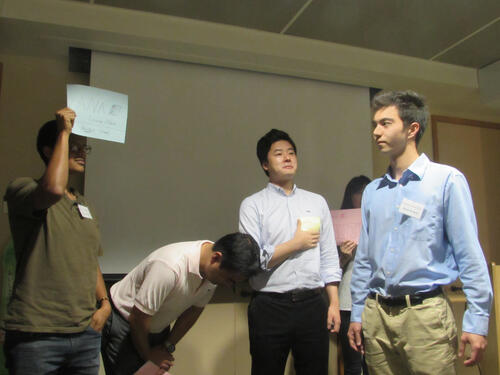
Team Three acts out a skit. | They proposed that ANA establish lounges for the general public to gather in and purchase goods from Uniqlo and Muji, two Japanese lifestyle retailers. The lounges would offer a place to reinforce ANA's brand outside of the airport, they said.
Image

Team Four puts their heads together to generate ideas. | In their pitch, the team noted that baseball is a popular sport among Americans and Japanese. They recommended baseball be a focus of the marketing campaign, and said television and social media would best reach the target audience.
Image

Team Five explains their marketing approach. | Flying can lead to some unpleasant experiences, and a way ANA can set itself apart is to make those experiences manageable, and even enjoyable, they said. Their proposal was to bring new amenities to the in-flight experience such as a care package for people who sit in the middle seat.
Image

Team One poses for a picture after their presentation. | In their pitch, they recommended using ANA’s association with Japan to differentiate from other global airlines. Their approach included creating a film that features an American celebrity traveling on ANA.
The winning team was Team One whose concept was to use a celebrity figure – Ellen DeGeneres – in their advertising. They said that the target audience could relate to DeGeneres, and her already-established following would be an advantage.
The judges commended Team One for the creativity of their idea and its level of feasibility. Team One consisted of students Yaqian Fan, Michael Hong, Sam Ide, Lu Li and Adelbert Tan.
Kenji Kushida, a Stanford alumnus and project leader of SV-NJ, said:
“When I was a student, I craved for an opportunity to brainstorm solutions to real-world challenges and to do it in an environment that provided instant feedback,” he said, “We were able to make that happen here with the support of ANA and WiL, and are thrilled with the outcome."
Hero Image

All News button
1
Call for papers: Koret Workshop on Globalization, Innovation and Culture in Korea
News Type
News
Date
Paragraphs
The Korea Program at Stanford’s Walter H. Shorenstein Asia-Pacific Research Center is soliciting papers for the Koret Workshop on Globalization, Innovation and Culture in Korea at Stanford University.
South Korea has become an economic powerhouse, but faces multiple challenges. To maintain its dynamism and growth in the increasingly innovation-driven global knowledge economy, Korea needs to turn its attention to the more social, cultural and educational aspects of development.
Of paramount importance is the ability to welcome and embrace difference and creativity, upgrade pertinent social values of cultural diversity and social tolerance, promote innovation and effectively reflect and transmit such values through institutions. The conference will be interdisciplinary, problem-oriented and policy-relevant. A broad range of questions and approaches are welcomed, particularly those that address main challenges Korea will face going forward.
Possible research topics include:
• Higher education, cultural diversity and development.
• Social cohesion beyond nationalism and multiculturalism.
• Entrepreneurial culture and innovation.
• Causes and consequences of rising inequality.
• Demographic changes, skilled foreign labor and education/work culture.
The conference will be held on April 22, 2016 at Stanford University. Beyond research presentations, the conference also aims to foster connections among scholars with common interests. Travel (domestic or international economy class) and hotel costs as well as a modest honorarium will be covered for the presenters.
Papers may be submitted for consideration in a PDF file (6,000-8,000 words) to Yong Suk Lee by email at yongslee@stanford.edu. The submission deadline is Jan. 31, 2016.
The Koret Workshop is organized by the Korea Program to bring together an international panel of experts in Korean affairs. The Korea Program established the Koret Fellowship in 2008 with generous funding from the Koret Foundation.
Hero Image

Seoul city at night.
Flickr/wwian
All News button
1
The Strategy for Korea's Economic Success
-
Image

Hwy-Chang Moon is a visiting professor in the Korea Program for the 2015 academic year and is currently teaching a course on Korean economy and business through the Center for East Asian Studies at Stanford University. Moon is a professor at Seoul National University, where he also served as the Dean of Graduate School of International Studies. He has delivered special lectures at various institutions, and has consulted several multinational companies and governments (e.g., Malaysia, Dubai, Azerbaijan and the Guangdong Province of China).
Moon is the editor-in-chief of the Journal of International Business and Economy, and has published numerous articles and books on topics covering international business strategy, cross-cultural management and Economic Development in East Asia with a focus on South Korea.
Moon received a PhD from the University of Washington, and has previously taught at the University of Washington, University of the Pacific, State University of New York at Stony Brook, Helsinki School of Economics, Keio University, and Hitotsubashi University.
The Strategy for Korea's Economic Success
Download pdf
Hwy-Chang Moon
Encina Hall E301616 Serra StreetStanford, CA 94305-6055
(650) 723-6530
0
hwychang@stanford.edu
hwychangmoon_2.jpg
PhD
Hwy-Chang Moon has joined the Walter H. Shorenstein Asia-Pacific Research Center (Shorenstein APARC) for the 2015-2016 academic year. During his time at Shorenstein APARC, he will be working on a research project entitled, “The Global Strategy of Korean Firms in Silicon Valley," and will also teach a course on Korean economy and business in the fall quarter.
Moon is a professor of international business strategy at the Graduate School of International Studies (GSIS), Seoul National University, where he also served as the dean of GSIS.
Professor Moon is the editor-in-chief of the Journal of International Business and Economy, and has published numerous articles and books on topics covering international business strategy, cross-cultural management and economic development in East Asia with a focus on South Korea. He frequently provides his perspectives on global economy and business through interviews and televised debates, and his writings appear regularly in South Korean newspapers. The New York Times and NHK World TV have also asked for his perspectives on these topics.
Professor Moon received a PhD from the University of Washington, and has previously taught at the University of Washington, University of the Pacific, State University of New York at Stony Brook, Helsinki School of Economics, Keio University, and Hitotsubashi University. He has also consulted several multinational companies, international organizations, and governments (e.g., Malaysia, Dubai, Azerbaijan, and the Guangdong Province of China).
Visiting Professor
Seminars
Sociologist named incoming Koret Fellow
News Type
News
Date
Paragraphs
Joon Nak Choi will be the 2015-16 Koret Fellow in the Korea Program at Stanford University’s Walter H. Shorenstein Asia-Pacific Research Center (APARC), effective Jan. 1, 2016.
A sociologist by training, Choi is an assistant professor at Hong Kong University of Science and Technology. His research and teaching areas include economic development, social networks, organizational theory, and global and transnational sociology, within the Korean context.
Choi, a Stanford graduate, has worked jointly with Stanford professor Gi-Wook Shin to analyze the transnational bridges linking Asia and the United States. The research project explores how economic development links to foreign skilled workers and diaspora communities.
Most recently, Choi coauthored Global Talent: Skilled Labor as Social Capital in Korea with Shin, who is also the director of the Korea Program. From 2010-11, Choi developed the manuscript while he was a postdoctoral fellow at Shorenstein APARC.
Mark Granovetter, a professor and chair of Stanford’s sociology department, praised Choi for his work in academia.
“Joon Nak’s dissertation on social influences on hedge fund managers’ success broke important ground in our understanding of financial markets. His recent book Global Talent sheds critical new light on the challenges of Korea and other economies facing high-level labor shortages, and the potential of foreign workers to meet them. As the 2015-16 Koret Fellow, he will bring his considerable talents to bear on the study of Korean society,” Granovetter said.
During his fellowship, Choi will study the challenges of diversity in South Korea and teach a class for Stanford students. Choi’s research will buttress efforts to understand the shifting social and economic patterns in Korea, a now democratic nation seeking to join the ranks of the world’s most advanced countries.
Supported by the Koret Foundation, the fellowship brings leading professionals to Stanford to conduct research on contemporary Korean affairs with the broad aim of strengthening ties between the United States and Korea. The fellowship has expanded its focus to include social, cultural and educational issues in Korea, and aims to identify young promising scholars working on these areas.
“It will be my pleasure and honor to spend the next year at Shorenstein APARC, and have the opportunity to engage in the vibrant research community there," Choi said.
Choi holds a bachelor’s degree in economics, international relations and urban studies from Brown University, and a master’s degree and doctorate in sociology from Stanford University.
Hero Image

All News button
1
Changing Corporate Governance in Japan
Related Multimedia


Stanford scholar underscores diversity, global education goals
News Type
Q&As
Date
Paragraphs
This week the World Education Forum convenes in Incheon, South Korea. Drawing leaders from UNESCO member states and heads of international organizations and NGOs, the 4-day gathering will examine global education priorities and discuss a framework for action and implementation of shared goals and targets.
The Forum, which last met in Dakar in 2000, will explore five major themes: equity, inclusion, quality education and lifelong learning, and also set out an agenda on global citizenship education—how to cultivate in youth the attitudes, values and skills needed in today’s world.
As the Forum approaches, the Walter H. Shorenstein Asia-Pacific Research Center asked Stanford professor Gi-Wook Shin to offer his perspectives on global education and his vision for South Korea. He is Korean and an expert on South Korea’s higher-education system, politics and society. He also advises some universities in Asia such as the Center for Asia-Pacific Future Studies at Kyushu University in Japan.
Shin leads two multi-year research projects—one focused on diversity and tolerance in Asia, and another on global social capital, delving into the linkages between innovation, economic globalization and diaspora communities. He recently published key findings in Global Talent with coauthor Joon Nak Choi, a Stanford graduate now professor at Hong Kong University of Science and Technology.
Education has played an important role in the social and economic development of South Korea. Can you explain?
Over the past fifty years, South Korea has gone from being one of the least developed countries to one of the most developed—an “economic miracle,” as it is often referred. The country rose from periods of wartime, poverty and social unrest to become a stable high-income developed country, all in an incredibly short time span. Education has played a substantial role in South Korea’s emergence. Nearly 70 percent of Koreans between the ages of 25 and 34 years of age hold an equivalent of a bachelors degree. This is the highest ranking in all Organization for Economic Co-operation and Development (OECD) countries. Investment in its own people, as well as areas of technology and the sciences, catapulted South Korea toward such success. Its education system is lauded globally. President Obama has referred to its system on multiple occasions, saying the respect and level of support given to teachers there helps to empower student learning. Teaching is a very highly respected profession in South Korea.
In pursuit of the “creative economy,” South Korea has sought to capitalize on the knowledge value of its population. How does diversity fit into this context?
South Korea, like many advanced nations, is driving toward a “creative economy,” a policy objective that President Park Geun-hye set out in Feb. 2013. It’s a strategy to move South Korea away from its manufacturing past toward a future of a service-oriented economy. The latter requires greater creative thinking, and human and social capital are necessary ingredients in that process. Many people look to Silicon Valley as a model of success, a place that continues to harness ideas and investment in those ideas. As I say, there is one known “secret” that has contributed to Silicon Valley’s success, and that’s cultural diversity. In fact Japanese Prime Minister Shinzo Abe visited Stanford recently on his state visit to the United States in a bid to underscore his commitment to building a creative economy in Japan. He convened with leaders of major technology firms like Apple and Twitter, and one of the main messages shared with Abe was the scale to which immigrants contributed to the workforce here. So, South Korea, like many Asian nations, would benefit from recognizing the connection between diversity and the economy, and take it one step further and actively encourage a society who accepts foreigners—this, of course, comes with inherent hurdles in any ethnically homogeneous country like South Korea.
How can a society cultivate globally responsible citizens?
Shifting a society to truly respect and value diversity can be an especially difficult task for countries steeped in nationalism and traditional values. In the case of South Korea, policies supporting values of diversity are just starting to appear, but full social integration of minorities remains a distant future. If the government acts to support diversity over the long-term, though, hopefully change is in the closer future. The challenge is for South Korea to strike the right balance between embracing the nation’s historical legacy, while also recognizing what it means to be a “global citizen” in today’s world. I’ve been working with Rennie Moon, a professor at Yonsei University, on this research question. Teachers play a definitive role in the development of students. Providing curriculum that is balanced is an important factor. This means teaching materials—from textbooks to videos—must provide a neutral stance, or even better, show information in a comparative perspective. Teachers themselves must also commit to being facilitators. Encouraging pride in one’s own country, while also showing respect and value toward others’ is a key message that teachers can help reinforce.
Why do foreign students in Korea matter? And, what role can Korean students have when abroad?
Foreign students in Korea represent a positive-sum game. For one, foreign students diversify Korea, and also help fill the national labor shortfall. In my study with Choi, we found that three groups of students prove to be more beneficial to Korean society. “Focused instrumentalists,” students who are pursuing advanced degrees in technical subjects, “focused Koreaphiles,” students who view Korea as special but focus mainly on their studies, and “youthful Koreaphiles,” students who view Korea as special but focus mainly on exploring their social environments. Instrumentalists grow an affinity to Korea by likely working for a firm in Korea upon graduation. Someone who is a Koreaphile will show affinity for Korea because of an admiration for pop culture and other aspects of Korean society—K-pop, hallyu, Korean dramas and so forth.
Increasingly, Korean students are choosing to study abroad. Just over 123,000 Korean students pursued an undergraduate degree abroad in year 2011; 29% of whom studied in the United States. We see chogi yuhak, a trend of Koreans sending their children overseas to avoid the secondary education system, which is often cited for its rigor and stressful entrance exams. Yet, even if Korean students do not return home, they still have an opportunity to contribute back to South Korea. They form a global network and serve as “transnational bridges” between South Korea and their host countries. As a result, information, innovation and other opportunities bounce between and among people on both sides. This same lesson could be applied to any country really.
What policy implications will transnational bridges have in South Korea?
The affects on policy are largely two-fold. First, South Korean universities, companies and the government must seek to promote values of diversity. The Korean government has taken steps to recognize the strategic value of recruiting foreigners. But, the push isn’t big enough yet. For example, we hosted former Seoul National University President Yeon-Cheon Oh as a visiting fellow this year. He voiced that while Korean universities are orienting some of their policies toward ‘internationalization,’ they still aren’t totally committed to the idea. Better support systems should be developed for foreign students, and tenure should be more accessible to foreign faculty members. Second, for Koreans overseas, diaspora networks could be strengthened. About 10 percent of all ethnic Koreans live outside the Korean Peninsula. Creating codified social and cultural forums for diasporans will help instill a sense of the homeland, so that they want to stay engaged.
Are aspects of South Korea’s model translatable in neighboring countries in Asia and elsewhere?
The Korean model is relevant in other developed, nonimmigrant societies. Different from settler societies like the United States or Canada, for instance, who have heterogeneous populations. Germany and Japan provide the closest comparison study; both their national identities are based on shared ethnicity. Japan has in many ways successfully leveraged its diaspora. Ethnic Japanese who left have been recruited back, and foreign unskilled workers, particularly from Asia, infuse the labor market. A large number of foreign students study in Japan. Germany also sees an substantial amount of foreign students each year. Japan now allows students to stay up to one year to search for a job after graduation, and in Germany, the same for six months. But both countries have trouble retaining graduates. Applying the case of South Korea, seeking benefits from transnational bridges could also benefit both societies. Assimilation of diasporans—like ethnic Koreans in Japan and Turkish people in Germany—should be a long-term goal.
Gi-Wook Shin wrote in Nikkei Asian Review about aspects of Silicon Valley that Asian countries should consider adopting to emulate its success, and how foreign skilled workers can provide social capital. He also contributed a post to Stanford University Press blog about steps South Korea could take to counter the "brain drain" phenomenon. Later, Shin and Rennie Moon wrote a piece for The Conversation, expanding upon the challenges that foreign faculty and students face in South Korea and other Asian nations.
All News button
1