


China’s Belt, Road, and Beyond: State Mobilization and Localized Implementation
-
This is a virtual event. Please click here to register and generate a link to the talk.
The link will be unique to you; please save it and do not share with others.
Most people attribute the Belt and Road Initiative (BRI) to Beijing’s imperialist ambitions. In her talk, Professor Min Ye will go beyond top-level rhetoric, however, and investigate BRI’s origins, its implementation, and its on-the-ground effects inside China. She will unpack different local governments' approaches to the BRI by discussing how subnational entities have leveraged Beijing’s grand strategy and how the implementation of projects and programs related to the BRI facilitate local economic agendas. China’s local developmentalism, which has undergirded not only the BRI but also other national-level strategies (like the Western Development Program and China Goes Global policy), has propelled the Chinese economy from a middle power in 1998 to a superpower in 2018. The talk will conclude with a discussion of COVID-19’s impact on China’s BRI as well as preliminary findings from Professor Ye’s current research into other state-mobilized development initiatives in China.
Image

Via Zoom Webinar. Register at: https://bit.ly/3kJlhM9
Min Ye
Associate Professor, Pardee School of Global Studies, Boston University
Seminars
Kiyoteru Tsutsui
Shorenstein APARC
Encina Hall
616 Jane Stanford way
Stanford, CA 94305-6055
0
teru@stanford.edu
Senior Fellow at the Freeman Spogli Institute for International Studies
Professor of Sociology
Henri H. and Tomoye Takahashi Professor and Senior Fellow in Japanese Studies at the Walter H. Shorenstein Asia-Pacific Research Center (Shorenstein APARC)
Kiyoteru Tsutsui is the Henri H. and Tomoye Takahashi Professor and Senior Fellow in Japanese Studies at the Walter H. Shorenstein Asia-Pacific Research Center (APARC), the director of APARC and of the Japan Program at APARC, co-director of the Southeast Asia Program at APARC, executive director of the Inter-University Center for Japanese Language Studies, co-director of the Center for Human Rights and International Justice, senior fellow at the Freeman Spogli Institute for International Studies, and professor of sociology, all at Stanford University.
Prior to his appointment at Stanford in July 2020, Tsutsui was professor of sociology, director of the Center for Japanese Studies, and director of the Donia Human Rights Center at the University of Michigan, Ann Arbor.
Tsutsui’s research interests lie in political/comparative sociology, social movements, globalization, human rights, and Japanese society. More specifically, he has conducted (1) cross-national quantitative analyses on how human rights ideas and instruments have expanded globally and impacted local politics and (2) qualitative case studies of the impact of global human rights on Japanese politics. His current projects examine (a) changing conceptions of nationhood and minority rights in national constitutions and in practice, (b) populism and the future of democracy, (c) experimental surveys on public understanding about human rights, (d) campus policies and practices around human rights, (e) global expansion of corporate social responsibility and its impact on corporate behavior, and (f) Japan’s public diplomacy and perceptions about Japan in the world.
His research on the globalization of human rights and its impact on local politics has appeared in American Sociological Review, American Journal of Sociology, Social Forces, Social Problems, Journal of Peace Research, Journal of Conflict Resolution, and other social science journals. His book publications include Rights Make Might: Global Human Rights and Minority Social Movements in Japan (Oxford University Press 2018), and two co-edited volumes Corporate Social Responsibility in a Globalizing World (with Alwyn Lim, Cambridge University Press 2015) and The Courteous Power: Japan and Southeast Asia in the Indo-Pacific Era (with John Ciorciari, University of Michigan Press forthcoming). He has been a recipient of National Endowment for the Humanities Fellowship, National Science Foundation grants, the SSRC/CGP Abe Fellowship, Stanford Japan Studies Postdoctoral Fellowship, and other grants as well as awards from American Sociological Association sections on Global and Transnational Sociology (2010, 2013, 2019), Human Rights (2017, 2019), Asia and Asian America (2018, 2019), Collective Behavior and Social Movements (2018), and Political Sociology (2019).
Tsutsui received his bachelor’s and master’s degrees from Kyoto University and earned an additional master’s degree and Ph.D. from Stanford’s sociology department in 2002.
Director, Shorenstein APARC
Director, Japan Program at Shorenstein APARC
Co-Director, Southeast Asia Program at Shorenstein APARC
Executive Director, Inter-University Center for Japanese Language Studies
Co-Director, Center for Human Rights and International Justice
CV
Document
tsutsui_current_cv_july_2020.pdf
(186.4 KB)
Hide publication sections
Off
Experts Gather to Share Findings, Brainstorm Approaches, and Spur Further Research on China’s Belt and Road Initiative
News Type
News
Date
Paragraphs
The Stanford Center at Peking University (SCPKU), the Center on Democracy, Development and the Rule of Law (CDDRL), and the APARC China Program jointly hosted a workshop on China’s Belt and Road Initiative (BRI) in early March. The workshop, held on March 2 and 3, welcomed researchers from around the world with expertise in the Initiative. Unfortunately, because of the rapidly developing health emergency related to the coronavirus, participants from not only China, but also Japan, were prevented from attending. As described by Professor Jean Oi, founding director of SCPKU and the China Program, and Professor Francis Fukuyama, director of CDDRL and the Ford Dorsey Master's in International Policy, who co-chaired the workshop, the meeting aimed to provide a global perspective on the BRI, consolidate knowledge on this opaque topic, and determine the best method and resources for future research.
The workshop began with presentations from several of the invited guests. Dr. Atif Ansar from the University of Oxford’s Saïd Business School kicked off the first day by describing not only the tremendous opportunity that the BRI presents to developing economies, but also the serious pitfalls that often accompany colossal infrastructure projects. Pointing out the poor returns on investment of mega infrastructure projects, Ansar examined the frequest cost and schedule overruns, random disasters, and environmental degradation that outweigh the minimal benefits that they generally yield. China’s own track record from domestic infrastructure projects does little to mitigate fear of these risks, Ansar claimed. In response, he urged professional management of BRI investments, institutional reforms, and intensified deployment of technology in BRI projects. Dr. Ansar was followed by Dr. Xue Gong of the S. Rajaratnam School of International Studies, Nanyang Technological University, Singapore. Dr. Gong’s analysis centered on the extent to which China’s geopolitical motivations influenced its outward foreign direct investments (OFDI). Although her research was still in the early stages, her empirical analysis of China’s OFDI inflows into fifty BRI recipient countries from 2007-2018 nevertheless revealed that geopolitical factors often outweigh economic factors when it comes to China’s OFDI destinations.
Image
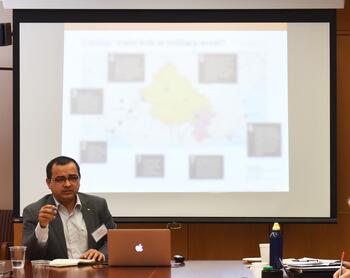
Professor Curtis J. Milhaupt and Scholar-in-Residence Jeffrey Ball, both at Stanford Law School, followed with individual presentations on the role of State-Owned Enterprises (SOEs) in the BRI and the emissions impact of the BRI on climate change, respectively. Professor Milhaupt characterized Chinese SOEs as both geopolitical and commercial actors, simultaneously charged with implementing Party policies and attaining corporate profits. Chinese SOEs are major undertakers of significant overseas BRI projects, acting not only as builders but also as investors, partners, and operators. This situation, Milhaupt asserted, carries significant risks for SOEs because these megaprojects often provide dismal returns, have high default rates, and can trigger political backlash in their localities. Milhaupt highlighted the importance of gathering firm-level data on businesses actually engaged in BRI projects to better infer geostrategic, financial, or other motivations. Jeffrey Ball turned the discussion to carbon emissions from BRI projects and presented preliminary findings from his four-country case studies. He concluded that, on aggregate, the emissions impact of the BRI is still “more brown than green.” Twenty-eight percent of global carbon emissions may be accounted for by BRI projects, Ball asserted, underscoring the importance of the BRI to the future of global climate change.
The day concluded with presentations by Michael Bennon, Managing Director at the Stanford Global Projects Center, and Professor David M. Lampton, Oksenberg-Rohlen Fellow at the Freeman Spogli Institute for International Studies. Bennon first presented findings from two empirical case studies of BRI projects and then went on to describe how the BRI is now practically the “only game in town” for infrastructure funding for developing countries. Lengthy environmental review processes at Western multilateral banks have turned the World Bank, for example, from a lending bank into a “knowledge bank,” he argued. He also highlighted that, in general, economic returns on BRI projects for China are very poor, even though recipient countries may accrue macroeconomic benefits from these projects. Finally, Professor Lampton turned the discussion back to Southeast Asia, where China is currently undertaking massive cross-border high-speed rail projects through eight ASEAN countries. He described how each host country had varying capacity to negotiate against its giant neighbor, and how the sequential implementation of these cross-border rail projects also had varying impacts on the negotiating positions of these host countries. BRI played out differently in each country, in other words, eliciting different reactions, push-backs and negotiated terms.
The second day of the workshop was dedicated to working toward a collaborative approach to future BRI research. The group discussed the key gaps in the existing research, including how to know what China’s true intentions are, how to measure those intentions, who the main players and their interests in both China and the host countries are, and even what the BRI is, exactly. Some cautioned that high-profile projects may not be representative of the whole. Participants brainstormed about existing and future sources of data, and stressed the importance of diversifying studies and seeking empirical evidence.
Hero Image

All News button
1
The PRC at 70: Past, Present -- and Future?
IMPORTANT EVENT UPDATE:
U.S.-China Trade Dispute Likely to Morph into Technology War, Says President of the U.S.-China Business Council
Related Multimedia

Japan in the Bay Area: From Competition to Collaboration
-
The Bay Area Council Economic Institute and the Walter H. Shorenstein Asia-Pacific Research Center Japan Program invite you to a forum on the critical transformations underway in Japan’s economy and the unique synergies that connect it to the Bay Area. The program will include a discussion of the high-level findings of a new report by the Bay Area Council Economic Institute on Japan’s economic engagement in the San Francisco/Silicon Valley Bay Area, and the role the region is playing as California and Japan look to expand trade and investment and accelerate innovation. Leading experts and practitioners from both Japan and the Bay Area will join us for this discussion.
This event is brought to you by the Shorenstein Asia-Pacific Research Center Japan Program and the Bay Area Council Economic Institute, in cooperation with the Japan Society of Northern California.
Agenda
1:00pm Welcome
Jim Wunderman, President & CEO, Bay Area Council
Hon. Tomochika Uyama, Consul General of Japan
Takeo Hoshi, Director, Shorenstein APARC Japan Program
1:10pm Introduction of Bay Area Council Economic Institute Report: High-Level Findings
Sean Randolph, Senior Director, Bay Area Council Economic Institute
1:30pm Observations and Silicon Valley Overview
Kenji Kushida, Research Scholar, Stanford University
1:45pm Panel 1: The Emerging New Japan
Kanetaka Maki, Associate Professor, Waseda Business School
Mio Takaoka, CFO, Medical Note and Partner, Arbor Ventures
Takeshi Ebihara, Founding GP, Rebright Partners
Emre Yuasa, Principal, Globis Capital Partners
Sean Randolph, Senior Director, Bay Area Council Economic Institute (Moderator)
2:45pm Panel 2: Japanese Companies in Silicon Valley Creating Value in New Ways
Hiroshi Menjo, Managing Partner, Net Service Ventures
Tsunehiko Yanagihara, Executive VP, Mitsubishi Corp M-LAB
Gen Isayama, General Partner & CEO, World Innovation Lab
Dennis Clark, Managing Director, Honda Innovations
George Saikalis, SVP & CTO, Hitachi America, Ltd.
Kenji Kushida, Research Scholar, Stanford University (Moderator)
4:00pm Closing Remarks
Bechtel Conference Center
Encina Hall
616 Serra Mall, Stanford, CA 94305
Panel Discussions
A New Cold War?: Sharp Power, Strategic Competition, and the Future of U.S.-China Relations
Image

Dual Labor Markets and Economic Globalization: Theory and Evidence from Japanese Manufacturing
-
Labor market duality refers to the coexistence of temporary workers with low dismissal costs and permanent workers with high dismissal costs within the same firms. The prevalence of temporary employment is a common feature in several countries, such as Continental European countries. Further, since the 1980s, the Japanese labor market has been experiencing a substantial increase in temporary jobs. The quality of temporary jobs tends to be lower than that of permanent jobs (e.g., the former includes lesser job security, lower wages, and fewer training opportunities compared to the latter). For this reason, the causes and consequences of widespread temporary employment have both policy and academic implications. To date, most of the research on this topic has focused on the supply side of labor markets (demographic changes in workforce), macroeconomic impacts (business cycles), and labor-market institutions. However, since the majority of temporary workers tends to be involuntary, the demand-side analysis is important, as well. It has rarely been examined how market competition would affect firms’ demand for temporary and permanent labor, particularly within the context of economic globalization.
Our study attempts to fill this gap. By proposing a heterogeneous-firm trade model with a dual labor market, we examine the relations between the demand for temporary and permanent workers and economic globalization. Our model highlights intensified product market competition as a driving force behind the shift in demand from permanent to temporary workers. In addition, our model demonstrates that international outsourcing effectively reduces labor adjustment costs, which decreases the demand for permanent workers. Using industry-level data from the Japanese manufacturing sector, we empirically test the relations between the demand for temporary and permanent workers and economic globalization and find that they support most of our theoretical predictions.
Hitoshi Sato joins the Walter H. Shorenstein Asia-Pacific Research Center (Shorenstein APARC) during the 2018–2019 academic year from the Institute of Developing Economies (IDE-JETRO), a national research institute in Japan, where he currently serves as a senior chief research fellow. Sato’s field of study is international trade, and his current research interests include the relationships between internationalization of firms and labor markets. His research efforts have been published in journals, books, and policy reports, including the Journal of Japanese and International Economies. Further, Sato has been appointed as a consulting fellow by the Research Institute of Economy, Trade and Industry since 2013. He received his PhD in economics from the University of Wisconsin–Madison in 2006.Image

Philippines Conference Room Encina Hall, 3rd Floor 616 Serra Mall, Stanford, CA 94305
Hitoshi Sato
616 Serra StreetEncina Hall E301Stanford, CA94305-6055
0
hisato@stanford.edu
hitoshi_sato.jpg
Ph.D.
Dr. Hitoshi Sato joins the Walter H. Shorenstein Asia-Pacific Research Center (APARC) for the 2018 year from the Institute of Developing Economies (IDE-JETRO) in Japan, where he serves as Senior Chief Research Fellow. He will be working on the internationalization of firms, management practices, and development. Dr. Sato received his Ph.D. from the University of Wisconsin, Madison.
Visiting Scholar at APARC
Seminars
Shorenstein APARC Center Overview 2017-18
Paragraphs
Shorenstein APARC's annual overview for academic year 2017-18 is now available.
Download it for information on the wide variety of Center research from the the past academic year, Shorenstein APARC's educational activities, and major Center events like the Shorenstein Journalism Award.
All Publications button
1
Publication Type
Annual Reports
Publication Date