Society

FSI researchers work to understand continuity and change in societies as they confront their problems and opportunities. This includes the implications of migration and human trafficking. What happens to a society when young girls exit the sex trade? How do groups moving between locations impact societies, economies, self-identity and citizenship? What are the ethnic challenges faced by an increasingly diverse European Union? From a policy perspective, scholars also work to investigate the consequences of security-related measures for society and its values.

The Europe Center reflects much of FSI’s agenda of investigating societies, serving as a forum for experts to research the cultures, religions and people of Europe. The Center sponsors several seminars and lectures, as well as visiting scholars.

Societal research also addresses issues of demography and aging, such as the social and economic challenges of providing health care for an aging population. How do older adults make decisions, and what societal tools need to be in place to ensure the resulting decisions are well-informed? FSI regularly brings in international scholars to look at these issues. They discuss how adults care for their older parents in rural China as well as the economic aspects of aging populations in China and India.

-

The event is jointly sponsored by the Japan Program at the Shorenstein Asia-Pacific Research Center and the Japan Foundation Center for Global Partnership.


Image
dekle photo
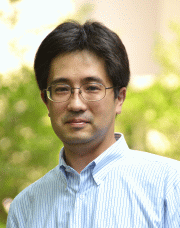
Through previously unexamined data from Japan, Professor Robert Dekle presents results from a preliminary study shoing the impact of robotics on Japanese labor between 1980 and 2012.

Robert Dekle is a Professor at the Department of Economics, University of Southern California. His field of research include international finance, open-economy and development, macroeconomics and the economies of Japan and East Asia.    He obtained his Ph.D in economics at Yale University and B.A in economics at the University of California, Berkeley. 

Robert Dekle, Professor of Economics, University of Southern California
Seminars
-

Recent power shifts have thrown into sharp relief the U.S.-India-China triangular relationship. In the Xi Jinping era, as a bolder China seeks to grow its supremacy in Asia, Beijing’s goals set China in direct opposition to both India and the United States. India, with its own claim to global power, now confronts a reality that sees China’s reaching out for unprecedented influence in the Indian subcontinent and the Indian Ocean, and that casts doubts on the United States’ regional role and presence. Under Prime Minister Narendra Modi, how is New Delhi navigating this new strategic terrain? What are some of the alternative futures for the U.S.–India-China triangular power-balance game?

On this panel, celebrating the 2017 Shorenstein Journalism Award, the award recipient, Siddharth Varadarajan, founding editor of The Wire, will discuss these and other questions, drawing on his career in journalism.

Panelists:

Image
sv rt copy cropped

Siddharth Varadarajan is a founding editor of The Wire. He started the online news website in 2015 with cofounders Sidharth Bhatia and M.K. Venu. Previously Varadarajan was the editor of The Hindu. He has taught Economics at New York University and Journalism at the University of California, Berkeley, besides working at the Times of India and the Centre for Public Affairs and Critical Theory, Shiv Nadar University. He is the editor of a book on the 2002 anti-Muslim violence and co-author of Nonalignment 2.0: A Foreign and Strategic Policy for India in the 21st Century (Penguin, 2014). Find him on Twitter at @svaradarajan.

Image
nayan chanda portrait

Nayan Chanda is the founder, former editor-in-chief, and current consulting editor of YaleGlobal Online magazine, published by the Whitney and Betty MacMillan Center for International and Area Studies at Yale. Previously he was as editor-at-large and correspondent with the Hong Kong-based magazine The Far Eastern Economic Review, editor of the Asian Wall Street Journal Weekly, and a Senior Fellow at the Carnegie Endowment for International Peace. He is the author of Bound Together: How Traders, Preachers, Adventurers and Warriors Shaped Globalization (Yale University Press, 2007), Brother Enemy: The War After the War, and coauthor of over a dozen books on Asian politics, security, and foreign policy. Chanda is the recipient of the 2005 Shorenstein Journalism Award.

Image
fingar tom

Thomas Fingar is the Shorenstein Asia-Pacific Research Center Fellow in the Freeman Spogli Institute for International Studies at Stanford University and a China specialist. He was the inaugural Oksenberg-Rohlen Distinguished Fellow from 2010 through 2015 and the Payne Distinguished Lecturer at Stanford in 2009. Previously, he served as the first deputy director of national intelligence for analysis and, concurrently, as chairman of the National Intelligence Council. Prior to that, he held multiple positions with the State Department’s Bureau of Intelligence and Research, including assistant secretary, principal deputy assistant secretary, deputy assistant secretary for analysis, director of the Office of Analysis for East Asia and the Pacific, and chief of the China Division. His most recent books are Uneasy Partnerships: China and Japan, the Koreas, and Russia in the Era of Reform (Stanford, 2017), The New Great Game: China and South and Central Asia in the Era of Reform (Stanford, 2016), and Reducing Uncertainty: Intelligence Analysis and National Security (Stanford University Press, 2011).

Image
shalendra sharma cropped

Shalendra Sharma is a professor in the Department of Politics at the University of San Francisco. He also teaches in the MA program in the Department of Economics and the Center for the Pacific Rim. Sharma is the author of numerous articles in leading peer-reviewed journals and of several books, including China and India in the Age of Globalization (Cambridge University Press, 2009), winner of 2010 Alpha Sigma Nu Book award, and Democracy and Development in India (Lynne Rienner, 1999), winner of the Choice Outstanding Academic Title for 1999. His latest book, A Political Economy of the United States, China, and India: Prosperity with Inequality, is forthcoming from Cambridge University Press.

Panel discussion chaired by:

Image
2011 dan sneider 2 web

, a visiting scholar with Stanford’s Shorenstein Asia-Pacific Research Center. His research is focused on current U.S. foreign and national security policy in Asia and on the foreign policy of Japan and Korea. Sneider was named a National Asia Research Fellow by the Woodrow Wilson International Center for Scholars and the National Bureau of Asian Research in 2010. His publications include History Textbooks and the Wars in Asia: Divided Memories (Routledge, 2011), Does South Asia Exist?: Prospects for Regional Integration (APARC, 2010), and First Drafts of Korea: The U.S. Media and Perceptions of the Last Cold War Frontier (APARC, 2009). His writings have appeared in many publications, including the Washington Post, the New York Times, Slate, Foreign Policy, the New Republic, National Review, the Far Eastern Economic Review, the Oriental Economist, Newsweek, Time, the International Herald Tribune, the Financial Times, and Yale Global. Prior to coming to Stanford, Sneider was a long-time foreign correspondent.

About the Award:

The Shorenstein Journalism Award, which carries a cash prize of $10,000, honors a journalist not only for a distinguished body of work, but also for the particular way that work has helped American readers to understand the complexities of Asia. The award, established in 2002, was named after Walter H. Shorenstein, the philanthropist, activist, and businessman who endowed two institutions that are focused respectively on Asia and on the press: the Walter H. Shorenstein Asia-Pacific Research Center (Shorenstein APARC) in the Freeman Spogli Institute at Stanford University, and the Joan Shorenstein Center on the Press, Politics, and Public Policy in the Kennedy School of Government at Harvard University. In 2011, Shorenstein APARC re-envisioned the award in recognition of the fact that Asia has served as a crucible for the role of the press in democratization in places such as South Korea, Taiwan, India, Pakistan, and Indonesia.


Paul Brest Hall East

555 Salvatierra Walk, Stanford, CA 94305

Panel Discussions
Paragraphs

The development community has increased its focus on higher education over the past two decades, recognizing that education can contribute to building up a country’s capacity for participation in an increasingly knowledge-based world economy and accelerate economic growth. The value added by higher education to economies—job creation, innovation, enhanced entrepreneurship, and research, a core higher education activity—has been highlighted by an important body of literature. 

Yet experts remain concerned that investing in higher education in less-developed countries may lead to a “brain drain”--highly educated students and professionals permanently leaving their home countries. In the 2016 Kauffman report on international science, technology, engineering, and math (STEM) students in the United States, for instance, 48 percent among a randomly sampled survey of 2,322 foreign doctoral students in the United States wished to stay there after graduation, with only 12 percent wanting to leave and 40.5 percent being undecided. In fact, high percentages of foreign students in the United States with doctorates in science and engineering continue to stay in the United States, creating a brain drain problem for the sending countries. 

Because students tend to move from developing to developed countries to study, brain drain is more problematic for developing countries. In addition, given accelerated talent flows around the world and the increasing integration of less-developed countries into global value chains, the negative impact of brain drain could be further amplified. As demonstrated by the studies reviewed in this paper, the migration of high-skilled professionals from developing countries may indeed create brain drain for them, but at the same time can significantly enhance the social and economic development of their home countries, regardless of whether or not they decide to return home, thus complicating what used to be seen as a straightforward case of brain drain. 

From Brain Drain to Brain Circulation and Linkage examines how brain drain can contribute to development for the sending countries through brain circulation and linkage. It provides an overview of the conceptual framework to map out high-skilled labor flows, identifies empirical cases and policies in Asia that demonstrate high-skilled migrant professionals actually make significant contributions to their home countries (beyond monetary remittances), summarizes key social and economic enabling factors that are important in attracting and motivating migrant high-skilled professionals to return or engage with their home countries, and concludes with policy implications and suggestions for further research based on these findings.

All Publications button
1
Publication Type
Working Papers
Publication Date
Authors
Gi-Wook Shin
Rennie Moon
Number
978-1-931368-49-0
Paragraphs

China has undergone dramatic change in its economic institutions in recent years, but surprisingly little change politically. Somehow, the political institutions seem capable of governing a vastly more complex market economy and a rapidly changing labor force. One possible explanation, examined in Zouping Revisited, is that within the old organizational molds there have been subtle but profound changes to the ways these governing bodies actually work. The authors take as a case study the local government of Zouping County and find that it has been able to evolve significantly through ad hoc bureaucratic adaptations and accommodations that drastically change the operation of government institutions.

Zouping has long served as a window into local-level Chinese politics, economy, and culture. In this volume, top scholars analyze the most important changes in the county over the last two decades. The picture that emerges is one of institutional agility and creativity as a new form of resilience within an authoritarian regime.

About the authors:

Jean C. Oi is William Haas Professor in Chinese Politics and a Senior Fellow at the Freeman Spogli Institute for International Studies at Stanford University.

Steven Goldstein is Sophia Smith Professor Emeritus of Government at Smith College, Director of the Taiwan Studies Workshop, and Associate at the Fairbank Center at Harvard University.

This book is part of the Studies of the Walter H. Shorenstein Asia-Pacific Research Center series with Stanford University Press.

All Publications button
1
Publication Type
Books
Publication Date
Journal Publisher
Stanford University Press
Authors
Jean C. Oi
-

Co-sponsored by the Southeast Asia Program and the Abbasi Program in Islamic Studies

Transnational Islam lacks the centralized leadership and institutions associated with Catholicism. Yet hierarchical and authoritative bodies do make decisions regarding Islam in various contemporary settings, including within the institutional frameworks of states. What happens when Muslim faith and practice are adapted to the terms and procedures of bureaucracy and the modern nation-state?

Dr. Müller will present an original conceptual framework for studying the bureaucratization of Islam. He will apply it to five Southeast Asian cases—Brunei, Indonesia, Malaysia, the Philippines, and Singapore. State bureaucracies in these countries vary widely,
but generally they aim to influence or control trends and meanings in local Islamic discourse. Drawing on current debates in the anthropology of the state, with particular reference to Brunei and Singapore, Müller will offer an original analytic framework to explain similarities and differences in bureaucratized Islam in Southeast Asia. Possible implications beyond the region will also be explored.

Dominik Müller

Image
dominik mueller4x4
heads the Max Planck Institute for Social Anthropology’s Research Group on the Bureaucratization of Islam and Its Socio-Legal Dimensions in Southeast Asia. He is also a non-resident fellow in the Centre for Asian Legal Studies at the National University of Singapore (NUS). Prior positions include visitorships at NUS (2016), the University of Oxford (2015), the University of Brunei Darussalam (2014), and Stanford University (APARC, 2013).  His doctorate in anthropology is from Goethe University Frankfurt (2012).His latest publication is an article on “Hybrid Pathways to Orthodoxy” in Brunei in the April-May 2018 Journal of Current Southeast Asian Affairs, a special issue on bureaucratized Islam that he also guest-edited.


Shorenstein APARC
Stanford University
Encina Hall, Room C331
Stanford, CA 94305-6055

(650) 724-5656 (650) 723-6530
0
Visiting Scholar
MullerDominik.jpg PhD

Dominik Müller joins the Walter H. Shorenstein Asia-Pacific Research Center (Shorenstein APARC) from February until May 2013 from the Department of Anthropology at Goethe-University Frankfurt where he serves as a postdoctoral research associate.

His research interests encompass Islam and popular culture in contemporary Southeast Asia, Malaysian domestic politics, and socio-legal change in the Malay world.

During his time at the Shorenstein APARC, Müller will conduct research on the religious bureaucracy of Malaysia. His research project at Stanford is funded by the German Academic Exchange Service (DAAD).

Müller obtained his PhD summa cum laude in 2012 in cultural anthropology from the Cluster of Excellence the “Formation of Normative Orders” at Frankfurt University. He previously studied anthropology, philosophy, and law in Frankfurt and at Leiden University. His dissertation on Islam, Politics, and Youth in Malaysia received the Frobenius Society’s Research Award 2012 and will be published in 2013.

Visiting Fellow, Islamic Legal Studies Program on Law and Social Change, Harvard University
Seminars
-

Symposium on "History of US-Japan Relations"

March 6, 2018

Philippines Conference Room

Shorenstein Asia Pacific Research Center (Stanford University)


Program

9:00am     Registration and Breakfast
 

9:30am     Welcome Remark
                 Takeo Hoshi (Stanford University)
 

9:40am  Session 1: From Perry to the War with China

Presenter:
Kaoru Iokibe (University of Tokyo)

Discussant:
Peter Duus (Stanford University)
 

10:40am  Break
 

11:00am  Session 2: Pacific War and Occupation

Presenter:
Fumiaki Kubo (University of Tokyo)

Discussant:
Kenji Kushida (Stanford University)


12:00pm  Lunch
 

1:00pm   Session 3: Pax Americana and Japan's Postwar Resurgence

Presenter:
Makoto Iokibe (Prefectural University of Kumamoto and Hyogo)

Discussant:
Tsuneo Akaha (Middlebury Institute of International Studies at Monterey)


2:00pm   Session 4: Neoliberalism and Redefinition of the US-Japan Alliance

Presenter:
Masayuki Tadokoro (Keio University)

Discussant:
Michael Armacost (Stanford University)


3:00pm  Break
 

3:20pm   Session 5: US-Japan Leadership Today

Presenter:
Koji Murata (Doshisha University)

Discussant:
Phillip Lipscy (Stanford University)


4:20pm   Closing Remark
              
Makoto Iokibe (Prefectural University of Kumamoto and Hyogo)


Symposiums
-

The “Baby Boomer” generation (dankai no sedai) has begun to reach the age of retirement en mass.  10,000 people turn 65 every day in the United States. In Japan, one-fifth of the population is over the age of 65 and is on track to increase to one-third of the population by 2050. In addition, people are living longer. Japan boasts the highest life expectancy in the world with an average of 84 years. As a result, we currently have a growing group of accomplished professionals contemplating spending their next 20-30 years doing something other than traditional work. According to the International Longevity Center (ILC) there is a great interest among this population to engage in activities that contribute back to society, but very few actually make the leap to do so. Nonprofits in the United States have developed a variety creative strategies to engage older adults; creating dynamic partnerships that provide opportunity and meaning to seniors while furthering social purpose missions. Lago will provide an overview of how nonprofits are leveraging the skills and experience of senior professionals for the social good.

SPEAKER:

Ulea Lago, Director of Consulting Empower Success Corp

BIO:

Ulea Grace Lago directs ESC’s consulting practice of 150 senior professionals, overseeing approximately $2.5M in pro bono services annually. An attorney and independent consultant, Ulea has over 17 years of experience working with nonprofits, religious organizations, and community groups. A veteran community organizer, she is the former director of the Truth and Reconciliation Project in Nashville, Tennessee, and previously served as Associate Director of Community Partnership and Service Learning at Sarah Lawrence College and Chair of the Political Action Network at Vanderbilt University, where she organized educational panels, forums, and fundraisers. She has a BA from Sarah Lawrence College, and a M.Div. and J.D. from Vanderbilt University

AGENDA:

4:15pm: Doors open
4:30pm-5:30pm: Talk and Discussion
5:30pm-6:00pm: Networking

RSVP REQUIRED:

Register to attend at http://www.stanford-svnj.org/31218-public-forum

For more information about the Silicon Valley-New Japan Project please visit: http://www.stanford-svnj.org/
Ulea Lago, Director of Consulting, Empower Success Corp
Seminars
-

Using previously unexamined nationally representative data from the Philippines, this study employs detailed measures of children’s welfare and addresses biases related to endogeneity of parental migration to examine the wellbeing of left-behind children. The results are robust across several econometric methods (treatment effects, biprobit, PSM, PSM-IV). They suggest that migrants’ children have better educational outcomes and are less likely to work, but are more likely to be physically sick, which cognitive stress theory would attribute to parental migration as a stressor. Still, the positive impacts of parental migration, attributable to income effect, outweigh the negative effects attributable to parental absence. The results also show heterogeneity in the impacts of parental migration conditional on children’s gender.

Image
marjorie
Dr. Marjorie Pajaron is an Assistant Professor at the School of Economics, University of the Philippines. Prior to her appointment, she was a Postdoctoral Fellow at Stanford University’s Walter H. Shorenstein Asia-Pacific Research Center. She also served as a lecturer at the University of Hawai’i at Manoa Department of Economics where she also received her PhD in Economics. Her research lies at the intersection of applied microeconometrics, gender, health, migration, and development economics.

Walter H. Shorenstein
Asia-Pacific Research Center
616 Serra St C333
Stanford University
Stanford, CA 94305-6055

(650) 724-6459 (650) 723-6530
0
Asia Health Policy Postdoctoral Fellow in Developing Asia
PajaronMarjorie_WEB.jpg

Marjorie Pajaron joins the Walter H. Shorenstein Asia-Pacific Research Center during the 2012–13 academic year from the University of Hawai’i at Manoa Department of Economics where she served as a lecturer.

She took part for five years in the National Transfer Accounts project based in Honolulu. Her research focuses on the role of migrant remittances as a risk-coping mechanism, as well as the importance of bargaining power in the intra-household allocation of remittances in the Philippines.

Pajaron received a PhD in economics from the University of Hawai’i at Manoa.

Working Papers:

 “Remittances, Informal Loans, and Assets as Risk-Coping Mechanisms: Evidence from Agricultural Households in Rural Philippines.” October 2012. Revise and Resubmit, Journal of Development Economics.

“The Roles of Gender and Education on the Intra-household Allocations of Remittances of Filipino Migrant Workers.” June 2012.

“Are Motivations to Remit Altruism, Exchange, or Insurance? Evidence from the Philippines.” December 2011.

Assistant Professor at the School of Economics, University of the Philippines
Seminars
-

Image
cover pic

After the Cold War, Thailand became a poster child of democratizing processes in Southeast Asia. Student protests, farmers’ activism, a thriving civil society, and an expanding middle class suggested a model of successful democratic transition. In the last decades, however, many of the forces that supported that process turned sour on electoral politics. Dr. Sopranzettis book will explore how that happened—new class alliances, discourses of corruption and morality, questions of law.  In this context, he will portray Thailand as an experimental space for a new model of authoritarianism, inspired by Beijing and now spreading throughout the region.  The book, Owners of the Maps: Motorcycle Taxi Drivers, Mobility, and Politics in Bangkok, will be available for sale at the talk.


Claudio Sopranzetti is a Postdoctoral Research Fellow at All Souls College at the University of Oxford. He is the author of Owners of the Maps: Motorcycle Taxi Drivers, Mobility, and Politics in Bangkok and he is currently working on Awakened,  an anthropological graphic novel on Thai politics.

Claudio Sopranzetti Postdoctoral Research Fellow, All Souls College, Oxford University
Seminars
-

Stanford Conference on "The Political Economy of Japan under the Abe Government"

February 8 - February 9, 2018

Philippines Conference Room

Sponsored by: Japan Society for Promotion of Science, Freeman Spogli Institute for International Studies (Stanford University), and Shorenstein Asia Pacific Research Center (Stanford University)

Organizers: Takeo Hoshi and Phillip Lipscy


Program

2/8/2018

8:30am     Breakfast
 

9:15am     Welcome remarks
                 Gi-Wook Shin (Stanford University)
                Toru Tamiya (Japan Society for Promotion of Science)


9:30am  "Transformation of the Japanese Political System: Expansion of the Power of the Japanese Prime Minister", Harukata Takenaka (National Graduate Institute for Policy Studies)

Discussant:
Saori Katada (University of Southern California)
 

10:30am  Break
 

10:50am  "Constitutional Revision Under the Abe Administration", Kenneth McElwain (University of Tokyo)

Discussant:
Yu Jin Woo (Stanford University)


11:50am  Lunch
 

1:00pm    "Do election results reflect voters' policy preferences? Evidence from the 2017 Japanese general election", Yusaku Horiuchi (Dartmouth College), Shiro Kuriwaki (Ph.D, Harvard University), Daniel Smith (Harvard University)

Discussant:
Rob Weiner (Naval Postgraduate School)


2:00pm   "Japan's Security Policy in 'the Abe Era': Radical Transformation or Evolutionary Shift?", Adam Liff (Indiana University)

Discussant:
Ashten Seung Cho (Stanford University)


3:00pm  Break
 

3:20pm   "Abenergynomics: The Politics of Energy and Climate Change under Abe", Trevor Incerti (Yale University) and Phillip Lipscy (Stanford University)

Discussant:
Kent Calder (Johns Hopkins SAIS)


4:20pm   "Innovation Policy", Kenji Kushida (Stanford University)

Discussant:
John Zysman (University of California, Berkeley)
 

5:20pm     Adjourn
 

6:30pm     Group Dinner


2/9/2018

9:00am   Breakfast
 

9:30am   "Abenomics, Monetary Policy, and Consumption", Joshua Hausman (University of Michigan), Takashi Unayama (Hitotsubashi University), and Johannes Wieland (University of California, San Diego)

Discussant:
Huiyu Li (Federal Reserve Bank of San Francisco)
 

10:30am  Break

10:50am "The Great Disconnect: The Decoupling of Wage and Price Inflation in Japan", Takeo Hoshi (Stanford University) and Anil Kashyap (University of Chicago)

Discussants:
Joshua Hausman (University of Michigan)
Johannes Wieland (University of California, San Diego)


11:50pm  Lunch
 

1:00pm  "Corporate Governance Reform", Hideaki Miyajima (Waseda University)

Discussant:
Curtis Milhaupt (Stanford University)
 

2:00pm   "Womenomics", Nobuko Nagase (Ochanomizu University)

Discussant:
Steve Vogel (University of California, Berkeley)
 

3:00pm  Break
 

3:20pm  "Japanese Agricultural Reform Under Abe Shinzo: Two Steps Forward, A Half-Step Back?", Patricia Maclachlan (University of Texas at Austin) and Kay Shimizu (University of Pittsburgh)

Discussant:
Takatoshi Ito (Columbia University and National Graduate Institute for Policy Studies)
 

4:20pm   "Yen Depreciation and Competitiveness of Japanese Firms", Kyoji Fukao (Hitotsubashi University) and Shuichiro Nishioka (West Virginia University)

Discussant:
Katheryn Russ (University of California, Davis)
 

5:20pm  "Next Step", Takeo Hoshi (Stanford University) and Phillip Lipscy (Stanford University)
 

5:50pm  Adjourn

Conferences
Subscribe to Society