
After Liberalism? The Future of Hedging and the Chimerica Choice for Southeast Asia
After Liberalism? The Future of Hedging and the Chimerica Choice for Southeast Asia
Friday, October 16, 202612:00 PM - 1:30 PM (Pacific)
Philippines Conference Room (C330)
Encina Hall, 3rd Floor
616 Jane Stanford Way, Stanford, CA 94305
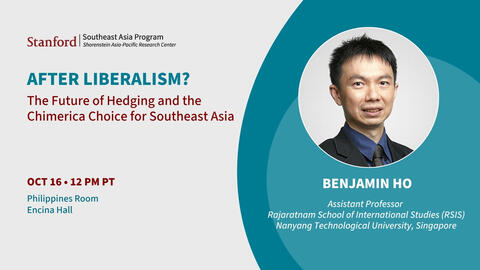
In recent years, questions have been posed regarding the durability of the current rules-based (liberal) international order and what this means for the practice of international relations. In this talk, Benjamin Ho, an assistant professor from the S. Rajaratnam School of International Studies, Nanyang Technological University (Singapore) argues that Southeast Asia countries are increasingly challenged in their ability to hedge and would have to make some tough choices between US and China (Chimerica) in their foreign relations. To this end, domestic myths will become increasingly important in determining how states exercise their foreign policy choices and preference towards international order. Drawing from his vantage point as a hybrid scholar/thinktank analyst in a key Southeast Asia state and supplemented with fieldwork experience elsewhere in Northeast Asia (Mainland China, Japan, South Korea and Taiwan), Ho argues that states will view the international order as good or just if the characteristics of such an order support and allow for preservation for domestic myths. On the other hand, states will view the international order unfavourably if the characteristics of this order run up or challenge their ability to preserve domestic myths. As such, how Southeast Asia countries chose would provide clues to the future of the international order and the extent to which hedging remains a (still?) viable strategy moving forward.
Speaker
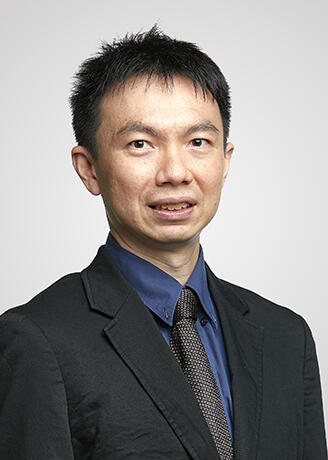
Dr Benjamin Ho is Assistant Professor and Coordinator at the China Programme, S. Rajaratnam School of International Studies (RSIS), Singapore. He obtained his PhD from the Department of International Relations at the London School of Economics and Political Science, UK under a RSIS PhD scholarship. His research focus includes the study of China’s international relations, with an emphasis on Chinese political worldview and exceptionalism thinking. Other research interests include security multilateralism in the Asia Pacific region with a focus on regional institutions and fora, national security (intelligence), the sociology of religion and public theology (Christianity). He is the author of the book China’s Political Worldview and Chinese Exceptionalism: International Order and Global Leadership (Amsterdam University Press, 2021) and is working on his second book project on Political Myths and International Order in Northeast Asia (with a focus on China, Japan and South Korea). He has also published in journals such as China Quarterly, Journal of Contemporary China, East Asia: An International Quarterly, Alternatives: Global, Local, Political, Asia Policy, and the Australian Journal of International Affairs. He was a Fulbright scholar at the Elliot School of International Affairs (George Washington University between 2021-2022), a Taiwan MOFA Fellow at the Institute of Political Science Academia Sinica (Taiwan) in 2022 and a Republic of Korea-ASEAN Scholar at the Korea National Diplomatic Academy in 2025.