
The Promise and Peril of Informal Categorization as Refugee Brothers and Sisters
The Promise and Peril of Informal Categorization as Refugee Brothers and Sisters
Wednesday, October 7, 202612:00 PM - 1:30 PM (Pacific)
Location available following valid registration
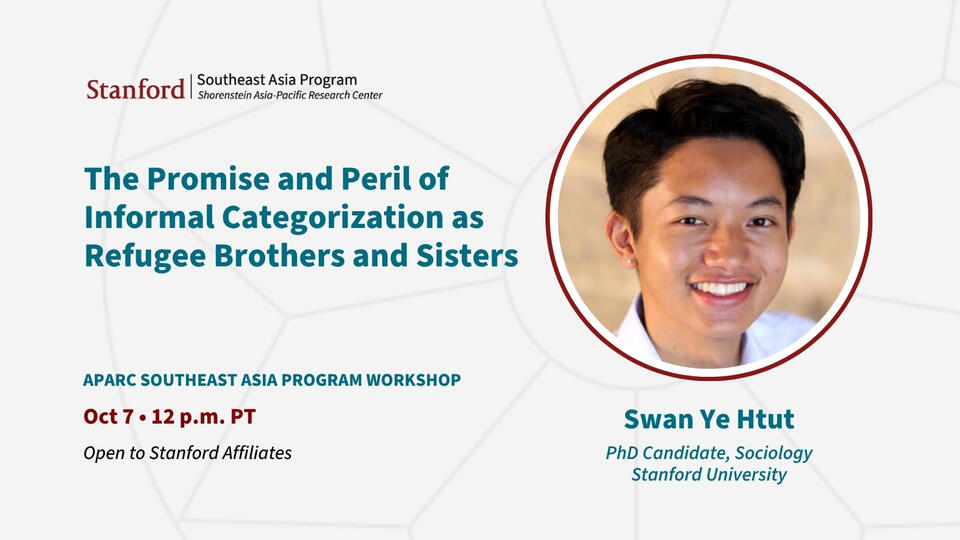
This talk is open to Stanford affiliates.
It is part of the APARC Southeast Asia Program Workshop series. Learn more about the workshop and student presentation opportunities here.
After the 2021 Myanmar military coup, over 40,000 Chin displaced migrants from Myanmar fled across the border into Mizoram, India. Despite India not being a signatory to the 1951 Refugee Convention or the 1967 Refugee Protocol, the Mizoram welcomed the migrants as "refugee brothers and sisters". This talk investigates the informal "refugee" status, or "raltlan" in the Mizo language, which positions migrants as ethnic kin, but also subjects them to legal exclusion and moral judgements. This research offers broader lessons on how colonialism, minoritization within the nation-state order and transborder ethnic ties facilitate, but also complicate informal refugee reception.
Speaker

Swan Ye Htut (he/him) is a PhD candidate in Stanford's Sociology Department. His dissertation focuses on how Chin displaced migrants from Myanmar navigate informal refugee reception in the Indian northeastern state of Mizoram. He has published research on migration, race/ethnicity, social movements, and Southeast Asia in the Journal of Ethnic and Migration Studies, Journal of Contemporary Asia, and Big Data & Society. Swan holds an MA in Sociology from Stanford University and a BA in Sociology and Global Studies at UCLA.