
The Stakes of the Trump-Xi Summit and What Next for U.S.-China Relations
The Stakes of the Trump-Xi Summit and What Next for U.S.-China Relations
Speaking on the latest episode of the APARC Briefing series, China expert and veteran diplomat Susan Thornton argues for managing expectations of the summit between the two presidents, rethinking the U.S.-China technology competition, and understanding Beijing’s long game on Taiwan.
As U.S. President Donald Trump prepares to visit Beijing on May 14-15, 2026, for a highly anticipated summit with President Xi Jinping, the world is watching to see if the two leaders can stabilize a U.S.-China relationship strained by disputes over trade, technological race, the future of Taiwan, and the rippling effects of the conflict with Iran.
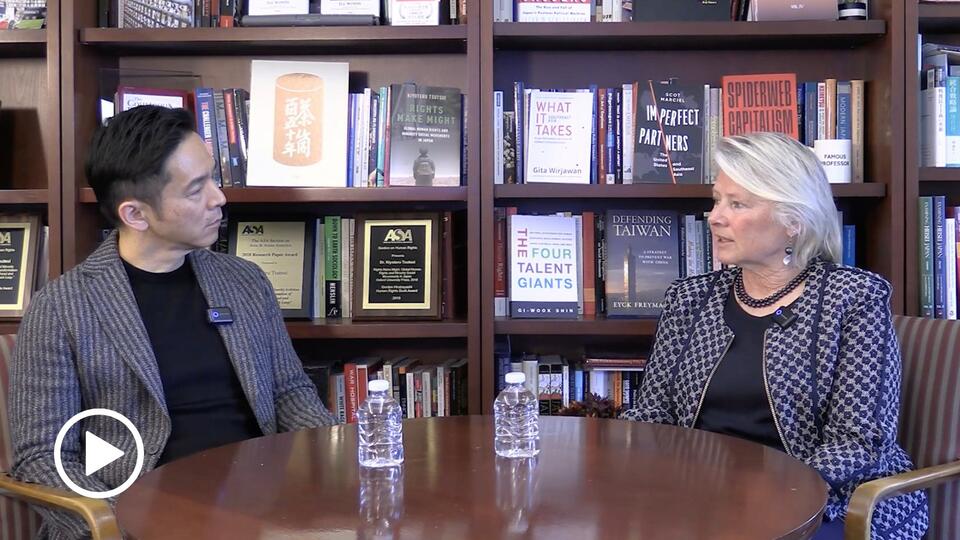
Trump’s trip to Beijing – already rescheduled once due to the conflict in the Middle East – has been described as having tremendous symbolic significance. Yet, expectations for a breakthrough on specific deliverables should remain low, according to Susan Thornton, a China expert and former U.S. diplomat. Thornton joined APARC Director Kiyoteru Tsutsui on the latest episode of the APARC Briefing video series to analyze the potential outcomes of the Trump-Xi summit and the high-stakes dynamics shaping U.S.-China relations.
Sign up for APARC newsletters to receive expert analysis and insights from our scholars and guests >
Symbols Over Deliverables
Thornton’s nearly three-decade career with the U.S. State Department in Eurasia and East Asia culminated in her role as Acting Assistant Secretary of State for East Asian and Pacific Affairs during the first Trump administration. She offered a pragmatic forecast for the Trump-Xi summit, arguing that its primary value lies in the act of meeting itself.
While both President Trump and President Xi are committed to keeping their dialogue, the expectations for concrete outcomes on pivotal issues in the U.S.-China bilateral relationship should be tempered, argued Thornton, who is currently a senior fellow at Yale Law School’s Paul Tsai China Center, the director of the Forum on Asia-Pacific Security at the National Committee on American Foreign Policy, and a nonresident senior fellow at the Brookings Institution.
Whether on Taiwan or other pressing matters, China has made it clear it is not interested in a “G2 or a grand bargain” and has relatively low expectations for the list of substantive disputes between the two powers.
The Shadow of the Iran War
The ongoing conflict with Iran has added a new layer of complexity to the tense bilateral relationship. President Trump heads to Beijing after unsuccessful efforts to pressure China into helping reopen the Strait of Hormuz, while Beijing continues backing Tehran politically and potentially militarily.
Thornton assessed that China will not allow the conflict to derail its high-level engagement with Washington, even as it officially disapproves of the U.S. intervention in the Middle East. “Keeping the U.S.-China relationship on track is much more important than having some kind of a protest signal like that,” she stated.
She suggested that Beijing may see a strategic advantage in America’s renewed focus on the Middle East. While China has made nominal peace proposals, it has not stepped up as a mediator. “It seems like they are kind of hanging back and waiting to see what will happen,” Thornton observed. She posited that, from Beijing’s perspective, a U.S. entanglement in the Middle East may serve as a useful distraction, diverting Washington’s attention and pressure away from China.
At the same time, China is hedging its bets by securing alternative energy supplies and gaining influence in regions where the conflict in the Middle East has damaged U.S. credibility.
Trade and Tech: A Call for a Paradigm Shift
On the economic front, Thornton drew on her deep experience in trade negotiations to critique the lack of focus in U.S. policy.
"The biggest problem for U.S. negotiators is deciding what it is that we want from China," she said. "We tend to give them a long list of revolving priorities, which [makes it easy for the] other side of the negotiating table to just fob them off and not actually commit to anything over years of negotiations.”
On the technology rivalry between the two powers, Thornton urged a shift in strategy. Rather than pursuing sweeping export controls that are often unilateral and incomplete, she advocated for a narrower, multilateral approach focused on the most sensitive technologies, combined with a greater emphasis on American innovation. AI governance is one of the areas Thornton believes could be a common ground for Washington and Beijing to align their policies.
“It's going to be very hard for the United States to contain China's technological ambitions and growth,” she said. “I don't think that we're exactly competing on the same metrics. I question how it is that we're going to be able to keep China from getting technologies that are dual-use but might be useful in some military application when these things are basically economy-wide products.”
When it comes to technological competition, "We need to try to run faster than China, not be constantly trying to trip China up and looking in the rearview mirror," Thornton urged. "I don't think that's going to bode well for the long-term development of the U.S. tech sector."
The Taiwan Flashpoint: A Longer-Term Challenge
While Taiwan remains the most dangerous flashpoint that could trigger a kinetic warfare between the United States and China, Thornton believes that the immediate risk of conflict has receded, in accordance with recent U.S. threat assessments that no longer see 2027 as a likely target date for a potential Chinese takeover of the island.
Beijing, she argued, is closely watching the domestic political situation in Taiwan and how the leadership in Taipei views U.S. reliability and support. “I think the Chinese have determined, based on both of those things they've been watching, that they can afford to wait a bit longer, see what happens.”
Thornton cautioned, however, that, even as a conflict over Taiwan may no longer pose an immediate-term threat, “it is a problem that is going to develop over the coming decade.”
Diplomacy in a Multipolar World Order
When asked about the future of the global order, Thornton described a trend toward fragmentation. If the United States steps back from its global leadership role, it is difficult to see who else would be willing or able to shoulder the cost of providing global public goods, she said. A “thinner world order,” with the United Nations at its center, may eventually find favor with countries that can afford to pay for some of those goods, she reflected.
In a closing advice for aspiring foreign service officers, Thornton argued that the emergence of a multipolar world reinforces the need for skilled diplomacy. “As the global order changes and more countries come into the mix of the councils of politics in the world, the United States will have to lean back toward diplomacy more,” she predicted.
“We're going to need very good diplomats,” she concluded, because it will be significantly harder to be an American diplomat in a fragmented world order in which the United States is no longer the single overwhelmingly dominant power.


