Governance

FSI's research on the origins, character and consequences of government institutions spans continents and academic disciplines. The institute’s senior fellows and their colleagues across Stanford examine the principles of public administration and implementation. Their work focuses on how maternal health care is delivered in rural China, how public action can create wealth and eliminate poverty, and why U.S. immigration reform keeps stalling. 

FSI’s work includes comparative studies of how institutions help resolve policy and societal issues. Scholars aim to clearly define and make sense of the rule of law, examining how it is invoked and applied around the world. 

FSI researchers also investigate government services – trying to understand and measure how they work, whom they serve and how good they are. They assess energy services aimed at helping the poorest people around the world and explore public opinion on torture policies. The Children in Crisis project addresses how child health interventions interact with political reform. Specific research on governance, organizations and security capitalizes on FSI's longstanding interests and looks at how governance and organizational issues affect a nation’s ability to address security and international cooperation.

News Type
News
Date
Paragraphs

The Shorenstein Asia-Pacific Research Center (APARC) at Stanford is now accepting applications for the Shorenstein Postdoctoral Fellowship in Contemporary Asia, an opportunity made available to two junior scholars for research and writing on Asia.

Fellows conduct research on contemporary political, economic or social change in the Asia-Pacific region, and contribute to Shorenstein APARC’s publications, conferences and related activities. To read about this year’s fellows, please click here.

The fellowship is a 10-mo. appointment during the 2017-18 academic year, and carries a salary rate of $52,000 plus $2,000 for research expenses.

For further information and to apply, please click here. The application deadline is Dec. 16, 2016.

Hero Image
27193530153 58630c4828 o
All News button
1
Paragraphs

It is tempting to characterize the recent round of North Korea missile and nuclear tests as only the latest example of the provocative behavior of its brash young leader, Kim Jong Un. A simultaneous launch of three medium-range missiles, mounted on mobile launchers, was defiantly timed to coincide with China’s hosting of the G20 summit in Hangzhou. And the latest nuclear test, the fifth carried out by North Korea, seemed designed to assert its status as a nuclear weapons power ahead of the U.S. presidential vote, Sneider writes.

All Publications button
1
Publication Type
Commentary
Publication Date
Journal Publisher
Toyo Keizai Online
Authors
News Type
News
Date
Paragraphs

Rennie J. Moon has been selected as the 2016-17 Koret Fellow in the Korea Program at Stanford’s Shorenstein Asia-Pacific Research Center (APARC). She will join the center next January to study diversity in higher education and teach a student course.

Image
rennie moon

Moon is an associate professor at the Underwood International College at Yonsei University in Seoul, South Korea. Her research explores the interrelationships among globalization, migration and citizenship, and internationalization of higher education.

Moon, a graduate of Stanford’s Graduate School of Education, Ph.D. ‘09, has collaborated with Stanford professor Gi-Wook Shin on a multiyear research project that examines diversity in higher education in East Asia. She co-edited the book Internationalizing Higher Education in Korea: Challenges and Opportunities in Comparative Perspective published earlier this year.

Stanford professor Francisco O. Ramirez, an expert on international comparative education and sociology of education, recognized her scholarly contributions to the field.

“Moon is a creative contributor to the ‘world society perspective’ in the social sciences,” said Ramirez, noting that Moon's work has been published in leading journals of international comparative education, Comparative Education Review and Comparative Education.

Supported by the Koret Foundation, the Koret Fellowship brings professionals to Stanford to conduct research on contemporary Korean affairs. In 2015, the fellowship expanded its focus to include social, cultural and educational issues in North and South Korea, and aims to identify emerging scholars working on those areas.

During her fellowship, Moon will also give public talks and be a lead organizer of the Koret Workshop, an international conference held annually at Stanford.

“As an alum, I’m very pleased and excited to spend my sabbatical year at Stanford,” Moon said. “Over the last few years, I’ve been collaborating on various research projects with Professor Shin and other colleagues at APARC. I’m looking forward to a productive fellowship during which I hope to bring these evolving projects to fruition.”

Moon holds a doctorate and master’s degree in international comparative education from Stanford and a bachelor’s degree in French from Wellesley College.

Hero Image
rennie moon crop
All News button
1
-

Korea’s economic development trajectory is well known. From an impoverished war-torn nation, the country has progressed on all fronts. In the 1950s the country’s per capita income was estimated to be lower than India’s. Today the income difference is fifteen-fold in favor of Korea. It stands out internationally when it comes to education. Politically it has moved away from authoritarian to more spirited, people-driven democratic system. This presentation will shift the debate to the question what does a country do after it has achieved prosperity. Using the concept of capitalist maturity, do we look for answers in the OECD experience or should we treat Korea on its own terms? What are the development challenges for Korea in the post-development era? Given that there are both external and internal issues that merit appropriate responses, the presentation focuses on Korea’s regional (Asian) economy, business and institutional responses to expanding Asia, and the societal adjustment issues to increasing flows of Asian students, professionals, and unskilled workers. The presentation concludes by briefly indicating the many unfinished domestic reforms at multiple levels, which could reinforce Korea’s external engagement and potentially resolve the development conundrum arising from capitalist maturity.

Image
anthony dcosta
Anthony P. D’Costa is Chair and Professor of Contemporary Indian Studies, Development Studies at the University of Melbourne. He was the A.P. Møller Mærsk Foundation Professor of Indian Studies, Copenhagen Business School and Professor of Comparative International Development for 18 years at the University of Washington. He also taught at National University of Singapore, Indian Institute of Management, Calcutta, and Bordeaux École de Management. He has published widely on the political economy of development, global capitalism, labor, and industrial restructuring using the steel, auto, and IT sectors. His most recent book is International Mobility, Global Capitalism, and Changing Structures of Accumulation: Transforming the Japan-India IT Relationship (2016). His edited books include Transformation and Development: The Political Economy of Transition in India and China (2012), Globalization and Economic Nationalism in Asia (2012), After-Development Dynamics: South Korea's Contemporary Engagements with Asia (2015), and The Land Question in India: State, Dispossession, and Capitalist Transition (2017), all by Oxford University Press. He edits Dynamics of Asian Development book series and has held several fellowships: Fulbright-Hays, American Institute of Indian Studies, Korea Foundation, Abe - Japan Foundation, and POSCO at the East West Center.

Anthony P. D’Costa <i>Chair and Professor of Contemporary Indian Studies, University of Melbourne</i>
Seminars
News Type
News
Date
Paragraphs

The Korea Program at Stanford’s Walter H. Shorenstein Asia-Pacific Research Center is soliciting papers for the Koret Workshop entitled “Korea’s Migrants: From Homogeneity to Diversity” held at Stanford University on April 21, 2017.

This ninth annual conference seeks to examine major issues related to recent migrants in Korea. Korea has long promoted a sense of ethnic unity but in recent years has seen an influx of ethnic and non-ethnic Koreans, making the country more diverse. The government has promoted multiculturalism to deal with such diversity; however, migrants, either permanent or temporary, continue to face discrimination. New approaches are needed to create better social cohesion.

We are looking for empirical papers that address the following questions for one of the following groups of migrants: North Korean refugees, Chosonjok, foreign brides, migrant labor (skilled or unskilled), and Korean returnees.

  • What are the real and perceived contributions of this group to Korean society?
  • What are the remaining challenges and concerns associated with this group as a migrant living in Korea? Have these challenges worsened or improved over time?
  • How have Korean perceptions of your migrant group changed over time, if at all? Why or why not?
  • Do you think this particular group has been more or less discriminated against compared to other migrant groups? Is there any change over time?
  • Based on your study, do you think that boundaries between various migrant groups are blurring, remaining distinct, or becoming more salient?
  • Based on your study, what is the most important barrier to social integration in Korean society? Is it ethnicity, citizenship, class, or something else?
  • Has multiculturalism as a policy and social discourse adequately addressed the concerns of your migrant group?  If not, then do we need a new framework? What would you suggest?
  • Do you think the influx of your migrant group can lessen the looming demographic crisis that will reduce the working-age population?
  • In recent years, there has been growing anti-immigrant sentiment in the United States and Europe. Do you think this will be an issue in Korea as well?
  • Based on your study of your migrant group, do you think Korea is ready for large-scale mass migration? Why or why not? If not, what would be an alternative to migration?

Submission for the conference
Upload papers in PDF (6,000-8,000 words) here. Inquiries can be made to Dr. Yong Suk Lee at yongslee@stanford.eduThe submission deadline is Dec. 31, 2016.

The authors of the accepted papers will be invited to and asked to present their studies at the conference. After the workshop, selected papers will be published as a special issue at a top Asian studies journal and/or as an edited volume. Travel (domestic or international economy class) and accommodation costs for the presenters will be reimbursed.

About the Koret Workshop
The Koret Workshop is organized by the Korea Program to bring together an international panel of experts in Korean affairs. The Korea Program established the Koret Fellowship in 2008 with generous funding from the Koret Foundation.

 
Hero Image
encinascenery
All News button
1
-

In this sixteenth session of the Strategic Forum, former senior American and South Korean government officials and other leading experts will discuss current developments in the Korean Peninsula and North Korea policy, the future of the U.S.-South Korean alliance, and a strategic vision for Northeast Asia. The session is hosted by the Korea Program in association with The Sejong Institute, a top South Korean think tank.

Workshops
Paragraphs

No nation is free from the charge that it has a less-than-complete view of the past. History is not simply about recording past events—it is often contested, negotiated, and reshaped over time. The debate over the history of World War II in Asia remains surprisingly intense, and Divergent Memories examines the opinions of powerful individuals to pinpoint the sources of conflict: from Japanese colonialism in Korea and atrocities in China to the American decision to use atomic weapons against Japan.

Rather than labeling others' views as "distorted" or ignoring dissenting voices to create a monolithic historical account, Gi-Wook Shin and Daniel Sneider pursue a more fruitful approach: analyzing how historical memory has developed, been formulated, and even been challenged in each country. By identifying key factors responsible for these differences, Divergent Memories provides the tools for readers to both approach their own national histories with reflection and to be more understanding of others.


"A well-written investigation on the legacy of World War II in Asia, greatly contributes to the field of cultural and military history.”Mel Vasquez, H-War

"This book is an important counterweight to prevailing tendencies that promote uncritical nationalism and is thus an invaluable resource for this generation’s Asian and American youth to gain a critical understanding of their national histories...[T]he authors’ non-judgmental approach, coupled with persistence in pursuing the multiple interpretations and experiences of these traumatic events, provoke a reconsideration of our notions of justice, equality, and humanity within our nationalist thinking."—Grace Huang, Journal of American-East Asian Relations, Vol. 26.2


This book is part of the Studies of the Walter H. Shorenstein Asia-Pacific Research Center series at Stanford University Press.

All Publications button
1
Publication Type
Books
Publication Date
Journal Publisher
Stanford University Press
Authors
Gi-Wook Shin
Paragraphs

Scholars have long examined the relationship between nation-states and their "internal others," such as immigrants and ethno-racial minorities. Contested Embrace shifts the analytic focus to explore how a state relates to people it views as "external members" such as emigrants and diasporas. Specifically, Jaeeun Kim analyzes disputes over the belonging of Koreans in Japan and China, focusing on their contested relationship with the colonial and postcolonial states in the Korean peninsula.

Extending the constructivist approach to nationalisms and the culturalist view of the modern state to a transnational context, Contested Embrace illuminates the political and bureaucratic construction of ethno-national populations beyond the territorial boundary of the state. Through a comparative analysis of transborder membership politics in the colonial, Cold War, and post-Cold War periods, the book shows how the configuration of geopolitics, bureaucratic techniques, and actors' agency shapes the making, unmaking, and remaking of transborder ties. Kim demonstrates that being a "homeland" state or a member of the "transborder nation" is a precarious, arduous, and revocable political achievement.

This book is part of the Studies of the Walter H. Shorenstein Asia-Pacific Research Center series at Stanford University Press.

All Publications button
1
Publication Type
Books
Publication Date
Journal Publisher
Stanford University Press
Authors
Jaeeun Kim
-

Left-center parties in South Korea and Taiwan recently defeated their conservative opponents amid a surge in turnout by younger voters. What are the underlying causes of these developments? Do they signal the beginning of a political transformation in these vibrant democracies? Booseung Chang will discuss the role of growing voter anger over socio-economic disparities and the rise of new nationalisms in potentially changing the political party systems of South Korea and Taiwan, along with the implications for the United States.

Image
bchang5x5
Booseung Chang is the 2015-16 Shorenstein Postdoctoral Fellow at Stanford’s Shorenstein Asia-Pacific Research Center. His research focuses on domestic developments and foreign relations of Japan, South Korea, and Taiwan, as well as North Korean nuclear issues. Chang received a doctorate in international relations from Johns Hopkins University. Previously, he served as a South Korean foreign service officer for fifteen years.

Booseung Chang <i>2015-16 Shorenstein Postdoctoral Fellow</i>, Stanford University
Seminars
-

South Korea has relied on its export-oriented development model to become an economic powerhouse, but has now reached the limits of this model. Indeed, Korea’s phenomenal growth has incubated the seeds of its own destruction. Learning from the Korean developmental experience, China has adopted key elements of the Korean development model and has become a potent competitor in electronics and the heavy industries. Meanwhile, the organizational and institutional legacies of late industrialization have constrained Korean efforts to move into technology entrepreneurship and the service sector. These strategic challenges are compounded by a demographic bomb, as social development has led to collapsing birthrates in Korea, much like other developed countries in Europe and Asia. Within the next few years, the Korean workforce will start diminishing in size and aging rapidly, straining the country’s resources and curtailing its growth. In this seminar, Joon Nak Choi, 2015-16 Koret Fellow at Stanford's Shorenstein Asia-Pacific Reserach Center, will discuss innovations in business strategy, educational policy and social structure that are directly relevant to these problems, and that would alleviate or perhaps even reverse Korea’s economic malaise.

Image
joon nak choi 7 cropped
A Stanford graduate and sociologist by training, Choi is an assistant professor of management at the School of Business and Management, Hong Kong University of Science and Technology. His research and teaching areas include economic development, social networks, organizational theory, and global and transnational sociology, within the Korean context. He coauthored Global Talent: Skilled Labor as Social Capital in Korea (Stanford University Press, 2015).

This public event is made possible through the generous support of the Koret Foundation.

Shorenstein APARC
Encina Hall
Stanford University
Stanford, CA 94305-6055

0
joon_nak_choi_7_cropped.jpg

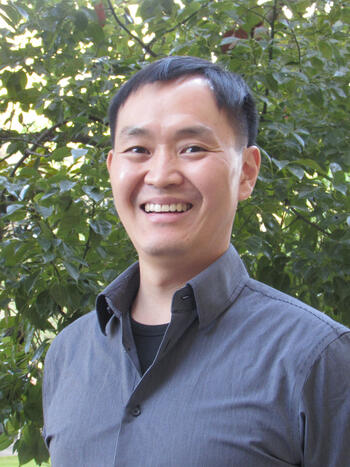
Joon Nak Choi is the 2015-2016 Koret Fellow in the Korea Program at Stanford University's Walter H. Shorenstein Asia-Pacific Research Center (Shorenstein APARC). A sociologist by training, Choi is an assistant professor at Hong Kong University of Science and Technology. His research and teaching areas include economic development, social networks, organizational theory, and global and transnational sociology, within the Korean context.

Choi, a Stanford graduate, has worked jointly with professor Gi-Wook Shin to analyze the transnational bridges linking Asia and the United States. The research project explores how economic development links to foreign skilled workers and diaspora communities.

Most recently, Choi coauthored Global Talent: Skilled Labor as Social Capital in Korea with Shin, who is also the director of the Korea Program. From 2010-11, Choi developed the manuscript while he was a William Perry postdoctoral fellow at Shorenstein APARC.

During his fellowship, Choi will study the challenges of diversity in South Korea and teach a class for Stanford students. Choi’s research will buttress efforts to understand the shifting social and economic patterns in Korea, a now democratic nation seeking to join the ranks of the world’s most advanced countries.
 
Supported by the Koret Foundation, the Koret Fellowship brings leading professionals to Stanford to conduct research on contemporary Korean affairs with the broad aim of strengthening ties between the United States and Korea. The fellowship has expanded its focus to include social, cultural and educational issues in Korea, and aims to identify young promising scholars working on these areas.


2015-2016 Koret Fellow
Visiting Scholar
<i>2015-16 Koret Fellow, Shorenstein APARC, Stanford University</i>
Seminars
Subscribe to Governance