FSI researchers work to understand continuity and change in societies as they confront their problems and opportunities. This includes the implications of migration and human trafficking. What happens to a society when young girls exit the sex trade? How do groups moving between locations impact societies, economies, self-identity and citizenship? What are the ethnic challenges faced by an increasingly diverse European Union? From a policy perspective, scholars also work to investigate the consequences of security-related measures for society and its values.
The Europe Center reflects much of FSI’s agenda of investigating societies, serving as a forum for experts to research the cultures, religions and people of Europe. The Center sponsors several seminars and lectures, as well as visiting scholars.
Societal research also addresses issues of demography and aging, such as the social and economic challenges of providing health care for an aging population. How do older adults make decisions, and what societal tools need to be in place to ensure the resulting decisions are well-informed? FSI regularly brings in international scholars to look at these issues. They discuss how adults care for their older parents in rural China as well as the economic aspects of aging populations in China and India.
South Korea has become an economic powerhouse, but faces multiple challenges. The conference will focus on four areas that South Korea needs to turn its attention to: 1) the higher education and development; 2) entrepreneurship and innovation; 3) global competitiveness; and 4) demographic changes and immigration policy.
During the conference, a keynote speech is open to the public. Please click here for more information about the public keynote.
Divided Lenses: Screen Memories of War in East Asia is the first attempt to explore how the tumultuous years between 1931 and 1953 have been recreated and renegotiated in cinema. This period saw traumatic conflicts such as the Sino-Japanese War, the Pacific War, and the Korean War, and pivotal events such as the Rape of Nanjing, Pearl Harbor, the Battle of Iwo Jima, and the bombings of Hiroshima and Nagasaki, all of which left a lasting imprint on East Asia and the world. By bringing together a variety of specialists in the cinemas of East Asia and offering divergent yet complementary perspectives, the book explores how the legacies of war have been reimagined through the lens of film.
This turbulent era opened with the Mukden Incident of 1931, which signaled a new page in Japanese militaristic aggression in East Asia, and culminated with the Korean War (1950–1953), a protracted conflict that broke out in the wake of Japan's post–World War II withdrawal from Korea. Divided Lenses explores how the intervening decades have continued to shape politics and popular culture throughout East Asia and the world. Essays in part I examine historical trends at work in various "national" cinemas, including China, Taiwan, Japan, Korea, and the United States. Those in part 2 focus on specific themes such as comfort women in Chinese film, the Nanjing Massacre, or nationalism, and how they have been depicted or renegotiated in contemporary films. Of particular interest are contributions drawing from other forms of screen culture, such as television and video games.
Why has Korean pop music (K-Pop) become so popular overseas? A wide variety of explanations have been proposed by academics, journalists and the fans themselves, ranging from superior training and product quality to the strategic usage of social media. Although some of these explanations have become widely-cited especially in the Korean media, whether or not they are actually correct remains largely unknown. To demystify why K-Pop has gained a following overseas, this study examines data on K-Pop concert booking overseas, from 2011 through 2014. The findings highlight the importance of cultural proximity, while casting doubt upon several other widely-cited explanations.
Joon Nak Choi is the 2015-2016 Koret Fellow in the Korea Program at Stanford's Shorenstein Asia-Pacific Research Center (APARC). A Stanford graduate and sociologist by training, Choi is an assistant professor at Hong Kong University of Science and Technology. His research and teaching areas include economic development, social networks, organizational theory, and global and transnational sociology, within the Korean context. He recently coauthored Global Talent: Skilled Labor as Social Capital in Korea which he developed the manuscript from 2010-11 while he was a William Perry postdoctoral fellow at APARC.
This event is made possible through the generous support of the Koret Foundation.
Shorenstein APARC
Encina Hall
Stanford University
Stanford, CA 94305-6055
0
jnchoi@stanford.edu
joon_nak_choi_7_cropped.jpg
Joon Nak Choi is the 2015-2016 Koret Fellow in the Korea Program at Stanford University's Walter H. Shorenstein Asia-Pacific Research Center (Shorenstein APARC). A sociologist by training, Choi is an assistant professor at Hong Kong University of Science and Technology. His research and teaching areas include economic development, social networks, organizational theory, and global and transnational sociology, within the Korean context.
Choi, a Stanford graduate, has worked jointly with professor Gi-Wook Shin to analyze the transnational bridges linking Asia and the United States. The research project explores how economic development links to foreign skilled workers and diaspora communities.
Most recently, Choi coauthored Global Talent: Skilled Labor as Social Capital in Korea with Shin, who is also the director of the Korea Program. From 2010-11, Choi developed the manuscript while he was a William Perry postdoctoral fellow at Shorenstein APARC.
During his fellowship, Choi will study the challenges of diversity in South Korea and teach a class for Stanford students. Choi’s research will buttress efforts to understand the shifting social and economic patterns in Korea, a now democratic nation seeking to join the ranks of the world’s most advanced countries.
Supported by the Koret Foundation, the Koret Fellowship brings leading professionals to Stanford to conduct research on contemporary Korean affairs with the broad aim of strengthening ties between the United States and Korea. The fellowship has expanded its focus to include social, cultural and educational issues in Korea, and aims to identify young promising scholars working on these areas.
2015-2016 Koret Fellow
Visiting Scholar
2015 Koret Fellow
2015 Koret Fellow, Korea Program, APARC, Stanford
Shorenstein APARC's center overviews provide detailed information about Shorenstein APARC's mission, history, faculty, financial support, organizational structure, projects, and programs.
Myoung-kyu Park is a professor of sociology and director of the Institute for Peace and Unification Studies (IPUS) at Seoul National University. Professor Park is one of South Korea's leading scholars of the North Korea problem, Korean identity and nationalism, and popular attitudes toward Korean unification. He is an FSI-Humanities Center International Visitor at Stanford for the fall 2015.
In this talk, Professor Park will examine South Koreans' perception of North Korea-related issues: denuclearization, human rights, security, cooperation, and unification. Based on data from annual surveys conducted by IPUS during 2007-2015, Professor Park will discuss South Korean psychological attitudes, the generational gap, and general trends and policy orientation regarding North Korea.
Myoung-kyu Park
Professor of Sociology, Seoul National University
Americans think of South Korea as one of the most pro-American of countries, but in fact many Koreans hold harsh and conspiratorial views of the United States. If not, why did a single U.S. military traffic accident in 2002 cause hundreds of thousands of Koreans to take to the streets for weeks, shredding and burning American flags, cursing the United States, and harassing Americans? Why, too, the death threats against American athlete Apolo Ohno and massive cyberattacks against the United States for a sports call made at the Utah Winter Olympics by an Australian referee? These are just two of the incidents detailed in David Straub’s recently published book, Anti-Americanism in Democratizing South Korea, the story of an explosion of anti-Americanism in South Korea from 1999 to 2002.
Straub, a Korean-speaking senior American diplomat in Seoul at the time, reviews the complicated history of the United States’ relationship with Korea and offers case studies of Korean anti-American incidents during the period that make clear why the outburst occurred, how close it came to undermining the United States’ alliance with Korea, and whether it could happen again.
David Straub has been associate director of the Korea Program at Stanford University’s Walter H. Shorenstein Asia-Pacific Research Center (APARC) since 2008, following a thirty-year diplomatic career focused on U.S. relations with Korea and Japan.
For more information about this topic, click here.
David Straub was named associate director of the Korea Program at the Walter H. Shorenstein Asia-Pacific Research Center (Shorenstein APARC) on July 1, 2008. Prior to that he was a 2007–08 Pantech Fellow at the Center. Straub is the author of the book, Anti-Americanism in Democratizing South Korea, published in 2015.
An educator and commentator on current Northeast Asian affairs, Straub retired in 2006 from his role as a U.S. Department of State senior foreign service officer after a 30-year career focused on Northeast Asian affairs. He worked over 12 years on Korean affairs, first arriving in Seoul in 1979.
Straub served as head of the political section at the U.S. embassy in Seoul from 1999 to 2002 during popular protests against the United States, and he played a key working-level role in the Six-Party Talks on North Korea's nuclear program as the State Department's Korea country desk director from 2002 to 2004. He also served eight years at the U.S. embassy in Japan. His final assignment was as the State Department's Japan country desk director from 2004 to 2006, when he was co-leader of the U.S. delegation to talks with Japan on the realignment of the U.S.-Japan alliance and of U.S. military bases in Japan.
After leaving the Department of State, Straub taught U.S.-Korean relations at the Johns Hopkins University's School of Advanced International Studies in the fall of 2006 and at the Graduate School of International Studies of Seoul National University in spring 2007. He has published a number of papers on U.S.-Korean relations. His foreign languages are Korean, Japanese, and German.
Associate Director of Korea Program, APARC, Stanford University
Kathleen Stephens
Panelist
<i>Panelist</i>; former US ambassador to South Korea; William J. Perry Distinguished Fellow, APARC, Stanford University
Daniel Sneider
Moderator
<i>Moderator</i>; Associate Director for Research, APARC, Stanford University
The Washington Post's Anna Fifield reviewed Crossing Heaven's Border (Shorenstein APARC, 2015), a book by author and journalist Hark Joon Lee. The book details the challenges facing North Korean defectors -- their perilous escapes, the repressive regime that they seek to flee from, and for some, what life looks like on the other side.
"Lee’s book is compelling because it offers a fresh perspective on the puzzle that is North Korea. He writes about the challenges he faced in reporting on this story and the ethical questions he encountered, and the toll it took on him as a person," Fifield writes.
Sensationalist stories about North Korea often swirl in news headlines, but Lee chronicles their hardships as a firsthand witness who embedded with defectors from 2007 to 2011.
Lee, reporting for the Korean newspaper Chosun Ilbo, initially published the stories as articles, and later as a documentary on the Public Broadcasting Service in 2009. Lee's account focuses on the lives of ordinary North Koreans.
"He writes about the tenderness he sees between a middle-aged couple from different social backgrounds who fled so they could be together; Soo-ryun, who had a difficult escape but found love and had a baby, only to be struck down by stomach cancer; pretty Young-mi, who dreamed of going to the United States but then found she couldn’t even understand the English that South Koreans use," Fifield writes.
The United Nations has thus far fulfilled its charter to prevent a third world war, but with 60 million refugees, continued bloodshed with unresolved civil conflicts and terrorism spreading like cancer, the world's leading peacekeeping organization must spearhead global action, U.N. Secretary-General Ban Ki-moon said Friday at Stanford on the 70th anniversary of the international organization.
Ban, the U.N.'s eighth secretary-general, did not rest on any laurels during his speech at a public event sponsored by the Walter H. Shorenstein Asia-Pacific Research Center (APARC). "I humbly accept criticism that the U.N. is not doing enough," he said.
However, the situation could have been worse if not for the United Nations, he continued. "Without peacekeepers, or without the U.N.'s continued humanitarian assistance and advocacy of human rights, I'm afraid to tell you that this world would have been poorer, more dangerous and even bloodier without the United Nations."
Ban's visit to Stanford – his second to the university in less than three years – was part of a trip to the Bay Area to commemorate the signing of the U.N. charter. In 1945, representatives from 50 nations gathered in San Francisco to create the United Nations – an international organization aimed at saving future generations from the "scourge of war."
Today, the United Nations has grown to 193 member nations. Its challenges – from climate change and poverty to civil wars and terrorism – have never been greater, Ban said.
"This is a critical year; 2015 is a year of global action," he said. "The U.N. cannot do it alone. We need strong solidarity among government, business communities and civil societies, from each and every citizen."
The fact that so many young people around the globe are drawn to violent narratives is worrisome, Ban said. "Violent terrorism is spreading like cancer around the world."
The rise in terrorist activities stems from "a failure of leadership," he said. That's why the United Nations needs to develop a comprehensive plan of action to address extremism, he maintained.
The U.N.'s 70th anniversary coincidentally fell on a momentous day of tragedy and celebration around the world. Dozens were killed when terrorists launched horrific attacks across three continents – in France, Tunisia and Kuwait – fueling anger, sadness and fear of more violence.
But in the United States, celebrations rang out in response to a landmark U.S. Supreme Court ruling that legalizes same-sex marriages nationwide.
Ban, who has long advocated for equality and last year pushed the United Nations to recognize same-sex marriages of its staff, drew a round of applause when he heralded the court ruling as "a great step forward for human rights."
As people around the world look to support earthquake relief efforts in Nepal, scholars from Stanford and the London School of Economics and Political Science offer new research that can help donors make better decisions about where and how to contribute their money.
“NGO reports tend to focus on quantity in delivery, such as numbers of homes and people served—but not on quality,” write Yong Suk Lee (Stanford) and J. Vernon Henderson (LSE).
In a forthcoming paper, the coauthors evaluate reconstruction efforts in Indonesia following the 2004 earthquake and tsunami, and find two trends: aid agencies that directly execute their services—point-to-point—perform the highest quality work. And, when agencies contract their services, higher quality work is performed when a global, not domestic, implementer completes the work.
Knowing this reality, and with improved disclosure of outcomes, the coauthors hope that donors would be able to make more informed choices.
Fishing village survey
Figure 1. A map details the survival rate of the population and flood damage within northern Indonesia in 2004. Darker shaded areas show a higher survival rate, lighter shaded areas show a lower survival rate. Striped areas denote flooding, largely on the northeastern border. Boundaries marked with thicker lines are ‘kabupaten,’ or county divisions, and lightly colored lines are ‘kecamatan,’ or sub-county units larger than a village alone. (Courtesy of Yong Lee).
Through fieldwork and three rounds of surveys – in 2005, 2007 and 2009 – Henderson and Lee investigated aid work in Aceh, an area of coastal villages in northern Indonesia (Figure 1).
Humanitarian efforts there focused on “hard aid” such as construction of houses and fishing boats. Total aid delivered amounted to $7.7 billion and was implemented by international and domestic aid agencies—some directly and some as contractors—as well as the Indonesian government.
First, Henderson and Lee conducted a pilot survey, and then with a cohort of surveyors from the University of Indonesia, held interviews with village leaders and fishing families. Participants were asked to rate their housing accommodation, and if applicable, how their fishing activity compared to before the disaster.
“Mostly, we sat with villagers to see how willing they were to talk about aspects of aid,” Lee said. “Since it was several years after the tsunami hit, people were pretty open throughout the process.”
Data from those surveys was combined with information from the Recovery Aceh-Nias relief project database maintained by the government and the U.N., as well as demographic information provided by participants.
Delivering aid: Global v. local
Empirical analysis revealed that aid agencies such as the Red Cross and Catholic Relief Services reflected higher quality aid delivery (at a mean quality near 3.00), while agencies such as Save the Children and Concern Worldwide reflected lower quality (at a mean quality between 1.0-1.5).
“What’s surprising is that reputation didn’t really line up with what was expected,” Lee said, citing a few renowned agencies that didn’t receive high marks.
Lee said this could be explained by the fact that aid agencies that specialize in disaster recovery are better equipped, while a learning curve might exist for agencies with wider missions.
Global aid agencies are more likely to have logistical experience given their reach across multiple disaster situations. And while all NGOs face reputational costs for their results, global aid agencies are greater exposed to criticism because, by size, they’re more visible.
Yet, while global aid agencies and implementers may have the raw skills, local implementers have the cultural know-how.
“Local implementers might not have the most experience – like how to construct a house or manufacture a fishing boat – but they will likely know what’s actually desired,” Lee said. “So, there are obvious tradeoffs at play.”
For example, villagers reported bad ventilation in houses. This was because some aid agencies used small windows and concrete instead of wood material more traditionally used in Indonesia. Some boats were impossible to use because of improper design; they sank upon first use or fell apart after a few months.
Image
Collection of photos from fieldwork in Aceh, Indonesia, provided courtesy of Yong Lee. Upper left: A house built in an aid project village shows windows retrofitted after initial construction. Upper right: Boats constructed by aid agencies for fishing activity are refashioned to serve as water taxis for people and cars. Lower: Fishing boats sit unused on the side of the road many of them impossible to use, according to villagers surveyed.
Upper left: A house built in an aid project village shows windows retrofitted after initial construction. Upper right: Boats constructed by aid agencies for fishing activity are refashioned to taxi people and cars. Lower: Fishing boats sit unused on the side of the road many of them impossible to operate, according to villagers surveyed. (Courtesy of Yong Lee).
Logistics and oversight
Aid delivery depends in many ways on the location and scale of the disaster. But, a few main aspects can determine if an aid agency doing its own work or operating as an implementer meets or exceeds expectations.
Henderson and Lee suggest that agencies that were highly supervisory had greater positive outcomes from their workers. In the case of Aceh, better monitoring and insistence on quality by leadership is a likely corollary between construction of better quality homes and boats.
“Rather than just give money, NGOs need to really oversee the projects. Organization and management are essential facets,” Lee said. “And that requires a lot of additional effort on their part.”
Oversight is especially relevant in disaster situations because of the often-overwhelming need for reconstruction. A flood of less-skilled workers enters the market to fill this gap, and on average the quality of work degrades.
“It’s much more difficult to impose quality control at this point,” Lee said. “So the implication that comes out of it is how does the implementer effectively utilize less-skilled workers.”
Getting to know the implementers and evaluating their work in-progress would help ensure quality on behalf of the aid agency. And, better dissemination of information about aid outcomes would help assure donors that their monies are being applied in the best possible way.
Future study
Most “hard aid” delivered to Aceh’s villages had finished by 2010, but “soft aid” such as democracy promotion and women’s empowerment stayed longer.
Henderson and Lee conducted one final survey in 2011. The data has been offered as open source material for researchers along with the larger data set.
Noting this, Lee said, “We’re thrilled that people are looking into the data further. It’s exactly what we wanted.”
Research projects applying the data include the impact of the tsunami on Aceh’s local economies and health effects on the population, among other areas.
Hero Image
A United Nations Humanitarian Air Service helicopter offloads relief supplies from the World Food Programme in Gorkha District, Nepal. Villagers help distribute tents and food. | WFP/Angeli Mendoza

 FSI researchers work to understand continuity and change in societies as they confront their problems and opportunities. This includes the implications of


 Figure 1. A map details the survival rate of the population and flood damage within northern Indonesia in 2004. Darker shaded areas show a higher survival rate, lighter shaded areas show a lower survival rate. Striped areas denote flooding, largely on the northeastern border. Boundaries marked with thicker lines are ‘kabupaten,’ or county divisions, and lightly colored lines are ‘kecamatan,’ or sub-county units larger than a village alone. (Courtesy of Yong Lee).
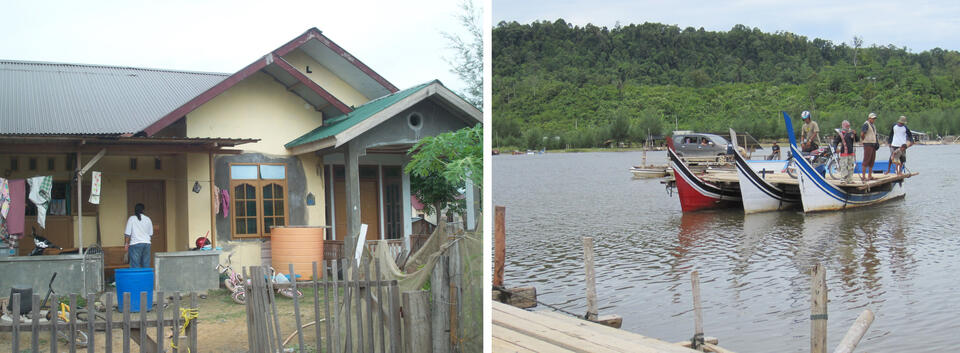
 Collection of photos from fieldwork in Aceh, Indonesia, provided courtesy of Yong Lee. Upper left: A house built in an aid project village shows windows retrofitted after initial construction. Upper right: Boats constructed by aid agencies for fishing activity are refashioned to serve as water taxis for people and cars. Lower: Fishing boats sit unused on the side of the road many of them impossible to use, according to villagers surveyed.
