How has North Korea managed to experience numerous foreign policy crises without escalation to war? Why has North Korea been willing to repeatedly engage in small-scale attacks against the United States and its South Korean ally? And why have U.S. officials in liberal and conservative presidential administrations only rarely taken North Korean threats seriously? In this presentation of his newly released book, Rival Reputations: Coercion and Credibility in US-North Korea Relations, (Cambridge University Press), Dr. Van Jackson argues that these puzzles are best explained with reference to the weight of history in U.S. and North Korean foreign policy. The book draws on the concept of reputation--the influence of past words and deeds on decision-making in the present--to explain patterns of hostile interactions in foreign policy between the United States and North Korea from 1960s through the present day. The book's findings have major implications for the conduct of U.S. and South Korean foreign and defense policy toward North Korea.
Dr. Van Jackson is an associate professor in the College of Security Studies at the Daniel K. Inouye Asia-Pacific Center for Security Studies, specializing in East Asian security, U.S. foreign policy, defense strategy, historical institutionalism, and international relations theory. He is also an adjunct senior fellow at the Center for a New American Security (CNAS) in Washington, as well as a senior editor for the online defense daily, War on the Rocks. From 2009 to 2014, Dr. Jackson held positions in the Office of the Secretary of Defense as a strategist and policy adviser focused on the Asia-Pacific, senior country director for Korea, and working group chair of the U.S.–Republic of Korea Extended Deterrence Policy Committee. He has previously taught at Georgetown University and the Catholic University of America, and has held fellowships with the Council on Foreign Relations, CNAS, and Pacific Forum CSIS. He is also widely published in leading disciplinary and area studies journals.
Van Jackson
<i>College of Security Studies, Daniel K. Inouye Asia-Pacific Center for Security Studies</i>
Daniel Sneider, associate director for research at the Walter H. Shorenstein Asia-Pacific Research Center, provides an in-depth analysis of how the agreement on the “comfort women” issue between Japan and South Korea was reached late last year. In Japanese publication Toyo Keizai Online, Sneider writes that – after at least four years of negotiations between the two governments – political leadership in Seoul and Tokyo as well as pressure from the Obama administration can be credited for the breakthrough.
Earlier in December, David Straub, associate director for the Korea Program, said the agreement is a sign of progress. He said it vindicates the victims and is a positive development for Korea-Japan relations.
South Korean Foreign Minister Yun Byung-Se (Right) shakes hands with his Japanese counterpart Fumio Kishida (Left) during their meeting at the Foreign Ministry in Seoul Dec. 28, 2015. | Reuters/Jung Yeon-je/Pool
The breakthrough agreement on the comfort women issue between Japan and South Korea on Dec. 28,2015, was the culmination of at least four years of negotiations between the two governments. South Korean President Park Geun-hye and Japanese Prime Minister Shinzo Abe pushed for the agreement; the Obama administration provided persistent pressure while resisting a mediation role. The danger of the agreement falling apart is apparent to officials in Washington and Seoul, and hopefully Tokyo too, writes Sneider.
North Korea claimed it successfully tested a hydrogen bomb on Jan. 6, according to a broadcast from the nation’s Korean Central Television. Experts at the Freeman Spogli Institute for International Studies offered their analyses to media.
In a Q&A, Siegfried Hecker answered nine questions, offering perspective on the situation and how the United States should respond. Hecker, a CISAC senior fellow, is a former director of the Los Alamos National Laboratory and has visited North Korea seven times since 2004.
David Straub, associate director of the Korea Program, commented on the North Korean nuclear program in an NK News article. He said the timing of the nuclear test, now the nation’s fourth, was likely only marginally influenced by external factors such as Kim Jong-un’s birthday. The primary factor is technical, he said. Straub also spoke with Yonhap News on Feb. 12. In the interview, Straub said "although the United States and the People's Republic of China certainly have differences [in dealing with the North Korean nuclear issue], they pale in comparison to U.S.-Soviet differences."
Straub also offered, in an extended interview with South Korea's Segye Ilbo newspaper, his thoughts on Pyongyang's motivations for pursuing nuclear weapons. He argued that the appropriate policy response is to continue to increase pressure on the regime. Pressure applied by Washington is meant to convince Pyongyang that nuclear weapons will bring more cost than benefit, while holding open the door to good-faith negotiations to resolve peninsular issues.
Shorenstein APARC Associate Director for Research Daniel Sneider talked with Al Jazeera America and Slateabout the developments. He said the nuclear test signified North Korea’s uneasiness and was largely an accommodation of domestic politics.
In early February, South Korea announced temporary closure of Kaesong Industrial Complex (KIC), a jointly held project with North Korea. In Chosun Ilbo newspaper, Straub argued that South Korea's closure of KIC was a necessary response to North Korea's fourth nuclear test and latest satellite rocket launch. Two articles were published in Korean; the first is available here and the second here.
Hero Image
North Korean leader Kim Jong Un provides field guidance at the newly built National Space Development General Satellite Control and Command Centre in this undated photo released by North Korea's Korean Central News Agency (KCNA) in Pyongyang, May 3, 2015. | Reuters/KCNA
David Straub, associate director of the Korea Program, says that the recent "Comfort Women" agreement vindicates the victims and should be good for overall Korea-Japan relations.
The fifteenth session of the Korea-U.S. West Coast Strategic Forum, held in Korea on November 17, 2015, convened senior South Korean and American policymakers, scholars and regional experts to discuss North Korea policy and recent developments on the Korean Peninsula. Hosted by the Korea Program at the Walter H. Shorenstein Asia-Pacific Research Center at Stanford University, the Forum is also supported by the Sejong Institute.
South Korea must stand with the United States in the event of escalated tensions between China and the United States in the South China Sea, Stanford professor Gi-Wook Shin advised at a forum in Seoul on November 19th.
"Flexibility is necessary, but what's more important is…principle," said Shin, emphasizing the importance of South Korea’s alliance with the United States over its strategic partnership with China.
South Korea and the United States are “completely aligned” on North Korea strategy, the chief American diplomat in South Korea said to a Stanford audience on Monday.
Mark Lippert, who assumed the role of U.S. ambassador to the Republic of Korea in 2014, delivered remarks at a public seminar, “Perspectives on the U.S.-Korea Alliance,” organized by the Korea Program at the Walter H. Shorenstein Asia-Pacific Research Center.
Arriving from the Washington summit of President Obama and Korean President Park Geun-hye, Lippert spoke of the success of the state visit. The U.S.-Korea relationship is in “as good a shape as it’s ever been,” and that secure foundation is allowing the two countries to forge ahead on shared challenges, including North Korea, trade and global health.
Mark Lippert expressed optimism about the U.S.-ROK alliance at a Stanford talk on Oct. 19, 2015.
“We want to get back to credible and authentic negotiations towards a denuclearized Korea,” Lippert said, explaining that U.S.-Korea strategy toward North Korea aligns in three main areas: diplomacy, economics and deterrence.
He said the United States and South Korea are invested in getting to a place where the North Koreans will “come back to the table” for discussions on ending their nuclear program, noting the continuing viability of the Six Party Talks mechanism which has been stalled for more than five years.
Lippert also cited U.S.-Korea strategic cooperation on sanctions against North Korea, and defense capabilities aimed to deter the threat of a North Korea with nuclear and long-range missile capacity.
Looking ahead, “The United States strongly supports calls for reunification of the Korean Peninsula,” he said. Human rights, a free economy and a democratically elected government in the North would be a priority in that pursuit.
Lippert said the United States is supportive of inter-Korean talks and reunions for families separated by the Korean War, both announced earlier this year. On Tuesday, hundreds of South Koreans crossed the border to meet with North Korean relatives, who have been separated for more than six decades.
Partnering on the economic level was another key aspect of the summit, Lippert said, and the Trans-Pacific Partnership (TPP) was among items discussed. The United States, as one of 12 TPP member nations, would welcome an application from South Korea should they choose to pursue it, he said.
Lippert acknowledged that South Korea already has bilateral trade agreements with 10 out of the 12 TPP member nations, including one with the United States. The U.S.-Korea Free Trade Agreement (KORUS) came into force in 2012 and is moving toward full implementation, he said. The United States’ sixth largest trading partner is South Korea.
Following his formal remarks, Lippert took questions from the audience.
Michael Armacost, a Shorenstein Distinguished Fellow, asked Lippert how Japan and China figured into the summit discussions following recent developments. In September, President Park attended a military parade in Beijing that marked the 70th anniversary of the end of World War II. She was the only leader from a democratic country at the event.
Responding on China, Lippert said the United States is supportive of South Korea engaging with China. “We don’t view this as a zero-sum game,” he said, likening South Korea’s regional relationships to a situation where “all boats rise” together.
Dafna Zur, a professor of Korean culture and literature, asked Lippert to talk about how his education informed his career in public service.
Lippert attended Stanford and studied political science and international policy studies.
His education, he said, was invaluable in preparing him for the diverse situations and people that a diplomatic career brings.
Lippert encouraged students to savor conversation and debate in the classroom. Participating in that kind of forum not only “makes you a more informed person” but also “sharpens your analytic skills,” he said.
Prior to becoming ambassador, Lippert held senior positions in the Department of Defense and the White House and served in the U.S. Navy.
Following the event, Lippert met with faculty members of Shorenstein APARC and the Freeman Spogli Institute for International Studies for a roundtable discussion, chaired by Kathleen Stephens, a distinguished fellow at Shorenstein APARC and former U.S. ambassador to the Republic of Korea (2008-11).
Embedded photo: Mark Lippert speaks at Stanford on Oct. 19, 2015. Photo credit: Heather Ahn.
Hero Image
Korean President Park Geun-hye (left) and U.S. President Barack Obama have an in-depth discussion at a White House summit. This picture is from their first summit in Washington in May 2013. Their second summit took place in October 2015. | Flickr/Korea.net - Cheong Wa Dae (crop applied)
In the wake of South Korean President Park Geun-hye's meeting with President Obama in Washington, D.C. on October 16, Mark Lippert, the American Ambassador to Korea, will offer his thoughts about U.S.-Korean relations and the challenges and opportunities the alliance may face in coming years.
Ambassador Lippert previously held senior positions in the Department of Defense from May 2012 until September 2014. This included Chief of Staff to the Secretary of Defense, Chuck Hagel, and Assistant Secretary of Defense for Asian and Pacific Security Affairs, where he was the principal advisor to the Secretary of Defense on all international security strategy and policy issues related to the nations and international organizations of Asia and the Pacific. Prior to being confirmed in April 2012, he completed a two-year mobilization on active duty in the United States Navy. During that time, which included a deployment to Afghanistan, he served as an Intelligence Officer for the Naval Special Warfare Development Group in Virginia Beach, Virginia from 2009 to 2011.
Ambassador Lippert served as Deputy Assistant to the President and Chief of Staff for the National Security Council in 2009. In 2008, he served as Deputy Director for Foreign Policy on the Obama-Biden Transition Team, and Senior Foreign Policy Advisor on the Obama for America campaign. Previously, he worked as the Foreign Policy Advisor for then-Senator Obama from 2005 to 2008, where he managed the Senator's work on the Senate Foreign Relations Committee. From 2007 to 2008, he took a leave of absence from this position to deploy on active duty as an Intelligence Officer with Seal Team One in support of Operation Iraqi Freedom. From 2000 to 2005, he was a Professional Staff Member on the Senate Appropriations Committee, State-Foreign Operations Subcommittee, advising Senator Patrick Leahy on a range of foreign aid and security assistance issues. From 1999 to 2000, he served as the Foreign and Defense Policy Advisor to Senator Tom Daschle and the Senate Democratic Policy Committee.
Ambassador Lippert’s military awards and decorations include the Bronze Star Medal for his service in Iraq, the Defense Meritorious Service Medal, and the Basic Parachutist Badge. He is also the recipient of the Department of Defense’s Distinguished Public Service Award and the Department of the Navy’s Distinguished Public Service Award.
Ambassador Lippert graduated Phi Beta Kappa from Stanford University with a B.A. in Political Science and holds an M.A. in International Policy Studies from the same institution. He also studied Mandarin Chinese at Beijing University.
Mark W. Lippert
<i>U.S. Ambassador to Republic of Korea</i>

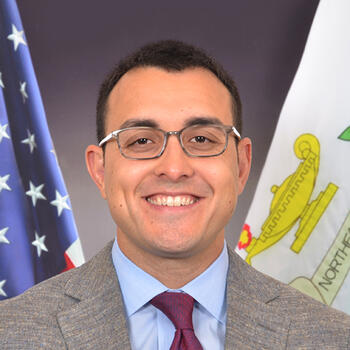


 Mark Lippert expressed optimism about the U.S.-ROK alliance at a Stanford talk on Oct. 19, 2015.

