Diplomacy
0
andrew_kim.jpg

Sung Hyun "Andrew" Kim was a visiting scholar at the Walter H. Shorenstein Asia-Pacific Research Center (APARC) through December 2019. Previously he was William J. Perry visiting scholar at APARC. Kim, who retired from the Central Intelligence Agency in 2018 as a senior intelligence officer after 28 years of service, was assistant director of the CIA's Korea Mission Center, where he helped secure the foundation for the Trump-Kim summit of June 2018.  At Stanford, he will contribute to studies of current North Korea diplomacy in comparison to previous negotiations with the DPRK, a research scope that he refers to as "U.S.-DPRK summit of the century and the tide of history."  Kim will also participate in policy engagement regarding North Korea issues through Shorenstein APARC and its Korea Program.

Kim established the CIA's Korea Mission Center in April 2017 in response to a presidential initiative to address North Korea's longstanding threat to global security. As part of his role as head of the Mission Center, he managed and guided CIA Korean analysts in providing strategic and tactical analytic products for a range of policymakers. He accompanied CIA Director and then Secretary of State Mike Pompeo to Pyongyang in meeting with the North Korean leader Kim Jong Un several times. Formerly he served as the Agency's associate deputy director for operations and technology, leading all efforts to update operational technology and incorporate a state-of-the-art doctrine into CIA training curricula.

Earlier in his career, Kim served as the CIA's chief of station in three major East Asian cities, while also managing the intelligence relationship with politically and militarily complicated foreign countries and advancing U.S. interests. In recognition of his many contributions, Kim was honored by the Agency with the Director's Award (2018), Presidential Rank Award (2012), and the Donovan Award (1990). He speaks fluent Korean, Japanese, and Mandarin Chinese.

Visiting Scholar at APARC
Authors
Andray Abrahamian
News Type
Commentary
Date
Paragraphs

This post was originally published by PacNet Commentary, a publication of Pacific Forum.

North Korea’s state-owned news agency ran a wire story with tremendous significance just before Christmas, making clear that unilateral denuclearization is not going to happen. As part of a detailed explanation of Pyongyang’s position, it said: “When we refer to the denuclearization of the Korean peninsula, it, therefore, means removing all elements of nuclear threats from the areas of both the north and the south of Korea and also from surrounding areas from where the Korean peninsula is targeted. This should be clearly understood.” The text also states that “the denuclearization of the Korean peninsula means ‘completely removing the nuclear threats of the U.S. to the DPRK.’”
 
Pyongyang has long held that their nuclear weapons are a necessary deterrent and has made similar statements in the past, but not so clearly, nor with such a detailed explanation, nor at such a crucial time. Why did they choose to do so at the very end of 2018? There is a degree of unsatisfactory speculation that must take place to try to answer such a question, but we can see a few key elements of the negotiating procedure.
 
The North Koreans have made it clear they want to deal with President Trump himself, probably correctly assessing that he is more likely to make concessions or take significant risks than are his subordinates. Moreover, working-level negotiations have moved slowly over the past several months.
 
The DPRK statement, released in a semi-public way on the newswire, might have been an attempt to get the issue clearly and squarely on the president’s desk. Perhaps the North Koreans don’t believe Secretary of State Mike Pompeo is relaying messages to Trump. Or perhaps the recent retirement of the CIA’s Andrew Kim, who has liaised with the North Koreans alongside and for Pompeo, worried Pyongyang. Stephen Biegun, the new US special representative for North Korea, is an unknown quantity to them. Pyongyang probably didn’t want to resume and rehash this year’s logjam with Biegun in the new year.
 
This shift in communication strategy fits the North Korean political calendar. The New Year Joint Editorial frames the Korean Worker’s Party’s positions for the year and all adult North Koreans study the adjustments in the party line for several weeks in January. This includes North Koreans who interface with the outside world: in 2019 they will present to their foreign interlocutors a specific set of demands based on this clearer definition of “denuclearization.”
 
This leaves President Trump in a bit of a bind. He has to decide if he wants to proceed with the peace and denuclearization process as North Korea has defined it. He could choose a couple different paths.
 
First, Trump appears to have very few deeply held beliefs about the international order, other than that the US has generally been taken advantage of on trade and multilateral defense. He certainly doesn’t care much for alliances. One could imagine him saying, “that’s fine, we could remove our nuclear umbrella from South Korea” once we move toward denuclearization of the north. This would face tremendous pushback from the policy and military communities in the US as well as from allies in Asia, however. It would be the sort of pronouncement that would leave him isolated from much of his administration, Congress, and the pundit community that comments on TV; it would be hard to sustain this position.
 
More likely, he could say, “fine, let’s talk about a freeze on your program and worry about denuclearization later.” This seems more plausible for several reasons.
 
First, his core constituency doesn’t really care about denuclearization. His base wants to see Trump keep winning and if he tells them this is a win, they will likely accept it and move on. He has shown he is rhetorically able to slip out of nooses that other presidents would have choked on. He could conceivably pivot toward a freeze and cap of the North Korean nuclear program as an attainable goal and let the experts – who again largely don’t matter to his base – fight about whether this is good enough.
 
In that regard, Trump may well have been aided by a shift in the professional North Korea-watching community. Since roughly the fall of 2017, when war rhetoric and tensions were escalating, an increasing number of commentaries, events, and lectures with titles along the lines of “living with a nuclear North Korea” began to appear. There are now clearly more voices in the analyst community willing to say that the United States can tolerate and deter a nuclear North Korea. Such an opinion was incredibly scarce in 2016.
 
This is a situation that Trump helped foster. His administration helped raise the prospect of conflict that really did highlight the absurdity of war on the Korean Peninsula. The administration was essentially saying “we are willing to risk a nuclear war to prevent a country from being able to wage nuclear war.” This focused a lot of minds and helped clarify the fact that deterrence remains viable. Whether that means seeking to cooperate or continuing to pressure and isolate North Korea remains up for debate.
 
In defining that debate, if Trump decides he wants to try to change the US-DPRK relationship, he can point to the text of the Singapore Declaration that he and Kim Jong Un signed at their June 12 summit. While the declaration was much pilloried by observers as a “nothingburger,” it did promise to “establish new US–DPRK relations in accordance with the desire of the peoples of the two countries” and “to build a lasting and stable peace regime on the Korean Peninsula.” Those clauses come before a promise by both sides “to work toward complete denuclearization of the Korean Peninsula.”
 
President Trump could conceivably articulate a position in which a freeze of the North Korean program is a realistic goal that takes place alongside improved relations between the two countries, putting the issues of the DPRK’s stockpile and the US nuclear umbrella in Asia off for a later date.
 
This formula would be unsatisfactory to many people, but Trump has shown a willingness to upset traditional stakeholders. Besides, this is North Korea policy. Past attempts at pressure and engagement have been unsatisfactory to one group or another. The status quo is basically unsatisfactory to many, particularly in South Korea. Satisfying everyone will be impossible. Who Trump decides to upset will define how the next round of negotiations with the DPRK goes.
 
Andray Abrahamian is the 2018-19 Koret Fellow at APARC, Stanford University. He is an adjunct fellow at Pacific Forum and Griffith Asia Institute, an honorary fellow at Macquarie University, and a member of the US National Committee on North Korea. His book, North Korea and Myanmar: Divergent Paths, was published by McFarland in 2018.
 
Hero Image
3D illustration for the concept of U.S.-North Korea diplomacy: U.S. and DPRK flags carried from strings by birds on a sky background wildpixel/ Getty Images
All News button
1
-

The 11th Annual Koret Workshop

A dramatic opening created by the unique strategic outlooks and personalities of Moon Jae-in, Kim Jong Un and Donald Trump instigated a series of highly symbolic summits in the early months of 2018. The process kicked off by those summits has bogged down, however, as the necessary compromises for an agreement between the United States and North Korea have proved elusive. This year's Koret Workshop will therefore invite experts from a variety of areas in order to reflect on what the stumbling blocks have been as well as prospects for overcoming them. Conference participants will work towards better understanding and supporting potential emerging solutions to the persistent conflict on the Korean Peninsula.

The workshop will consist of three sessions:

Session I: Assessments of Summit Diplomacy

Session II: Challenges and Opportunities in Media Coverage

Session III: Prospects and Pitfalls in the Near-Term

NOTE: During the conference, a keynote address is open to the general public. Please click here to register for the public event on March 15.
 
The annual Koret Workshop is made possible through the generous support of the Koret Foundation.

Bechtel Conference Center
Encina Hall, 616 Serra Street
Stanford University

Conferences
Authors
News Type
News
Date
Paragraphs
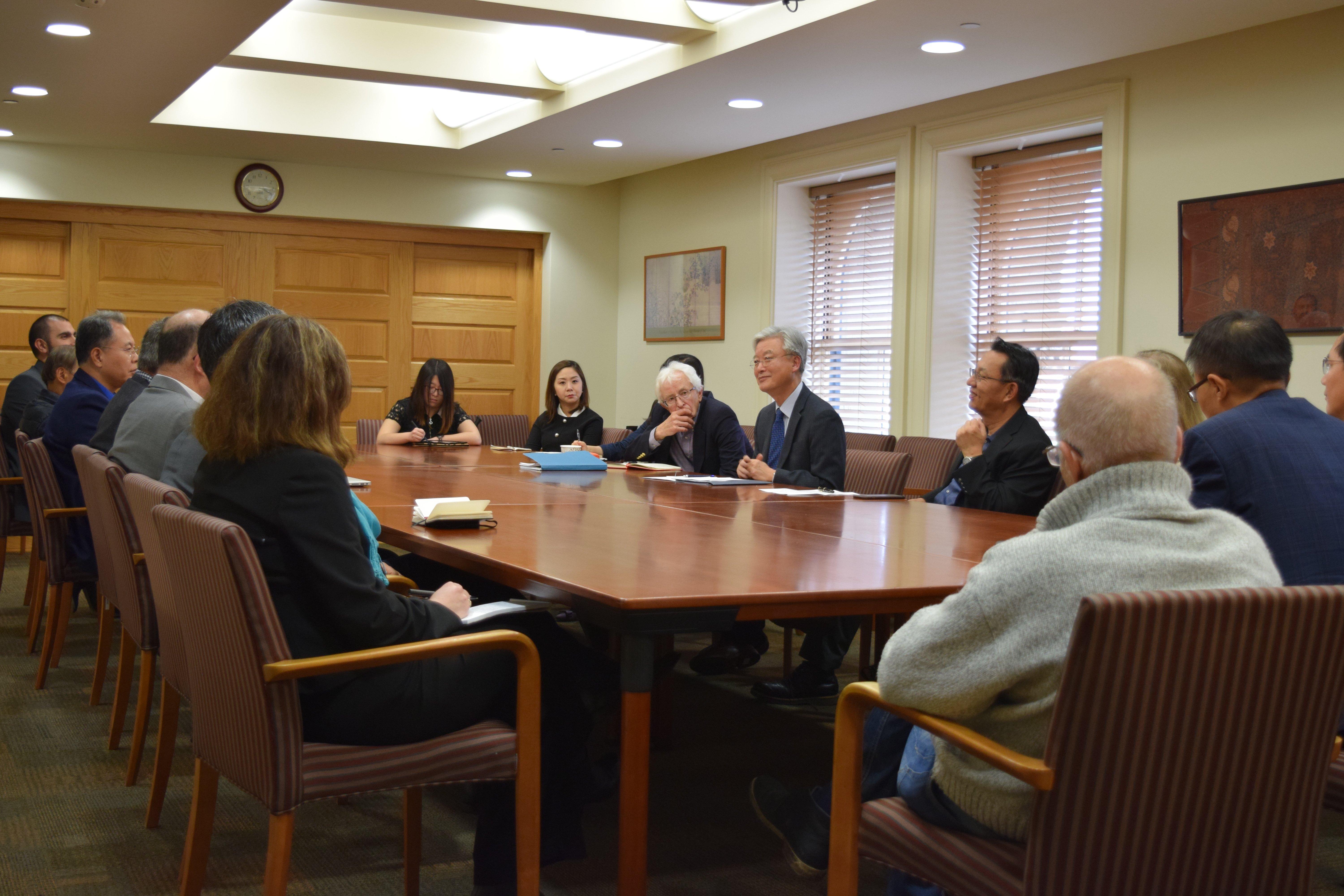
On November 29, the Korea Program at the Walter H. Shorenstein Asia-Pacific Research Center ( APARC ) welcomed the Ambassador of the Republic of Korea to the United States, Cho Yoon-je , who joined faculty members from the Freeman Spogli Institute for International Studies and other Stanford experts for a roundtable discussion about North Korea diplomacy and U.S.-ROK relations. 
 
“We were delighted to host Ambassador Cho,” said Gi-Wook Shin , director of APARC and of the Korea Program. “The candid conversation enabled us to learn from the Ambassador about the latest developments in the North Korea denuclearization talks and to offer our perspectives and policy recommendations. Convenings of academics and government officials, which Shorenstein APARC frequently organizes, are an excellent venue for advancing dialogue with U.S. counterparts in Asia and for bringing our research to bear on pressing policy issues.”
 

Rountable participants and Ambassador Cho Rountable participants and Ambassador Cho at Shorenstein APARC. Photo: Thom Holme.

 
Ambassador Cho recently marked his first year since taking office at the height of the 2017 tensions between North Korea and the United States, when the North conducted a sixth nuclear test and several tests of intercontinental ballistic missiles with the potential to reach the U.S mainland. President Trump threatened to “totally destroy” the regime and the North Korean leader responded in kind. Then renewed inter-Korean discussions paved the way for an unprecedented U.S.-DPRK summit and following diplomatic engagement. 
 
Ambassador Cho and the roundtable participants discussed recent reports pointing that diplomacy has stagnated in the months since the summit. The Ambassador expressed South Korea’s determination to seize the opportunity for rapprochement with the North and its commitment to the ROK alliance with the United States.
 
A specialist in international finance and economics, Ambassador Cho earned his MA and PhD in economics from Stanford University. Throughout his career he has held leadership positions that span both public service and academia. His former roles include the ROK Ambassador to the United Kingdom; Special Envoy to the European Union and to Germany; Senior Counselor to the Deputy Prime Minister and Minister of Finance and Economy of the ROK; Vice President of the Korea Institute of Public Finance; Senior Economist at the World Bank; Economist at the International Monetary Fund; and Director of Sogang University’s Institute for Area Studies.
 
Hero Image
From left to right: FSI Senior Fellow Siegfried Hecker, ROK Ambassador Cho Yoon-je, and APARC Director Gi-Wook Shin.
Thom Holme, APARC
All News button
1
-

The evidentiary weight of North Korean defectors’ testimony depicting crimes against humanity has drawn considerable attention from the international community in recent years. Despite the ramped-up attention to North Korean human rights, what remains unexamined is the rise of the transnational advocacy network which drew attention to the issue in the first place. In their new book, North Korean Human Rights: Activists and Networks, Andrew Yeo and Danielle Chubb lead a team of scholars in tracing the emergence and evolution of North Korean human rights activism. Together they challenge existing conceptions of transnational advocacy, how they operate, and why they provoke a response from even the most recalcitrant regimes. In this event, Professor Yeo draws particular attention to the politics of North Korean human rights in both domestic and international contexts. He explains the relevance and importance of human rights even as the diplomatic environment on the Korean Peninsula shifts from pressure towards engagement.

Image
andrew yeo
Andrew Yeo is Associate Professor of Politics and Director of Asian Studies at The Catholic University of America in Washington DC. He is the author of the forthcoming book, Asia's Regional Architecture: Alliances and Institutions in the Pacific Century (Stanford University Press 2019) and has written or co-edited three other books: North Korean Human Rights: Activists and Networks (Cambridge University Press 2018);  Living in an Age of Mistrust:An Interdisciplinary Study of Declining Trust and How to Get it Back (Routledge Press 2017); and Activists, Alliances, and Anti-U.S. Base Protests (Cambridge University Press 2011). His  research and teaching interests include international relations theory; East Asian regionalism; Asian security; narratives and discourse; the formation of beliefs, ideas, and worldviews; civil society; social and transnational movements, overseas basing strategy and U.S. force posture; Korean politics; and North Korea. He is a former term member of the Council on Foreign Relations and the recipient of Catholic University's Young Faculty Scholar's Award in 2013. He received his Ph.D. in Government from Cornell University, and BA in Psychology and International Studies from Northwestern University. 


Philippines Conference Room
Encina Hall, 3rd Floor
616 Serra Mall, Stanford, CA 94305

Andrew Yeo <i>Associate Professor of Politics, The Catholic University of America</i>
Seminars
616 Serra StreetEncina Hall E301Stanford, CA94305-6055
0
eun_young_park.jpg J.S.D., L.L.M.
Eun Young Park joins the Walter H. Shorenstein Asia-Pacific Research Center (Shorenstein APARC) during the 2018-2019 academic year from the law firm of Kim & Chang where he serves as a partner and co-chair of international arbitration and litigation practice group.  Dr. Park has served as Judge in the Seoul District Court during the Kim Young Sam government. After joining Kim & Chang he has focused on international dispute resolution including trade sanctions, transnational litigation, and international arbitration. He was appointed to Vice-President of the London Court of International Arbitration and a Member of the Court of Arbitration of the Singapore International Arbitration Centre. He has taught in many universities including SKK University School of Law as an adjunct professor. His research focuses on the possibility of establishing dispute resolution mechanism in the transition of East Asian countries. The research interests encompass decisions from international tribunal arising out of international and transnational disputes of various areas including boundaries, economic disputes, and reparation arising out of transitional justice; trends and efforts to establish an independent judicial body to cope with conflicts and disputes in the region. Dr. Park is an editor of Korean Arbitration Review and has published articles including "Appellate Review in Investor State Arbitration," Reshaping the Investor-State Dispute Settlement System: Journeys for the 21st Century and "Rule of Law in Korea," Taiwan University Journal of Law. He is an author of a book entitled "The Analysis of the Iran Sanctions Act of the United States and the Strategy of the Overseas Construction Project” (in Korean). 

He holds a J.S.D. and LL.M. from NYU School of Law and M. Jur. and B. Jur. from Seoul National University.

Visiting Scholar at APARC
-

After his secret meeting with President Xi Jinping of China in March, North Korea’s Kim Jong-un is set to meet with President Moon Jae-in of South Korea on April 27 at Peace House, south of the military demarcation line. This would make Kim Jong-un the first North Korean leader to set foot in South Korea since the Korean War. A panel of Korea experts will engage in discussion about outcomes and implications of this historic summit.

Panelists:

Gi-Wook Shin, Director of Shorenstein APARC; Senior Fellow at FSI; Professor of Sociology, Stanford University

Kathleen Stephens, William J. Perry Fellow at Shorenstein APARC; former U.S. Ambassador to South Korea

Philip Yun, Executive Director and Chief Operation Officer of Ploughshares Fund; former vice president at The Asia Foundation

Yong Suk Lee (moderator), Deputy Director of Korea Program, Shorenstein APARC; SK Center Fellow at FSI, Stanford University


Panel Discussions
News Type
News
Date
Paragraphs

"Moon's proposal of a trilateral summit between the two Koreas and the United States, undermining China's influence, turned out to be nothing more than a pipe dream," said researchers at the Shorenstein Asia-Pacific Research Center in a recently published article. "The series of summits that began with Kim's visit to Beijing should lead to Four Party Talks involving the two Koreas, the United States, and China."

The full article in The Diplomat is available here.

Hero Image
kim yong nam
President Moon of South Korea meeting at Cheong Wa Dae with Mr. Kim Yong-nam of the Presidium of the Supreme People's Assembly of North Korea
Cheong Wa Dae
All News button
1
Paragraphs
Book cover of "Peace on a Knife's Edge" showing South Korean president Roh Moo-hyun alongside George W. Bush and Kim Jong-il

Lee Jong-Seok served as vice-secretary of South Korea’s National Security Council and as its unification minister under the Roh Moo-Hyun administration (2003–08). After Roh’s tragic death in 2009, Lee resolved to present a record of the so-called participatory government’s achievements and failures in the realm of unification, foreign affairs, and national security.

Peace on a Knife’s Edge is the translation of Lee’s 2014 account of Roh’s efforts to bring peace to the Korean Peninsula in the face of opposition at home from conservative forces and abroad from the Bush administration’s hard stances of “tailored containment” and its declaration of the North as part of the “axis of evil.” Lee’s narrative will give American readers rare insights into critical moments of Roh’s incumbency, including the tumultuous Six-Party Talks; the delicate process of negotiating the relocation and reduction of United States Forces Korea; Roh’s pursuit of South Korea’s “autonomous defense”; conflicts with Japan over history issues; and the North’s first nuclear weapons test.

Desk, examination, or review copies can be requested through Stanford University Press.

All Publications button
1
Publication Type
Books
Publication Date
Subtitle

The Inside Story of Roh Moo-hyun's North Korea Policy

Book Publisher
Shorenstein APARC
News Type
News
Date
Paragraphs

Former U.S. ambassador to South Korea Kathleen Stephens spoke on the "PBS News Hour" about the first high-level talks between North Korea and South Korea in more than two years. The two nations agreed to hold future military talks aimed at easing border tensions and the North pledged to send a delegation to the Olympic Games next month.

Stephens called it a good first step and an “all-too-rare positive development” on the peninsula. The decrease in potential for disruptions to next month’s games could—according to Stephens-be seen as the first deliverable by South Korea’s new president, Moon Jae-In, on a promise to reengage with the North.

Ambassador Stephens said it was not surprising that denuclearization did not come up during Tuesday’s talks, noting North Korea’s position that the issue is one to be dealt with the United States. Ambassador Stephens speculated that once the Olympics closed, the peninsula might experience a period of reduced tensions along with confidence building. However, she believes that come the spring there would still remain important questions about military exercises as well as nuclear weapons.

Asked about news reports of discussions within the Trump administration on the possibility of targeted strikes against North Korean military sites, Ambassador Stephens described it as a very risky strategy, adding that the discussions alone could prove unnerving in South Korea as well as North Korea.

The full interview is available on PBS.

Hero Image
Former Ambassador Stephens discusses talks between North and South Korea on PBS News Hour
All News button
1
Subscribe to Diplomacy