FSI researchers strive to understand how countries relate to one another, and what policies are needed to achieve global stability and prosperity. International relations experts focus on the challenging U.S.-Russian relationship, the alliance between the U.S. and Japan and the limitations of America’s counterinsurgency strategy in Afghanistan.
Foreign aid is also examined by scholars trying to understand whether money earmarked for health improvements reaches those who need it most. And FSI’s Walter H. Shorenstein Asia-Pacific Research Center has published on the need for strong South Korean leadership in dealing with its northern neighbor.
FSI researchers also look at the citizens who drive international relations, studying the effects of migration and how borders shape people’s lives. Meanwhile FSI students are very much involved in this area, working with the United Nations in Ethiopia to rethink refugee communities.
Trade is also a key component of international relations, with FSI approaching the topic from a slew of angles and states. The economy of trade is rife for study, with an APARC event on the implications of more open trade policies in Japan, and FSI researchers making sense of who would benefit from a free trade zone between the European Union and the United States.
The United States is prepared to pursue “simultaneously and in parallel” all of the commitments outlined at the Trump-Kim Singapore Summit, said the U.S. Special Representative for North Korea Stephen Biegun at an event hosted by Shorenstein APARC on Thursday, January 31.
Biegun's remarks, delivered as he prepares to travel to South Korea for meetings with North and South Korean officials, were his first public address since he began his appointment in August 2018. On behalf of U.S. Secretary of State Mike Pompeo, Mr. Biegun directs all U.S. policy on North Korea and leads negotiations.
Just prior to the event President Trump said he will announce next week the site and date for the second summit he plans with Kim Jong Un at the end of February. Biegun noted that the U.S. is prepared to move forward “provided that North Korea likewise fulfills its commitment to final, fully verified denuclearization” and that “there are many challenges that make it especially complicated for the United States and North Korea to embark upon a diplomatic initiative of this magnitude.” But he also highlighted several areas of progress and concluded his remarks by saying, “Now is the opportunity. Now is the moment. The United States is ready to turn the vision outlined by President Trump and Chairman Kim at Singapore into reality.”
Mr. Biegun’s public address was followed by a conversation with Robert Carlin, a specialist on U.S.–North Korea relations and a visiting scholar at Stanford’s Center for International Security and Cooperation. The event concluded with a question-and-answer session.
You can read a transcript of Mr. Biegun’s remarks.
A live video stream of the discussion with Stephen Biegun will be available through Shorenstein APARC's Facebook page: https://www.facebook.com/stanfordsaparc.
Stephen Biegun, the U.S. Special Representative for North Korea, will deliver public remarks as part of a discussion on the DPRK hosted by Stanford University’s Walter H. Shorenstein Asia-Pacific Research Center (Shorenstein APARC) on Thursday, January 31, at 12 p.m. As Special Representative, on behalf of U.S. Secretary of State Mike Pompeo Mr. Biegun directs all U.S. policy on North Korea, leads negotiations, and spearheads U.S. diplomatic efforts with allies and partners.
Following his opening remarks, Mr. Biegun will be in conversation with Robert Carlin, an expert on U.S.-North Korea relations and a visiting scholar at Stanford’s Center for International Security and Cooperation. The event will conclude with a question-and-answer session. It will be held at the Koret-Taube Conference Center at the John A. and Cynthia Fry Gunn SIEPR Building.
The event is open to the Stanford community and the public, but a Stanford or government-issued ID must be presented for admission.
The event is on-the-record but off-camera: no photography or video recording will be allowed. Cameras will not be allowed inside the venue.
Media Advisory:
Journalists interested in covering the discussion on the DPRK with Special Representative for North Korea Stephen Biegun should contact Shorenstein APARC’s Associate Director for Communications and External Relations Noa Ronkin at noa.ronkin@stanford.edu by 12:00 p.m., Wednesday, January 30, to register. At the venue, they will be required to present a press credential from an established news organization. Freelance reporters should email a letter from the news organization for which they work to Noa Ronkin by the January 30 deadline. The press area is limited and press seating is not guaranteed.
As noted above, the event is on-the-record but off-camera.
Attendees and media should enter the campus via Galvez Street and park at the Galvez Lot or other designated, paid visitor parking. See also Stanford’s parking map. No parking at the Stanford Oval is allowed.
UPDATE: This event will be live streamed on our Facebook page. Follow us there to make sure you don't miss the start.
This event is open to the Stanford community and the public, but a Stanford or government-issued ID must be presented for admission.
The event is on-the-record but off-camera. No photography or video recording will be permitted. Cameras will not be permitted inside the venue.
Members of the media: registration is required; please follow the directions below.
Join the Walter H. Shorenstein Asia-Pacific Research Center for a discussion on the DPRK with the U.S. Special Representative for North Korea Stephen Biegun.
Mr. Biegun will deliver opening remarks followed by a conversation with Robert Carlin, an expert on U.S.-North Korea relations and a visiting scholar at Stanford’s Center for International Security and Cooperation. The event will conclude with a question-and-answer session.
Members of the media interested in covering the event should register with Shorenstein APARC by 12:00 p.m., Wednesday, January 30. A press credential must be presented for admission.
Stephen E. Biegun was appointed by Secretary of State Mike Pompeo as the U.S. Special Representative for North Korea in August 2018. As Special Representative, on behalf of the Secretary of State he directs all U.S. policy on North Korea, leads negotiations, and spearheads U.S. diplomatic efforts with allies and partners.
Biegun has three decades of experience in the Executive and Legislative Branches in government as well as the private sector. Most recently, Biegun was vice president of International Governmental Relations for Ford Motor Company, where—as a third generation Ford employee—he oversaw all aspects of Ford’s international governmental interactions including throughout the Indo-Pacific Region.
Previously, as national security advisor to Senate Majority Leader Bill Frist, he provided analysis and strategic planning for the U.S. Senate’s consideration of foreign policy, defense and intelligence matters, and international trade agreements. Prior to that, Biegun worked in the White House from 2001-2003 as Executive Secretary of the National Security Council. He served as a senior staff member to the National Security Advisor, Condoleezza Rice, and performed the function of chief operating officer for the National Security Council.
Before joining the White House staff, Biegun served for 14 years as a foreign policy advisor to members of both the House of Representatives and the U.S. Senate. During this time, he held the position of Chief of Staff of the U.S. Senate Committee on Foreign Relations from 1999-2000. In addition, he served as a senior staff member of the U.S. House of Representatives Committee on Foreign Affairs for six years.
From 1992 to 1994, Biegun served in Moscow, Russia as the Resident Director in the Russian Federation for the International Republican Institute, a democracy-building organization established under the National Endowment for Democracy.
He is a member of the Council on Foreign Relations and the Aspen Strategy Group, and has served on the boards of the National Bureau of Asian Research, the US-ASEAN Business Council, the US-Russia Foundation for Economic Development and the Rule of Law, and Freedom House.
Koret-Taube Conference CenterJohn A. and Cynthia Fry Gunn SIEPR Building366 Galvez Street
Stephen Biegun, U.S. Special Representative for North Korea
Sung Hyun "Andrew" Kim was a visiting scholar at the Walter H. Shorenstein Asia-Pacific Research Center (APARC) through December 2019. Previously he was William J. Perry visiting scholar at APARC. Kim, who retired from the Central Intelligence Agency in 2018 as a senior intelligence officer after 28 years of service, was assistant director of the CIA's Korea Mission Center, where he helped secure the foundation for the Trump-Kim summit of June 2018. At Stanford, he will contribute to studies of current North Korea diplomacy in comparison to previous negotiations with the DPRK, a research scope that he refers to as "U.S.-DPRK summit of the century and the tide of history." Kim will also participate in policy engagement regarding North Korea issues through Shorenstein APARC and its Korea Program.
Kim established the CIA's Korea Mission Center in April 2017 in response to a presidential initiative to address North Korea's longstanding threat to global security. As part of his role as head of the Mission Center, he managed and guided CIA Korean analysts in providing strategic and tactical analytic products for a range of policymakers. He accompanied CIA Director and then Secretary of State Mike Pompeo to Pyongyang in meeting with the North Korean leader Kim Jong Un several times. Formerly he served as the Agency's associate deputy director for operations and technology, leading all efforts to update operational technology and incorporate a state-of-the-art doctrine into CIA training curricula.
Earlier in his career, Kim served as the CIA's chief of station in three major East Asian cities, while also managing the intelligence relationship with politically and militarily complicated foreign countries and advancing U.S. interests. In recognition of his many contributions, Kim was honored by the Agency with the Director's Award (2018), Presidential Rank Award (2012), and the Donovan Award (1990). He speaks fluent Korean, Japanese, and Mandarin Chinese.
This post was originally published by PacNet Commentary, a publication of Pacific Forum.
North Korea’s state-owned news agency ran a wire story with tremendous significance just before Christmas, making clear that unilateral denuclearization is not going to happen. As part of a detailed explanation of Pyongyang’s position, it said: “When we refer to the denuclearization of the Korean peninsula, it, therefore, means removing all elements of nuclear threats from the areas of both the north and the south of Korea and also from surrounding areas from where the Korean peninsula is targeted. This should be clearly understood.” The text also states that “the denuclearization of the Korean peninsula means ‘completely removing the nuclear threats of the U.S. to the DPRK.’”
Pyongyang has long held that their nuclear weapons are a necessary deterrent and has made similar statements in the past, but not so clearly, nor with such a detailed explanation, nor at such a crucial time. Why did they choose to do so at the very end of 2018? There is a degree of unsatisfactory speculation that must take place to try to answer such a question, but we can see a few key elements of the negotiating procedure.
The North Koreans have made it clear they want to deal with President Trump himself, probably correctly assessing that he is more likely to make concessions or take significant risks than are his subordinates. Moreover, working-level negotiations have moved slowly over the past several months.
The DPRK statement, released in a semi-public way on the newswire, might have been an attempt to get the issue clearly and squarely on the president’s desk. Perhaps the North Koreans don’t believe Secretary of State Mike Pompeo is relaying messages to Trump. Or perhaps the recent retirement of the CIA’s Andrew Kim, who has liaised with the North Koreans alongside and for Pompeo, worried Pyongyang. Stephen Biegun, the new US special representative for North Korea, is an unknown quantity to them. Pyongyang probably didn’t want to resume and rehash this year’s logjam with Biegun in the new year.
This shift in communication strategy fits the North Korean political calendar. The New Year Joint Editorial frames the Korean Worker’s Party’s positions for the year and all adult North Koreans study the adjustments in the party line for several weeks in January. This includes North Koreans who interface with the outside world: in 2019 they will present to their foreign interlocutors a specific set of demands based on this clearer definition of “denuclearization.”
This leaves President Trump in a bit of a bind. He has to decide if he wants to proceed with the peace and denuclearization process as North Korea has defined it. He could choose a couple different paths.
First, Trump appears to have very few deeply held beliefs about the international order, other than that the US has generally been taken advantage of on trade and multilateral defense. He certainly doesn’t care much for alliances. One could imagine him saying, “that’s fine, we could remove our nuclear umbrella from South Korea” once we move toward denuclearization of the north. This would face tremendous pushback from the policy and military communities in the US as well as from allies in Asia, however. It would be the sort of pronouncement that would leave him isolated from much of his administration, Congress, and the pundit community that comments on TV; it would be hard to sustain this position.
More likely, he could say, “fine, let’s talk about a freeze on your program and worry about denuclearization later.” This seems more plausible for several reasons.
First, his core constituency doesn’t really care about denuclearization. His base wants to see Trump keep winning and if he tells them this is a win, they will likely accept it and move on. He has shown he is rhetorically able to slip out of nooses that other presidents would have choked on. He could conceivably pivot toward a freeze and cap of the North Korean nuclear program as an attainable goal and let the experts – who again largely don’t matter to his base – fight about whether this is good enough.
In that regard, Trump may well have been aided by a shift in the professional North Korea-watching community. Since roughly the fall of 2017, when war rhetoric and tensions were escalating, an increasing number of commentaries, events, and lectures with titles along the lines of “living with a nuclear North Korea” began to appear. There are now clearly more voices in the analyst community willing to say that the United States can tolerate and deter a nuclear North Korea. Such an opinion was incredibly scarce in 2016.
This is a situation that Trump helped foster. His administration helped raise the prospect of conflict that really did highlight the absurdity of war on the Korean Peninsula. The administration was essentially saying “we are willing to risk a nuclear war to prevent a country from being able to wage nuclear war.” This focused a lot of minds and helped clarify the fact that deterrence remains viable. Whether that means seeking to cooperate or continuing to pressure and isolate North Korea remains up for debate.
In defining that debate, if Trump decides he wants to try to change the US-DPRK relationship, he can point to the text of the Singapore Declaration that he and Kim Jong Un signed at their June 12 summit. While the declaration was much pilloried by observers as a “nothingburger,” it did promise to “establish new US–DPRK relations in accordance with the desire of the peoples of the two countries” and “to build a lasting and stable peace regime on the Korean Peninsula.” Those clauses come before a promise by both sides “to work toward complete denuclearization of the Korean Peninsula.”
President Trump could conceivably articulate a position in which a freeze of the North Korean program is a realistic goal that takes place alongside improved relations between the two countries, putting the issues of the DPRK’s stockpile and the US nuclear umbrella in Asia off for a later date.
This formula would be unsatisfactory to many people, but Trump has shown a willingness to upset traditional stakeholders. Besides, this is North Korea policy. Past attempts at pressure and engagement have been unsatisfactory to one group or another. The status quo is basically unsatisfactory to many, particularly in South Korea. Satisfying everyone will be impossible. Who Trump decides to upset will define how the next round of negotiations with the DPRK goes.
Andray Abrahamian is the 2018-19 Koret Fellow at APARC, Stanford University. He is an adjunct fellow at Pacific Forum and Griffith Asia Institute, an honorary fellow at Macquarie University, and a member of the US National Committee on North Korea. His book, North Korea and Myanmar: Divergent Paths, was published by McFarland in 2018.
The stories of North Korea and Myanmar (Burma) are two of Asia’s most difficult. For decades they were infamous as the region’s most militarized and repressed, self-isolated and under sanctions by the international community while, from Singapore to Japan, the rest of Asia saw historic wealth creation. Andray Abrahamian, author of the recent book North Korea and Myanmar: Divergent Paths (McFarland, 2018), examines and compares the recent histories of North Korea and Myanmar, asking how both became pariahs and why Myanmar has been able to find a path out of isolation while North Korea has not.
Abrahamian finds that both countries were faced with severe security threats following decolonization. Myanmar was able to largely take care of its main threats in the 1990s and 2000s, allowing it the space to address the reasons for its pariah status. North Korea's response to its security threat has been to develop nuclear weapons, which in turn perpetuates and exacerbates its isolation and pariah status. In addition, Pyongyang has developed a state ideology and a coercive apparatus unmatched by Myanmar, insulating its decision makers from political pressures and issues of legitimacy to a greater degree.
Dr. Andray Abrahamian is currently the 2018-19 Koret Fellow in Korea Program at Stanford. He is a member of the US National Committee on North Korea and an Adjunct Fellow at Pacific Forum and at Griffith University. Working for a non-profit, Choson Exchange, has taken him to the DPRK nearly 30 times; he has also lived in Myanmar.
Andray Abrahamian was the 2018-19 Koret Fellow at Stanford University. He is also an Honorary Fellow at Macquarie University, Sydney and an Adjunct Fellow at the Griffith Asia Institute. He is an advisor to Choson Exchange, a non-profit that trains North Koreans in economic policy and entrepreneurship. He was previously Executive Director and Research Director for Choson Exchange. That work, along with supporting sporting exchanges and a TB project, has taken him to the DPRK nearly 30 times. He has also lived in Myanmar, where he taught at Yangon University and consulted for a risk management company. He has conducted research comparing the two countries, resulting in the publication of "North Korea and Myanmar: Divergent Paths" (McFarland, 2018). Andray has published extensively and offers expert commentary on Korea and Myanmar, including for US News, Reuters, the New York Times, Washington Post, Lowy Interpreter and 38 North. He has a PhD in International Relations from the University of Ulsan, South Korea and an M.A. from the University of Sussex where he studied media discourse on North Korea and the U.S.-ROK alliance, respectively. Andray speaks Korean, sometimes with a Pyongyang accent.
In a recent interview with Korea Times, Gi-Wook Shin, director of APARC, said "only a drastic measure [by North Korea] can resolve the current stalemate." Shin also urged Moon administration to rework its North Korea policy.
Stanford Korean studies expert Gi-Wook Shin has been named the William J. Perry Professor of Contemporary Korea, an endowed professorship established jointly by the Freeman Spogli Institute for International Studies (FSI) and the School of Humanities and Sciences (H&S). Shin is a professor in the Department of Sociology, senior fellow at FSI, director of the Walter H. Shorenstein Asia-Pacific Research Center (APARC) at FSI, and the founding director of the Korea Program within APARC.
“Gi-Wook is richly deserving of this appointment,” said FSI Director Michael McFaul. “He is a remarkable colleague and scholar who established a unique Korean studies program at Stanford and, within a relatively short period of time, built it into a leading research hub on contemporary Korea and U.S.-Korea relations. Grounded in the social sciences, the program’s approach to exploring issues of vital importance to policymaking in the United States and Korea from cross-regional and comparative perspectives is at the forefront of FSI’s efforts to foster global engagement through research and teaching.”
The William J. Perry professorship of contemporary Korea was established thanks to a generous gift from Jeong H. Kim, a technology entrepreneur passionate about education and public service, in honor of Professor William Perry, his mentor and friend, who played a significant role in encouraging Kim’s entrepreneurship. Perry is the Michael and Barbara Berberian Professor (emeritus) at Stanford and senior fellow at FSI. An expert in U.S. foreign policy, national security, and arms control, Perry was the 19th U.S. Secretary of Defense, serving during the 1994 crisis on the Korean peninsula. He has long worked inside and outside of government toward a peaceful resolution to the conflict on the Korean peninsula, an effort that he continues today as director of the Preventive Defense Project at FSI. Having witnessed the growth of the Korea Program under Gi-Wook Shin’s leadership, Kim decided to endow a professorship on contemporary Korea, which was named after Perry upon his retirement.
A prolific scholar, Shin is the author and editor of more than twenty books and numerous articles. Some of his recent books include Strategic, Policy and Social Innovation for a Post-Industrial Korea: Beyond the Miracle (2018); Superficial Korea (2017); Divergent Memories: Opinion Leaders and the Asia-Pacific War (2016); Global Talent: Skilled Labor as Social Capital in Korea (2015); and Troubled Transition: North Korea’s Politics, Economy, and External Relations (2013). Due to the wide popularity of his publications, many of them have been translated and distributed to Korean audiences. He frequently contributes expert commentary and analysis on the two Koreas and U.S.-Korea relations in both American and Korean news outlets.
Shin is currently leading a multi-year research cluster that advocates for a “New Asia” of social, cultural, and economic maturity. It includes several projects that analyze a host of issues, such as flows of talent across national boundaries and talent management practices and policies harnessed by leading Asia-Pacific countries to compete in the new global knowledge economy; migration and diversity programs and policies of Asia-Pacific universities, corporations, and governments, and their impact on innovation and creativity; and the interests and policy environments of the two Koreas and their neighbors in relation to the North Korean nuclear problem, the U.S.-DPRK dialogue, the U.S.-ROK alliance, the rise of China, and Korean reunification.
“I am honored to become the William J. Perry Professor of Contemporary Korea,” said Shin. “As a Korean American scholar, my mission has been to strengthen the bonds between the two countries to which I am most attached. It has been a blessing to work together with collogues, friends, and partners at Stanford and in the United States and Korea to deliver on that mission through the Korea Program research, education, and outreach. I am proud of our accomplishments to date and look forward to addressing the challenges ahead and building on our record of achievement.”
Previously Shin held the Tong Yang, Korea Foundation, and Korea Stanford Alumni Chair of Korean Studies. His appointment as the William J. Perry Professor of Contemporary Korea concludes a long search for a candidate to fill the position. “We are thankful to Gi-Wook for his patience throughout the search process,” said McFaul. “This professorship is especially important at a time when changing regional relations and geopolitical developments around the Korean peninsula are front and center to U.S. and international interests.”
Media contact:
Noa Ronkin, Associate Director for Communications and External Relations
Walter H. Shorenstein Asia-Pacific Research center
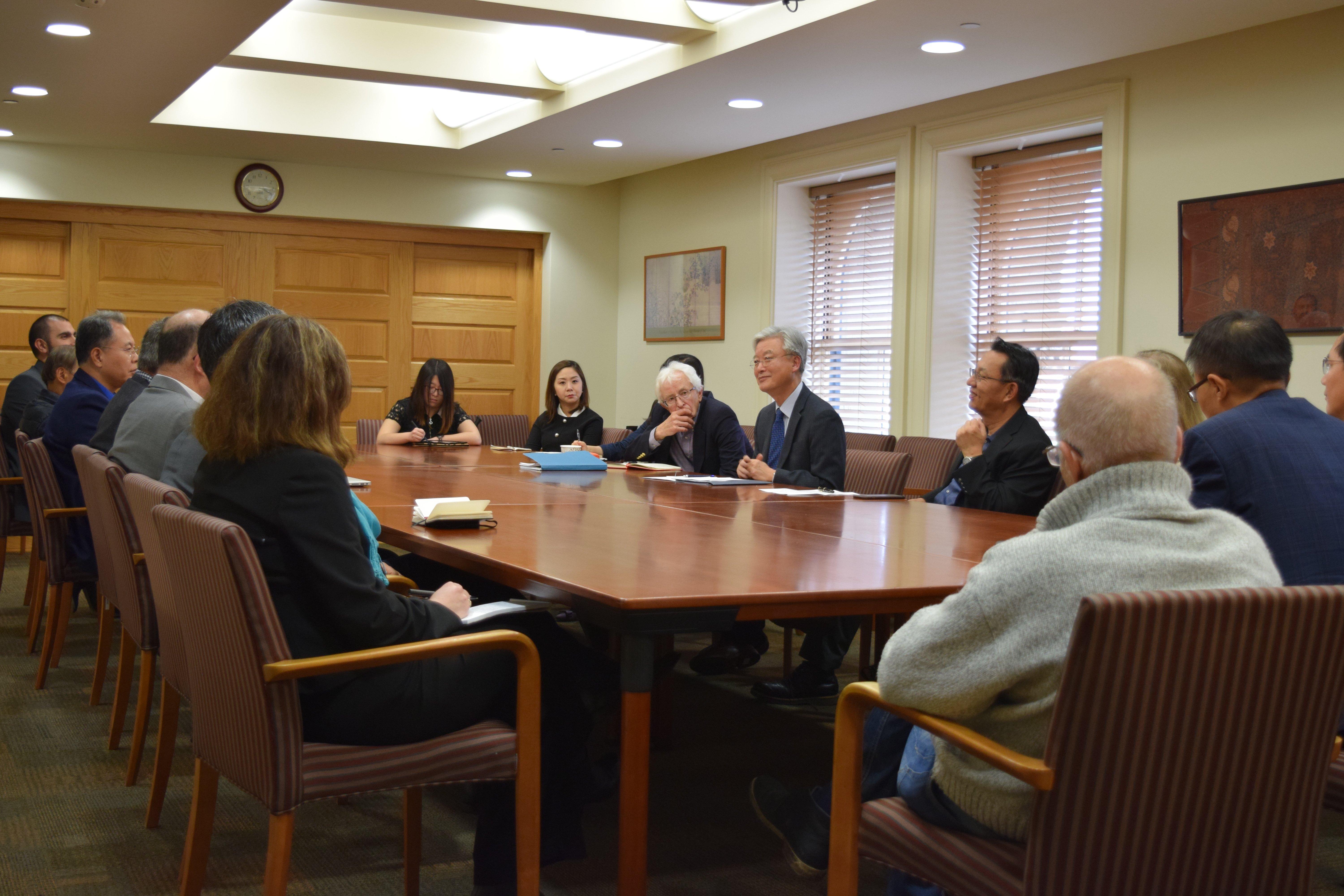
On November 29, the Korea Program at the Walter H. Shorenstein Asia-Pacific Research Center ( APARC ) welcomed the Ambassador of the Republic of Korea to the United States, Cho Yoon-je , who joined faculty members from the Freeman Spogli Institute for International Studies and other Stanford experts for a roundtable discussion about North Korea diplomacy and U.S.-ROK relations.
“We were delighted to host Ambassador Cho,” said Gi-Wook Shin , director of APARC and of the Korea Program. “The candid conversation enabled us to learn from the Ambassador about the latest developments in the North Korea denuclearization talks and to offer our perspectives and policy recommendations. Convenings of academics and government officials, which Shorenstein APARC frequently organizes, are an excellent venue for advancing dialogue with U.S. counterparts in Asia and for bringing our research to bear on pressing policy issues.”
Rountable participants and Ambassador Cho at Shorenstein APARC. Photo: Thom Holme.
Ambassador Cho recently marked his first year since taking office at the height of the 2017 tensions between North Korea and the United States, when the North conducted a sixth nuclear test and several tests of intercontinental ballistic missiles with the potential to reach the U.S mainland. President Trump threatened to “totally destroy” the regime and the North Korean leader responded in kind. Then renewed inter-Korean discussions paved the way for an unprecedented U.S.-DPRK summit and following diplomatic engagement.
Ambassador Cho and the roundtable participants discussed recent reports pointing that diplomacy has stagnated in the months since the summit. The Ambassador expressed South Korea’s determination to seize the opportunity for rapprochement with the North and its commitment to the ROK alliance with the United States.
A specialist in international finance and economics, Ambassador Cho earned his MA and PhD in economics from Stanford University. Throughout his career he has held leadership positions that span both public service and academia. His former roles include the ROK Ambassador to the United Kingdom; Special Envoy to the European Union and to Germany; Senior Counselor to the Deputy Prime Minister and Minister of Finance and Economy of the ROK; Vice President of the Korea Institute of Public Finance; Senior Economist at the World Bank; Economist at the International Monetary Fund; and Director of Sogang University’s Institute for Area Studies.
Hero Image
From left to right: FSI Senior Fellow Siegfried Hecker, ROK Ambassador Cho Yoon-je, and APARC Director Gi-Wook Shin. | Thom Holme, APARC
Future Visions: Challenges and Possibilities of Korean Studies in North America — Social Science panel. From left to right: UC Berkeley's Laura Nelson, University of Michigan's Jordan Siegel, Stanford's Yong Suk Lee, USC's David Kang, Harvard's Paul Chang.
How can Korean studies faculty cultivate supportive and critical scholarly communities with graduate students? What can be done to overcome the severe constraints on Korean language training in North America? Why is there a dearth of Korea scholarship in academic literature? And how should Korean studies librarians prepare for the future in the light of new technologies and young researchers’ increasing interest in digital scholarship?
These were some of the questions examined at a two-day conference, “Future Visions: Challenges and Possibilities of Korean Studies in North America,” convened by the Korea Program of Stanford’s Shorenstein Asia-Pacific Research Center (APARC) on November 1-2. Co-sponsored by the Seoul-based Foundation Academia Platonica, the conference, the first of its kind, gathered distinguished Korean studies scholars from twelve North American institutions to consider the state of the field, assess its challenges, and carry forward a vision for its future direction and potential. Its six unique panels focused not only on the major disciplines of Korean studies—history, literature, and the social sciences—but also on language education, library collections and services, and Korean Wave.
“The presentations and discussions by our fellow experts reflected the breadth and depth of Korean studies in North America,” says APARC Director and the Korea Program Director Gi-Wook Shin. “Our program was established at Stanford in 2001 and has since become a leader in Korean studies in North America, so it is a special privilege for us to bring together colleagues from eminent institutions around the continent to further advance Korean studies education and research in the academic and policy worlds, and to build upon our track record of action and achievements.”
“The field of Korean studies, however,” notes Shin, “has significantly changed over the past seventeen years and it isn’t without its challenges. This is our opportunity to consider frankly where we go next and how we could explore the path ahead together.”
Conference participants indeed engaged in deep conversations and shared ideas and dilemmas regarding teaching in the different disciplines of Korean studies in North America. Harvard sociologist Paul Chang listed three types of challenges facing the field: publication, academic, and professional challenges. David C. Kang, professor of international relations and director of the Korean Studies Institute at the University of Southern California, emphasized the publication challenge: why is it, asked Kang, that top academic journals in the discipline of political science and international relations publish so much more scholarship about Europe than they do about Korea and Asia at large, even while the rise of Asian nations is surely one of the most consequential issues of the twenty-first century? The onus, Kang argued, comes back to East Asia scholars “to produce better and more compelling scholarship, and to better train graduate students.”
University of British Columbia's Ross King and conference participants.
Yet complex issues surround the question of how to broaden graduate coursework—and whether to do so. Korean language and linguistics expert Ross King, head of the department of Asian Studies at the University of British Columbia in Vancouver, Canada, was one of several panelists who considered the obstacles to graduate training, among different aspects of academic challenges facing the field of Korean studies. King probed into how Sinocentrism and what he called the “Mandarin conceit”—that is, the notion that training in Literary Sinitic should be predicated on a near-native proficiency in modern Mandarin Chinese—are emerging as a major stumbling block to the study of premodern Korean literary culture. He also pointed to the constraints on language training in both Korean and hanmun in North America, which, he claimed, is why we can probably anticipate continued decrease in the number of ethnically non-Korean (non-Korea-educated) graduate students undertaking graduate study in Korean literature.
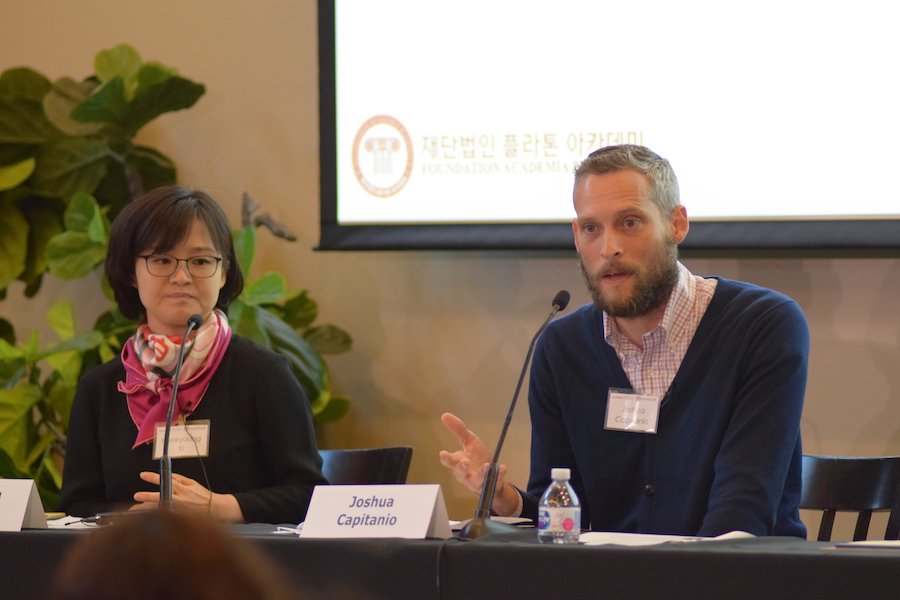
University of Washington's Hyokyoung Yi (left) and Stanford's Joshua Capitanio at a panel on library collections and service.
Sung-Ock Sohn, who coordinates the Korean language program in the department of Asian languages and cultures at the University of California – Los Angeles, further shed light on King’s prediction. She explained that while enrollments in Korean language classes have shown a sharp increase in American higher education institutions in the past decade, particularly at the introductory level and among ethnically non-Korean students, there is a high attrition rate of students from an introductory to advanced Korean classes nationwide.
How should the field move forward?
Participants proposed a host of ideas to that end. These included helping graduate students collaborate with colleagues in Korea; dedicating funding for junior faculty to spend periods of time before tenure conducting research and honing language skills in Korea at appropriate institutions, and for mid-career scholars to spend a year in Korea; emphasizing the application of social science theories and methods to premodern and modern East Asia; motivating scholars to apply a comparative lens to the study of the historical and contemporary experience of East Asia; and integrating linguistic and cultural diversity in Korean language classes by, for example, incorporating service learning in authentic contexts and extending the content spectrum to include topics such as Korean popular culture.
Image
K-pop star Siwon Choi (left) highlights closing panel on Korean Wave.
Korean Wave was the focus of the conference’s widely attended closing panel that featured K-pop star Siwon Choi, a member of Korean boy band Super Junior, and multi-platinum music producer Dominique Rodriguez, managing director of SM Entertainment USA. They spoke about the global reach of Korean pop music and some of the ways in which Korean popular culture could stimulate interest in Korean studies. Dafna Zur, assistant professor in Stanford’s department of East Asian languages and cultures, who chaired the panel, challenged her students to consider “what it means not just to monetize culture but to design culture with specific markets and audience in mind.” The Stanford Daily published a detailed article on the panel.
“We are grateful to Foundation Academia Platonica for its generous support of Stanford’s Korea Program at Shorenstein APARC and for making this conference possible through our shared vision for the future of Korean studies in North America,” said Gi-Wook Shin. “Our thanks also go to our many other friends and partners, including the Korea Foundation that has helped achieve great results through its commitment to promoting understanding of Korea in academia and beyond and its support of the overseas Korean Studies Program since its establishment in 1991.”
South Korean TV company SBS NBC filmed the conference that will be featured in an upcoming documentary about Korean studies in the United States.
Read the conference report or listen to the audio recordings of the sessions, below.

 FSI researchers strive to understand how countries relate to one another, and what policies are needed to achieve global stability and prosperity. International relations experts focus on the challenging U.S.-Russian relationship, the alliance between the U.S. and Japan and the limitations of America’s counterinsurgency strategy in Afghanistan.