FSI researchers work to understand continuity and change in societies as they confront their problems and opportunities. This includes the implications of migration and human trafficking. What happens to a society when young girls exit the sex trade? How do groups moving between locations impact societies, economies, self-identity and citizenship? What are the ethnic challenges faced by an increasingly diverse European Union? From a policy perspective, scholars also work to investigate the consequences of security-related measures for society and its values.
The Europe Center reflects much of FSI’s agenda of investigating societies, serving as a forum for experts to research the cultures, religions and people of Europe. The Center sponsors several seminars and lectures, as well as visiting scholars.
Societal research also addresses issues of demography and aging, such as the social and economic challenges of providing health care for an aging population. How do older adults make decisions, and what societal tools need to be in place to ensure the resulting decisions are well-informed? FSI regularly brings in international scholars to look at these issues. They discuss how adults care for their older parents in rural China as well as the economic aspects of aging populations in China and India.
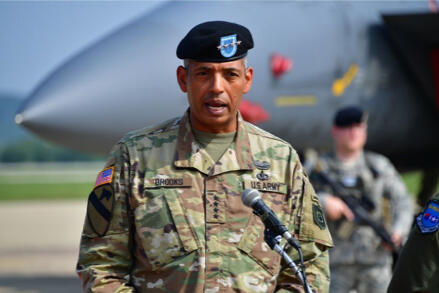
About the speaker:Vincent K. Brooks is a career Army officer who recently retired from active duty as the four-star general in command of all U.S. Forces in Korea, where he concurrently commanded United Nations Command – continuously serving since 1950 and initially commanded by General of the Army Douglas MacArthur; and the Republic of Korea-U.S. Combined Forces Command comprising over 625,000 Koreans and Americans under arms.
General Brooks, who goes by “Vince,” is a 1980 graduate of the United States Military Academy at West Point, the first class to include women, and he led the 4,000 cadets as the cadet brigade commander or “First Captain.” He is the first African American to have been chosen for this position, and he was also the first cadet to lead the student body when women were in all four classes (freshman or “plebe” to senior or “first classman”).
General Brooks is from a career military family and claims Alexandria, Virginia as home given the long roots in maternal and paternal branches of the family tree. His areas of expertise are national security, policy, strategy, international relations, military operations, combating terrorism and countering the proliferation of weapons of mass destruction, diversity and inclusion, leadership in complex organizations, crisis leadership, and building cohesive trust-based teams. He is a combat veteran and a member of the Council on Foreign Relations.
Image
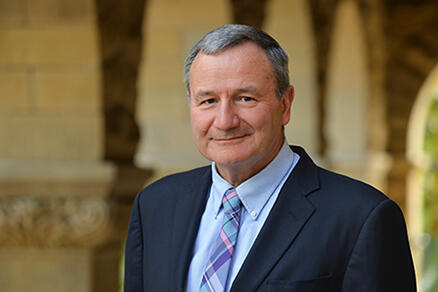
Ambassador Karl Eikenberry, currently director of U.S.-Asia Security Initiative at Stanford's Shorenstein Asia-Pacific Research Center, will moderate the discussion. He served as the U.S. Ambassador to Afghanistan from 2009 until 2011. Before appointment as Chief of Mission on Kabul, Ambassador Eikenberry had a thirty-five year career in the United States Army, retiring in April 2009 with the rank of Lieutenant General.
This keynote event is part of the 11th annual Koret Workshop, "North Korea and the World in Flux," and open to the general public with registration.
The event is made possible through the generous support of the Koret Foundation.
A dramatic opening created by the unique strategic outlooks and personalities of Moon Jae-in, Kim Jong Un and Donald Trump instigated a series of highly symbolic summits in the early months of 2018. The process kicked off by those summits has bogged down, however, as the necessary compromises for an agreement between the United States and North Korea have proved elusive. This year's Koret Workshop will therefore invite experts from a variety of areas in order to reflect on what the stumbling blocks have been as well as prospects for overcoming them. Conference participants will work towards better understanding and supporting potential emerging solutions to the persistent conflict on the Korean Peninsula.
The workshop will consist of three sessions:
Session I: Assessments of Summit Diplomacy
Session II: Challenges and Opportunities in Media Coverage
Session III: Prospects and Pitfalls in the Near-Term
NOTE: During the conference, a keynote address is open to the general public. Please click here to register for the public event on March 15.
The stories of North Korea and Myanmar (Burma) are two of Asia’s most difficult. For decades they were infamous as the region’s most militarized and repressed, self-isolated and under sanctions by the international community while, from Singapore to Japan, the rest of Asia saw historic wealth creation. Andray Abrahamian, author of the recent book North Korea and Myanmar: Divergent Paths (McFarland, 2018), examines and compares the recent histories of North Korea and Myanmar, asking how both became pariahs and why Myanmar has been able to find a path out of isolation while North Korea has not.
Abrahamian finds that both countries were faced with severe security threats following decolonization. Myanmar was able to largely take care of its main threats in the 1990s and 2000s, allowing it the space to address the reasons for its pariah status. North Korea's response to its security threat has been to develop nuclear weapons, which in turn perpetuates and exacerbates its isolation and pariah status. In addition, Pyongyang has developed a state ideology and a coercive apparatus unmatched by Myanmar, insulating its decision makers from political pressures and issues of legitimacy to a greater degree.
Dr. Andray Abrahamian is currently the 2018-19 Koret Fellow in Korea Program at Stanford. He is a member of the US National Committee on North Korea and an Adjunct Fellow at Pacific Forum and at Griffith University. Working for a non-profit, Choson Exchange, has taken him to the DPRK nearly 30 times; he has also lived in Myanmar.
Andray Abrahamian was the 2018-19 Koret Fellow at Stanford University. He is also an Honorary Fellow at Macquarie University, Sydney and an Adjunct Fellow at the Griffith Asia Institute. He is an advisor to Choson Exchange, a non-profit that trains North Koreans in economic policy and entrepreneurship. He was previously Executive Director and Research Director for Choson Exchange. That work, along with supporting sporting exchanges and a TB project, has taken him to the DPRK nearly 30 times. He has also lived in Myanmar, where he taught at Yangon University and consulted for a risk management company. He has conducted research comparing the two countries, resulting in the publication of "North Korea and Myanmar: Divergent Paths" (McFarland, 2018). Andray has published extensively and offers expert commentary on Korea and Myanmar, including for US News, Reuters, the New York Times, Washington Post, Lowy Interpreter and 38 North. He has a PhD in International Relations from the University of Ulsan, South Korea and an M.A. from the University of Sussex where he studied media discourse on North Korea and the U.S.-ROK alliance, respectively. Andray speaks Korean, sometimes with a Pyongyang accent.
Future Visions: Challenges and Possibilities of Korean Studies in North America — Social Science panel. From left to right: UC Berkeley's Laura Nelson, University of Michigan's Jordan Siegel, Stanford's Yong Suk Lee, USC's David Kang, Harvard's Paul Chang.
How can Korean studies faculty cultivate supportive and critical scholarly communities with graduate students? What can be done to overcome the severe constraints on Korean language training in North America? Why is there a dearth of Korea scholarship in academic literature? And how should Korean studies librarians prepare for the future in the light of new technologies and young researchers’ increasing interest in digital scholarship?
These were some of the questions examined at a two-day conference, “Future Visions: Challenges and Possibilities of Korean Studies in North America,” convened by the Korea Program of Stanford’s Shorenstein Asia-Pacific Research Center (APARC) on November 1-2. Co-sponsored by the Seoul-based Foundation Academia Platonica, the conference, the first of its kind, gathered distinguished Korean studies scholars from twelve North American institutions to consider the state of the field, assess its challenges, and carry forward a vision for its future direction and potential. Its six unique panels focused not only on the major disciplines of Korean studies—history, literature, and the social sciences—but also on language education, library collections and services, and Korean Wave.
“The presentations and discussions by our fellow experts reflected the breadth and depth of Korean studies in North America,” says APARC Director and the Korea Program Director Gi-Wook Shin. “Our program was established at Stanford in 2001 and has since become a leader in Korean studies in North America, so it is a special privilege for us to bring together colleagues from eminent institutions around the continent to further advance Korean studies education and research in the academic and policy worlds, and to build upon our track record of action and achievements.”
“The field of Korean studies, however,” notes Shin, “has significantly changed over the past seventeen years and it isn’t without its challenges. This is our opportunity to consider frankly where we go next and how we could explore the path ahead together.”
Conference participants indeed engaged in deep conversations and shared ideas and dilemmas regarding teaching in the different disciplines of Korean studies in North America. Harvard sociologist Paul Chang listed three types of challenges facing the field: publication, academic, and professional challenges. David C. Kang, professor of international relations and director of the Korean Studies Institute at the University of Southern California, emphasized the publication challenge: why is it, asked Kang, that top academic journals in the discipline of political science and international relations publish so much more scholarship about Europe than they do about Korea and Asia at large, even while the rise of Asian nations is surely one of the most consequential issues of the twenty-first century? The onus, Kang argued, comes back to East Asia scholars “to produce better and more compelling scholarship, and to better train graduate students.”
University of British Columbia's Ross King and conference participants.
Yet complex issues surround the question of how to broaden graduate coursework—and whether to do so. Korean language and linguistics expert Ross King, head of the department of Asian Studies at the University of British Columbia in Vancouver, Canada, was one of several panelists who considered the obstacles to graduate training, among different aspects of academic challenges facing the field of Korean studies. King probed into how Sinocentrism and what he called the “Mandarin conceit”—that is, the notion that training in Literary Sinitic should be predicated on a near-native proficiency in modern Mandarin Chinese—are emerging as a major stumbling block to the study of premodern Korean literary culture. He also pointed to the constraints on language training in both Korean and hanmun in North America, which, he claimed, is why we can probably anticipate continued decrease in the number of ethnically non-Korean (non-Korea-educated) graduate students undertaking graduate study in Korean literature.
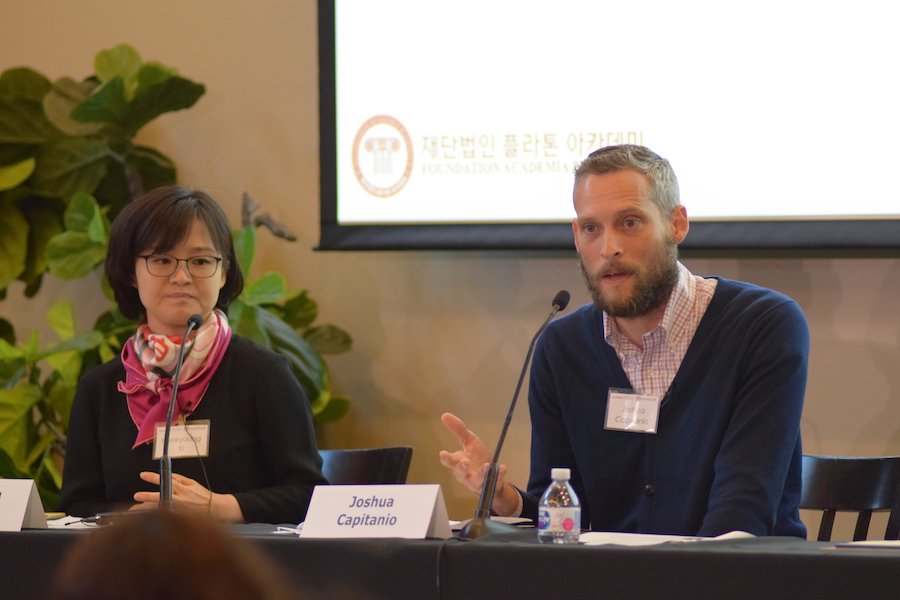
University of Washington's Hyokyoung Yi (left) and Stanford's Joshua Capitanio at a panel on library collections and service.
Sung-Ock Sohn, who coordinates the Korean language program in the department of Asian languages and cultures at the University of California – Los Angeles, further shed light on King’s prediction. She explained that while enrollments in Korean language classes have shown a sharp increase in American higher education institutions in the past decade, particularly at the introductory level and among ethnically non-Korean students, there is a high attrition rate of students from an introductory to advanced Korean classes nationwide.
How should the field move forward?
Participants proposed a host of ideas to that end. These included helping graduate students collaborate with colleagues in Korea; dedicating funding for junior faculty to spend periods of time before tenure conducting research and honing language skills in Korea at appropriate institutions, and for mid-career scholars to spend a year in Korea; emphasizing the application of social science theories and methods to premodern and modern East Asia; motivating scholars to apply a comparative lens to the study of the historical and contemporary experience of East Asia; and integrating linguistic and cultural diversity in Korean language classes by, for example, incorporating service learning in authentic contexts and extending the content spectrum to include topics such as Korean popular culture.
Image
K-pop star Siwon Choi (left) highlights closing panel on Korean Wave.
Korean Wave was the focus of the conference’s widely attended closing panel that featured K-pop star Siwon Choi, a member of Korean boy band Super Junior, and multi-platinum music producer Dominique Rodriguez, managing director of SM Entertainment USA. They spoke about the global reach of Korean pop music and some of the ways in which Korean popular culture could stimulate interest in Korean studies. Dafna Zur, assistant professor in Stanford’s department of East Asian languages and cultures, who chaired the panel, challenged her students to consider “what it means not just to monetize culture but to design culture with specific markets and audience in mind.” The Stanford Daily published a detailed article on the panel.
“We are grateful to Foundation Academia Platonica for its generous support of Stanford’s Korea Program at Shorenstein APARC and for making this conference possible through our shared vision for the future of Korean studies in North America,” said Gi-Wook Shin. “Our thanks also go to our many other friends and partners, including the Korea Foundation that has helped achieve great results through its commitment to promoting understanding of Korea in academia and beyond and its support of the overseas Korean Studies Program since its establishment in 1991.”
South Korean TV company SBS NBC filmed the conference that will be featured in an upcoming documentary about Korean studies in the United States.
Read the conference report or listen to the audio recordings of the sessions, below.
Sungmoon Lim (BA '18 Urban Studies) has won the 7th annual Korea Program Prize for Writing in Korean Studies for her paper, "Urban Design in the Age of Globalization: An Analysis of the Global Reception of Seoul’s Cheonggyecheon Stream Restoration Project." Gi-Wook Shin, director of the Korea Program at Shorenstein APARC, says, "Sungmoon's paper is superb. Her work is original and ambitious and her thesis will make an excellent contribution to various fields and sub-fields, including urban studies, globalization, and Korean studies." The award announcement may be viewed here.
Sponsored by the Korea Program and the Center for East Asian Studies, the writing prize recognizes and rewards outstanding examples of writing by Stanford students in an essay, term paper or thesis produced during the current academic year in any discipline within the area of Korean studies, broadly defined. The competition is open to both undergraduate and graduate students.
Andray Abrahamian was the 2018-19 Koret Fellow at Stanford University. He is also an Honorary Fellow at Macquarie University, Sydney and an Adjunct Fellow at the Griffith Asia Institute. He is an advisor to Choson Exchange, a non-profit that trains North Koreans in economic policy and entrepreneurship. He was previously Executive Director and Research Director for Choson Exchange. That work, along with supporting sporting exchanges and a TB project, has taken him to the DPRK nearly 30 times. He has also lived in Myanmar, where he taught at Yangon University and consulted for a risk management company. He has conducted research comparing the two countries, resulting in the publication of "North Korea and Myanmar: Divergent Paths" (McFarland, 2018). Andray has published extensively and offers expert commentary on Korea and Myanmar, including for US News, Reuters, the New York Times, Washington Post, Lowy Interpreter and 38 North. He has a PhD in International Relations from the University of Ulsan, South Korea and an M.A. from the University of Sussex where he studied media discourse on North Korea and the U.S.-ROK alliance, respectively. Andray speaks Korean, sometimes with a Pyongyang accent.
Asia has achieved remarkable progress on economic development and poverty reduction over the past decades. It is now considered as the main driver of global economic growth and we are witnessing the shift of economic center of gravity toward Asia. Continued success is, however, not preordained or guaranteed. More specifically, the region has to manage several mega-challenges to realize the "Asian Century." These include remaining poverty incidence and increasing inequality, demographic changes, growing environmental pressure, climate change and disaster risk, rapid urbanization, and governance and institutional capacity concern. These increasingly complex challenges pressure Asian countries to take a more sustainable development path, moving away from more traditional development patterns.
The world is experiencing various technological advancement —including digital and cloud technologies, big data, robotics, artificial intelligence, the internet of things, 3-D printing, blockchain, energy storage, and autonomous vehicles. These technologies will significantly change the way people live and also bring very broad and deep impact on economic and social development landscape. The progress and impacts of technological advancement may be different between developed and developing countries. Will disruptive technologies help developing countries in Asia and the Pacific to solve development challenges or harm their catch-up momentum? What are opportunities and risks posed by emerging technological changes to developing countries in that region? How will developing countries and the international development community prepare to fully harness technological advancements for sustainable development? These are some of the areas to be explored in this seminar.
Image
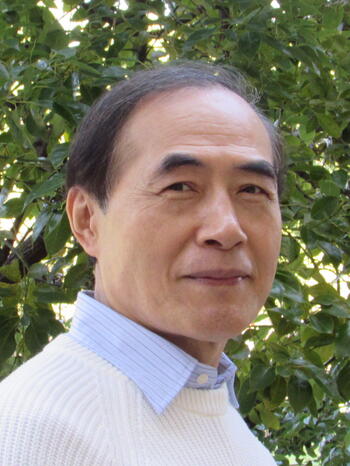
Gilhong Kim is currently a visiting scholar in the Korea Program at Shorenstein APARC for the 2018 calendar year. Previously, he was Senior Director concurrently Chief Sector Officer of the Sustainable Development and Climate Change Department in Asian Development Bank (ADB). His research interests encompass technological development and impact on developing countries in Asia and the Pacific. Dr. Kim has more than 33 years of research and operational experience in country and regional development, sectoral strategies and operations covering clean energy, transport, water supply and sanitation, urban development, education, health and finance. Since 1996, Dr. Kim has worked for ADB in the areas of country economic assessment and country operational program development, corporate strategy and policy development, country field office head (in Lao PDR), sector operational strategy development, operational knowledge management, and promoted technology application and innovative approach. Before joining ADB, he worked for Ministry of Finance in Korea for about 12 years in the areas of economic cooperation and international finance. He holds a PhD in economics from the University of Texas, Austin, and a BA in economics from Korea University in Korea.
616 Serra StreetEncina Hall E301Stanford, CA94305-6055
0
gilhongk@stanford.edu
gilhong_kim.jpg
Ph.D.
Dr. Gilhong Kim joins the Walter H. Shorenstein Asia-Pacific Research Center for the 2018 year as visiting scholar. He currently serves as the Senior Director and Chief Sector Officer of the Sustainable Development and Climate Change Department at the Asian Development Bank. He will be conducting research on technological development and impact in the Asia-Pacific.
Andray Abrahamian will be the 2018-19 Koret Fellow in the Korea Program at Stanford’s Walter H. Shorenstein Asia-Pacific Research Center (APARC). Abrahamian has been Executive Director and Director of Research for Choson Exchange, a non-profit that has trained over 2000 North Koreans in entrepreneurship and economic policy since 2010. His work for Choson Exchange and other projects has taken him to North Korea 30 times. He has also lived in Myanmar, allowing him the ability to conduct field research for his new book, North Korea and Myanmar: Divergent Paths (2018, McFarland). Divergent Paths asks how Myanmar came to end its isolation, while North Korea has yet not.
“When it comes to North Korea, Dr. Abrahamian has been very active both as an academic and on the ground. He has genuine hands-on experience of working with North Koreans from his numerous trips to the country. In this important period of flux for North Korea’s place on the world stage, we welcome Dr. Abrahamian as 2018-19 Koret Fellow, and look forward to his meaningful contributions to our activities.” “His experience and understanding of North Korea will be a great asset to our program,” Gi-Wook Shin, director of APARC said.
Image
As the 2018-19 Koret Fellow, Abrahamian will research the economic relations of North Korea during changing geopolitical conditions as well as entrepreneurship in North Korea as it relates to communities of Koreans abroad. He also plans to write a general readership book that explains contemporary North Korean society. While at Stanford, he will teach a course on contemporary North Korean society and engage in public talks and conferences on Korea issues. During his fellowship, Abrahamian will also help organize the Koret Workshop, an international conference held annually at Stanford University.
Abrahamian is an Honorary Fellow at Macquarie University, Sydney, and an Adjunct Fellow at the Griffith Asia Institute. He is a frequent contributor to 38North.org, a website focused on North Korea analysis, and is a member of the US National Committee on North Korea. Andray holds a PhD from the University of Ulsan and an MA from the University of Sussex in International Relations. He has taught courses at Yangon University and Ulsan University.
Supported by the Koret Foundation, the fellowship brings leading professionals to Stanford to conduct research on contemporary Korean affairs with the broad aim of strengthening ties between the United States and Korea.
The Korea Program invites junior faculty, post-doctoral fellows, and graduate students to apply for travel awards to attend an upcoming two-day conference organized by the Korea Program at Stanford' Asia-Pacific Research Center. The workshop titled "Future Visions: Challanges and Possibilities of Korean Studies in North America" will be held on November 1st and 2nd, 2018 at Stanford University.
The awards will cover accepted applicants' lodging, domestic airfares, and/or ground transportation. To apply for the travel awards, please submit your CV and 2-page statement as a single file by July 15here.
About the conference:
“Future Visions: Challenges and Possibilities of Korean Studies in North America,” is designed to bring together leading scholars in the fields of language education, literature, history, social sciences, and library studies. Each panel will consist of three-four scholars who will be tasked with presenting a report on the state of the field. The purpose of the panels is to generate discussion around some of the following questions:
What are the research trends in each field?
What kinds of directions can we expect in the near future?
What are some of the disciplinary or other challenges in each field?
How does each field interact with related fields?
What are some of the limitations and possibilities around graduate student training?
How can faculty with graduate students cultivate supportive and critical scholarly communities?
How are junior faculty encouraged, and what institutional structures may offer better support?
Accepted applicants are expected to actively participate in discussion sessions and to engage in networking with other scholars during the 2-day conference.
Ethnicity and immigration status may play a role in entrepreneurship and innovation, yet the impact of university entrepreneurship education on this relationship is under-explored. This paper examines the persistence and differences in entrepreneurship by ethnicity and nationality. We find that among Stanford alumni, Asian Americans have a higher rate of entrepreneurship than white Americans. However, non-American Asians have a substantially lower, about 12% points lower, start-up rate than Asian Americans. Such discrepancy not only holds for entrepreneurial choice but also for investing as an angel investor or venture capitalist, or utilizing Stanford networks to find funding sources or partners. Participation in Stanford University’s entrepreneurship program as a student does little to reduce this gap. The low level of parental entrepreneurship and the high degree of intergenerational correlation in entrepreneurship likely result in the lower level of entrepreneurship and participation in university entrepreneurship programs among Asians relative to their Asian American counterparts. Our findings highlight the value of immigration in terms of breaking the persistence in entrepreneurship among certain ethnic groups and promoting potential high-growth entrepreneurship in the United States. In addition, our findings may have important implications for programs to incorporate immigrant entrepreneurs within their home countries to promote entrepreneurship and help break the persistence of entrepreneurship across generations.

 FSI researchers work to understand continuity and change in societies as they confront their problems and opportunities. This includes the implications of