International Development

FSI researchers consider international development from a variety of angles. They analyze ideas such as how public action and good governance are cornerstones of economic prosperity in Mexico and how investments in high school education will improve China’s economy.

They are looking at novel technological interventions to improve rural livelihoods, like the development implications of solar power-generated crop growing in Northern Benin.

FSI academics also assess which political processes yield better access to public services, particularly in developing countries. With a focus on health care, researchers have studied the political incentives to embrace UNICEF’s child survival efforts and how a well-run anti-alcohol policy in Russia affected mortality rates.

FSI’s work on international development also includes training the next generation of leaders through pre- and post-doctoral fellowships as well as the Draper Hills Summer Fellows Program.

Authors
News Type
News
Date
Paragraphs

We are pleased to share that Professor of Sociology Kiyoteru Tsutsui, the Henri H. and Tomoye Takahashi Professor and Senior Fellow in Japanese Studies at the Walter H. Shorenstein Asia-Pacific Research Center (APARC), is the recipient of the 2022 Ishibashi Tanzan Award for his book Human Rights and the State: The Power of Ideas and the Realities of International Politics (Iwanami Shinsho, 2022).

Established in 1980 and presented by the Ishibashi Tanzan Memorial Foundation, the annual award recognizes excellence in the fields of politics, economics, international relations, society, and culture. It honors individuals who have contributed to advancing the legacy of former Japanese Prime Minister Ishibashi Tanzan and his ideas on liberalism, democracy, and international peace. Tsutsui’s book explores the paradox underlying the global expansion of human rights, examines Japan’s engagement with human rights ideas and instruments, and assesses their impacts on domestic politics around the world.

“I’m deeply honored to receive this prestigious award, especially in this historical moment in which commitment to the international liberal order is ever more critical,” says Tsutsui, who is also director of APARC’s Japan Program, APARC’s deputy director, a senior fellow at the Freeman Spogli Institute for International Studies, and the co-director of the Center for Human Rights and International Justice. “Among all the Japanese Prime Ministers in history, no one demonstrated a more unwavering commitment to liberalism than Ishibashi Tanzan, and I’m especially pleased that my book on global human rights has received this recognition bearing his name. There’s also a personal connection for me, as my father is the author of the first social science book on Ishibashi Tanzan and I helped with his research as a middle school student, making copies of relevant newspapers.”


Sign up for APARC newsletters to receive our experts' commentary and analysis.


In an APARC interview about the book, Tsutsui explains the tension inherent in the diffusion of global human rights, which is rooted in states’ embracing these universal rights although they are grounded in principles that constrain their sovereignty. “The end of the Cold War enabled the United Nations to engage in human rights activities free from Cold War constraints, and now those states that committed to human rights without thinking about the consequences have to face a world in which their violations can become a real liability for them,” he notes.

Tsutsui believes that Japan has an opportunity to become a global leader in human rights. “The more inwardly oriented United States is creating a vacuum in promotion and protection of liberal values, especially with China’s influence surging, and Japan should carry the torch taking the mantle of human rights, democracy, and rule of law,” he argues.

Tsutsui’s research interests lie in political and comparative sociology, social movements, globalization, human rights, and Japanese society. His current projects examine issues including changing conceptions of nationhood and minority rights in national constitutions and in practice, populism and the future of democracy, the global expansion of corporate social responsibility, and Japan’s public diplomacy and perceptions of Japan in the world.

Read More

Protesters hold signs and chant slogans during a Black Lives Matter peaceful march in Tokyo.
Q&As

New Book by Stanford Sociologist Kiyoteru Tsutsui Probes the Decoupling of Policy and Practice in Global Human Rights

In his new book, Shorenstein APARC’s Japan Program Director Kiyoteru Tsutsui explores the paradox underlying the global expansion of human rights and Japan’s engagement with human rights ideas and instruments. Japan, he says, has an opportunity to become a leader in human rights in Asia and in the world.
New Book by Stanford Sociologist Kiyoteru Tsutsui Probes the Decoupling of Policy and Practice in Global Human Rights
Shinzo Abe speaking from a lectern
Commentary

Reflections on the Assassination of Former Prime Minister of Japan Shinzo Abe

Abe was one of the most transformative political leaders in modern Japanese history, and his passing will change Japanese politics in a number of ways, most immediately shaking up internal politics within the ruling Liberal Democratic Party. To honor Abe’s legacy, we all need to reassert our resolve to protect our democracy in Japan, the United States, and all over the world.
Reflections on the Assassination of Former Prime Minister of Japan Shinzo Abe
Stanford campus archway and text about call for applications for APARC 2023-24 fellowships
News

APARC Invites Fall 2023 Asia Studies Fellowship Applications

The Center offers a suite of fellowships for Asia researchers to begin fall quarter 2023. These include postdoctoral fellowships on contemporary Japan and the Asia-Pacific region, inaugural postdoctoral fellowships and visiting scholar positions with the newly launched Stanford Next Asia Policy Lab, and fellowships for experts on Southeast Asia.
APARC Invites Fall 2023 Asia Studies Fellowship Applications
Hero Image
Kiyoteru Tsutsui and book cover of Human Rights and the State
All News button
1
Subtitle

The Ishibashi Tanzan Memorial Foundation recognizes Tsutsui, the Henri H. and Tomoye Takahashi Professor and Senior Fellow in Japanese Studies at the Shorenstein Asia-Pacific Research Center, for his book 'Human Rights and the State.'

Date Label
-

Image
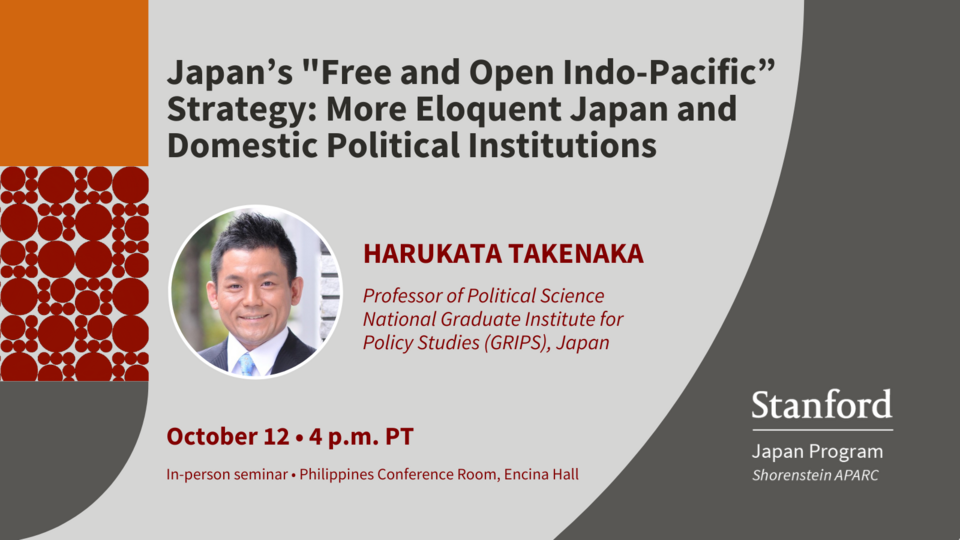
Visually banner card with the event title "Japan’s "Free and Open Indo-Pacific” Strategy: More Eloquent Japan and Domestic Political Institutions", and featuring a circle photo portrait of speaker Professor Harukata Takenaka

Since Prime Minister Shinzo Abe has advocated “Free and Open Indo-Pacific (FOIP)” Vision in 2016, various scholars have analyzed policy formulation process of FOIP. Most of them refer to the rise of China as an influential power in the Indo-Pacific region with its own initiative, namely, the Belt and Road Initiative as a major factor which prompted the Second Abe Administration to launch FOIP.

It is the contention of this presentation that the current configuration of the Japanese political institutions has made it possible for the Second Abe administration to launch and pursue such a comprehensive strategy while an international factor is important. It demonstrates that a series of political reforms since 1990s have strengthened the power of the prime minister as an institution to initiate key cabinet policies and coordinate policy formulation among different ministries. The strong institutional foundation of the Japanese prime ministerial power has made it possible for the Abe administration to effectively pursue such a broad vision, engaging various ministries and organizations.

The existing research on Japan's diplomacy often evaluates Japan as a passive state. It considers that in the past Japan only responded to foreign pressure while it did not proactively push forward its own policies. The presentation suggests that Japan has changed and become more eloquent as a result of changes in domestic political institutions.

Speaker

Image
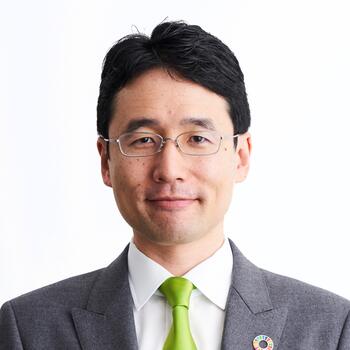
Square photo portrait of Harukata Takenaka
Harukata Takenaka is a professor at the National Graduate Institute for Policy Studies (GRIPS) in Tokyo. He holds a PhD from Stanford University and a Bachelor of Laws from the University of Tokyo.

His key research areas are the role the prime minister in Japanese politics, changes in Japanese external policy, and democratization in Pre-war Japan.

Prof. Takenaka’s recent publications include: “Kyokoku Chugoku” to Taijisuru Indo-Taiheiyo Shokoku [Indo-Pacific Nations facing China aspiring to be a “Great Country”](edited) (Tokyo: Chikura Shobo, 2022), “Evolution of Japanese security policy and the House of Councilors,” Japanese Journal of Political Science, 22:2, (June 2021), 96-115, Korona Kiki no Seiji [Politics of Covid 19 Crisis](Tokyo: Chuo Koron Shinsha, 2020), “Expansion of the Japanese prime minister’s power in the Japanese parliamentary system: Transformation of Japanese politics and the institutional reforms,”Asian Survey,59:5:844-869 (September 2019); Futatsu no Seiken Kotai [Two Changes of Government] (edited) (Tokyo: Keiso Shobo, 2017); Failed Democratization in Prewar Japan (Stanford University Press 2014),

Harukata Takenaka Professor of Political Science National Graduate Institute for Policy Studies, Japan
Authors
News Type
News
Date
Paragraphs

The Walter H. Shorenstein Asia-Pacific Research Center (APARC) is pleased to invite applications for a suite of fellowships in contemporary Asia studies to begin fall quarter 2023.

The Center offers postdoctoral fellowships that promote multidisciplinary research on contemporary Japan and contemporary Asia broadly defined, inaugural postdoctoral fellowships and visiting scholar positions as part of the newly launched Stanford Next Asia Policy Lab, and a fellowship for experts on Southeast Asia. Learn more about each opportunity and its eligibility and specific application requirements:

Postdoctoral Fellowship on Contemporary Japan

Hosted by the Japan Program at APARC, the fellowship supports research on contemporary Japan in a broad range of disciplines including political science, economics, sociology, law, policy studies, and international relations. Appointments are for one year beginning in fall quarter 2023. The application deadline is December 1, 2022.
 

Shorenstein Postdoctoral Fellowship on Contemporary Asia

APARC offers two postdoctoral fellowship positions to junior scholars for research and writing on contemporary Asia. The primary research areas focus on political, economic, or social change in the Asia-Pacific region (including Northeast, Southeast, and South Asia), or international relations and international political economy in the region. Appointments are for one year beginning in fall quarter 2023. The application deadline is December 1, 2022.
 

Read More

Hero Image
Stanford campus archway and text about call for applications for APARC 2023-24 fellowships
All News button
1
Subtitle

The Center offers a suite of fellowships for Asia researchers to begin fall quarter 2023. These include postdoctoral fellowships on contemporary Japan and the Asia-Pacific region, inaugural postdoctoral fellowships and visiting scholar positions with the newly launched Stanford Next Asia Policy Lab, and fellowships for experts on Southeast Asia.

Authors
News Type
Q&As
Date
Paragraphs

U.S.-based donors and international organizations have long dominated the development sector, but their Asian peers are increasingly challenging Western hegemony in the field, argues APARC Postdoctoral Fellow in Contemporary Asia Mary-Collier Wilks.

Wilks is currently at work on a book project that examines variation in ‘aid chains,’ or the links through which programs travel from donors to international nongovernmental organizations (INGOs), and finally to implementing partners. Her ethnographic research examines two aid chains focused on the delivery of women’s health services in Cambodia. After completing her residency at APARC this summer, she will head to the University of North Carolina Wilmington to start a tenure track position at the Department of Sociology.

In the following Q&A, Wilks discusses her research and fellowship experience at Stanford. The interview was slightly edited for length and clarity.


Sign up for APARC newsletters to receive research and commentary updates from our scholars


Your research centers on meaning-making and power dynamics in international organizations. What drew you to this topic?

Before going to graduate school, I worked at a Cambodian NGO, Social Services of Cambodia, that implemented social welfare programs for women and children. While there, I observed conversations between the foreign director, local staff, donors, and beneficiaries, and noticed how these interactions shaped SSC’s work. I was particularly struck by how differently donors from various nations defined gender empowerment. These questions evolved into a desire to go to graduate school and study how donor differences impact international development programs in Southeast Asia.

East Asian nations are increasingly vying for influence and offering new, alternative models for development.
Mary-Collier Wilks

You are working on your first book. Can you tell us a bit about what to expect from it?

During my postdoctoral fellowship at APARC, I’m focusing on transforming my dissertation into a book. Learning to write a book is a difficult, unique, and rewarding process in and of itself! It’s still a work in progress, but the book argues that the global development sector is shifting. Donors and international organizations based in the United States, Europe, and Australia have long been dominant actors, producing prevailing global norms around “good development.” However, East Asian nations are increasingly vying for influence and offering new, alternative models for development. As a case study of these transformations, I conduct a multi-sited ethnography of two INGOs, one from the United States and the other from Japan, that implement development programs in Cambodia.

I see Cambodian practitioners render the above geopolitical transformations meaningful in their own lives by discussing two “development imaginaries” or narratives about the best way for society to develop, one “Asian” and the other “Western.” Consequently, I contend Cambodia is a case of a larger phenomenon in which Asian donors and development organizations are playing a more prominent role, challenging Western hegemony in the development sector and producing new development norms. This book is therefore trying to tell a dual story about the macro-level geopolitical transformations taking place in the development space in Cambodia, and Asia more generally, and the micro-level meanings, practices, and contradictions that these changes create in the lives of the people living through them.

Health screening in a Cambodia primary school
A team of health workers screens children in a primary school in Cambodia. | Global Partnership for Education/Natasha Graham via Flickr (CC BY-NC-ND 2).

You have mentioned your interest in how people encounter international development and foreign aid in their everyday lives. What are some aspects of those encounters that you find revealing about the dynamics of global development?

Cambodia is a nation where international donors have a lot of power. But, that’s never the whole story. Development is never just donor-driven. In my work, I try to center the ways Cambodian practitioners make sense of, adapt, or resist donor visions of their nation’s development.

For instance, during my fieldwork, I met an NGO director who I’ll call Rith and whose career trajectory can provide us with some insights. Rith was born in 1979, at the very end of the Khmer Rouge regime. In his twenties, he decided to become a monk to bring merit to his family. In the late 1990s, Rith started noticing the influx of foreign aid funding and the proliferating numbers of international and local NGOs in his country. In 2000, he decided to quit being a monk to open an NGO. He turned out to be a savvy fundraiser, securing funding for his NGO to implement multiple health, education, and economic empowerment projects. However, when I met him in 2019, Rith told me he thought “it might be time to change paths” because NGO funding from Western donors “is not like it was ten years ago.” Two years later, he became the co-CEO of a private construction and sourcing company that takes advantage of the numerous infrastructure development loans China provides to Cambodia.

You can therefore observe how the larger geopolitical changes Cambodia undergoes play out in a micro-way in Rith’s strategic career choices as he shifts from being a monk to an NGO director to a CEO.

I believe that projects that support a strong state and those that encourage the market and nonprofit actors could be synchronized for more effective aid.
Mary-Collier WIlks

What do you see as some of the biggest challenges to delivering aid via INGOs?

There are several answers to this question floating around in my data. One that immediately comes to mind is synchronization. Despite a shared aim of improving women’s health, INGOs from the United States and Japan implement very different kinds of programs in Cambodia. Japanese INGOs focus on strengthening government-provided maternal health services in Cambodia. In contrast, U.S. organizations are more likely to promote a diverse maternal and reproductive healthcare sector, including private providers and civil society advocacy. I’ve also found that INGOs that originate in the United States and Japan are unaware of each other’s distinctive projects. Often, U.S. INGO directors and donors don’t even know Japanese NGOs exist!

While they work with different stakeholders, I believe that projects that support a strong state and those that encourage the market and nonprofit actors could be synchronized for more effective aid. To start with, U.S.-based INGOs sometimes try to upgrade private clinics, provide education, and refer beneficiaries to women’s health services in the same regions where Japanese INGOs support public clinics. On a basic level, if you could just get the INGO directors from Japan and the U.S. organizations that are working in the same areas to sit down together, U.S. INGO health educators might be able to do things like referring to improved private and public clinics if they know which public clinics the Japanese INGO works with, or collaborate on healthcare provision training for private and public clinic doctors.  

Beyond your book project, what are you working on while at APARC? How has your time here advanced your research?

The main thing a postdoctoral fellowship affords is the privilege of time to read and write. Outside of the book project, I have been able to work on two other papers while here at Stanford. One article proposes to theorize the process of “script decoupling” and why INGOs might formally adopt the same global script but enact it very differently in implementation. The second paper investigates how the meanings of aid money in NGOs is shaped by the business cultures of donor and recipient nations. I plan to have both papers under review before I leave APARC at the end of July.

Being at APARC has provided me with numerous opportunities to discover insightful, new perspectives on my research projects and career prospects from my postdoctoral advisor, Kiyoteru Tsutsui, as well as various other faculty, fellows, and associates here. For instance, Kiyo is starting a Japanese studies lunch-and-learning session where fellows get to meet and discuss their research. I’m particularly interested in the policy-oriented lectures and learning how to articulate that side of my research since that’s something I wasn’t taught to do in graduate school. Overall, my time at Stanford has been invigorating for my research and writing process. I’ve enjoyed being part of the learning community at FSI and the university at large, and have greatly benefited from connecting with different scholars and working groups across campus.

Has the Covid-19 pandemic affected your ability to travel and do research? How have you adapted?

I was incredibly lucky because I completed my international fieldwork in the fall of 2019. So I was able to collect all the data I needed for my dissertation before the pandemic hit us hard. But, due to Covid, I was not able to do the follow-up field visits that I wanted to do in order to find out what happened when the two INGOs I studied completed their projects. Also, continuing connections in the field for new ideas and the next research project is important for an ethnographer. I have done what I could to catch up with Cambodian friends and practitioners over Zoom. Now that Cambodia has lifted its quarantine requirements, I may be able to return this summer. 

What is on the horizon for you? What's next?

As I have wanted to be a college professor since I was 19 (after I gave up my dream of being a pop singer), I’m extremely happy to share I was offered a tenure track position in the Department of Sociology at the University of North Carolina Wilmington! I’ll be starting there in the fall and continuing my research on international development and Southeast Asia.

Read More

Encina Commons, Stanford with text about APARC's 2022-23 predoctoral fellowship
News

APARC Invites 2022-23 Predoctoral Fellowship Applications

Up to three fellowships are available to Stanford Ph.D. candidates. Submissions are due by April 15, 2022.
APARC Invites 2022-23 Predoctoral Fellowship Applications
Hero Image
Portrait of Mary-Collier Wilks
All News button
1
Subtitle

Ethnographer and APARC Postdoctoral Fellow Mary-Collier Wilks unveils how distinct development narratives shape the dynamics of aid chains and international organizations’ delivery of services in Southeast Asia.

-

This event will offer simultaneous translation between Japanese and English. 
当イベントは日本語と英語の同時通訳がついています。

This is a virtual event. Please click here to register and generate a link to the talk. 
The link will be unique to you; please save it and do not share with others.
当イベントはZoomウェビナーで行われます。ウェビナーに参加するためには、こちらのリンクをクリックし、事前登録をして下さい。

March 1, 5-6:30 p.m. California time/ March 2, 10-11:30 a.m. Japan time

This event is part of the 2022 Japan Program Winter webinar series, The Future of Social Tech: U.S.-Japan Partnership in Advancing Technology and Innovation with Social Impact


The challenges of climate change require solutions on multiple fronts, one of which is technological innovation. Attempts for innovation for new energy sources have been ongoing in many parts of the world, and Japan has produced a number of new technologies. This session will focus on two of the most promising innovations coming out of Japan, biofuel and hydrogen energy, and assess their promises and challenges, highlighting technological, regulatory, and business aspects of developing new technologies. Where do these technologies fit in the energy portfolio that would address the issues of climate change and what can Japan and the United States do to collaboratively solve the key problems in advancing these technologies further? Three leading experts in the field will discuss these questions that would shape the future of climate change. 


Panelists

Image
Headshot photo of Mitsuru Izumo
Mitsuru Izumo is a graduate of the University of Tokyo, having specialised in agricultural structural
management. In 2005, he established Euglena Co., Ltd. to harness the properties of microalgae
Euglena. Euglena Co., Ltd. became the world’s first biotechnology company that succeeded in the
outdoor mass cultivation of Euglena. Currently, Euglena Co., Ltd upholds “Sustainability First” as
their philosophy and has developed the manufacture and sale of foods and cosmetics as the
healthcare domain, the biofuel business, the bioinformatics business, and the social business in
Bangladesh by leveraging Euglena and other advanced technologies.


Image
Headshot photo of Eiji Ohira
Eiji Ohira is the Director General of the New Energy and Industrial Technology Development Organization (NEDO)’s Fuel Cell and Hydrogen Technology Office In this capacity, he is responsible for the overall strategy, execution and coordination of NEDO’s research, development and demonstration project on fuel cell and hydrogen.

He has also coordinated fuel cell and hydrogen activities with international stakeholders, through International Energy Agency’s Technology Collaboration Program (IEA TCP: Advanced Fuel Cell & Hydrogen), and International Partnership for Hydrogen and Fuel Cells in the Economy (IPHE). 

He joined the NEDO in 1992, just after graduation from the Tokyo University of Science. He served as a visiting scholar at the Massachusetts Institute of Technology in 1997-1998.


Moderator

Image
Headshot photo of Kate Hardin
Kate Hardin, Deloitte Executive Director for Energy and Industrials Research, has worked in the energy industry for 25 years.  She currently leads Deloitte research on the impact of the energy transition on the energy and industrial manufacturing sectors. Before that, Kate led integrated coverage of transportation decarbonization and the implications for the oil, gas, and power sectors.  Kate has also developed global energy research for institutional investors and has led analysis of Russian and European energy developments.  Kate recently served as an expert in residence at Yale’s Center for Business and Environment, and she is also a member of the Council on Foreign Relations.  


Image
Shorenstein APARC Winter 2022 Speaker Series Icon with text "New Frontiers: Technology, Politics, and Society in the Asia-Pacific"
This event is part of the 2022 Winter webinar series, New Frontiers: Technology, Politics, and Society in the Asia-Pacific, sponsored by the Walter H. Shorenstein Asia-Pacific Research Center.

Via Zoom Webinar
Register:  https://bit.ly/3LuNa94


Mitsuru Izumo <br>Founder and President, Euglena Co Ltd.<br><br>
Eiji Ohira <br>Director General of Fuel Cell and Hydrogen Technology Office, Japan New Energy and Industrial Technology Development Organization (NEDO) <br><br>
Kate Hardin <br>Executive Director, Deloitte Research Center for Energy & Industrials
Panel Discussions
News Type
News
Date
Paragraphs

The Shorenstein APARC Predoctoral Fellowship supports Stanford students working within a broad range of topics related to contemporary Asia. APARC is now accepting applications for the 2022-23 Predoctoral Fellowship. Up to three fellowships are available to Ph.D. candidates who have completed all fieldwork and are nearing the completion of their dissertation. Applications are due by April 15, 2022.

The Center will give priority to candidates who are prepared to finish their degree by the end of the 2022-23 academic year.

This opportunity is open to current Stanford students only.

APARC offers a stipend of $37,230 for the 2022-23 academic year, plus Stanford's Terminal Graduate Registration (TGR) fee for three quarters. We expect fellows to remain in residence at the Center throughout the year and to participate in Center activities.

Read More

Stanford
News

Call for Stanford Student Applications: APARC Hiring 2022 Summer Research Assistants

To support Stanford students working in the area of contemporary Asia, the Shorenstein Asia-Pacific Center is offering research assistant positions for summer 2022. The deadline for submitting applications and letters of recommendation is March 1, 2022. 
Call for Stanford Student Applications: APARC Hiring 2022 Summer Research Assistants
Stanford arch and text calling for nominations for APARC's 2022 Shorenstein Journalism Award.
News

2022 Shorenstein Journalism Award Open to Nomination Entries

Sponsored by Stanford University’s Shorenstein Asia-Pacific Research Center, the annual award recognizes outstanding journalists and journalism organizations for excellence in coverage of the Asia-Pacific region. News editors, publishers, scholars, and organizations focused on Asia research and analysis are invited to submit nominations for the 2022 award through February 15.
2022 Shorenstein Journalism Award Open to Nomination Entries
Hero Image
Encina Commons, Stanford with text about APARC's 2022-23 predoctoral fellowship
All News button
1
Subtitle

Up to three fellowships are available to Stanford Ph.D. candidates. Submissions are due by April 15, 2022.

News Type
News
Date
Paragraphs

Shorenstein APARC invites highly motivated and dedicated undergraduate- and graduate-level students to join our team as paid research assistant interns for the duration of the summer 2022 quarter. The research assistants work with assigned APARC faculty members on projects focused on contemporary Asia, studying varied issues related to the politics, economies, populations, security, foreign policies, and international relations of the countries of the Asia-Pacific region.

All research assistant positions are open to current Stanford students only.

Apply Now
 

APARC is now accepting applications for our summer 2022 RA positions. The deadline for submitting applications and letters of recommendation is March 1, 2022

All summer research assistant positions will be on campus for eight weeks. The hourly pay rate is $17 for undergraduate students, $25 for graduate students.

Decisions regarding the options for telecommuting work will be made closer to the appointment start dates in accordance with the evolving COVID-19 situation and the University's recommendations.


Please follow these application guidelines

I. Prepare the following materials:

II. Fill out the online application form for summer 2022, including the above two attachments, and submit the complete form.

III. Arrange for a letter of recommendation from a faculty to be sent directly to Shorenstein APARC.
Please note: the faculty members should email their letters directly to Kristen Lee at kllee@stanford.edu.

We will consider only applications that include all supporting documents.

Read More

Stanford arch and text calling for nominations for APARC's 2022 Shorenstein Journalism Award.
News

2022 Shorenstein Journalism Award Open to Nomination Entries

Sponsored by Stanford University’s Shorenstein Asia-Pacific Research Center, the annual award recognizes outstanding journalists and journalism organizations for excellence in coverage of the Asia-Pacific region. News editors, publishers, scholars, and organizations focused on Asia research and analysis are invited to submit nominations for the 2022 award through February 15.
2022 Shorenstein Journalism Award Open to Nomination Entries
Hero Image
Stanford Rod Searcey
All News button
1
Subtitle

To support Stanford students working in the area of contemporary Asia, the Shorenstein Asia-Pacific Center is offering research assistant positions for summer 2022. The deadline for submitting applications and letters of recommendation is March 1, 2022. 

Authors
News Type
News
Date
Paragraphs

The Walter H. Shorenstein Asia-Pacific Research Center (APARC) is pleased to invite applications for four types of fellowship in contemporary Asia studies for the 2022-23 academic year.

The Center offers postdoctoral fellowships that promote multidisciplinary research on contemporary Japan, contemporary Asia broadly defined, health or healthcare policy in the Asia-Pacific region, and a fellowship for experts on Southeast Asia. Learn more about each fellowship and its eligibility and specific application requirements:

Postdoctoral Fellowship on Contemporary Japan

Hosted by the Japan Program at APARC, the fellowship supports research on contemporary Japan in a broad range of disciplines including political science, economics, sociology, law, policy studies, and international relations. Appointments are for one year beginning in fall quarter 2022. The application deadline is January 3, 2022.
 

Shorenstein Postdoctoral Fellowship on Contemporary Asia

APARC offers two postdoctoral fellowship positions to junior scholars for research and writing on contemporary Asia. The primary research areas focus on political, economic, or social change in the Asia-Pacific region (including Northeast, Southeast, and South Asia), or international relations and international political economy in the region. Appointments are for one year beginning in fall quarter 2022. The application deadline is January 3, 2022.
 

Read More

Photo of Charles Crabtree
News

Charles Crabtree Appointed as a Visiting Assistant Professor with the Japan Program at APARC

Crabtree, an assistant professor at Dartmouth College, researches discrimination in politics, particularly in Japan.
Charles Crabtree Appointed as a Visiting Assistant Professor with the Japan Program at APARC
Hero Image
Autumn scene on the Stanford campus with a call to apply for APARC's 2022-23 fellowships for Asia schoalrs
All News button
1
Subtitle

The Center offers fellowships for postdoctoral scholars specializing in contemporary Asia, Japan, and Asia health policy and for experts on Southeast Asia.

Authors
News Type
Q&As
Date
Paragraphs

This interview was first published by the Stanford News Service.


The 2020 Summer Olympics have begun this week but public support among the Japanese public for the games has been generally low and their mood can be articulated through the succinct question: “Why are we doing this now?” says Stanford sociologist and Japan Program Director Kiyoteru Tsutsui.

 
Here, Tsutsui discusses how the various challenges posed by the COVID-19 pandemic and other national scandals related to the games have led to a general dissatisfaction among the Japanese public towards their government and the International Olympic Committee. Despite low morale, the country’s mood may change once the Summer Games commence – barring any further complications or disruptions. But given that the games are pared down this year, it still may be hard to generate the same levels of excitement as in previous years, Tsutsui said.
 
Tsutsui is the Henri H. and Tomoye Takahashi Professor and director of the Japan Program at the Walter H. Shorenstein Asia-Pacific Research Center, which is part of the Freeman Spogli Institute for International Studies. Tsutsui is also a professor of sociology and his research focuses on social movements, globalization, human rights and Japanese society. He is the author of Rights Make Might: Global Human Rights and Minority Social Movements in Japan (Oxford University Press, 2018).
 

Polls among the Japanese public show mixed support for the games and meanwhile, major advertisers in the country are pulling out. As a sociologist, how do you see this mixed public sentiment affecting overall mood and morale?

There is no question that there is a strong headwind against the Olympics in the lead-up to the opening ceremony. Opinion polls are still against the games, although the numbers improved a little in recent weeks. The general public sentiment can be summed up as “Why are we doing this now?”

The road to the Tokyo Olympics has been a long and winding one complicated by COVID-19, first and foremost, and various scandals. The Japanese public has been fed up with the COVID-19-related emergency declarations and other restrictions as well as the slower pace of vaccination compared to other developed countries. The perception, right or wrong, is that the government is making decisions based on whether they help in hosting the Olympics successfully, when the focus should be on public health and economic rescue in the COVID environment.

Morale is low, but many are hoping that things will change quickly once the games begin. Whether that happens or not depends on a whole host of factors, most importantly whether major public health incidents and other unfortunate accidents happen or not, how Japanese athletes fare, who might emerge as global stars, and so on.

To what extent has the International Olympic Committee (IOC) helped or hindered support for the games among the Japanese public?

The Japanese public sees the IOC as simply pushing its economic interest without the proper regard for their safety and health. Many people do not understand that the Japanese government does not have the authority to cancel the Olympics and could have faced a lawsuit with a huge compensation at stake if it tried to do so. The IOC looks like the IMF/World Bank during the Asian economic crisis in affected countries or the EU in some European countries – an international entity that pushes its agenda without accountability to the citizens. The frustration has nowhere to go but to the Japanese government, which combined with overall COVID-19-related dissatisfaction, has led to the most recent polls showing the lowest approval rating for the government under Prime Minister Yoshihide Suga.

For Japan, hosting the 2020 Olympic Games initially symbolized the country’s rebound from the devastating Tōhoku earthquake, tsunami and Fukushima Daiichi nuclear accident in 2011 and was poised to boost their economy. Then COVID hit, and meanwhile, Olympic expenses ballooned. Are there any opportunities for the Olympic Games to help the country bounce back? 

The 2020 Olympics was initially framed as a symbol of recovery from the triple disaster in 2011, but that slogan is no longer central. The expenses were justified as a way to develop infrastructure for foreign visitors and increase inbound tourists, and the government’s goals for the number of visitors from abroad have been met already. With no spectators allowed, Japan will lose money on hosting the Olympics, but the economic damage is not irrecoverable. Once the world gets out of COVID-19, the Japanese economy will likely rebound and tourists will come back.

It will be interesting to follow how socially, in terms of the national psyche and its unity, Japan will respond to the Tokyo Olympics. Even when the games take place in other countries, the Olympics often serve as a moment of national unity, especially in Japan. With Japan being the host, many thought that it would serve as an enormous booster towards national confidence and unity. We have yet to see how the games will turn out, but these psychological impacts will likely be lessened as the games are scaled down and may not get as much global attention as typical Olympics do.

There’s still a chance for a better outcome though if the games go smoothly and offer many compelling moments. People in many countries are still more homebound than usual and the contents that the games offer could be attractive. And the Japanese public is known to swing from one side to the other very quickly and on a massive scale, so once the games begin, TV personalities who were questioning whether the games should happen will likely quickly turn around and support Japanese athletes and tout their accomplishments. That is, if no serious outbreak incidents occur.

The Olympics are often celebrated as a nonpolitical event that can unite the world. In a globally turbulent world, what do you make of that assessment? Can the Olympics be nonpolitical?

The Beijing Winter Olympics in 2022 is a case in point. Boycott of the games seems unlikely, but House Speaker Nancy Pelosi has already floated an idea of diplomatic boycott. There’s a lot at stake for the host country, and the Olympics will likely be politicized when countries like China, Russia or even the U.S. host it.

Another problem is that not many democracies would be eager to host the games anymore. Public support is needed for democracies to host the Olympics, but the growing cost of the games, combined with increasingly less clear benefits of hosting, has made it difficult to find democracies that are eager to be the host country. Meanwhile, non-democracies like China and Russia, and even smaller countries like Kazakhstan or Azerbaijan campaign to become host nations. The pattern of dictatorships hosting the Olympics and the world demanding a change in their human rights practices and, threatening a boycott, might be a recurring pattern in the coming decades.

 
Photo of Kiyoteru Tsutsui

Kiyoteru Tsutsui

Senior Fellow at FSI, Professor of Sociology, Director of the Japan Program
Full Biography

Read More

President Biden and President Suga walk through the Rose Garden colonnade at the White House
Commentary

China Looms Large, Despite a Strong US-Japan Alliance

From Taiwan and the Senkaku Islands to economics, trade, and human rights issues in Xinjiang and Hong Kong, the U.S.-Japan alliance has plenty to tackle with its policies towards China.
China Looms Large, Despite a Strong US-Japan Alliance
Hero Image
A man cycles past a security fence outside the New National Stadium, the main stadium for the Tokyo Olympics, on June 23, 2021 in Tokyo, Japan
A man cycles past a security fence outside the New National Stadium, the main stadium for the Tokyo Olympics, on June 23, 2021 in Tokyo, Japan.
Yuichi Yamazaki/ Getty Images
All News button
1
Subtitle

While public support in Japan has been lackluster for the 2020 Tokyo Olympic Games, the mood may change once the games start – provided no major public health incidents and other unfortunate accidents occur, says Stanford sociologist Kiyoteru Tsutsui.

News Type
News
Date
Paragraphs

APARC is pleased to announce the appointment of political scientist Dr. Diana Stanescu and doctoral candidate in sociology Mary-Collier Wilks as our 2021-22 Shorenstein postdoctoral fellows on contemporary Asia. They will begin their appointments at Stanford in autumn 2021.

The Shorenstein Postdoctoral Fellowship on Contemporary Asia supports recent doctoral graduates dedicated to research and writing on contemporary Asia, primarily in the areas of political, economic, or social change in the Asia-Pacific, or international relations in the region.

Fellows develop their dissertations and other projects for publication, present their research, and participate in the intellectual life of APARC and Stanford at large. Our postdoctoral fellows often continue their careers at top universities and research organizations around the world and remain involved with research and publication activities at APARC.

Meet our new postdoctoral scholars:


Diana Stanescu

Research Project: Do Bureaucratic Networks Matter for Market Access? The Effect of Informal Connections on Trade and FDI of Japanese Firms.

Image
Portrait of Diana Stanescu
Diana Stanescu is a postdoctoral fellow with the Program on U.S.-Japan Relations at Harvard University’s Weatherhead Center for International Affairs. She holds a B.A. in International Relations and Asian Studies from Mount Holyoke College and an M.A. and Ph.D. in Political Science from Princeton University. She is a former pre-doctoral exchange scholar in the Department of Government at Harvard.

Dr. Stanescu’s research interests include international trade, regulation, and lobbying with a focus on Japan. Using formal and quantitative methods, her research addresses the overarching question of how bureaucracies shape global economic governance, from a structural and agent-driven perspective. Her dissertation, “The Bureaucratic Politics of Foreign Economic Policymaking,” explains the mechanisms by which stakeholders shape international economic policy through bureaucratic channels of influence. Additional work looks at the micro-foundations of bureaucratic structure and its consequences for policy, examines the role of individual bureaucrats within domestic and international institutions, and develops micro-level data on bureaucratic careers and appointments.

At APARC, Stanescu will further assess how politicians and interest group representatives maneuver within bureaucratic channels to have influence over foreign economic policy. In particular, she will examine how bureaucratic-interest group networks help firms obtain market access abroad, with evidence from trade and foreign direct investment in Japan.

Mary-Collier Wilks

Research project: How do conceptions of gender, sexuality, and women’s advancement shape the construction of development knowledge and foreign aid?

Image
Portrait of Mary-Collier Wilks
Mary-Collier Wilks is currently a doctoral candidate in Sociology at the University of Virginia. Her research agenda centers on meaning-making and power dynamics in international organizations, with a particular focus on the ways in which people encounter international development in everyday lives and the gendered meanings, divisions, and struggles that arise from such encounters.

It was Wilk’s work as a grant writer at a local NGO, Social Services of Cambodia, that first sparked her interests in globalization, gender, and the politics of international development. Having seen how resources and ideas from all over the world flow through NGOs to affect the lives of people in Cambodia, she began thinking about the complicated process of foreign aid and international development. She also gained experience as a consultant in the development sector, performing a gender analysis for a USAID health project and serving as a trainer for a USAID Women’s Leadership Conference.

For her dissertation, which is funded by the National Science Foundation and the Fulbright IIE, Wilks conducted a multi-sited ethnography comparing U.S. and Japanese international NGOs that advance women's health in Cambodia. Her work contributes to scholarly theories of global civil society and international development, contending that to adequately analyze and improve development outcomes, we must attend to national variation in international NGO programs and practices.

At APARC, Wilks will transform her dissertation manuscript into a book and extend her comparative research agenda to investigate how NGO practices are shaped by the business cultures in which their donors are embedded.

Read More

Hero Image
Spring blooms in the courtyard near History Corner, Stanford University. L.A. Cicero
All News button
1
Subtitle

Political scientist Dr. Diana Stanescu and sociologist Mary-Collier Wilks will join APARC as Shorenstein postdoctoral fellows on contemporary Asia for the 2021-22 academic year.

Subscribe to International Development